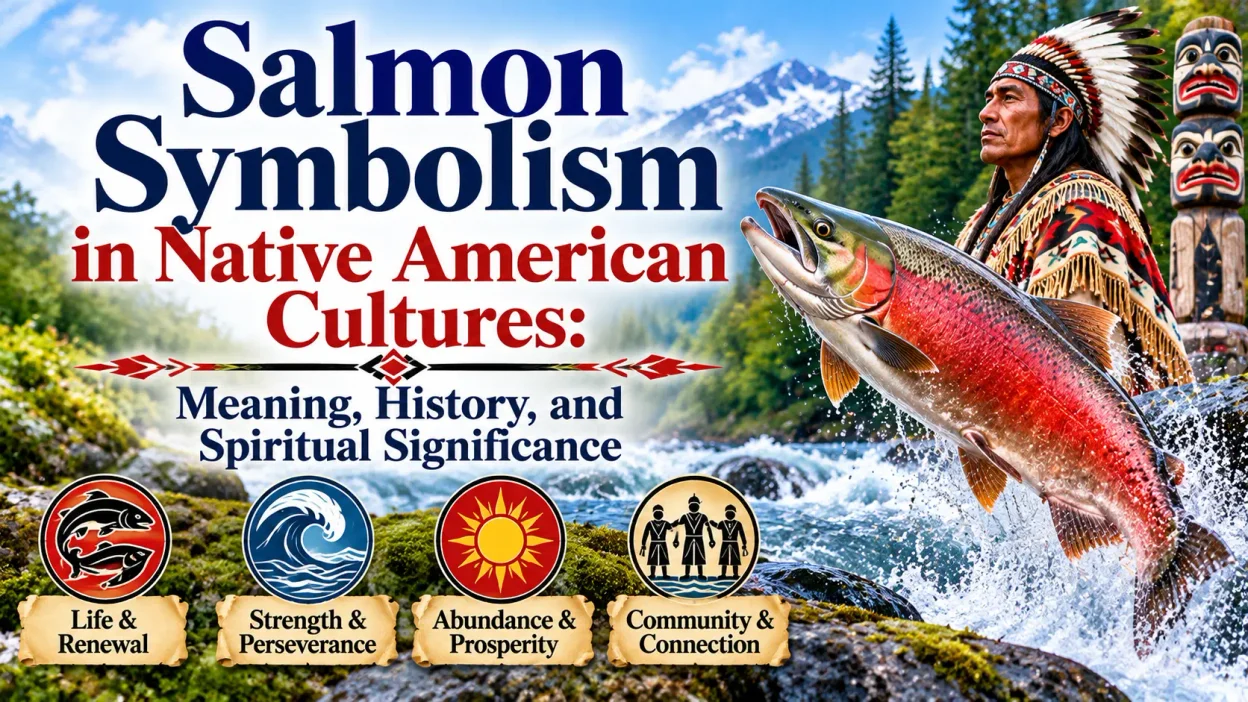
Salmon symbolism in Native American cultures is closely connected to life, abundance, gratitude, spiritual relationships, and the natural cycles that sustain communities. For many Indigenous nations of the Pacific Northwest, salmon is much more than a source of food. It represents a sacred relationship between people, rivers, the ocean, and the natural world.
For thousands of years, salmon have shaped the diets, economies, ceremonies, stories, and identities of Indigenous communities along the Pacific Coast, Puget Sound, and Columbia River Basin. Their annual return from the ocean to freshwater rivers became an important event, marking the renewal of food supplies and the continuation of cultural traditions.
Although salmon holds particular importance among Pacific Northwest tribes, its meaning is not identical across all Native American nations. Each community has its own history, language, spiritual beliefs, and ceremonial practices. Understanding these differences makes it possible to appreciate salmon symbolism without reducing diverse Indigenous traditions to one interpretation.
Quick Answer: What Does Salmon Symbolize in Native American Cultures?
Salmon commonly symbolizes abundance, survival, gratitude, renewal, and the sacred relationship between humans and nature in many Native American cultures of the Pacific Northwest. Historically, its annual return inspired ceremonies honoring the fish as a gift from the Creator, representing nourishment, community responsibility, spiritual respect, and the continuation of life.
TL;DR
- Salmon represents nourishment, survival, and the continuation of life.
- First Salmon Ceremonies express gratitude and respect for nature.
- Its return symbolizes renewal, abundance, and seasonal balance.
- Salmon connects Indigenous identity with ancestral rivers and fishing traditions.
- Traditional stories describe salmon as respected spiritual relatives.
- Modern symbolism includes cultural preservation, treaty rights, and environmental protection.
1. Why Salmon Holds a Special Place in Native American Cultures
Salmon has been essential to Indigenous life in the Pacific Northwest for thousands of years. Communities living near the Columbia River, Fraser River, Klamath River, and other waterways developed fishing practices that provided dependable sources of food and supported complex systems of trade and community relationships.
The fish was particularly important because of its predictable seasonal migrations. Salmon spend much of their lives in the ocean before returning to freshwater rivers to reproduce. Their arrival brought communities together for fishing, food preparation, preservation, and ceremonial activities.
For many Indigenous peoples, this relationship extended beyond practical survival. Salmon was understood as a gift that required respect and responsible treatment.
The Columbia River Inter-Tribal Fish Commission uses the expression Wy-Kan-Ush-Pum, meaning Salmon People, to describe the close relationship between salmon and the Indigenous nations of the Columbia River Basin.
This connection helps explain why salmon can represent several things simultaneously:
- Physical nourishment and community survival.
- Gratitude for the natural world.
- Respect for spiritual relationships.
- Continuity between generations.
- Responsibility toward rivers and wildlife.
Salmon was not simply something communities harvested. It was part of the cultural and spiritual foundation of their societies.
2. Salmon as a Symbol of Life and Survival
One of the most recognizable meanings of salmon in Pacific Northwest Indigenous traditions is survival.
For generations, seasonal salmon runs provided food that could sustain families throughout the year. Communities developed sophisticated fishing methods, including nets, traps, hooks, spears, and carefully managed fishing locations.
The fish could be smoked, dried, and preserved, allowing people to store food for colder months when other resources were less available.
This practical importance contributed to salmon’s spiritual significance. A successful salmon season could mean food security, community stability, and the ability to maintain established ways of life.
Salmon therefore became associated with the continuation of human life.
Its symbolism also reflects the relationship between individual survival and collective well-being. Fishing involved more than catching a single fish. Families and communities shared knowledge, labor, preservation methods, and responsibilities.
In this context, salmon represents the idea that survival depends on relationships between people and the environments that support them.
It also reminds modern readers that food security, cultural identity, and environmental health are closely connected.
3. The Sacred Meaning of the Salmon People
The idea of the Salmon People is central to understanding salmon symbolism in several Indigenous traditions of the Pacific Northwest.
In some traditional stories, salmon are understood as beings with their own communities, homes, and social relationships beneath the ocean. They are not presented simply as ordinary fish without identity or significance.
These stories describe salmon as living beings who willingly travel into rivers and provide nourishment to human communities.
Their annual migration can be understood as a return visit between relatives. People receive the salmon with gratitude, while ceremonial practices demonstrate that the fish have been treated respectfully.
This worldview creates a relationship based on reciprocity.
Humans depend on salmon for food, but they also have responsibilities toward the fish. Respectful harvesting, proper ceremonies, and care for the waterways help maintain the relationship.
The concept does not mean every Pacific Northwest nation tells exactly the same story. Specific details differ among communities, and some traditions are intended primarily for their own members.
Nevertheless, the Salmon People concept offers an important way to understand why salmon carries meanings of kinship, generosity, respect, and mutual responsibility.
4. First Salmon Ceremonies and Their Spiritual Meaning
The First Salmon Ceremony is among the most recognizable cultural traditions associated with salmon in the Pacific Northwest.
Historically, many communities held ceremonies to welcome the first salmon of the season. The arrival of the fish was treated as an important occasion because it marked the beginning of a new period of nourishment and renewal.
Although practices differed between nations, several traditions shared common elements.
The first salmon was caught according to established ceremonial customs. It was prepared with care, and portions were distributed among community members. Songs, prayers, and expressions of gratitude could accompany the gathering.
In some traditions, the bones and remains were returned to the river after the fish had been consumed.
This act carried spiritual meaning. Returning the remains demonstrated respect for the salmon and acknowledged the relationship between the fish and its people.
The ceremony also expressed hope for future salmon runs.
Its central meanings include:
- Gratitude: Recognizing salmon as a gift that sustains life.
- Respect: Treating the fish as a valued spiritual relative.
- Renewal: Welcoming the return of the seasonal migration.
- Community: Bringing people together through shared food and ceremony.
- Continuity: Passing cultural responsibilities between generations.
First Salmon Ceremonies continue in various forms within contemporary Indigenous communities.
5. Salmon Symbolism Among Columbia River Tribes
The Columbia River Basin is one of the most important regions for understanding Indigenous salmon traditions.
For thousands of years, salmon migrated through the Columbia River and its tributaries, reaching areas far inland. Their abundance supported fishing communities, trading networks, and cultural gatherings.
Among the Indigenous nations connected to this river system are the Yakama Nation, Nez Perce Tribe, Confederated Tribes of the Umatilla Indian Reservation, and Confederated Tribes of the Warm Springs Reservation of Oregon.
Each has distinct cultural traditions, but salmon remains an important shared connection.
Fishing locations such as Celilo Falls historically served as major centers of fishing, trade, and community interaction. People traveled considerable distances to obtain salmon and participate in the economic and social life surrounding the fisheries.
For Columbia River tribes, salmon can represent:
- Ancestral connections to particular waterways.
- Cultural continuity and traditional knowledge.
- Food sovereignty and community independence.
- Spiritual responsibilities toward natural resources.
- The survival of Indigenous traditions.
The meaning of salmon here cannot be separated from the river itself. The fish, fishing locations, ancestral territories, and community histories form an interconnected cultural relationship.
6. Salmon Symbolism Among Coast Salish and Puget Sound Peoples
Salmon also has considerable cultural importance among Coast Salish peoples and Indigenous communities throughout the Puget Sound region.
These communities have long depended on the waterways surrounding the Salish Sea. Salmon, alongside shellfish, marine animals, plants, and other resources, helped support established communities and extensive systems of exchange.
Among these traditions, salmon is connected with family relationships, seasonal responsibilities, community gatherings, and spiritual practices.
The arrival of spawning salmon is still recognized in several communities through ceremonies and cultural events.
Traditional fishing knowledge has also been passed between generations. Understanding the rivers, tides, fishing seasons, and behavior of different salmon species was essential for maintaining successful fisheries.
Salmon therefore represents more than a food tradition. It connects people to specific places and inherited knowledge.
It also reflects the importance of teaching younger generations how to maintain relationships with the environment.
For many Coast Salish families, the fish remains a visible connection between ancestral practices and contemporary cultural identity.
7. The Symbolism of Salmon Migration and Return
One reason salmon carries such recognizable symbolism is its extraordinary life cycle.
Many Pacific salmon are born in freshwater, migrate toward the ocean, spend part of their lives in saltwater, and eventually return to freshwater streams to reproduce.
This journey has attracted attention because of the fish’s ability to navigate back toward its place of origin.
In Indigenous cultural contexts, the return of salmon is associated with seasonal renewal and the continuation of life.
The migration also provides a natural reminder that different environments depend on one another. Healthy rivers, forests, oceans, and wildlife populations contribute to the continuation of salmon runs.
The symbolism of migration can be understood through several related ideas:
Returning to one’s origins: Salmon’s journey can evoke connections to ancestral homelands, family histories, and the importance of belonging.
Renewal: Its seasonal return marks the continuation of an established natural cycle.
Perseverance: The fish’s movement upstream provides a recognizable image of determination and movement against difficult conditions.
Interdependence: Its life cycle demonstrates how ocean and freshwater environments are connected.
These interpretations should be understood as broader ways of discussing the fish’s cultural significance, rather than assuming every meaning belongs to every Indigenous nation.
8. Salmon as a Symbol of Abundance and Gratitude
For communities that traditionally depended on seasonal salmon runs, the arrival of fish represented an important source of abundance.
A healthy salmon run could support families, provide material for preservation, and make trade possible.
However, abundance did not necessarily mean taking as many fish as possible.
Many traditional practices emphasized respect, appropriate harvesting, and responsibilities toward future seasons.
The First Salmon Ceremony reflects this relationship particularly clearly. The first fish was treated as an honored gift rather than an ordinary resource.
Gratitude was expressed through food sharing, ceremonial practices, and the respectful handling of the fish.
This understanding offers a different perspective on abundance.
Instead of representing unlimited possession, salmon can symbolize receiving what nature provides while recognizing the responsibility to preserve it.
In contemporary American culture, this idea connects with discussions about sustainable fishing, food sovereignty, conservation, and responsible resource management.
The symbolism is especially relevant when considering the relationship between traditional ecological knowledge and modern environmental practices.
9. Salmon in Native American Stories, Folklore, and Spiritual Traditions
Salmon appears in many traditional stories of the Pacific Northwest, although the characters, lessons, and spiritual meanings differ among nations.
One recurring theme in some regional traditions is the existence of Salmon People who live beneath the water and return to rivers during the annual migration.
Other stories connect salmon with important cultural figures, supernatural beings, or the origins of particular customs.
Some traditions also feature figures associated with the arrival of salmon. For example, Fog Woman appears in certain Pacific Northwest stories connected with salmon and the seasonal return of fish.
These narratives help explain why the fish should be treated with respect and why particular ceremonial practices developed.
Traditional stories can communicate important lessons about:
- Respecting animals and natural resources.
- Maintaining relationships with the environment.
- Recognizing the responsibilities that come with receiving food.
- Following established community customs.
- Understanding the relationship between humans and other living beings.
It is important not to assume that all Native American communities share the same salmon stories.
Many Indigenous nations have their own oral traditions, languages, and teachings. Some cultural knowledge is also private or intended to be shared only within particular communities.
A respectful understanding of salmon folklore recognizes these differences rather than combining unrelated stories into one general mythology.
10. The Emotional and Psychological Meaning of Salmon
Salmon can also carry emotional meanings connected to belonging, family, memory, and continuity.
For people whose families have maintained fishing traditions over generations, salmon may represent memories of relatives, traditional fishing locations, community gatherings, and meals prepared according to inherited practices.
A salmon returning to its birthplace can also evoke the emotional importance of home.
Its migration provides a natural comparison for people who maintain connections with their ancestral communities despite living elsewhere.
For Indigenous individuals, however, these feelings are personal and cannot be assumed from cultural identity alone.
Some may associate salmon with family traditions, while others may connect it more strongly with environmental protection, political rights, or community history.
For non-Indigenous Americans, salmon may represent environmental responsibility, regional identity, and respect for Indigenous knowledge.
The fish’s emotional significance is therefore shaped by personal experience as well as cultural tradition.
11. What Salmon Represents in Modern American Culture
Salmon has become an important cultural and environmental symbol throughout the United States, particularly in Washington, Oregon, Alaska, and Northern California.
For Indigenous communities, its importance continues through traditional fishing, ceremonies, food practices, and efforts to protect ancestral resources.
For the broader American public, salmon is frequently associated with the Pacific Northwest and its natural environment.
Its presence in rivers and coastal waters can communicate the health of an ecosystem. Declining salmon populations often raise concerns about habitat destruction, pollution, dams, changing water temperatures, and overfishing.
Modern interpretations include several important themes.
Cultural preservation: Salmon represents the continuation of Indigenous fishing knowledge, languages, ceremonies, and community traditions.
Environmental protection: Healthy salmon populations depend on functioning rivers, clean water, and connected habitats.
Food sovereignty: Access to traditional fishing grounds remains important to Indigenous communities seeking to maintain control over their food systems.
Regional identity: Salmon is closely associated with the Pacific Northwest’s rivers, forests, coastal environments, and fishing communities.
Intergenerational responsibility: Protecting salmon populations reflects the responsibility to preserve natural resources for future generations.
This modern interpretation connects traditional cultural values with contemporary discussions about conservation and Indigenous rights.
12. Salmon and Native American Treaty Rights
The history of salmon in the United States is also connected to Indigenous sovereignty and treaty rights.
During the nineteenth century, the federal government negotiated treaties with numerous Indigenous nations in the Pacific Northwest.
Several agreements reserved the right to fish at traditional locations, including places outside reservation boundaries.
Despite these agreements, Indigenous fishers increasingly faced restrictions, arrests, and interference with their traditional fishing practices.
During the 1960s and early 1970s, Indigenous activists organized fishing protests known as fish-ins. These demonstrations challenged restrictions and brought national attention to treaty rights.
The legal history eventually included the important 1974 decision in United States v. Washington, commonly known as the Boldt Decision. It affirmed treaty fishing rights and established an important framework for tribal participation in regional fisheries.
This history added another dimension to salmon’s modern symbolism.
The fish became associated with:
- Indigenous sovereignty.
- Treaty rights and legal recognition.
- Cultural survival.
- Environmental justice.
- The protection of ancestral traditions.
For many Indigenous communities, defending salmon populations also means defending the cultural practices and rights connected to them.
13. Salmon Symbolism in Art, Jewelry, Tattoos, and Design
Salmon appears in contemporary art, jewelry, carving, clothing, and tattoo designs.
Its recognizable body shape makes it suitable for visual representation, while its cultural importance gives it meanings beyond its physical appearance.
However, salmon imagery should be approached with an understanding of the specific artistic traditions being represented.
Traditional and contemporary Indigenous art
Salmon appears in a variety of Indigenous artistic traditions across the Pacific Northwest. Artists may represent the fish through carving, painting, weaving, and other forms of cultural expression.
Specific visual styles belong to particular nations and artistic traditions. They should not be treated as one interchangeable Native American design style.
Jewelry
Salmon-shaped pendants, earrings, and other decorative objects can express connections to fishing communities, regional identity, or Indigenous heritage.
Tattoos
A salmon tattoo may symbolize perseverance, returning home, family connections, environmental respect, or appreciation for Pacific Northwest culture.
For someone with an Indigenous family or community connection, it may also carry personal meanings related to ancestry and traditional fishing practices.
Home decor
Salmon artwork is popular in homes and businesses throughout the Pacific Northwest. It may reflect regional identity, outdoor interests, fishing traditions, or appreciation for local wildlife.
When purchasing Indigenous artwork, supporting Indigenous artists and checking the authenticity of cultural representations is important.
14. Common Misunderstandings About Salmon Symbolism
Although salmon is an important cultural symbol, some modern interpretations oversimplify its meaning.
One common misunderstanding is the belief that every Native American nation considers salmon sacred.
Salmon has particular importance among many Indigenous peoples of the Pacific Northwest, but Native American cultures are geographically and culturally diverse. Communities in regions without traditional salmon fisheries may have entirely different relationships with animals and natural resources.
Another misunderstanding is treating salmon symbolism as a universal spiritual meaning.
There is no single Native American dictionary of animal symbolism. Interpretations depend on specific nations, languages, stories, and cultural practices.
A third misunderstanding involves using Indigenous salmon imagery without recognizing its cultural background.
Some commercial designs borrow traditional-looking patterns and present them as generic Native American artwork. This can erase the identities of the communities and artists responsible for those visual traditions.
It is also inaccurate to describe historical salmon ceremonies as identical across all tribes. Even when communities share certain ceremonial themes, the actual practices can differ considerably.
A respectful approach recognizes salmon’s cultural importance while allowing each Indigenous nation to define its own traditions.
15. How Salmon Symbolism Has Evolved Over Time
Salmon symbolism has changed in response to historical, environmental, and political developments.
For thousands of years, salmon represented a reliable seasonal food source and an important part of Indigenous cultural life.
Traditional fishing practices developed alongside ceremonies, oral histories, and community responsibilities.
During the nineteenth century, colonization, land dispossession, commercial fishing, and the construction of dams disrupted many established fisheries.
Some historic salmon runs declined dramatically, while important fishing locations were permanently altered or submerged.
Celilo Falls, for example, was inundated in 1957 following the construction of The Dalles Dam. The loss affected an important Indigenous fishing and trading center on the Columbia River.
Despite these changes, salmon traditions did not disappear.
Indigenous communities continued practicing ceremonies, teaching traditional fishing knowledge, asserting treaty rights, and participating in conservation efforts.
Today, salmon represents both cultural continuity and the challenges of protecting Indigenous relationships with the natural world.
Its meaning has expanded to include environmental restoration, food sovereignty, and the survival of traditional ways of life.
The central relationship remains recognizable: salmon sustains communities, and communities have responsibilities toward salmon.
Salmon Symbolism in Different Contexts
The following table summarizes several important interpretations while recognizing that meanings vary between Indigenous nations.
| Context | Symbolic Meaning | Common Associations | Cultural Significance |
|---|---|---|---|
| First Salmon Ceremony | Gratitude and renewal | Respect, food, celebration | Honors the seasonal return |
| Salmon migration | Continuity and return | Home, origins, life cycles | Connects rivers and generations |
| Traditional fishing | Survival and abundance | Nourishment, family, trade | Supports community life |
| Salmon People stories | Spiritual relationship | Kinship, reciprocity, respect | Recognizes salmon as more than a resource |
| Modern conservation | Responsibility and preservation | Clean water, restoration, sovereignty | Protects cultural and environmental continuity |
Frequently Asked Questions Salmon Symbolism in Native American Cultures
1. What does salmon symbolize in Native American cultures?
Salmon commonly symbolizes life, abundance, gratitude, renewal, and the relationship between humans and nature in many Pacific Northwest Indigenous traditions. It is also connected to cultural identity, ancestral fishing practices, and spiritual responsibilities.
2. Why is salmon considered sacred by some Native American tribes?
Some Indigenous nations consider salmon sacred because it provides nourishment and maintains an important relationship between people and the natural world. Traditional ceremonies recognize the fish as a gift that deserves respect and gratitude.
3. What is the First Salmon Ceremony?
The First Salmon Ceremony is a traditional gathering held by various Indigenous communities to welcome the first salmon of the season. Depending on the community, it can involve preparing and sharing the fish, ceremonial songs, prayers, and returning its remains to the water.
4. What do Salmon People mean in Native American traditions?
Salmon People refers to traditional understandings in which salmon are regarded as living beings with their own communities and spiritual relationships. The concept helps explain why some Indigenous nations treat salmon as relatives rather than simply as food.
5. What does a salmon tattoo symbolize?
A salmon tattoo can represent perseverance, returning home, renewal, family connections, and appreciation for nature. For people with Pacific Northwest Indigenous connections, it may also express cultural heritage, although specific tribal imagery should be approached respectfully.
6. Is salmon symbolism the same across all Native American tribes?
No. Salmon has particular cultural and spiritual importance among Indigenous nations of the Pacific Northwest, where traditional salmon fisheries have supported communities for thousands of years. Other Native American nations have different environments, histories, and animal traditions.
7. Why is salmon important to Native American environmental protection?
Salmon depends on healthy rivers, oceans, and migration routes, making its survival closely connected to environmental protection. For many Indigenous communities, restoring salmon populations also protects traditional food systems, treaty rights, cultural practices, and relationships with ancestral territories.
Conclusion
Salmon represents much more than nourishment in many Indigenous cultures of the Pacific Northwest. Its annual return connects ideas of survival, gratitude, renewal, community, and responsibility toward the natural world. First Salmon Ceremonies and traditional stories demonstrate why the fish has been treated with respect across generations.
Understanding salmon symbolism in Native American cultures also means recognizing the differences between Indigenous nations and their individual traditions. From ancestral fishing grounds to modern conservation movements, salmon continues to connect cultural identity with environmental health and Indigenous sovereignty.
Ultimately, the salmon’s significance rests in a relationship built on receiving, respecting, and giving back. It reminds us that the survival of a community and the well-being of the natural world are closely connected.


[…] about them offers a better understanding of Indigenous creativity and the continuing presence of Native American cultures in the United […]
[…] This association has become one of the most recognizable meanings of lei in American culture. […]
[…] commonly represents courage, honor, loyalty, protection, and moral responsibility in modern American culture. Historically, knights were mounted warriors associated with military service, aristocratic […]
[…] represents marriage, feminine authority, loyalty, queenship, and the protection of family in modern American culture. Historically, the Greek goddess also represented royal legitimacy, women’s life transitions, […]
[…] nature, renewal, fertility, growth, and humanity’s connection to the natural world in modern American culture. Historically, leafy human faces appeared in classical and medieval art, including Christian […]
[…] green dragon’s meaning in American culture is therefore flexible. It can be a symbol of environmental appreciation, a fantasy creature, a […]
[…] feminine independence, beauty, sensuality, fertility, personal power, and self-confidence in modern American culture. Historically, Norse traditions also associated her with magical knowledge, gold, prosperity, […]
[…] Eggs commonly symbolize new life, potential, and renewal. Their association with spring and Easter has strengthened these meanings in American culture. […]
[…] modern American culture, Fenrir appears in tattoos, fantasy novels, video games, heavy metal imagery, mythology-inspired […]
[…] These images appear throughout traditional Chinese paintings, embroidered clothing, ceramics, wedding decorations, architectural ornamentation, poetry, and celebrations. Their symbolism continues to influence Chinese communities around the world, including the United States, where Chinese-inspired artwork, jewelry, tattoos, and decorative objects are often chosen for their cultural meanings. […]
[…] happiness, renewal, motherhood, resilience, and appreciation for the present moment in modern American culture. Historically, particularly in Chinese tradition, daylilies have also symbolized maternal love, […]
[…] also carry meanings that extend beyond American culture. Ancient civilizations associated certain trees with gods, creation, wisdom, fertility, and the […]
[…] film is particularly relevant to American cultural anxieties about security, infrastructure, and national […]
[…] commonly represents identity, personal values, social status, trust, and belonging in modern American culture. Historically, brands developed from marks of ownership and identification into recognizable […]
[…] examples demonstrate how American popular culture has expanded the cat’s literary role. It can be a troublemaker, a loyal companion, a […]
[…] American culture associates eye imagery with observation, individuality, and surveillance. […]
[…] modern American culture, gold commonly represents luxury, achievement, prestige, and success. Fitzgerald complicates these […]