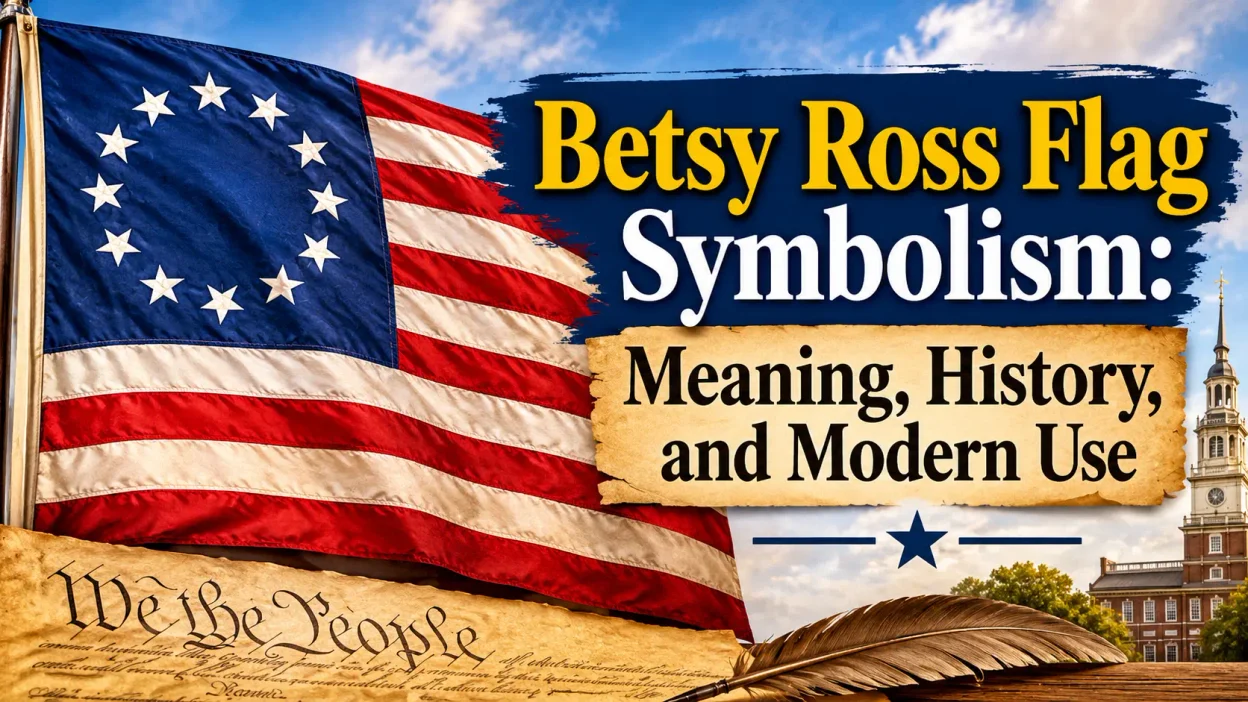
The Betsy Ross flag is one of the most recognizable symbols of the American Revolution. Featuring 13 white stars arranged in a circle against a blue field, alongside 13 alternating red and white stripes, it represents the country’s earliest struggle for independence and the unity of the original colonies. Betsy Ross flag symbolism is closely associated with patriotism, freedom, national identity, and the founding ideals of the United States.
The flag’s distinctive circular arrangement of stars gives it a different appearance from the modern American flag. Instead of emphasizing the country’s growth through additional states, it recalls the original 13 colonies and their shared decision to break away from British rule.
Its connection to Betsy Ross, a Philadelphia seamstress traditionally credited with sewing the first American flag, adds another dimension to its meaning. The design has become associated not only with revolutionary history but also with the contributions of ordinary Americans, women, craftsmanship, and the idea that a nation’s identity can be shaped by people outside political leadership.
Today, the Betsy Ross flag appears in historical displays, patriotic celebrations, home decor, clothing, political imagery, and personal expressions of American identity. Its meaning can vary depending on the setting, making it a symbol with both historical significance and modern cultural complexity.
Quick Answer
The Betsy Ross flag commonly symbolizes American patriotism, independence, unity, and the founding of the United States. Its 13 stars represent the original colonies, while its connection to Betsy Ross reflects the traditional story of ordinary citizens, including women, contributing to the American Revolution.
TL;DR
- The 13 stars represent the original American colonies.
- The circular arrangement symbolizes unity and equality among the colonies.
- The stripes recall the nation’s revolutionary origins.
- The flag is associated with independence, patriotism, and American heritage.
- Betsy Ross represents craftsmanship and women’s contributions to national history.
- Modern interpretations can range from historical pride to political identity.
1. What Does the Betsy Ross Flag Look Like?
The Betsy Ross flag is an early American flag design featuring:
- Thirteen alternating red and white horizontal stripes
- Thirteen white five-pointed stars
- A blue canton in the upper-left corner
- Stars arranged in a circular pattern
The circle of stars is its most distinctive feature. Unlike the modern American flag, where stars are arranged in rows, the original-style design places them in a ring, creating a visual impression of completeness and collective unity.
The flag is commonly called the Betsy Ross flag, although historians cannot conclusively establish that Ross designed or sewed the first flag with this exact arrangement.
The design is generally associated with the earliest years of American independence, making it an important visual representation of the country’s revolutionary beginnings.
2. The Symbolism of the 13 Stars
The thirteen white stars represent the thirteen colonies that declared independence from Great Britain and formed the original United States.
These colonies were:
- Delaware
- Pennsylvania
- New Jersey
- Georgia
- Connecticut
- Massachusetts
- Maryland
- South Carolina
- New Hampshire
- Virginia
- New York
- North Carolina
- Rhode Island
The stars symbolize the colonies becoming a united political community rather than separate territories under British authority.
Their white color is commonly associated with purity, innocence, and ideals, although the original flag legislation did not officially assign symbolic meanings to the colors.
The stars also represent a new political beginning. In 1777, the Continental Congress described the stars as representing a new constellation, an image that connected the emerging nation with the idea of a new place in the world.
The circular arrangement of the stars is often interpreted as a symbol of unity, equality, and cooperation.
A circle has no obvious beginning or end. In symbolic interpretation, this shape can suggest that all members belong to the same group and that no individual occupies a more important position than another.
Applied to the original colonies, the circular arrangement represents their collective commitment to independence.
The stars are visually connected without placing one colony above the others. This makes the design a natural symbol of shared identity and common purpose.
Today, people may interpret the circle as representing:
- Unity among the original colonies
- Cooperation during the Revolutionary War
- Shared responsibility for the new nation
- Equality among participating states
- A common commitment to freedom
These interpretations are symbolic rather than official explanations of the original design, but they help explain why the circular stars remain visually meaningful.
4. What the Red and White Stripes Represent
The thirteen stripes are one of the most enduring elements of the American flag.
The alternating red and white stripes represent the original thirteen colonies and connect the Betsy Ross flag with the broader history of the Stars and Stripes.
The colors carry familiar symbolic associations in American culture:
| Element | Common Symbolic Meaning | Historical Connection |
|---|---|---|
| Red stripes | Courage, sacrifice, resilience | Revolutionary struggle |
| White stripes | Purity, innocence, ideals | Founding principles |
| Blue field | Loyalty, vigilance, perseverance | The union of the colonies |
| Thirteen stars | Unity and independence | Original thirteen colonies |
| Circular arrangement | Cooperation and equality | Collective national identity |
These color interpretations became widely recognized through later patriotic traditions. The original 1777 flag resolution established the colors and pattern without providing detailed symbolic explanations for each color.
Nevertheless, red and white stripes have become strongly associated with American identity, military service, national holidays, and the country’s founding story.
5. Historical Origins of the Betsy Ross Flag
The American flag developed during the Revolutionary War, when the colonies needed a recognizable banner to represent their military and political independence.
On June 14, 1777, the Continental Congress adopted a resolution establishing a flag with thirteen alternating red and white stripes and thirteen white stars on a blue field.
The design represented a new nation emerging from colonial rule.
The Betsy Ross story became attached to this early flag through a family account. According to the traditional story, George Washington, Robert Morris, and George Ross visited Betsy Ross in Philadelphia in 1776 and asked her to make a flag based on a design they presented.
Ross supposedly recommended changing the stars from six points to five and arranging them in a circle.
However, this story was first publicly presented by her grandson William Canby in 1870, nearly a century after the supposed event. Historians have not found sufficient contemporary documentation to verify that Ross designed the first flag.
What is established is that Ross was a skilled upholsterer and flagmaker who produced flags during and after the Revolutionary War. Her historical work, combined with the family story, helped make her an important figure in American patriotic culture.
6. Betsy Ross and the Symbolism of Women’s Contributions
Betsy Ross represents more than the traditional story of the first American flag.
Her legacy also reflects the work of women who supported the Revolutionary War through practical labor, business, manufacturing, and community service.
During the eighteenth century, women rarely received the same public recognition as political leaders or military figures. Seamstresses, textile workers, and other women contributed by making uniforms, supplies, clothing, and flags.
Ross’s story gives a recognizable face to these contributions.
As a result, the Betsy Ross flag can symbolize:
- Women’s participation in American history
- Skilled craftsmanship
- Independence through business ownership
- Patriotism expressed through practical work
- The contributions of overlooked historical figures
Even though the exact story of her involvement in designing the first flag remains uncertain, her documented work as a flagmaker makes her an important part of the history of women in the American Revolution.
7. What the Flag Symbolizes in American Culture
In the United States, the Betsy Ross flag is strongly associated with the nation’s founding era.
It evokes the Revolutionary War, the Declaration of Independence, the Continental Congress, and the formation of a new political system.
For many Americans, it represents the idea that freedom requires collective action. The thirteen colonies were geographically, economically, and culturally different, yet they joined together to pursue independence.
The flag therefore symbolizes both national identity and the willingness of individuals to work toward a shared goal.
It can also represent admiration for early American history, interest in the country’s founding documents, and respect for the people who participated in the revolutionary movement.
Unlike the current 50-star flag, the Betsy Ross design emphasizes the country’s beginnings rather than its modern expansion.
8. Patriotism, Independence, and Revolutionary Ideals
The Betsy Ross flag is often used to express patriotism rooted in the American Revolution.
Its imagery recalls the historical struggle against British rule and the establishment of a country based on self-government.
The flag may symbolize:
Independence: The colonies’ separation from British authority and their effort to govern themselves.
Freedom: The pursuit of political liberties and individual rights.
Courage: The willingness to challenge a powerful government and risk personal safety.
Resistance: Opposition to perceived oppression or excessive authority.
National pride: Appreciation for the history and ideals associated with the United States.
These meanings are not necessarily identical for every person. Some focus on the historical events of the Revolution, while others use the flag to express their personal understanding of freedom or patriotism.
9. Betsy Ross Flag Symbolism During American Holidays
The Betsy Ross flag is particularly visible during patriotic celebrations.
Independence Day
On July 4, the flag may appear in decorations, historical reenactments, parades, and displays celebrating the Declaration of Independence.
Its thirteen stars connect directly with the revolutionary period, making it especially appropriate for events focused on early American history.
Flag Day
Flag Day, observed on June 14, commemorates the adoption of the American flag in 1777. The Betsy Ross flag is often displayed alongside later versions to illustrate the flag’s evolution.
Memorial Day
Some people use the flag during Memorial Day observances to honor those who died in military service. Its revolutionary imagery can connect the sacrifices of different generations.
Veterans Day
During Veterans Day celebrations, the design may express respect for military service and the historical traditions of the United States.
Its use during these occasions reinforces its association with patriotism, remembrance, and the nation’s founding.
10. The Flag as a Symbol of Unity and Collective Identity
The Betsy Ross flag can represent the idea that a nation is stronger when its members work together.
The original thirteen colonies had different interests, populations, economies, and regional identities. Their decision to unite under a common flag became a central part of the American founding story.
The circle of stars visually supports this interpretation because every star belongs to the same arrangement.
In modern contexts, the flag may be used to express:
- Community solidarity
- Shared national identity
- Cooperation across regional differences
- Commitment to constitutional ideals
- Pride in American heritage
For some people, it represents an idealized image of a united country. For others, it serves as a reminder that unity is an ongoing effort rather than an accomplished historical fact.
11. Cross-Cultural and Historical Symbolism
The Betsy Ross flag is primarily an American historical symbol rather than a universal religious or spiritual emblem.
Its thirteen stars and stripes have specific connections to the American Revolution, so its meaning is most directly understood within the history of the United States.
However, the design uses shapes and colors that carry broader symbolic associations.
Stars are frequently used in national flags to represent states, territories, political communities, or aspirations. Circles can symbolize completeness, unity, continuity, and belonging across many cultures.
Red, white, and blue also appear in the flags of numerous countries, although their meanings differ according to national histories.
The Betsy Ross flag’s particular symbolism comes from the combination of these visual elements with the history of American independence.
It is therefore best understood as a national and historical emblem rather than a symbol with a single universal meaning.
12. Emotional and Psychological Meaning
The Betsy Ross flag can evoke feelings of belonging, pride, nostalgia, and connection to the past.
For people who grew up learning about the American Revolution, the flag may bring back memories of school history lessons, Independence Day celebrations, family traditions, and patriotic ceremonies.
Its simplified design can also create a sense of familiarity. The thirteen stars in a circle are visually easy to recognize, and the historical appearance may feel more personal or traditional than the modern flag.
Psychologically, the symbol may communicate:
- Belonging: Feeling connected to a national community.
- Pride: Appreciation for American history or ideals.
- Nostalgia: A longing for an earlier period or a remembered version of the country’s history.
- Commitment: Support for principles such as independence and self-government.
- Identity: A way of communicating personal beliefs about American heritage.
The emotional meaning depends heavily on the person displaying it and the environment in which it appears.
13. Modern Uses in Tattoos, Clothing, and Home Decor
The Betsy Ross flag continues to appear in modern personal and decorative settings.
Tattoos
A Betsy Ross flag tattoo may represent patriotism, family military history, American heritage, or admiration for the Revolutionary period.
Some people combine the flag with other imagery, including eagles, historical dates, military insignia, the Declaration of Independence, or patriotic phrases.
The design may also represent a personal commitment to independence or a connection to a particular understanding of American identity.
Clothing and Fashion
The flag appears on T-shirts, jackets, hats, bandanas, and other clothing. Vintage styling often emphasizes the design’s historical appearance.
People may wear it during patriotic holidays, historical events, sporting celebrations, or as part of everyday fashion.
Home Decor
The Betsy Ross flag is frequently used in rustic, colonial, farmhouse, and vintage-inspired decor.
Its aged appearance can complement wooden signs, antique furniture, historical prints, and traditional Americana decorations.
Digital Culture
The design also appears in social media graphics, online historical communities, patriotic artwork, memes, and digital illustrations.
In these settings, its meaning can be shaped by accompanying text, imagery, political messages, or the particular event being commemorated.
14. Controversies and Modern Misinterpretations
The Betsy Ross flag is generally associated with American history and patriotism, but its modern use can sometimes carry political meanings.
Some people display it to emphasize revolutionary ideals, limited government, traditional American values, or national heritage. Others may associate it with particular political movements depending on where they encounter it and how it is presented.
These associations are not inherent to the flag’s original design.
The flag predates modern political parties, contemporary ideological movements, and current political debates. Its historical meaning is connected to the original thirteen colonies and the American Revolution.
It is important to distinguish the flag’s historical symbolism from the intentions of people who use it today.
A flag displayed at a historical museum, a Fourth of July celebration, a political rally, or a private residence may communicate different messages. Context matters.
The symbol should not automatically be interpreted as representing one political viewpoint or group simply because it appears in a particular modern setting.
15. How the Betsy Ross Flag’s Meaning Has Changed
The flag’s symbolism has developed considerably since the Revolutionary period.
Revolutionary Era
The thirteen stars and stripes represent the original colonies and the new nation’s independence.
Late 19th Century
The Betsy Ross story gains popularity as Americans develop stronger interest in national symbols and Revolutionary history.
20th Century
The flag becomes familiar through patriotic education, commemorative imagery, stamps, historical displays, and popular culture.
Modern Era
The flag represents American heritage, revolutionary ideals, historical interest, and sometimes political identity.
The flag’s meaning has expanded from a representation of the original colonies into a broader symbol of American historical identity.
Its association with Betsy Ross also became stronger over time, turning the design into a representation of women’s contributions to the country’s founding story.
Today, it functions simultaneously as a historical artifact, patriotic emblem, decorative motif, and cultural symbol.
Frequently Asked Questions
What does the Betsy Ross flag symbolize?
The Betsy Ross flag symbolizes American independence, patriotism, unity, and the original thirteen colonies. It is also associated with the Revolutionary War and the traditional story of Betsy Ross’s contribution to creating the first American flag.
What do the 13 stars on the Betsy Ross flag mean?
The thirteen stars represent the original thirteen colonies that united to establish the United States. Their circular arrangement is commonly interpreted as a symbol of unity, cooperation, and equality among the colonies.
Is the Betsy Ross flag a symbol of patriotism?
Yes. It is widely recognized as a patriotic symbol connected to the American Revolution, national independence, and the country’s founding history. Its historical appearance often evokes traditional American heritage and revolutionary ideals.
What does the Betsy Ross flag mean as a tattoo?
A Betsy Ross flag tattoo may symbolize patriotism, independence, American heritage, military family connections, or personal pride in the country’s founding history. Some people choose it because of its vintage design or because they associate it with courage and freedom.
Did Betsy Ross actually make the first American flag?
There is no conclusive historical evidence proving that Betsy Ross designed or sewed the first American flag. Her grandson presented the family story publicly in 1870, but historical records confirm that she did make flags during the Revolutionary period.
Why are the stars arranged in a circle?
The circular arrangement is traditionally associated with unity among the original thirteen colonies. Although historians cannot confirm the original designer’s specific reasoning for this arrangement, the circle naturally lends itself to interpretations of cooperation, equality, and shared identity.
Is the Betsy Ross flag associated with a political movement?
The flag has been used in various political settings, but its original historical meaning predates modern political movements. Its meaning in a particular situation depends on the context, accompanying imagery, and the intentions of the person displaying it.
Conclusion
The Betsy Ross flag symbolizes the founding of the United States, the unity of the original thirteen colonies, and the revolutionary pursuit of independence. Its stars, stripes, and circular arrangement connect it to the country’s earliest national identity, while its association with Betsy Ross highlights the role of craftsmanship and women’s contributions to American history.
Although the traditional story of Ross designing the first flag remains unverified, the flag itself continues to hold cultural importance. From historical displays and patriotic celebrations to tattoos and modern decor, it remains a recognizable reminder of America’s beginnings and the ideals that shaped its national identity.