
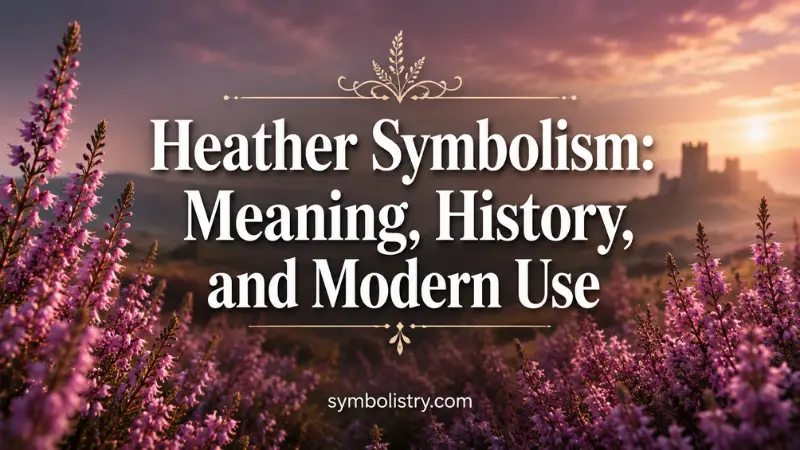
Heather is a low-growing evergreen shrub best known for carpeting open moors and hillsides with pink, lavender, purple, or white flowers. Heather symbolism is especially connected with good luck, admiration, protection, solitude, resilience, and Scottish identity, although not all of those meanings come from the same period or tradition.
The plant has a particularly strong association with Scotland, where flowering heather has become part of the visual identity of the Highlands. Later Victorian flower-language books gave individual colors more specific emotional meanings, helping turn a landscape plant into a personal symbol used in bouquets, keepsakes, and gifts.
In the United States today, heather is less likely to carry one fixed cultural message. Americans encounter it through floral symbolism, Scottish heritage, gardens, weddings, tattoos, jewelry, and nature-inspired design.
Quick Answer
Heather symbolism commonly represents good luck, admiration, protection, independence, and quiet resilience in modern American use. Historically, Scottish tradition gave white heather a strong connection with luck, while Victorian flower language associated lavender heather with admiration and solitude and white heather with protection. (Yard and Garden)
TL;DR
- White heather traditionally represents luck, protection, and favorable wishes.
- Lavender heather became associated with admiration and solitude.
- Scottish landscapes shaped its connection with endurance and national identity.
- Americans often use it in tattoos, weddings, and heritage-inspired designs.
- Its resilience symbolism comes largely from how the plant grows.
- Many supposed ancient meanings are later folklore, not documented Celtic doctrine.
What Heather Actually Looks Like
The plant most closely associated with traditional heather imagery is Calluna vulgaris, also called common heather or ling. It belongs to the Ericaceae family and grows as a compact evergreen shrub with many small leaves and dense spikes of tiny flowers. Those blossoms are most often pinkish-purple or pale purple, although white-flowered forms also occur. (Plants of the World Online)
True Calluna vulgaris is native across much of Europe and extends eastward into parts of Asia, with additional native populations in northern Africa and Atlantic islands. It has also been introduced into parts of North America. (Plants of the World Online)
Gardeners sometimes use “heather” more broadly for related plants in the Erica genus. Botanically, those plants are not identical, which helps explain why commercial flower guides occasionally assign slightly different meanings to plants sold under the same common name.
Visually, heather rarely suggests the lush softness of a peony or rose. Its symbolism comes partly from the opposite qualities: low growth, exposed landscapes, small flowers, persistent evergreen foliage, and the ability to cover large stretches of difficult ground.
What Heather Commonly Means in the United States
For most Americans, heather has several overlapping meanings rather than one universally recognized definition.
The most common are good fortune, admiration, protection, self-reliance, and peaceful solitude. White flowers tend to carry the strongest luck and protection associations, while purple or lavender heather is more closely tied to admiration and being comfortable alone.
These meanings are not all ancient. Some came through British and Scottish folklore, while others were formalized by nineteenth-century flower dictionaries.
That matters when giving heather as a gift. A sprig included in a wedding bouquet might mean “good luck.” The same plant in a tattoo could symbolize surviving difficult circumstances without losing one’s identity. In a Scottish-American family, it might simply represent ancestry and attachment to Scotland.
Context usually determines which meaning is strongest.
Why Scotland Became Central to Heather’s Meaning
Heather and Scotland are closely linked because the plant is common across Scottish heathland, moorland, bogs, dunes, and upland landscapes. During its flowering season, large expanses can appear purple from thousands of small blossoms. (Trees for Life)
That landscape connection gradually made heather a cultural marker of the Highlands. Unlike an official national emblem chosen through formal decree, its identity developed through geography, folklore, literature, tourism, and everyday familiarity.
Heather also had practical value. Scottish communities used it for purposes that included thatching, bedding, brooms, rope, dyes, drinks, and traditional remedies. NatureScot records historical uses involving ale, thatch, and mattresses, while folklore collections describe similar household applications. (nature.scot)
These uses help explain why the plant became associated with toughness and resourcefulness. It was not merely something people admired from a distance. It was part of working landscapes and domestic life.
Why White Heather Represents Good Luck
White heather carries the clearest traditional symbolic meaning: good luck.
White-flowered plants occur much less commonly than the familiar purple form, making an unexpected white sprig easy to treat as unusual or fortunate. By the late nineteenth century, the lucky-white-heather idea was firmly associated with Highland tradition. Queen Victoria recorded an incident in 1884 in which white heather was eagerly collected because it was regarded as lucky. (Trees for Life)
Several legends attempt to explain the belief. Some connect white heather with places untouched by bloodshed; others with fairies, warriors, or protection in battle. These stories belong to folklore rather than documented ancient religious doctrine, so their details vary considerably.
The broader pattern is more secure than any one legend: rare white heather became a sign of favorable fortune.
That association eventually made it especially suitable for marriages, journeys, new homes, and other occasions where people traditionally wish someone a safe or prosperous beginning.
Victorian Flower Language Changed Its Meaning
Heather’s modern emotional meanings also owe much to floriography, the nineteenth-century fashion of assigning sentiments to particular plants and flowers. Victorian flower dictionaries were never perfectly standardized. Different books sometimes gave different meanings to the same species.
By the late nineteenth century, however, publishers had produced extensive alphabetical lists that allowed bouquets to function almost like coded messages. Cornell University’s historical collection identifies Kate Greenaway’s 1884 Language of Flowers as one of the later major works in that tradition. (Cornell University Library Exhibits)
Modern horticultural references drawing from flower-language traditions commonly list:
- lavender heather as admiration and solitude
- white heather as protection and wishes coming true (Yard and Garden)
Those meanings strongly influence what Americans now encounter on floral websites, wedding guides, tattoo references, and gift descriptions.
The important distinction is that “admiration” and “solitude” are better understood as flower-language meanings than as proven ancient Scottish beliefs.
Heather Color Meanings
Color changes the message people usually attach to the flower.
| Heather Color | Common U.S. Meaning | Historical Connection | Typical Modern Use |
| Purple or lavender | Admiration, solitude, beauty | Victorian-style flower language | Tattoos, gifts, decor |
| White | Good luck, protection, hopeful wishes | Scottish folklore and later floriography | Weddings, keepsakes, charms |
| Pink | Good fortune, affection, gentleness | Mostly modern floral interpretation | Romantic arrangements, gifts |
| Mixed natural tones | Resilience, wilderness, Scottish identity | Landscape association | Heritage art, home decor |
The first two color meanings have the strongest historical foundation. Pink meanings are less standardized and often reflect modern floral color symbolism rather than a single old tradition. Contemporary flower guides still list purple heather with admiration and white heather with protection. (Yard and Garden)
Why Heather Represents Resilience
Resilience is one of the most intuitive modern interpretations of the plant.
Heather grows in exposed environments, including acidic soils, moors, heaths, bogs, and upland areas that can appear bleak or inhospitable. Its evergreen growth and ability to spread across open landscapes make it easy to read symbolically as persistence under pressure. (RHS)
This meaning is more interpretive than historical. There is no need to invent an ancient legend to explain it.
People see a plant thriving where conditions look difficult, then use that biological image as a metaphor for surviving hardship.
That is why a modern heather tattoo can communicate something like: I endured, adapted, and remained myself.
The symbolism works particularly well for people who prefer understated images of strength. Heather does not look imposing. Its message comes from persistence rather than dominance.
Solitude Does Not Necessarily Mean Loneliness
The old association between lavender heather and solitude can sound negative when read literally. In modern use, however, solitude often carries a more balanced meaning.
Heather naturally evokes wide open landscapes: quiet hills, wind, distance, and stretches of countryside with few visible human structures. Because of that imagery, solitude can suggest independence, contemplation, privacy, or comfort with one’s own company.
For a tattoo or artwork, the meaning might be closer to peace in being alone than abandonment.
That distinction is useful because Victorian flower dictionaries sometimes used emotional terms more rigidly than modern readers do. A person choosing heather today can reinterpret solitude as intentional self-possession rather than isolation.
Admiration and Quiet Affection
Purple and lavender heather are frequently associated with admiration. (Yard and Garden)
Unlike the red rose, that message does not necessarily imply romantic passion. Heather can express respect for someone’s character, strength, independence, or beauty.
That makes it suitable for relationships that do not fit conventional romantic flower symbolism.
A person might give it to honor a friend, mentor, parent, or partner without suggesting the dramatic declaration associated with roses.
Its small flowers also reinforce that understated quality. Heather feels less theatrical than many traditional bouquet flowers, which is part of its appeal for people who want affection to look natural rather than elaborate.
Heather in Weddings and Relationships
White heather is particularly well suited to weddings because its luck symbolism translates easily into a wish for a fortunate marriage.
Scottish and Scottish-inspired wedding traditions sometimes include sprigs of heather in bouquets, boutonnieres, floral arrangements, or decorative details. The flower may serve as both a good-luck emblem and a heritage reference.
In the United States, that meaning is most noticeable in weddings with Scottish family connections, Highland-inspired themes, tartan details, or rustic floral styling.
Heather does not inherently symbolize marriage itself in the way myrtle became strongly associated with bridal tradition. Instead, its wedding meaning is more accurately described as luck, protection, and hopeful beginnings.
A couple may also choose it simply because it connects their wedding to a meaningful place or ancestry.
What a Heather Tattoo Can Symbolize
Heather works particularly well in botanical tattoos because its long stems and clusters of tiny flowers translate easily into fine-line designs.
Common personal meanings include:
Resilience. The wearer identifies with surviving difficult conditions.
Independence. The open-moor association can symbolize a self-directed life.
Admiration. Purple heather may represent someone deeply respected.
Protection or luck. White-flower imagery can reference the Scottish good-luck tradition.
Scottish heritage. A sprig may commemorate ancestry, travel, family, or attachment to the Highlands.
Solitude. Some people use the plant to represent privacy, introspection, or finding peace alone.
Tattoo meanings are ultimately personal. Historical symbolism can provide a starting point, but the strongest interpretation is often tied to the wearer’s own experience.
Heather in Jewelry, Decor, Fashion, and Digital Culture
Modern uses often emphasize the flower’s visual identity as much as its traditional meaning.
Botanical jewelry may preserve heather in pendants or use small floral motifs to represent Scotland, luck, or nature. Home decor often pairs the flower with rustic landscapes, cottage interiors, dried botanical arrangements, or Highland imagery.
“Heather” is also widely used as a color term for softly mixed or muted fabric tones, although that textile meaning is separate from flower symbolism.
Online, the plant frequently appears in mood boards, tattoo references, wedding inspiration, nature photography, and heritage imagery. Social media has helped blend older meanings into a simplified modern group: luck, resilience, admiration, protection, and independence.
That blending is useful creatively, but it can also erase the historical differences between Scottish folklore and Victorian floral codes.
Does Heather Have a Religious Meaning?
Heather does not have one major, universally recognized religious meaning comparable with the Christian lily, Buddhist lotus, or Jewish pomegranate.
Online articles sometimes describe heather as a sacred Celtic or Druid plant, but those statements are often much more confident than the surviving evidence allows.
Heather certainly belonged to landscapes inhabited by Celtic-speaking peoples, and later folklore attached supernatural stories to it. That does not automatically prove that ancient Druids gave the plant the same meanings found in modern symbolism lists.
For contemporary spiritual use, people may personally associate heather with protection, nature, grounding, ancestral connection, or perseverance. Those are modern interpretations rather than binding religious definitions.
This distinction keeps personal symbolism meaningful without turning folklore into invented history.
Heather as a Scottish-American Heritage Symbol
For Americans with Scottish ancestry, heather can function less like a coded flower and more like a visual shorthand for place.
A heather sprig beside a thistle, tartan, Highland landscape, clan-related object, or Scottish motto may express family heritage or affection for Scotland.
The plant is not native to most of the United States. Calluna vulgaris has been introduced and naturalized in parts of North America, including areas of the Northeast and Great Lakes region. (Plants of the World Online)
That makes its American cultural symbolism largely imported rather than indigenous.
Its meaning traveled through immigration, literature, tourism, horticulture, Victorian floral culture, and Scottish heritage traditions rather than developing primarily from the American landscape.
Common Misunderstandings About Heather
One common mistake is treating every modern meaning as ancient Celtic symbolism.
They are not the same thing.
Another is assuming that one Victorian flower dictionary created a permanent universal code. Flower-language books often disagreed, and meanings changed between authors and periods. Iowa State’s modern guide explicitly notes that flower meanings can vary across sources. (Yard and Garden)
It is also misleading to say all heather means good luck. That association is strongest for white heather, while lavender forms are more closely linked to admiration and solitude.
Similarly, resilience is a sensible modern interpretation based on the plant’s ecology, but it should not be presented as a documented ancient Highland definition.
Finally, Calluna and Erica plants may both be sold as heathers. Botanical identity and symbolic naming therefore do not always align perfectly.
How Heather’s Meaning Evolved
Heather did not acquire all of its meanings at once.
Its earliest importance was rooted in landscape and practical use. In Scotland, it grew abundantly, provided useful material, supported wildlife, and became visually inseparable from many upland environments. (Trees for Life)
Folklore then added stories about luck, rarity, protection, warriors, and white-flowered plants.
During the nineteenth century, Victorian flower culture transformed plants into emotional vocabulary. Heather gained more specific associations such as solitude, admiration, protection, and wishes.
During the twentieth and twenty-first centuries, those meanings became increasingly personal. People began applying them to tattoos, weddings, jewelry, memorial objects, ancestry, and self-expression.
Today, heather is therefore best understood as a layered symbol rather than one with a single fixed definition.
FAQs
Is heather a symbol of good luck?
Yes, especially white heather. Scottish tradition strongly associates rare white-flowered heather with good fortune, and that belief became especially visible during the Victorian period. (Trees for Life)
What does purple heather symbolize?
Purple or lavender heather is traditionally associated with admiration and solitude in flower-language references. Today, people may also connect it with independence, quiet confidence, or respect. (Yard and Garden)
What does white heather symbolize?
White heather commonly represents protection, luck, and hopeful wishes. Its lucky reputation is particularly connected with Scottish tradition and the rarity of naturally white flowers. (Trees for Life)
Is heather associated with Scotland?
Very strongly. Heather grows extensively across Scottish moors, heaths, bogs, and upland landscapes, making its purple flowering season one of the recognizable images of the Scottish countryside. (Trees for Life)
What does a heather tattoo mean?
A heather tattoo can symbolize resilience, admiration, independence, protection, solitude, good fortune, or Scottish heritage. Color and personal context usually determine which meaning matters most.
Is heather a Celtic symbol?
It can be used today as a Celtic or Scottish-inspired symbol, but claims about a single documented ancient Celtic meaning should be treated cautiously. Much of the symbolism circulating today combines Scottish folklore, Victorian floriography, and modern interpretation.
Is heather symbolism positive or negative?
It is primarily positive. Luck, protection, admiration, resilience, and independence are favorable meanings, while solitude is neutral and can represent either isolation or peaceful self-reliance depending on context.
Conclusion
Heather carries several layers of meaning because its symbolism developed through landscape, folklore, flower language, and modern personal expression. White flowers remain especially connected with luck and protection, while purple and lavender forms suggest admiration and solitude. The plant’s ability to thrive across exposed moorland also makes resilience and independence natural contemporary interpretations.
In the United States, heather symbolism is most meaningful when the context is clear: it may honor Scottish heritage, wish someone good fortune, recognize quiet strength, or represent a person who values independence.
What makes heather distinctive is not an elaborate mythology but the way a small, persistent plant came to represent both a real landscape and the emotional qualities people see within it.
[…] Traditional flower-language references often associate the tiger lily with wealth and pride. […]