
Warm evenings, porch lights, and the sudden arrival of buzzing beetles are familiar parts of summer in many parts of the United States. June bug symbolism has grown from that seasonal experience, with the insect commonly interpreted as a sign of renewal, persistence, personal growth, and the arrival of a new phase.
“June bug” does not describe one exact species. Americans use the name for several scarab beetles, including brown May/June beetles in the genus Phyllophaga, the metallic green June beetle Cotinis nitida, and other related beetles. Many become noticeable in late spring or summer, while their immature stages spend long periods developing in soil. (University of Minnesota Extension)
That natural history matters because June bugs do not have one ancient, universally recognized symbolic tradition of their own. Much of their present meaning comes from observing their seasonal appearance and life cycle, combined with broader beetle imagery found in older cultures and newer spiritual interpretations. (The Metropolitan Museum of Art)
Quick Answer
June bug symbolism commonly represents renewal, persistence, seasonal change, and grounded personal growth in modern American interpretation. These meanings are largely inspired by the beetle’s emergence from the soil and summer appearance, while associations with rebirth and protection sometimes borrow from the older symbolism of scarab beetles rather than from a specific ancient June bug tradition. (Purdue Ag College)
TL;DR
- June bugs commonly suggest renewal, persistence, and seasonal transition.
- Their underground development can represent patient, unseen growth.
- Summer emergence connects them with change and new beginnings.
- Attraction to light can suggest curiosity, direction, or distraction.
- Ancient scarab symbolism should not be confused with June bug history.
- Modern American meanings are mostly personal and interpretive.
What a June Bug Actually Is
Understanding the insect itself helps separate meaningful symbolism from invented folklore.
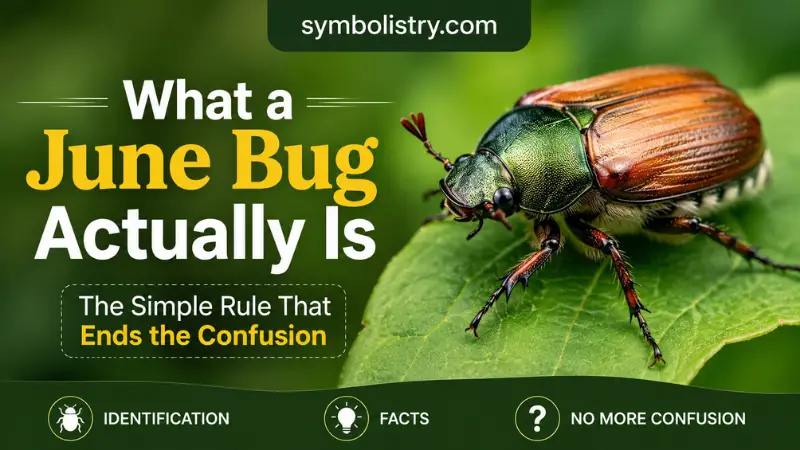
In the United States, the term “June bug” or “June beetle” can refer to several members of the scarab beetle family. Typical Phyllophaga species are brown, reddish-brown, or dark-colored beetles that often become active during May and June. They are especially noticeable at night because adults may gather around artificial lights. (University of Minnesota Extension)
The green June beetle looks quite different. Cotinis nitida has a striking metallic green appearance and is widespread through much of the eastern United States. A related figeater beetle occurs farther west and southwest, while western regions also have other insects commonly called June beetles. (LSU AgCenter)
Most of the insect’s development happens away from human attention. The larvae, usually called white grubs, live underground and feed before eventually pupating and becoming adults. Some May and June beetles take two or three years to complete development, depending on species and climate. (CSU Engagement and Extension)
That hidden-to-visible life pattern is one reason modern observers so easily connect the June bug with gradual development and emergence.
Core Meanings in Modern U.S. Interpretation
There is no official symbolic dictionary that assigns one fixed meaning to a June bug. Instead, several interpretations have developed from its behavior, season, appearance, and relationship to broader beetle symbolism.
| Context | Meaning in the USA | Common Association | Important Note |
| Summer emergence | Renewal | New phase, fresh start | Based on seasonal behavior |
| Underground development | Patient growth | Preparation, foundations | A modern metaphor |
| Persistent movement | Determination | Continuing despite difficulty | Often personally interpreted |
| Attraction to light | Direction or curiosity | Goals, searching, distraction | Can be positive or cautionary |
| Green June beetle | Growth and vitality | Nature, abundance, summer | Green adds color symbolism |
| Scarab resemblance | Rebirth or protection | Ancient Egyptian imagery | Not historically identical |
These interpretations work best when understood as modern symbolic associations, not as universal beliefs.
A person who sees a June bug after making a major decision, for example, might treat its appearance as a reminder that change often develops slowly before becoming visible. Someone else may simply associate the insect with childhood summers, nighttime gardens, or home.
Both readings can be meaningful without claiming that the beetle carries a supernatural message.
Summer Emergence: Renewal, Timing, and Seasonal Change
The June bug’s strongest symbolic connection is probably its relationship with seasonal change.
May and June beetles are named for the period when adults commonly emerge and become noticeable. Green June beetles and related species also appear during the warmer part of the year. Their arrival therefore overlaps with longer days, active gardens, school vacations, outdoor gatherings, and the transition into summer across much of the United States. (University of Minnesota Extension)
That timing makes renewal a natural symbolic interpretation.
Unlike spring flowers, which suggest the first return of life after winter, June bugs belong to a later stage of seasonal change. They can therefore represent something that has already been developing and is finally ready to appear.
This distinction gives the insect an especially useful metaphorical meaning: not every new beginning starts suddenly.
A career change, creative project, relationship decision, or personal goal may spend months developing quietly before other people can see the result. The June bug’s life cycle offers an easy image for that process.
Its symbolism can therefore be less about instant transformation and more about the right moment to emerge.
Underground Development: Patience and Grounded Growth
Much of a June beetle’s life is spent below the surface.
May and June beetle larvae live in soil, where they develop as white grubs. Depending on the species, that immature period may extend across more than one growing season before the insect eventually reaches adulthood. (CSU Engagement and Extension)
Symbolically, this creates an association with work that happens out of sight.
Modern culture often celebrates visible achievements: graduation, a successful business, a completed artwork, a promotion, or a major lifestyle change. Yet those outcomes usually depend on preparation that nobody sees.
The June bug provides a natural metaphor for that hidden stage.
In personal symbolism, it may stand for:
- developing skills before seeking recognition
- allowing a plan enough time to mature
- strengthening foundations before expanding
- accepting periods when progress is not obvious
- trusting preparation more than appearance
The word grounded also fits this interpretation because the insect literally develops within the earth. Used carefully, that symbolism can represent practicality, stability, and attention to basic needs rather than vague ideas about “earth energy.”
The meaning is especially suitable for someone entering a period in which patience matters more than speed.
Attraction to Light: Direction, Curiosity, and Risk
Anyone who has spent a warm evening near a porch light may understand another familiar image associated with June beetles.
Many May and June beetles are active at night and are attracted to lights. (University of Minnesota Extension)
Symbolically, light can represent a goal, answer, source of hope, or something demanding attention. A June bug moving toward light can therefore become an image of seeking direction.
There is also a less flattering interpretation.
Following what appears bright does not necessarily mean moving toward what is useful. A person may chase status, attention, an unhealthy relationship, an unrealistic opportunity, or another attractive distraction simply because it stands out.
For that reason, the June bug’s attraction to light can carry two complementary meanings:
Positive: Keep moving toward something that gives your life direction.
Cautionary: Make sure the thing attracting you is actually worth pursuing.
This dual interpretation makes the insect more interesting than a simple “good luck” symbol. Curiosity is valuable, but curiosity without judgment can become distraction.
Persistence and the Meaning of Imperfect Movement
June bugs are often remembered for their noisy, conspicuous flight around lights, windows, porches, and yards.
Their movement can appear awkward from a human perspective. They may bump into surfaces, fall, recover, and continue moving. That everyday observation has helped inspire modern associations with persistence and resilience.
The symbolism is not about flawless performance.
Instead, the June bug can represent continuing despite imperfect progress.
That idea can be useful when someone is learning a skill, adjusting to a major change, recovering from a setback, or working toward a goal without having every step planned.
Many symbols of perseverance emphasize strength or control. The June bug offers a different version: progress can be messy.
Its message, when used metaphorically, is not “never make mistakes.” It is closer to do not confuse awkwardness with failure.
That interpretation also explains why some people find June bug imagery appealing despite considering the real insects clumsy or inconvenient.
June Bug Symbolism in the United States
June bugs have a particularly seasonal character in American life.
They appear around lawns, gardens, farms, patios, porch lights, and wooded areas at a time when people spend more evenings outdoors. Depending on region and species, Americans may picture a brown beetle, a shiny green beetle, or another locally familiar scarab when they hear the name. (University of Minnesota Extension)
As a result, American June bug symbolism often carries a strong element of summer nostalgia.
For someone raised in an area where these beetles were common, the insect may evoke:
childhood evenings outdoors, grandparents’ yards, summer vacation, neighborhood porches, gardens, warm weather, or memories of a particular home.
In these cases, the June bug symbolizes place and memory more than spirituality.
This is important because symbolism does not always come from religion or mythology. Ordinary objects and animals can acquire emotional meaning through repeated personal or cultural experience.
A June bug illustration in home decor might therefore communicate a rustic summer atmosphere. A tattoo may commemorate childhood. A nickname such as “Junebug” can feel affectionate because the word has a small, playful, warm-weather quality.
The cultural meaning depends heavily on context.
Good Luck and Scarab Connections: What History Supports
June bugs are sometimes described online as symbols of luck, rebirth, protection, or prosperity. Those meanings exist in contemporary spiritual writing, but the historical explanation requires care. (Astrology.com)
The strongest ancient beetle tradition comes from Egyptian scarab symbolism, not from the American insects now called June bugs.
In ancient Egypt, scarab imagery was associated with creation, renewal, rebirth, solar cycles, and protection. Scarab amulets could also be connected with funerary beliefs and the hope of renewed life after death. (The Metropolitan Museum of Art)
June beetles belong to the scarab beetle family, so the visual and biological connection is understandable. However, it would be historically inaccurate to say that ancient Egyptians specifically revered “June bugs.” That modern English common name applies to different beetles found in the Americas.
Therefore, when a June bug is used today to mean rebirth or protection, the safest interpretation is that the symbolism echoes broader scarab imagery rather than continuing an ancient June bug tradition.
The same caution applies to good luck.
A June bug can certainly serve as a personal good-luck symbol today. What should be avoided is presenting luck as an ancient, universally documented meaning of this exact insect.
Cross-Cultural Claims and Native American Traditions
Claims about Indigenous symbolism require even more care.
Online symbolism articles sometimes state that “Native Americans believed” beetles or June bugs represented a single quality such as prosperity, protection, transformation, or intuition. That wording is too broad.
There is no single Native American belief system. Hundreds of distinct Indigenous nations have their own histories, languages, ceremonies, stories, and relationships with animals.
Documented beetle traditions also differ. Beetles are not especially prominent across Native North American folklore as a single category, although particular beetles have specific associations in some traditions. Examples recorded in compilations of Indigenous stories include fertility-related associations involving certain beetles and rain-related narratives involving others. (Native Languages)
That does not establish one universal June bug meaning.
A culturally responsible article should therefore avoid statements such as “the Native American meaning of the June bug is renewal.” Such claims flatten diverse traditions into an invented generalization.
The same rule applies globally. Egyptian scarabs, American June beetles, Japanese beetles, European chafers, and other insects may look related to a casual observer, but their cultural histories should not automatically be combined.
Similar appearance does not make their symbolism interchangeable.
Emotional Meaning, Dreams, and Personal Reflection
A June bug can also function as a psychological symbol without being treated as a supernatural sign.
Its most useful emotional themes are patience, emergence, persistence, adaptation, memory, and direction.
For someone going through a difficult transition, the insect’s hidden development may reflect the feeling of making progress that nobody else can see.
For another person, repeatedly moving toward light may resemble an intense search for purpose or approval.
Someone who dislikes June bugs may experience an entirely different association. Their buzzing, unpredictable movement could represent irritation, intrusion, chaos, or an issue that keeps demanding attention.
Dream interpretation works in much the same way.
There is no scientifically established universal meaning for dreaming about a June bug. A useful interpretation starts with what happened in the dream and how the dreamer felt.
A June bug emerging from soil might represent something becoming visible.
A June bug circling a light could reflect focus, attraction, or distraction.
A June bug inside the house may symbolize an unwanted concern entering personal space.
A large number of beetles could suggest feeling overwhelmed by small problems.
A green June beetle may emphasize growth, nature, freshness, or summer because green is strongly associated with vegetation and growth in modern Western color symbolism. (Wikipedia)
These should be treated as prompts for reflection, not predictions.
Tattoos, Jewelry, Art, and Decor
June bug imagery works especially well in modern visual design because beetles have a compact, symmetrical body shape and can be illustrated with considerable detail.
June Bug Tattoos
A June bug tattoo can represent:
- growth that happened privately
- a fresh chapter in life
- persistence after setbacks
- connection with summer
- love of insects or natural history
- memories of childhood or home
- an unconventional personal identity
A green June beetle tattoo may emphasize vitality and the natural world, while a brown June beetle can create a more earthy, understated appearance.
Scarab-inspired designs sometimes add wings, suns, circles, or Egyptian motifs. When those elements are included, however, the design moves beyond simple June bug imagery and begins referring deliberately to ancient Egyptian scarab symbolism. (The Metropolitan Museum of Art)
Jewelry and Accessories
Beetle-shaped pendants, earrings, pins, and brooches can suggest nature, transformation, vintage natural-history collections, or simply appreciation for unusual insects.
Metallic green June beetles are particularly suited to decorative art because their natural coloration already has a jewel-like appearance.
Home Decor and Illustration
In prints, botanical artwork, stationery, and seasonal decor, June bugs often work as part of a broader summer theme.
Paired with leaves, flowers, moonlight, garden scenes, or warm-weather plants, they usually communicate nature and season rather than a fixed spiritual doctrine.
That makes the symbol flexible. It can be meaningful without requiring one prescribed interpretation.
Common Misunderstandings and How the Meaning Has Evolved
The biggest misunderstanding is the idea that June bug symbolism comes from one ancient tradition.
It does not.
The phrase “June bug” is a common American name applied to several scarab beetles. Its current symbolic meaning is largely built from modern observation of the insect, seasonal memories, personal interpretation, and borrowed associations from broader beetle symbolism. (University of Minnesota Extension)
A second misunderstanding is treating every June bug as the same insect.
Brown Phyllophaga beetles, the green June beetle, the western figeater beetle, and the ten-lined June beetle are different insects even though regional common names may overlap. (LSU AgCenter)
A third problem is attaching unsupported cultural claims to the beetle. Ancient Egyptian scarab meanings should be identified as scarab traditions. Indigenous beliefs should be connected to specific peoples and documented stories rather than presented as one generic Native American worldview. (The Metropolitan Museum of Art)
Modern symbolism has nevertheless expanded.
Contemporary spiritual writing increasingly describes June bugs in terms of transformation, luck, rebirth, persistence, and personal change. (Astrology.com)
These interpretations are best understood as new layers of meaning, not evidence that the same symbolism has existed unchanged for centuries.
That distinction does not make modern symbolism less useful. It simply makes its origin clearer.
FAQs
Is seeing a June bug good luck?
A June bug can be treated as a personal good-luck symbol, and some modern spiritual interpretations connect beetles with fortune or positive change. However, there is no well-established ancient American tradition proving that seeing a June bug universally predicts good luck. (Astrology.com)
What does a June bug symbolize spiritually?
In modern spiritual interpretation, a June bug commonly represents renewal, persistence, change, patience, and emerging after a period of unseen growth. These meanings are contemporary interpretations based largely on its life cycle rather than a single established religious doctrine.
What does a green June bug symbolize?
A green June bug can represent growth, vitality, renewal, summer, and connection with nature. The additional emphasis on growth comes partly from modern Western associations between the color green and vegetation, life, freshness, and renewal. (Wikipedia)
What does a June bug tattoo mean?
A June bug tattoo may symbolize persistence, personal transformation, summer memories, hidden growth, or love of nature. Because there is no fixed traditional meaning, the wearer’s personal story usually matters more than any supposed universal definition.
Does the June bug have a biblical meaning?
The Bible does not establish a specific symbolic meaning for the modern insects Americans call June bugs. Religious interpretations that describe them as divine messages, signs of blessing, or warnings are later personal readings rather than a standard biblical symbol.
Are June bugs the same as Egyptian scarabs?
No. June bugs are modern common names for several beetles, particularly scarab-family beetles found in the Americas, while the famous Egyptian scarab symbolism developed around dung beetles and associated imagery. Ancient Egyptian scarabs represented concepts including creation, protection, solar renewal, and rebirth. (The Metropolitan Museum of Art)
What does it mean if you keep seeing June bugs?
Repeated sightings usually have a natural explanation, such as season, local beetle populations, vegetation, or nearby outdoor lighting. Symbolically, someone may choose to use the experience as a reminder of persistence, direction, or gradual change, but the sightings should not automatically be treated as supernatural predictions. (University of Minnesota Extension)
Conclusion
June bug symbolism is best understood as a modern interpretation of an insect closely tied to summer, soil, emergence, and persistence. Its most natural meanings are renewal, gradual growth, adaptability, determination, and the transition from a hidden stage into a visible one.
Broader ideas such as rebirth, protection, and good fortune can also appear, especially when June bugs are connected with scarab imagery. Historical accuracy matters, though: ancient Egyptian scarab traditions are real and well documented, while a specific ancient June bug tradition is not. (The Metropolitan Museum of Art)
Perhaps the most fitting lesson comes from the insect’s ordinary life rather than mythology. Significant change can spend a long time developing beneath the surface before anyone notices that something new has emerged.