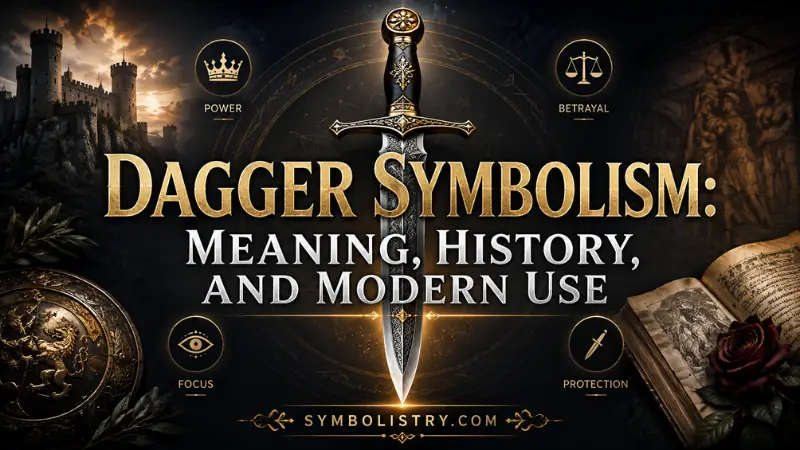
A dagger is a short, pointed blade designed for close-range use, but its cultural meaning reaches far beyond its original function. Dagger symbolism in the United States commonly centers on danger, courage, betrayal, defense, mortality, and decisive action.
The image works so well as a symbol because a dagger feels immediate. Unlike a distant weapon, it suggests closeness, risk, secrecy, and personal confrontation. At the same time, decorated ceremonial daggers from different societies show that short blades have also represented rank, sacred duty, political authority, and protection. (Cambridge Dictionary)
Today, Americans are most likely to encounter dagger imagery in tattoos, jewelry, fantasy art, movies, games, clothing, logos, and Gothic or traditional tattoo designs. Its meaning depends heavily on what appears beside the blade and whether it is shown raised, sheathed, broken, bloodied, or piercing another symbol.
Quick Answer
Dagger symbolism commonly represents courage, danger, betrayal, protection, and the willingness to face a difficult situation in modern American culture. Historically, dagger-like blades have also served as signs of authority, ritual protection, sacrifice, status, and religious commitment in different cultural traditions. (The Metropolitan Museum of Art)
TL;DR
- A dagger commonly represents danger, courage, defense, or betrayal.
- Its close-range nature gives it an intensely personal meaning.
- Ceremonial blades have represented authority, religion, sacrifice, and status.
- Dagger tattoos often combine strength with pain or survival.
- Hearts, roses, snakes, and skulls can significantly change its message.
- No single dagger meaning applies across every culture or design.
What a Dagger Looks Like and Why Its Shape Matters
A dagger is generally a short blade with a sharp point, historically designed primarily for thrusting and close combat. Many traditional examples have two cutting edges, although objects described as daggers vary considerably across periods and cultures. (Cambridge Dictionary)
That physical design helps explain its symbolic associations.
A long sword can suggest warfare, military rank, heroism, or open confrontation. A dagger feels more private. It can be carried close to the body and historically could be used at very short distance.
As a visual symbol, its sharp point naturally communicates focus, penetration, finality, and danger. Its compact form also lends itself to imagery involving concealment and sudden action.
That is why the same object can communicate two opposite ideas: being threatened by danger or being prepared to defend yourself from it.
What a Dagger Commonly Symbolizes in the United States
Modern American interpretations are not governed by one traditional code. The meaning usually comes from the setting, accompanying objects, and personal intention.
| Context | Meaning in the USA | Common Associations | Notes |
| Dagger alone | Courage or danger | Strength, readiness, risk | Meaning depends on presentation |
| Hidden dagger | Secrecy or betrayal | Intrigue, distrust, deception | Often negative |
| Defensive dagger | Protection | Survival, boundaries, vigilance | Can be empowering |
| Dagger through heart | Heartbreak or wounded love | Betrayal, grief, emotional pain | Common tattoo motif |
| Dagger with rose | Beauty mixed with danger | Love, sacrifice, resilience | Meaning is highly personal |
| Ceremonial dagger | Authority or ritual purpose | Rank, religion, tradition | Must be read culturally |
The key distinction is intent.
A dagger pointing toward someone can appear threatening. The same blade held defensively can suggest courage or protection. A decorative dagger displayed with flowers may communicate resilience, while a bloodied blade may emphasize violence, death, guilt, or revenge.
Why Daggers Became Symbols of Danger and Betrayal
Few objects communicate danger as quickly as a blade.
Daggers acquired an especially personal quality because they are associated with physical proximity. Symbolically, that closeness can transform ordinary danger into betrayal: the person causing harm is imagined as being close enough to strike directly.
This idea remains visible in English expressions about hostile relationships and secretive behavior. Americans use phrases involving daggers to describe sharp hostility, hidden motives, espionage, and conflict even when no actual weapon exists.
Literature strengthened the association. One famous example appears in Macbeth, when Macbeth sees a vision of a bloody dagger leading him toward the murder of King Duncan. The dagger becomes connected not simply with violence but with intention, temptation, fear, and the psychological movement toward an irreversible act. (Folger Shakespeare Library)
As a result, dagger imagery can suggest more than physical harm. It may represent broken trust, treachery, guilt, or the moment a relationship changes permanently.
Courage, Defense, and Readiness
The dagger has an equally important positive interpretation.
A weapon is dangerous, but carrying one has historically also meant being prepared for danger. That difference allows dagger imagery to represent courage, self-defense, vigilance, or the refusal to remain helpless.
In personal symbolism, a dagger may communicate:
- “I survived something difficult.”
- “I can defend my boundaries.”
- “I am prepared for what comes next.”
- “Fear will not control my choices.”
American tattoo traditions have long included military, sailor, weapon, and other bold motifs associated with courage, identity, hardship, and remembrance. Historical American military tattoos more broadly have been used to express courage, bravery, honor, and morale. (Air and Space Museum)
A modern dagger tattoo may draw on similar ideas, although the wearer ultimately determines its personal meaning.
Power, Status, and Ceremonial Authority
Not every historical dagger was simply a practical fighting tool.
Elaborate blades could be made from expensive materials, covered with decoration, inscribed, or carried in settings where display mattered as much as usefulness. In such situations, the blade could communicate wealth, position, political authority, or ceremonial importance.
This broader weapon symbolism appears in ancient objects that were deliberately unsuitable for ordinary combat. One large ancient Chinese jade dagger-axe, for example, was so thin and oversized that its function was symbolic rather than martial. Its form represented authority and was intended for public display. (National Museum of Asian Art)
This history helps explain why decorative dagger imagery can communicate command, dignity, rank, or controlled strength rather than aggression.
The important lesson is that a blade’s symbolism cannot be separated from its material and setting. A jeweled court weapon and a concealed fighting knife may share a pointed form while communicating very different social messages.
Ancient Blades and the Development of Symbolic Meaning
Sharp tools are among humanity’s oldest technologies, so blade symbolism developed long before the modern dagger had a standardized appearance.
In the ancient Americas, stone blades originally had practical cutting functions. Over time, certain blades were transformed into ceremonial objects, offerings, regalia, and artistic forms. By the second millennium BCE, ceremonial blade forms were already being used in ways that went beyond ordinary utility. (The Metropolitan Museum of Art)
Different societies created different interpretations.
Some Mesoamerican greenstone blades were connected with political power and maize agriculture. Certain Central Andean ceremonial knives became associated with sacrifice. Other specially shaped blades were connected to lightning, rulers, sacred offerings, or supernatural forces. (The Metropolitan Museum of Art)
These traditions should not be collapsed into one supposed “ancient dagger meaning.” They show something more useful: people repeatedly turned dangerous or valuable cutting objects into symbols of authority and ritual transformation, but they did so for culturally specific reasons.
Ritual Dagger Symbolism Across Cultures
One of the clearest examples of a dagger whose symbolic function differs sharply from ordinary violence is the Tibetan phurba, or ritual dagger.
Within Tibetan Vajrayana Buddhist practice, the phurba has a specific religious role. Historical examples were used symbolically against spiritual obstacles rather than functioning simply as ordinary weapons. One documented interpretation connects it with overcoming ignorance, greed, and delusion and suppressing forces understood as obstacles to spiritual progress. (The Metropolitan Museum of Art)
That meaning should not be transferred automatically to every three-sided dagger tattoo or decorative blade. The phurba belongs to a specific religious tradition.
The same caution applies elsewhere.
For example, the Sikh kirpan may visually resemble a knife or short sword, but for observant Sikhs it is an article of faith associated with religious commitment, justice, moral responsibility, and the duty to protect others. Treating it as merely a generic “dagger symbol” strips away its religious context. (Sikh Coalition)
Cultural accuracy matters whenever a recognizable sacred blade is used in art, jewelry, or tattoos.
Dagger Symbolism in American Language and Literature
Americans encounter symbolic daggers even when they never see a physical one.
English language and storytelling have made the blade a convenient image for conflict and secrecy. A dagger can suggest enemies facing one another, covert operations, hidden threats, or a betrayal delivered from close range.
Literature also gives the dagger a psychological dimension.
The Macbeth dagger scene remains an especially recognizable example because the weapon appears before the killing takes place. The image therefore connects action with thought: Macbeth has not yet committed the murder, but his mind is already moving toward it. (Folger Shakespeare Library)
That pattern continues in modern storytelling. A dagger shown before violence often serves as a visual warning that a character is approaching a critical decision.
Because of this tradition, dagger imagery can represent temptation, dangerous ambition, guilt, internal conflict, or a point of no return.
Why Dagger Tattoos Remain Popular
The dagger is especially suited to tattoo art.
Its long, narrow form works on arms, legs, backs, hands, and other areas where a vertical composition fits naturally. It can also pass through or sit beside other traditional motifs such as hearts, flowers, snakes, flames, skulls, banners, and animals.
More importantly, it can carry both positive and negative ideas at the same time.
Someone who has endured betrayal might choose a dagger because it represents the wound. Another person could use exactly the same blade as a sign of survival.
Common personal themes include:
Courage: facing danger rather than avoiding it.
Protection: defending oneself, loved ones, or personal boundaries.
Survival: living through loss, trauma, conflict, or major change.
Betrayal: remembering damaged trust.
Sacrifice: accepting pain for something considered important.
Determination: making a difficult decision and following through.
There is no universal tattoo dictionary, however. Placement, accompanying images, artistic tradition, and the wearer’s explanation matter more than generic online definitions.
What a Dagger Through a Heart Symbolizes
A heart and dagger create one of the clearest symbolic contrasts.
The heart represents affection, emotional attachment, vulnerability, or life. The blade introduces pain and danger. When the dagger pierces the heart, the resulting image naturally lends itself to heartbreak, betrayal, wounded love, grief, or emotional sacrifice.
Yet the image does not always mean a romantic partner was unfaithful.
For some people, it represents losing someone. For others, the heart survives despite being wounded, turning the image into a statement about endurance.
The direction matters too. A freshly pierced or bleeding heart emphasizes injury, while a stylized traditional design may function more broadly as a dramatic emblem of love and pain existing together.
Dagger and Rose, Snake, or Skull Meanings
Adding another object changes the interpretation significantly.
Dagger and Rose
A rose introduces beauty, affection, attraction, growth, and vulnerability. Combined with a sharp blade, it creates contrast.
The design may represent love and pain, beauty and danger, tenderness protected by strength, or surviving something that once caused hurt.
Dagger and Snake
A snake can introduce danger, transformation, temptation, survival, renewal, or vigilance depending on the design.
A snake wrapped around a dagger may therefore suggest conflict between two dangerous forces, control over danger, adaptability, or a struggle for survival. It should not automatically be assigned one fixed meaning.
Dagger and Skull
A skull makes mortality much harder to ignore.
Together, the images can represent death, acceptance of mortality, dangerous living, fearlessness, remembrance, or the consequences of violence.
These combinations work precisely because the dagger does not lose its basic associations. Instead, the second symbol tells viewers what kind of danger, struggle, love, or mortality the design is exploring.
Emotional and Psychological Meaning
Symbolically, a dagger often appears at emotional extremes.
It is not usually an image of comfort or neutrality. Even when used positively, it suggests that something difficult has been confronted.
For someone processing betrayal, the blade may represent the painful clarity that follows broken trust. For a survivor, it can represent discovering the ability to defend personal boundaries.
It can also express controlled aggression.
That does not necessarily mean wanting to harm another person. In art, a weapon can externalize emotions that are hard to describe directly: anger, fear, frustration, determination, or the need to feel less vulnerable.
A sheathed dagger may communicate restraint and controlled strength. A broken dagger can suggest the end of conflict or loss of power. A raised blade creates tension because action seems imminent.
Visual details therefore matter as much as the object itself.
Daggers in Movies, Games, Fantasy, and Modern Design
Modern entertainment keeps dagger imagery highly visible in the United States.
Fantasy stories often give daggers to rogues, assassins, thieves, scouts, or stealth-oriented characters. This reinforces ideas of speed, secrecy, precision, and hidden danger.
Horror and crime stories usually emphasize the darker side: murder, pursuit, betrayal, or threat. Gothic fashion may use an ornate dagger primarily for its dramatic combination of elegance and danger.
Games add another interpretation. A dagger can represent agility and precision rather than raw strength, especially when contrasted with heavier swords, axes, or hammers.
Jewelry and fashion designs can soften the violent implications further. A miniature jeweled dagger pendant may communicate rebellion, Gothic taste, historical interest, or a preference for sharp visual design without suggesting literal aggression.
Context determines whether the symbol feels threatening, heroic, romantic, spiritual, or simply decorative.
Common Misunderstandings and Controversial Uses
The biggest mistake is assuming that every dagger has the same secret meaning.
It does not.
Some online interpretations claim that specific dagger tattoos universally identify criminals, gang members, killers, prisoners, or particular life experiences. Such claims are unreliable unless the design belongs to a clearly documented group, place, or tradition.
Historical context also matters when collecting or wearing real military daggers. Twentieth-century authoritarian and extremist organizations sometimes incorporated decorated daggers into uniforms and ceremonial equipment. Museums preserve examples of such objects as historical artifacts. That does not make a plain dagger an extremist symbol; identifying marks, inscriptions, emblems, and historical context determine the association. (National Museum of American History)
Religious blades require similar care. A phurba or kirpan should not be stripped of its cultural meaning and treated as interchangeable with a fantasy assassin’s dagger.
The safest interpretation is always contextual rather than universal.
How Dagger Meaning Has Changed Over Time
The dagger’s symbolism has expanded because the object itself has occupied several roles.
At different times and places, short blades have been practical weapons, personal sidearms, luxury objects, religious implements, ceremonial regalia, status markers, and works of art.
Modern Americans inherit fragments of all those histories.
From weaponry comes danger and defense.
From concealed blades comes secrecy and betrayal.
From decorated court weapons comes status and authority.
From ritual traditions comes sacred or ceremonial meaning.
From literature comes guilt, ambition, and internal conflict.
From tattoo culture comes a highly personal language of pain, courage, survival, and identity.
The modern dagger therefore works less like a symbol with one definition and more like a framework. Its sharpness establishes tension; the surrounding context explains what that tension means.
FAQs
Is a dagger a positive or negative symbol?
It can be either. A dagger may represent violence, death, betrayal, or danger, but it can also symbolize courage, protection, survival, readiness, and personal strength. Its position and surrounding imagery usually reveal which interpretation fits best.
What does a dagger tattoo mean?
A dagger tattoo commonly represents courage, danger, protection, betrayal, sacrifice, or surviving hardship. There is no universal meaning, so the wearer’s intention and any accompanying symbols are important.
What does a dagger through a heart mean?
A dagger piercing a heart commonly suggests heartbreak, emotional injury, betrayal, grief, or painful love. Some people also use it to represent enduring emotional pain without being destroyed by it.
What does a dagger and rose symbolize?
A dagger and rose often contrast danger with beauty or pain with love. Depending on the wearer, it can also express resilience, sacrifice, guarded affection, or something beautiful surviving a difficult experience.
Does a dagger symbolize protection?
Yes. Because daggers historically could function as weapons of defense, the image can represent readiness, vigilance, courage, and protecting personal boundaries. A defensive or sheathed blade tends to communicate this more clearly than a bloodied or attacking one.
Does a dagger have a spiritual meaning?
Certain culturally specific ritual daggers do. The Tibetan phurba, for example, belongs to Vajrayana Buddhist practice and has religious meanings connected with overcoming spiritual obstacles; those meanings should not automatically be assigned to ordinary dagger imagery. (The Metropolitan Museum of Art)
Does a dagger always symbolize betrayal?
No. Betrayal is only one common interpretation arising from the dagger’s association with close, hidden, or sudden attacks. In other contexts, the same image can communicate courage, defense, authority, sacrifice, or survival.
Conclusion
A dagger carries tension wherever it appears because its form immediately suggests danger and decisive action. Yet reducing it to violence misses much of its history. Blades have also marked ceremonial authority, religious responsibility, protection, courage, status, and personal identity in different societies. (The Metropolitan Museum of Art)
In modern American culture, dagger symbolism is especially flexible. A bare blade may suggest danger, a dagger through a heart can express emotional injury, and a decorative or defensive dagger may communicate survival, courage, or protection.
The most accurate interpretation comes from looking beyond the blade itself. Its surrounding symbols, cultural tradition, artistic style, and personal context determine whether the dagger represents a wound, a warning, a responsibility, or the strength to face danger.
[…] Modern American meanings are mostly personal and interpretive. […]