
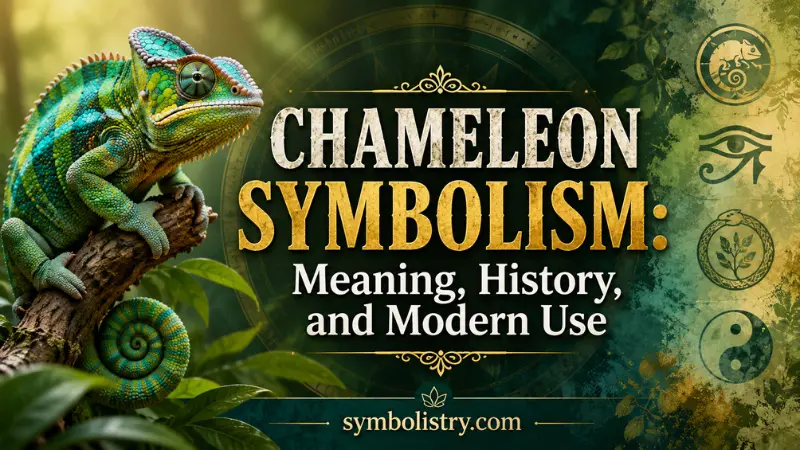
Chameleons are visually unusual animals: they have independently moving eyes, grasping feet, long projectile tongues, and skin capable of striking color changes. Those traits make chameleon symbolism especially easy to connect with ideas about adaptation, awareness, identity, patience, and personal change.
In the United States, the animal is most often understood through its reputation for adjusting to its surroundings. That interpretation can be positive, suggesting flexibility and resilience, or critical, suggesting that someone changes personality or opinions depending on the people around them.
The symbolism becomes more interesting when the real animal is separated from popular myth.
Chameleons do change color, but not simply to copy every background they encounter. Their appearance also reflects communication, temperature, stress, reproductive behavior, and other biological conditions.
Quick Answer
Chameleon symbolism commonly represents adaptability, personal transformation, awareness, and the ability to respond intelligently to changing circumstances in modern American culture. It can also represent unstable identity or opportunism, while several African traditions give the animal older associations with spiritual mediation, creation, mortality, and communication between worlds.
TL;DR
- Chameleons most commonly represent adaptability and adjustment.
- Color change also makes them symbols of transformation and identity.
- American usage can praise flexibility or criticize inconsistency.
- Some African traditions connect chameleons with spirits and creation.
- Tattoos often emphasize growth, awareness, independence, or resilience.
- Real chameleon biology is more complex than the camouflage stereotype.
What a Chameleon Is and Why It Became Symbolic
Chameleons belong to a distinctive family of lizards associated mainly with Africa and Madagascar, although species also occur elsewhere in the Old World. Many live in trees or shrubs and possess specialized feet and, in numerous species, prehensile tails that help them grip branches. Their eyes can move largely independently before focusing together on prey.
Almost every part of the animal invites metaphor.
Its changing appearance suggests transformation. Its deliberate movement suggests patience. Its wide visual awareness suggests observation. Its ability to function in varied habitats lends itself to ideas about resilience.
Because these traits are unusually visible, people can easily project human experiences onto them. A chameleon can therefore represent someone learning to handle a new environment, but it can just as easily represent someone hiding their real opinions.
That tension between adaptation and authenticity is central to its modern meaning.
The Core Meanings of the Chameleon
Several interpretations appear repeatedly in contemporary symbolic use.
Adaptability is the strongest. The chameleon represents adjusting behavior when circumstances change rather than responding to every situation in exactly the same way.
Transformation comes from visible shifts in color and appearance. People may choose the animal during periods of reinvention, recovery, career change, or personal growth.
Identity is more complicated. Changing appearance can suggest versatility, but when applied to a person it can also raise the question of whether adaptation has become self-erasure.
That last meaning gives the chameleon more psychological complexity than a simple symbol of change.
Adaptability: The Most Familiar Modern Interpretation
In everyday American symbolism, adaptability is usually the first meaning people associate with a chameleon.
Someone entering a new school, moving to another city, changing careers, or joining an unfamiliar community may need to learn new expectations while retaining their underlying values. In that situation, the chameleon becomes an appealing model of responsiveness.
Adaptability does not necessarily mean becoming whatever other people want.
A healthier interpretation is flexibility without surrendering identity. The environment may change, and a person’s approach may change with it, while core principles remain relatively stable.
That distinction matters because the same image can otherwise imply people-pleasing or social performance.
For someone choosing chameleon imagery as a personal emblem, it can communicate: I can adjust without being defeated by change.
Identity and the “Social Chameleon”
American English also uses chameleon metaphorically for a person who changes behavior, beliefs, or presentation according to circumstances. Merriam-Webster, for example, includes a figurative definition involving someone who changes beliefs or behavior to please others or succeed.
This gives the animal a distinctly double-sided meaning.
A socially adaptable person may read a room well, communicate effectively with different personalities, and feel comfortable moving between professional or cultural settings. Those abilities can be useful forms of social intelligence.
But constant adjustment can also look insincere.
Calling a politician a “chameleon,” for instance, is rarely straightforward praise. It may imply that positions change according to the audience. Similar criticism can appear in relationships or workplaces when someone seems to adopt whatever personality produces an advantage.
The symbolic question becomes simple: Are you adapting your method, or changing your values?
What Color Change Really Means
The familiar cartoon image of a chameleon instantly becoming the color of any object it touches exaggerates what the animals actually do.
Chameleons have species-specific ranges of colors and patterns. Their changes can be associated with social signaling, reproductive interactions, stress, temperature, light, and physiological condition. Smithsonian material specifically notes that color change can indicate stress or function as communication rather than merely providing camouflage.
Research on panther chameleons has also shown that structural changes involving microscopic guanine nanocrystals in specialized skin cells contribute to dramatic shifts in reflected color.
This biology strengthens rather than weakens the symbolism.
The chameleon’s color is not merely a disguise. It can communicate information.
Symbolically, that opens another interpretation: appearance can reveal internal condition. A person may try to control what others see, yet mood, confidence, fear, attraction, and stress still affect outward behavior.
Chameleons in African Traditions and Art
There is no single “African meaning” of the chameleon. Africa contains thousands of communities and distinct religious, artistic, and oral traditions, so interpretations should be connected to particular peoples rather than treated as universal.
Among the Senufo, chameleon imagery appears frequently in art. The Metropolitan Museum of Art describes the animal as primordial within Senufo thought and documents chameleon forms on yawiige, personal ornaments associated with divination and protection. Other museum interpretation describes chameleons in this context as intermediaries between human and spiritual realms.
Elsewhere in West African religious art, chameleon imagery can also carry associations with mediation and communication. Harvard Divinity Bulletin notes its representation as a messenger to the other world in certain shrine and divination objects.
These meanings differ considerably from the modern American focus on adaptability.
Rather than merely representing someone who “fits in,” the animal may occupy a position between visible and invisible realms, humans and spirits, or ordinary experience and sacred knowledge.
The Chameleon, Delay, and Mortality in Folklore
One of the most striking chameleon stories appears in southern African oral tradition.
An isiZulu account tells of a chameleon sent to humanity with a message that people would not die. The chameleon delayed during its journey, and another lizard carrying the opposite message arrived first. Death therefore became humanity’s condition. Variants of the broader “delayed messenger” story occur in African oral traditions, though details differ by community and telling.
Within such a story, the chameleon takes on meanings that would be difficult to predict from color change alone.
It can represent delay, missed opportunity, irreversible consequence, mortality, or the danger of failing to deliver something important in time.
The story also shows why symbolic animals cannot be reduced to a universal dictionary. The same creature that represents flexibility in an American tattoo can carry an entirely different emotional weight within another cultural tradition.
What the Chameleon Commonly Means in the United States
American interpretations tend to be shaped more by popular knowledge of the animal than by a single inherited religious tradition.
| Context | Common U.S. Meaning | Association | Possible Negative Side |
| Personal growth | Adaptability | Learning through change | Losing direction |
| Career or social life | Versatility | Reading situations well | People-pleasing |
| Tattoos | Transformation | Reinvention and resilience | Unstable identity |
| Art and fashion | Individuality | Color and self-expression | Constant image-changing |
| Public language | Behavioral change | Flexibility | Opportunism |
The dominant American idea is therefore neither purely positive nor negative.
A chameleon image can celebrate someone who survives change intelligently. The word chameleon, however, can become criticism when it suggests that the person has no stable position.
Context determines which meaning is intended.
Emotional and Psychological Meaning
As a personal symbol, the chameleon often speaks to the tension between belonging and individuality.
Most people modify some behavior depending on context. A person may speak differently with close friends than during a job interview without becoming a different person. Social adaptation is part of ordinary human interaction.
The chameleon becomes emotionally meaningful when that adjustment is especially important.
Someone who has repeatedly had to enter unfamiliar environments may identify with its flexibility. Someone recovering from a difficult period may interpret changing colors as evidence that identity can develop rather than remain fixed.
For another person, however, the animal can serve as a warning: changing constantly for acceptance may eventually make it difficult to know which preferences are genuinely one’s own.
These are symbolic interpretations, not psychological diagnoses. The image is useful precisely because it raises questions about how much people should adapt and what they should refuse to change.
Awareness, Observation, and Strategic Patience
A less obvious meaning comes from the chameleon’s eyes.
Chameleons can direct their eyes independently and achieve an unusually broad field of visual awareness before bringing both eyes to bear on a target.
That physical characteristic lends itself naturally to symbolism involving observation and perspective.
A chameleon can therefore represent someone who watches before speaking, gathers information before committing, or considers more than one side of a situation.
Its slow movement reinforces this reading.
Rather than symbolizing speed or aggression, the animal suggests controlled action. In personal imagery, that can communicate patience, timing, careful judgment, and the value of noticing what others miss.
This meaning is particularly useful because it balances the usual fixation on color change.
Chameleon Tattoo Meaning
Chameleon tattoos can carry several different messages depending on pose, color, accompanying imagery, and the wearer’s intention.
A brightly colored chameleon may emphasize self-expression and individuality. Instead of disappearing into the environment, the animal becomes visually impossible to ignore.
A green chameleon surrounded by leaves may lean toward adaptability, nature, or survival.
A design showing several colors across the body can suggest personal evolution, especially after a major change in relationships, career, identity, or lifestyle.
The animal’s eyes may be emphasized to represent awareness and perception, while a chameleon gripping a branch can suggest remaining steady during uncertain circumstances.
Some people also choose the image with deliberate irony. For them, being a “chameleon” does not mean lacking identity; it means possessing enough confidence to move between environments without needing every environment to stay the same.
Chameleons in Jewelry, Fashion, Art, and Decor
The chameleon’s physical form works especially well in decorative design.
Its curled tail creates an easily recognizable silhouette, while scales and shifting colors give artists room for unusual palettes. Jewelry may emphasize iridescent stones or multicolored enamel to reinforce ideas of change and individuality.
In home decor or illustration, the animal often appears in tropical and nature-oriented themes. These uses are usually more playful than spiritual.
Fashion can push the symbolism further.
Color-changing, reflective, or iridescent materials are sometimes described as “chameleon” effects because their appearance changes under different lighting or viewing conditions. In this setting, the word suggests visual versatility rather than moral inconsistency.
The animal has consequently become a convenient visual shorthand for anything capable of presenting more than one appearance.
Positive and Negative Meanings
The chameleon is unusual because its positive and negative interpretations arise from the same characteristic.
Changing according to circumstances can mean:
Positive: adaptable, perceptive, flexible, resilient, socially intelligent.
Or it can mean:
Negative: inconsistent, deceptive, opportunistic, excessively approval-seeking.
Neither interpretation is automatically correct.
A person who changes communication style when speaking with a child, colleague, or grandparent is simply responding to context. A person who changes basic principles whenever doing so brings an advantage may deserve the less flattering “chameleon” label.
The symbolism therefore depends on what remains stable beneath the change.
Common Misunderstandings and Misuse
The biggest misconception is that chameleons continuously scan their surroundings and perfectly copy whatever color they see.
Real color change is considerably more constrained and serves multiple biological functions. Communication and physiological state can be as important as concealment.
A second mistake is treating all traditional interpretations as interchangeable.
A Senufo protective ornament, a southern African death-messenger narrative, and a contemporary American tattoo do not represent three versions of one universal doctrine. They come from different cultural systems and should be explained separately.
Another problem is presenting the animal as an established symbol in traditions where evidence is weak. Modern spiritual writing frequently assigns fixed meanings such as “awakening,” “manifestation,” or “psychic power” to animals without showing that those meanings belong to any documented historical tradition.
A more grounded approach distinguishes personal interpretation from inherited cultural meaning.
How the Meaning Changed Over Time
The chameleon did not acquire one symbolic definition at a single moment.
Different meanings grew from different observations.
Traditional communities living alongside chameleons incorporated the animal into stories, religious ideas, protective objects, and explanations of human existence. In particular West African contexts, it could function as a primordial creature or spiritual intermediary, while an isiZulu narrative connected its delay with the arrival of death.
Modern English developed another path.
As the animal became famous for its changing appearance, chameleon became a metaphor for people or things that frequently change. In American usage, that metaphor now moves easily between praise and criticism.
Modern biology adds another layer by showing that the familiar camouflage story is incomplete.
As a result, the chameleon can now be understood not simply as an animal that hides, but as one whose visible changes can communicate information and respond to internal and external conditions.
That makes adaptability only one part of the picture.
FAQs
What does a chameleon symbolize spiritually?
There is no universal spiritual definition. In some documented West African traditions, chameleons have been associated with primordial existence, protection, mediation, or communication with the spirit world, while modern personal spirituality often interprets them more broadly as symbols of transformation and awareness.
Is a chameleon a positive symbol?
It can be. Adaptability, resilience, patience, observation, and personal growth are positive interpretations, while excessive change can represent inconsistency or loss of authenticity.
Does a chameleon symbolize good luck?
There is no widespread American tradition that defines the chameleon specifically as a good-luck animal. Cultural attitudes vary, and some African traditions have historically associated chameleons with spiritual importance or caution rather than simple luck.
What does a chameleon tattoo represent?
A chameleon tattoo commonly represents adaptability, transformation, individuality, survival, or awareness. Its meaning becomes more specific through color, posture, surrounding plants, and the personal reason for choosing the design.
Is the chameleon a biblical symbol?
The chameleon is not a major established Christian symbol. The King James Version uses the word in Leviticus 11:30 among animals regarded as unclean under ancient Israelite dietary law, but translations differ in identifying the Hebrew animal term, so the verse should not be treated as a universal symbolic doctrine about modern chameleons.
Why can calling someone a chameleon be negative?
The term can imply that someone changes beliefs, behavior, or loyalties according to the audience or personal advantage. In that sense, the criticism is not about adaptability itself but about appearing to lack stable principle.
Conclusion
At its clearest, chameleon symbolism centers on the ability to respond to change. In contemporary American culture, that can mean flexibility, resilience, awareness, and transformation, but it can also raise concerns about inconsistency, social performance, and whether adaptation has gone too far.
Older traditions broaden the picture. Chameleons have appeared as spiritual intermediaries, primordial creatures, protective images, and characters in stories about mortality and consequence. Their real biology adds another useful correction: changing color is not simply an act of hiding.
The chameleon’s most useful symbolic lesson is therefore not to become whatever surrounds you. It is to recognize changing conditions, respond intelligently, and understand what should remain unchanged.