Wolves occupy an unusual place in the American imagination. They are admired as intelligent, family-oriented animals and feared as predators that move beyond the edge of settled life. Wolf symbolism reflects both reactions, which is why the animal can represent loyalty in one setting and danger in another.
People encounter the wolf as a real animal, a storybook villain, a conservation emblem, a team mascot, a tattoo, or a personal identity symbol. Each form emphasizes a different quality: cooperation, independence, endurance, instinct, wilderness, or threat.
Understanding the symbol requires separating wolf behavior from the stories people have built around it. The wolf’s meaning has changed as American attitudes toward predators, wilderness, family, and personal freedom have changed.
Quick Answer
Wolf symbolism commonly represents loyalty, family bonds, freedom, instinct, resilience, and connection to the wild in modern American culture. Historically, wolves have also symbolized danger, predation, protection, warfare, spiritual relationships, and the tension between civilization and wilderness.
TL;DR
- Wolves often symbolize loyalty, cooperation, freedom, and survival.
- European folklore frequently cast wolves as deceptive or dangerous.
- Indigenous meanings differ by nation, community, and ceremonial tradition.
- American attitudes shifted from eradication toward conservation and coexistence.
- “Alpha wolf” and “lone wolf” imagery often misrepresents real behavior.
- Tattoos usually emphasize family, endurance, independence, or personal instinct.
What the Wolf Symbol Looks Like
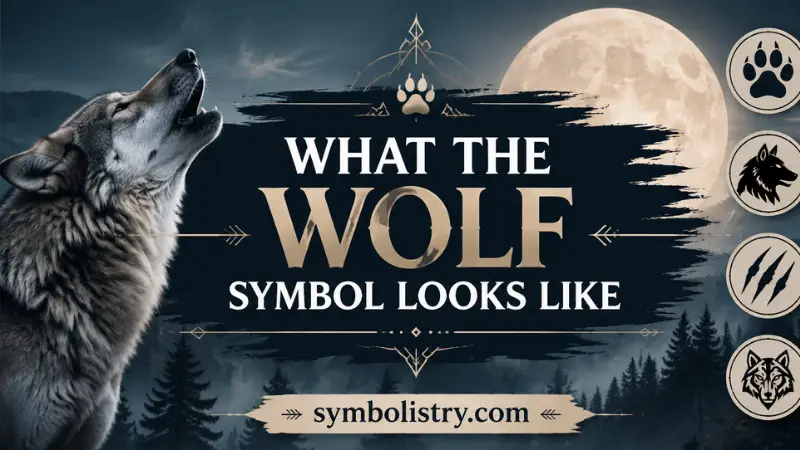
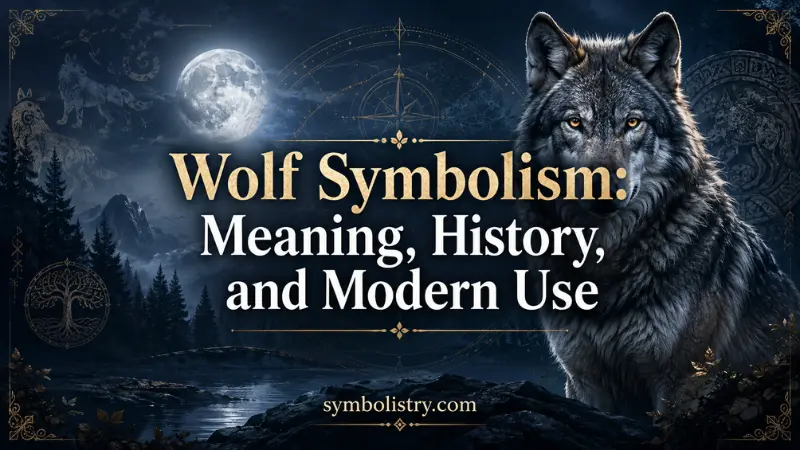
A wolf symbol may show the entire animal, a head in profile, a paw print, a pair of watchful eyes, or a silhouette howling beneath the moon. Gray, black, and white wolves dominate modern designs, even though coat color varies widely in real populations. Sharp ears, a long muzzle, a heavy winter coat, and an alert posture distinguish the wolf from the domestic dog in visual art.
People see wolf imagery on outdoor clothing, jewelry, sports logos, wilderness posters, book covers, motorcycles, military-style graphics, and social media profiles. A lone wolf standing on a ridge suggests independence or distance. A group moving together shifts the message toward family, teamwork, and mutual protection.
The real gray wolf is the largest wild member of the dog family and can live in forests, tundra, mountains, grasslands, and deserts. Its adaptability helps explain why the animal can symbolize both survival and a refusal to be confined.
What Wolves Commonly Mean in the United States
In the United States, the wolf usually carries a mixture of positive and cautionary meanings. It can represent fierce loyalty and healthy independence, but it can also suggest aggression, secrecy, or a threat approaching from outside the group.
| Context | Meaning in the USA | Common Associations | Important Note |
| Family or group | Loyalty and cooperation | Pack, protection, shared purpose | Real packs are usually family units |
| Wilderness | Freedom and untamed nature | Mountains, forests, open land | Often used in conservation imagery |
| Lone wolf | Independence or isolation | Self-reliance, distance, rebellion | Can romanticize unhealthy disconnection |
| Folklore | Danger and deception | Predators, disguises, warnings | Shaped heavily by European tales |
| Personal style | Resilience and instinct | Tattoos, jewelry, clothing | Meaning depends on pose and setting |
| Spiritual use | Kinship, guidance, or responsibility | Ceremony, clan, teachings | Meanings are culture-specific, not universal |
The symbol remains appealing because it combines qualities that Americans often treat as opposites: belonging and freedom, tenderness and ferocity, intelligence and instinct. A wolf can stand for devotion to one’s people without implying obedience to everyone else.
How Real Wolf Behavior Shapes the Symbol
Many positive wolf meanings come from observed social behavior. Wolves communicate through body posture, scent, vocalization, and coordinated movement. They hunt, defend territory, feed young, and care for offspring through group effort.
A typical wild pack is not a random collection of animals constantly fighting for rank. It is generally a family led by breeding parents and made up largely of their offspring, sometimes with additional adults. Field research has shown that the popular image of a permanent dominance contest came largely from studies of unrelated captive wolves rather than natural family groups.
This family structure supports symbolic meanings such as loyalty, shared responsibility, teaching, protection, and cooperation. At the same time, wolves defend territory and may fight rival packs, so the animal also communicates boundaries, vigilance, and the cost of protecting a group.
Indigenous Meanings Require Cultural Specificity
There is no single “Native American wolf meaning.” The United States includes hundreds of distinct Tribal Nations, each with its own languages, histories, stories, clan systems, and ceremonial practices. A meaning associated with the wolf in one community should not be presented as a universal Indigenous belief.
In some Indigenous traditions, animals are understood as relatives, teachers, clan beings, or participants in creation histories rather than decorative symbols. Because these relationships may involve family, clan, ceremony, and community authority, sacred or community-specific imagery should not be copied as generic “spirit animal” art.
The Anishinaabe relationship with ma’iingan, the wolf, is one important example. Public wolf-management planning in Minnesota recognizes that Ojibwe communities have longstanding cultural ties to wolves and that these relationships continue to inform Tribal policy and stewardship. This is more specific and respectful than claiming that all Indigenous peoples view wolves in the same way.
For non-Native readers, the best approach is to name the particular nation or community when reliable information is available. Personal admiration for wolves is valid, but it should not be dressed in borrowed ceremonial language.
European Folklore and Christian Imagery
Much of the wolf’s negative reputation in American culture arrived through European stories. In pastoral societies, wolves threatened animals that represented food, labor, and household wealth. The predator therefore became a practical danger and a useful character for teaching children about strangers, deception, and unsafe places.
In Little Red Riding Hood, The Three Little Pigs, The Wolf and the Seven Young Goats, and many fables, the wolf becomes a stand-in for dangerous human behavior. It may flatter, disguise itself, break into a home, or punish someone who ignores a warning. Familiar literary versions were shaped by writers such as Charles Perrault and the Brothers Grimm, then repeated through children’s books, theater, animation, and school lessons.
These tales did not attempt to describe wildlife accurately. They turned a predator into a moral device. As a result, “wolf” still appears in phrases about hidden threats, predatory people, false appearances, and people who exploit the vulnerable.
Biblical wolf imagery is usually cautionary because it comes from a world where shepherds understood the danger predators posed to flocks. Wolves can represent violent enemies, corrupt leaders, or false teachers who appear harmless while intending harm. The expression “wolf in sheep’s clothing” preserves that association in everyday American English.
Yet biblical symbolism is not entirely negative. Isaiah’s peaceful vision places the wolf with the lamb, using former enemies to represent an end to violence and disorder. In that setting, the wolf is not destroyed; its relationship to the vulnerable is transformed.
For many American Christians, wolf imagery therefore works in two directions. It can warn against predatory behavior, or it can illustrate the possibility of reconciliation and peace.
Roman and Norse Wolves Show Two Different Sides
Ancient Mediterranean and northern European traditions did not treat the wolf only as a villain. In the Roman founding story, a she-wolf nurses the abandoned twins Romulus and Remus. The image links the animal with survival, protection, motherhood, and the birth of political power.
Norse tradition presents a more divided picture. Fenrir is a monstrous wolf associated with broken restraints, cosmic disorder, and the death of Odin at Ragnarök. Other wolves, including those connected with Odin, suggest companionship, appetite, battle, and the dangerous strength surrounding divine authority.
Together, these traditions help explain the wolf’s enduring duality. It can nurture founders or threaten the world. It can protect power or overturn it.
From Frontier Enemy to Conservation Symbol
The American meaning of the wolf cannot be separated from settlement, ranching, hunting, and wildlife policy. European American communities often viewed wolves as competitors and threats to livestock. Government eradication programs, habitat loss, hunting, poisoning, and bounty systems nearly eliminated gray wolves from most of their historical range in the contiguous United States by the mid-20th century.
That history made the wolf a symbol of wilderness pushed aside by expansion. Later, endangered-species protection, scientific study, and highly visible recovery programs changed the public image. Wolves released into Yellowstone and central Idaho during the 1990s became emblems of ecological restoration, rewilding, and the return of a landscape that had been simplified by predator removal.
The shift is incomplete. Some Americans see wolves as necessary wildlife and symbols of intact ecosystems; others focus on livestock losses, hunting interests, or rural safety. Modern wolf imagery often carries this political tension even when it appears on a simple poster or T-shirt.
The wolf’s American meaning has moved through several overlapping stages. European folklore emphasized the predator outside the safe boundary. Frontier culture treated it as an obstacle to livestock production and settlement. Conservation movements reframed it as an essential part of wild ecosystems. Modern identity culture added themes of family loyalty, instinct, personal freedom, and recovery from hardship.
None of the older meanings disappeared. The wolf can still be a villain in a children’s story, a warning in a sermon, a conservation logo, a sports mascot, or a memorial tattoo. The context determines which qualities come forward.
When choosing wolf imagery, ask what the animal is doing. A hunting wolf communicates something different from a nursing mother, a dispersing individual, a bonded pair, or a pack caring for pups. Pose, setting, companions, and cultural references matter more than the animal alone.
Pack Loyalty and the Lone Wolf
A pack design usually symbolizes belonging without weakness. It suggests that individuals become more capable when they coordinate, share knowledge, protect young members, and accept responsibility for the group.
This meaning is common in family tattoos, memorial designs, team branding, and gifts between close friends. A pair of wolves may represent partners who move through difficulty together. An adult with pups can symbolize parenthood, guardianship, or the duty to prepare the next generation.
The strongest version of this symbol is not blind obedience. It is reciprocal loyalty. Each member benefits from the group and contributes to its survival.
The Lone Wolf: Freedom, Distance, and Isolation
The lone wolf is one of the most popular American interpretations, especially in tattoos, fiction, outdoor branding, and online identity. It communicates self-reliance, independence, privacy, refusal to conform, or survival after separation from a former group.
Real wolves do sometimes travel alone, usually while dispersing, seeking territory, or looking for a mate. However, lone travel is generally a stage or condition, not proof that wolves naturally prefer permanent isolation. Yellowstone data indicate that only a minority of wolves are alone at a given time.
As a human symbol, the lone wolf can be empowering for someone rebuilding life independently. It can also become a warning when it glorifies distrust, emotional withdrawal, or the belief that needing others is weakness. The design’s meaning depends on whether solitude is shown as chosen freedom, temporary transition, or alienation.
Wolf Tattoos and Personal Meaning
Wolf tattoos are usually chosen for identity rather than decoration alone. A realistic wolf face can express alertness, courage, or self-command. A howling silhouette often points to voice, longing, distance, or connection with wilderness. A pack scene emphasizes family, while a wolf with flowers may balance ferocity with tenderness or growth.
Other design elements change the message:
- A moon adds night, cycles, intuition, or solitude.
- Mountains suggest endurance, challenge, and wild places.
- A compass can represent direction or trust in instinct.
- Pups emphasize protection, parenting, and legacy.
- A skull introduces mortality, survival, or transformation.
- Geometric lines make the image feel controlled and modern.
Wolf jewelry and clothing usually carry a lighter version of the same meanings. A pendant may serve as a private reminder of resilience or family loyalty, while a bold graphic shirt may project toughness, independence, or outdoor identity.
Emotional and Psychological Meaning
Psychologically, the wolf often represents the part of a person that notices danger, protects boundaries, and reacts before every detail can be explained. This does not make the wolf a scientific personality type. It is a metaphor people use to describe vigilance, intuition, social loyalty, anger, grief, or a desire for autonomy.
A calm wolf can signal self-possession. A snarling wolf may externalize defensive anger. An injured wolf can represent endurance after betrayal or loss. A wolf watching from a distance may express caution, loneliness, or the need to observe before trusting.
Dream interpretations should remain personal rather than absolute. A wolf in a dream may reflect fear if the dreamer felt hunted, but the same animal may suggest protection if it walked beside them. The emotional tone and the dreamer’s own experiences matter more than a fixed symbol dictionary.
Wolves in Sports, Entertainment, and Digital Culture
American teams and clubs use wolf and wolf-pack identities because the animal suggests coordination, speed, territorial defense, endurance, and competitive aggression. The group name is usually more important than the solitary predator: members are expected to act as a unit.
Entertainment uses wolves in several recurring roles. The realistic wolf may represent wilderness or ecological conflict. The werewolf represents uncontrolled change, divided identity, bodily power, or fear of one’s own impulses. Fantasy stories often soften the old villain by giving wolves intelligence, loyalty, social rules, or bonds with human characters.
On social media, wolf avatars commonly signal independence, masculinity, outsider identity, nature affinity, or resilience. These uses are highly personal, but they often rely on familiar shorthand rather than real knowledge of wolves.
Common Misunderstandings and Misuse
The “alpha wolf” is the most widespread misconception. Popular culture treats the alpha as an aggressive male who dominates unrelated rivals through constant force. Studies of wild packs show that leadership usually comes from parents guiding a family, not from a permanent tournament among strangers. Using “alpha” as a human identity label therefore borrows authority from an outdated picture of wolf society.
Another problem is attaching generic Indigenous claims to commercial wolf art. Phrases such as “Native American wolf spirit” can erase differences among nations and turn living traditions into a single fantasy. The safer choice is either to identify a documented, nation-specific context or describe the image as personal nature symbolism.
The popular “two wolves” story about feeding an inner good wolf or bad wolf is often labeled an ancient Cherokee teaching, but its origin is disputed and earlier printed versions used dogs in Christian moral anecdotes. It can still work as a modern metaphor, but presenting it as verified Cherokee tradition is misleading.
Finally, wolf imagery can be used to romanticize predation, violent isolation, or contempt for vulnerability. A symbol of strength becomes distorted when strength is defined only as domination.
FAQs
Is the wolf a positive or negative symbol?
It can be either. Positive meanings include loyalty, family, resilience, freedom, and protection, while negative meanings include danger, deception, aggression, and social isolation.
What does a wolf tattoo symbolize?
A wolf tattoo commonly represents family loyalty, survival, independence, instinct, or connection with wilderness. A pack emphasizes belonging, while a solitary wolf usually highlights autonomy or life outside a former group.
What does a howling wolf symbolize?
Is the wolf a positive or negative symbol?
It can be either. Positive meanings include loyalty, family, resilience, freedom, and protection, while negative meanings include danger, deception, aggression, and social isolation.
What does a wolf tattoo symbolize?
A wolf tattoo commonly represents family loyalty, survival, independence, instinct, or connection with wilderness. A pack emphasizes belonging, while a solitary wolf usually highlights autonomy or life outside a former group.
What does a wolf symbolize in Christianity?
Christian imagery often uses the wolf as a warning against false teachers, predators, or forces that scatter a vulnerable community. Isaiah also uses the wolf living peacefully with the lamb to describe restored order and the end of hostility.
Does the wolf represent loyalty?
Yes, especially in modern American family, friendship, and team imagery. The association comes partly from the cooperative care, social bonds, and shared responsibilities found in wild wolf packs.
What does a white wolf symbolize?
A white wolf often represents endurance, rarity, winter, clarity, or survival in severe conditions. These are modern design associations rather than a single universal cultural meaning.
Is the wolf a Native American symbol?
Wolves hold important meanings in some Indigenous nations, but there is no universal Native American interpretation. Any claim should identify the specific nation, story, clan, language, or community involved.
Conclusion
Wolf brings together loyalty, freedom, instinct, family responsibility, danger, and the boundary between settled life and wilderness. Its meaning changes according to whether the animal appears alone or with a pack, calm or threatening, realistic or mythic.
The most grounded interpretation begins with context. A wolf can represent protective devotion without glorifying dominance, and independence without denying the importance of community.
The animal remains compelling because it does not fit a single moral role. It reminds people that strength can involve cooperation, boundaries, adaptability, and care for those who depend on us.