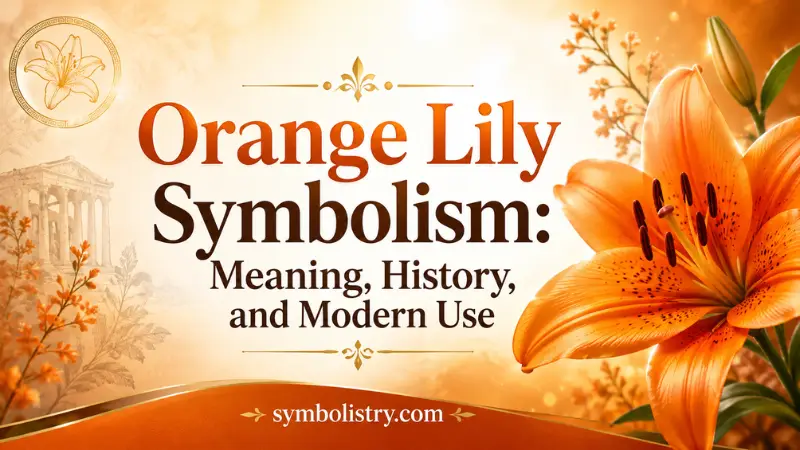
Orange lilies are among the most visually assertive flowers in gardens and bouquets. Orange lily symbolism today commonly centers on confidence, warmth, enthusiasm, attraction, vitality, and personal pride, although older flower-language traditions sometimes gave orange lilies surprisingly negative meanings.
That contrast is important. A bright orange lily given at a modern American celebration is unlikely to communicate hostility, even though some nineteenth-century flower dictionaries associated orange lilies with hatred or disdain. Modern interpretations are shaped much more by the flower’s vivid color, dramatic form, and use in contemporary floral design.
There is also a botanical complication: “orange lily” can describe several different lilies. The European orange lily, Lilium bulbiferum, the spotted tiger lily, Lilium lancifolium, and many modern Asiatic hybrids can all produce orange flowers. Their histories and symbolic associations are not identical.
Quick Answer
Orange lily symbolism commonly represents confidence, enthusiasm, warmth, attraction, vitality, and bold self-expression in modern American culture. Historically, some Victorian flower-language traditions gave orange lilies meanings such as hostility or disdain, while tiger lilies were more often linked with wealth and pride.
TL;DR
- Orange lilies commonly suggest confidence, warmth, enthusiasm, and vitality.
- Victorian flower meanings could be much more negative.
- Tiger lilies traditionally carry associations with wealth and pride.
- Modern Americans usually interpret orange lilies more positively.
- Context matters more than any single traditional definition.
What an Orange Lily Actually Is
“Orange lily” is not always the name of one precise botanical plant.
One species specifically known as the orange lily is Lilium bulbiferum, a European lily with naturally orange flowers. Its native range extends across parts of central and southern Europe, although it has also been introduced elsewhere.
Americans may also call the tiger lily an orange lily. The tiger lily, Lilium lancifolium, produces downward-facing orange flowers covered with dark spots. It originated in East Asia and has become naturalized in parts of eastern North America.
Garden centers also sell numerous orange Asiatic, trumpet, and hybrid lilies. These cultivated varieties may look quite different from either species.
This matters symbolically because online flower guides frequently combine meanings from different lilies. A meaning historically assigned to a tiger lily should not automatically be presented as the traditional meaning of every orange-flowered lily.
What Orange Lilies Commonly Mean in the United States
In modern American use, orange lilies usually communicate a more positive message than their older flower-dictionary reputation suggests.
Their strongest contemporary associations include:
| Context | Common U.S. Meaning | Why It Fits | Typical Use |
| Celebration | Enthusiasm, success | Bright color feels energetic | Bouquets, parties |
| Relationships | Attraction, excitement | Orange feels warmer than yellow | Romantic gifts |
| Personal symbolism | Confidence, independence | Bold flowers attract attention | Tattoos, artwork |
| Achievement | Pride, ambition | Upright lilies look commanding | Congratulations |
| Home and garden | Vitality, warmth | Orange creates visual energy | Decor, landscaping |
These meanings are largely interpretive rather than fixed cultural rules.
Most Americans do not carry a detailed Victorian floral dictionary in their heads. They are more likely to interpret the flower through its appearance, occasion, relationship to the recipient, and surrounding flowers.
Why Orange Changes the Meaning of the Lily
Lilies as a larger flower family often carry associations with purity, devotion, renewal, mourning, or spiritual themes. Much of that symbolism developed around white lilies, especially in European Christian art.
Orange produces a very different emotional effect.
It is warm, conspicuous, and visually energetic. Compared with a white lily, an orange lily tends to look less restrained and ceremonial. Compared with a red flower, it often feels less solemn or intensely romantic.
That gives the orange lily a natural connection with:
Confidence. It does not disappear into a floral arrangement.
Enthusiasm. Its bright coloring suggests activity and excitement.
Warmth. Orange visually recalls sunlight, fire, and autumn tones.
Individuality. Choosing an orange lily rather than a traditional white or pink bloom can communicate unconventional taste.
Attraction. Orange can suggest romantic or physical interest without carrying the established love symbolism of a red rose.
These are modern color-based interpretations, not evidence of an ancient universal code.
The Surprising Victorian Meaning of Orange Lilies
The nineteenth-century language of flowers, usually called floriography, complicates the flower’s modern reputation.
From roughly the 1820s through the late nineteenth century, books assigning sentiments to flowers became fashionable in Britain and the United States. People could consult these dictionaries when selecting flowers or interpreting bouquets. The system was never perfectly standardized, and different books sometimes assigned different meanings to the same plant.
Some historical and later flower-language references associate the orange lily with hatred, disdain, or hostility.
That can be startling because the modern flower looks cheerful rather than threatening.
The important point is that Victorian floral meanings were cultural conventions, not natural properties of the flower. They could also change between books.
One famous nineteenth-century flower dictionary by Kate Greenaway, for example, lists white lilies with purity and sweetness and yellow lilies with falsehood and gaiety, illustrating how strongly color could alter a flower’s assigned message.
So the old negative orange-lily meaning should be treated as a historical curiosity rather than the default meaning of an orange bouquet today.
Orange Lily vs. Tiger Lily Symbolism
This distinction causes some of the greatest confusion.
A tiger lily is orange, but not every orange lily is a tiger lily.
The classic tiger lily has strongly recurved orange tepals with dark spots. It is Lilium lancifolium, a species native to parts of East Asia and now naturalized in areas of North America.
Traditional flower-language references often associate the tiger lily with wealth and pride. A modern Iowa State University flower-language guide preserves that pairing.
Traditional flower-language references often associate the tiger lily with wealth and pride.
Those meanings make visual sense. Tiger lilies are tall, spotted, dramatic, and difficult to overlook.
Today, additional interpretations include:
- confidence
- courage
- independence
- ambition
- prosperity
- bold personality
These newer meanings are extensions of the older wealth-and-pride theme rather than universally documented historical definitions.
If someone specifically chooses a tiger lily tattoo or bouquet, “pride” and “confidence” are generally more historically appropriate than applying the old orange-lily meaning of hatred.
Lilies in Christian Art and Religious Symbolism
Lilies have a major place in Christian visual tradition, but orange lilies should not simply inherit every religious meaning of white lilies.
In medieval and Renaissance art, white lilies became especially associated with purity and the Virgin Mary. Lilies appear frequently in Annunciation imagery, and museum scholarship continues to identify the lily as a symbol of purity in Christian art.
The orange lily has a less standardized Christian meaning.
Because it belongs to the same flower family, a Christian viewer may still personally connect it with faith, resurrection, divine creation, or spiritual devotion. But describing orange lilies specifically as an established biblical symbol of purity would blur an important color distinction.
For modern religious arrangements, orange lilies may therefore suggest joy, thanksgiving, vitality, or celebration more naturally than virginal purity.
Their religious meaning depends heavily on the setting.
Orange Lilies as Symbols of Confidence and Pride
One of the most natural modern interpretations of an orange lily is confidence.
Lilies tend to grow on upright stems, with large flowers held prominently above their foliage. Orange varieties intensify that visibility.
As a result, the flower can symbolize someone who is willing to be noticed without apologizing for it.
This makes orange lilies suitable personal symbols for:
- becoming more self-assured
- celebrating an achievement
- accepting one’s personality
- moving into a leadership role
- recovering confidence after failure
- choosing independence over approval
Pride deserves more nuance.
Healthy pride means recognizing achievement, dignity, or self-worth. Arrogance means exaggerating one’s importance. Historical tiger-lily symbolism leaned toward pride, but modern users can interpret that idea in either direction.
An orange lily tattoo, for example, may represent learning to take pride in oneself rather than vanity.
Attraction, Desire, and Romantic Meaning
Orange lilies can work as romantic flowers, but their message differs from the conventional red rose.
They suggest heat and excitement more readily than lifelong devotion.
For that reason, an orange lily arrangement can communicate:
Attraction. The relationship feels magnetic or exciting.
Admiration. The recipient has a striking personality.
Enthusiasm. The relationship brings energy and enjoyment.
Desire. Orange can give the flower a warmer, more sensual tone.
That does not make orange lilies a universal symbol of sexual desire. It simply means their appearance can support that interpretation when the romantic context is already clear.
For a new relationship, they can feel lively and less predictable than red roses.
For an anniversary, however, they may work better when paired with flowers carrying stronger established associations with commitment or affection.
Orange Lilies in Weddings and Celebrations
Orange lilies are especially effective when a celebration is meant to feel energetic rather than delicate.
In American weddings, they may appear in autumn color palettes, outdoor ceremonies, rustic arrangements, or bold contemporary bouquets.
Their symbolic message can include:
- joyful beginnings
- confidence in the future
- enthusiasm for a shared life
- warmth between families
- celebration of individuality
They are not traditional marriage symbols in the same specific way that some flowers became associated with bridal purity or fidelity.
Instead, their wedding meaning usually comes from the emotional effect of the color and the couple’s personal interpretation.
Orange lilies also suit graduations, promotions, housewarmings, birthdays, and business celebrations because confidence and achievement translate easily to those occasions.
Can Orange Lilies Be Used for Funerals?
Yes, but the meaning changes with context.
Lilies are deeply familiar funeral flowers in the United States, particularly white varieties. Orange lilies create a less quiet tone.
Instead of emphasizing innocence or solemn purity, orange lilies may suggest:
- celebrating a vibrant life
- remembering someone’s strong personality
- warmth and affection
- courage
- lasting admiration
For someone remembered as lively, outspoken, creative, or energetic, orange flowers may feel more personal than a conventional white arrangement.
There is no rule requiring orange lilies to mean grief.
At a memorial, their symbolism comes from remembrance and the character of the person being honored.
What an Orange Lily Tattoo Can Symbolize
Orange lily tattoos are flexible because they combine traditional floral ideas with strong color symbolism.
Common interpretations include confidence, independence, attraction, ambition, personal transformation, pride, resilience, and vitality.
A tiger lily design may place stronger emphasis on pride or prosperity, especially when the dark spots are clearly shown.
Placement and surrounding imagery can change the message.
An orange lily with flames might emphasize passion or transformation. Combined with a butterfly, it may suggest personal change. Paired with a name or date, it could become a memorial symbol.
Some people also deliberately choose the flower because of its contradictory history.
A tattoo can acknowledge the old associations with hostility while transforming them into a personal message such as overcoming anger, surviving conflict, or refusing to be defined by resentment.
The most accurate interpretation therefore depends on the wearer rather than a single online symbolism list.
Emotional and Psychological Meaning
Orange lilies often communicate outward-directed emotion.
White flowers may feel quiet or restrained. Orange flowers tend to feel active.
Psychologically, that makes them useful symbols for people who identify with:
Optimism. The flower looks bright and forward-facing.
Sociability. Its color feels expressive rather than withdrawn.
Creative confidence. Orange stands apart from more conventional floral colors.
Motivation. Its visual intensity can suggest movement or action.
Emotional courage. A bold flower can represent willingness to show feelings openly.
These associations are modern interpretations rather than clinical psychological findings.
Still, they explain why orange lilies frequently appear in personal art, tattoos, decor, and celebratory arrangements. Their appearance naturally supports messages about visibility and emotional energy.
Cross-Cultural Meanings Are Not One Universal Code
Claims about worldwide orange-lily symbolism deserve caution.
Lilies have long histories across Europe, Asia, Christianity, gardening traditions, decorative arts, and literature. But those histories do not produce one universal meaning.
Even the plants themselves differ.
The European orange lily, Lilium bulbiferum, is native primarily to parts of Europe, while the tiger lily, Lilium lancifolium, has an East Asian native range.
This means a European floral tradition, an East Asian plant tradition, and an American tattoo interpretation may all use orange lilies without meaning the same thing.
Statements such as “orange lilies have always symbolized passion in every culture” should therefore be avoided.
Symbolism becomes more accurate when the species, location, time period, and cultural setting are identified.
The Orange Lily’s Political Meaning in Ireland
One unusual historical association has little to do with modern American floral gifts.
In parts of Irish and Northern Irish history, the orange lily became associated with Protestant and loyalist identity, particularly in connection with Orange traditions. Historical research on Northern Irish political symbols records cases in which wearing an orange lily was treated as an expression of Orange affiliation and could become controversial in divided communities.
This symbolism grew from political and religious identity rather than Victorian romantic flower language.
It should not be generalized beyond that historical setting.
An orange lily in an American garden normally carries no automatic sectarian message. However, someone researching the flower in Irish political history may encounter associations very different from confidence, attraction, or enthusiasm.
This is a useful reminder that symbols can acquire highly local meanings.
Common Misunderstandings About Orange Lily Symbolism
The first mistake is assuming that every orange lily means hatred because one historical flower dictionary says so.
Modern symbolism has changed considerably.
The second mistake is treating orange lilies and tiger lilies as interchangeable. They overlap visually, but tiger-lily traditions have their own association with wealth and pride.
Another problem is applying the white lily’s Christian symbolism directly to orange flowers. White lilies have the clearest historical connection with purity in European Christian art.
It is equally misleading to claim that confidence, motivation, or creativity are ancient meanings. Those are reasonable modern interpretations based primarily on color and appearance.
Finally, no flower meaning is completely independent of context.
A wedding bouquet, funeral spray, tattoo, political emblem, and garden photograph can use the same flower while communicating entirely different ideas.
How the Meaning of Orange Lilies Evolved
Orange-lily symbolism developed in layers rather than from a single origin.
Early religious and artistic traditions established broad symbolic importance for lilies, particularly white lilies.
Later European flower-language culture assigned more detailed meanings according to species and color. In the nineteenth century, floral dictionaries became especially popular in Britain and America, but their definitions were not always consistent.
Orange lilies acquired some negative associations within that system.
Tiger lilies followed a somewhat different path, becoming associated with pride and wealth in commonly repeated flower-language traditions.
Modern symbolism then shifted again.
Today, color psychology, personal expression, tattoo culture, weddings, floral design, social media, and contemporary gardening have encouraged more positive interpretations centered on confidence, warmth, vitality, attraction, and ambition.
The old meanings have not disappeared, but they are no longer the only framework available.
FAQs
What does an orange lily symbolize?
An orange lily commonly symbolizes confidence, enthusiasm, warmth, attraction, vitality, and pride today. Historical flower-language sources can give it more negative associations, so context and time period matter.
Does an orange lily mean hatred?
In some older flower-language traditions, orange lilies were associated with hatred or disdain. That meaning is not widely understood as the default message of an orange lily in modern American floral culture.
What does a tiger lily symbolize?
Tiger lilies are traditionally associated with wealth and pride. Modern interpretations often extend those ideas to confidence, ambition, courage, independence, and personal success.
Are orange lilies romantic?
They can be. Orange lilies usually suggest attraction, excitement, warmth, or admiration rather than the conventional declaration of love associated with red roses.
What does an orange lily tattoo mean?
An orange lily tattoo can represent confidence, vitality, independence, desire, pride, transformation, or resilience. A clearly depicted tiger lily may place stronger emphasis on prosperity or self-confidence.
Do orange lilies have a biblical meaning?
The Bible does not establish one specific symbolic definition for orange lilies. Christian art has a strong lily tradition, especially involving white lilies and purity, while orange varieties are more open to personal interpretations such as joy or spiritual vitality.
Are orange lilies positive or negative symbols?
They can be either, but modern usage is generally positive. Confidence, warmth, attraction, pride, and enthusiasm are more likely interpretations today, while hatred and disdain belong mainly to particular historical flower-language traditions.
Conclusion
Orange lilies have an unusually layered symbolic history. Their bright appearance now makes confidence, enthusiasm, warmth, vitality, attraction, and pride feel natural, while older floral traditions remind us that flower meanings can change dramatically between periods and cultures.
The clearest way to understand orange lily symbolism is to consider both the flower and its setting. A tiger lily may carry an older connection with pride and wealth, a Victorian reference may evoke hostility, and a modern tattoo or bouquet may simply celebrate courage, attraction, or a vibrant personality.
No single definition controls every use. The orange lily’s meaning is strongest when its color, species, occasion, and cultural context are considered together.