
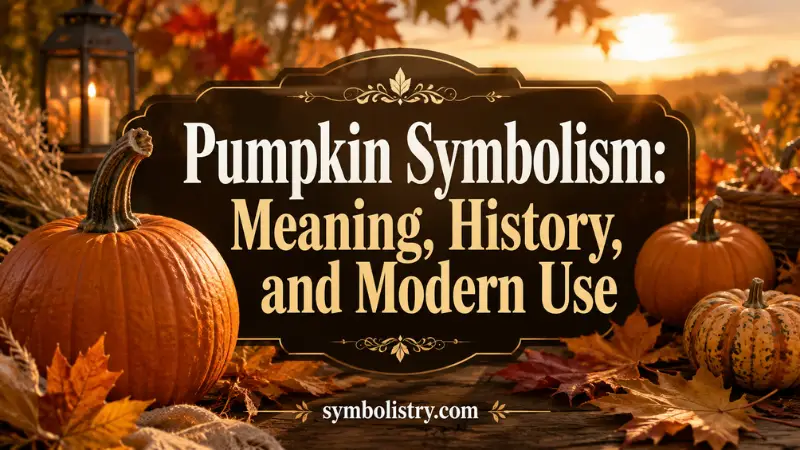
Few objects define the American fall season as clearly as the pumpkin. It appears on front porches, at farm stands, in Halloween displays, on Thanksgiving tables, and across seasonal advertising. Pumpkin symbolism therefore combines several ideas at once: harvest, abundance, home, transformation, autumn, and the playful darkness of Halloween.
Those meanings did not develop from one tradition. Pumpkins and other squash have ancient agricultural roots in the Americas, while the familiar jack-o’-lantern grew from European and Irish carving customs that changed after reaching North America. Later, literature, fairy tales, holiday traditions, and commercial fall culture added new layers.
For Americans today, the pumpkin can feel comforting or eerie depending on the setting. A pie suggests hospitality and family. A pumpkin patch suggests autumn nostalgia. A glowing carved face can signal Halloween, ghosts, mischief, or protection from the darkness.
Quick Answer
Pumpkin symbolism commonly represents harvest, abundance, autumn, gratitude, transformation, and seasonal change in modern American culture. Around Halloween, pumpkins also symbolize mystery, supernatural folklore, playful fear, and the boundary between the ordinary world and the strange.
TL;DR
- Pumpkins commonly symbolize harvest, abundance, and autumn.
- Jack-o’-lanterns connect pumpkins with Halloween folklore and playful fear.
- Thanksgiving pumpkins suggest gratitude, food, family, and hospitality.
- Cinderella gave pumpkins a lasting association with transformation.
- Modern pumpkin imagery often expresses comfort, nostalgia, and seasonal identity.
What a Pumpkin Represents Visually
The familiar American pumpkin is usually imagined as round, ribbed, heavy, and bright orange, although real pumpkins occur in many shapes and colors. Botanically, pumpkins belong to the squash group within the genus Cucurbita, and several species produce varieties commonly called pumpkins.
Its physical form helps explain much of its symbolism. Pumpkins become prominent when crops mature and summer gives way to cooler weather. Their size suggests fullness, while their many seeds can naturally suggest fertility, continuation, or abundance.
The orange color also makes them visually inseparable from American autumn. Against brown leaves, dried corn stalks, hay bales, and dark Halloween decorations, orange pumpkins become an immediate signal that the season has changed.
That seasonal visibility matters. A pumpkin does not need a formal symbolic code to communicate fall; repeated cultural use has made the connection automatic.
What Pumpkins Commonly Mean in the United States
In modern American culture, pumpkins rarely have one fixed meaning. Their symbolism changes with context.
| Context | Common U.S. Meaning | Typical Associations | Tone |
| Harvest displays | Abundance | Farms, crops, plenty | Warm |
| Halloween | Mystery and playful fear | Ghosts, costumes, night | Spooky |
| Thanksgiving | Gratitude and hospitality | Family, food, gathering | Comforting |
| Pumpkin patches | Nostalgia | Childhood, family outings | Sentimental |
| Cinderella imagery | Transformation | Possibility, temporary change | Hopeful |
| Tattoos and art | Growth and seasonal identity | Change, nature, individuality | Personal |
The strongest shared meaning is probably autumn abundance. Pumpkins are harvested in fall, displayed in quantity, and associated with food as well as decoration.
At the same time, Halloween gives them a darker identity. A whole pumpkin can feel cozy; the same pumpkin carved into a glowing face becomes theatrical, supernatural, and slightly unsettling.
Indigenous Agricultural Roots Come Before Modern Holiday Symbolism
Any history of pumpkin meaning in America should begin long before Halloween decorations and Thanksgiving marketing.
Squash plants were domesticated in the Americas thousands of years ago. Archaeological and botanical evidence places some of the earliest domestication of Cucurbita in ancient Mesoamerica, while squash also became central to agricultural systems farther north.
Among several Indigenous peoples, squash was grown alongside corn and beans. The agricultural system now widely called the Three Sisters had practical value because the crops supported one another, but for some nations it also carried cultural and spiritual significance. Among the Haudenosaunee, for example, the Three Sisters are associated with traditions about plants that sustain community life.
It would be inaccurate, however, to claim that every Indigenous nation gave pumpkins one universal spiritual meaning. Traditions differed by place, language, agricultural practice, and community.
The safest interpretation is that pumpkins and related squash can represent sustenance, continuity, cultivation, and community, especially when discussed within specific Indigenous agricultural traditions.
Why Pumpkins Symbolize Harvest and Abundance
The connection between pumpkins and abundance is unusually straightforward.
Pumpkins ripen during harvest season and can grow to impressive size. A field or wagon filled with them visually communicates that the growing season has produced something substantial. That makes pumpkins natural symbols of plenty, successful cultivation, and food stored for the colder months.
This symbolism became especially visible in American rural imagery. Pumpkin patches, barns, farm stands, hayrides, corn shocks, and baskets of produce create an idealized picture of agricultural abundance.
Modern fall decor keeps repeating the same visual language even when no working farm is involved. A decorative porch covered in pumpkins still communicates fullness and seasonal generosity.
This is also why several pumpkins together often feel more symbolically effective than one. Quantity reinforces the idea of a successful harvest.
How the Pumpkin Became a Halloween Symbol
The pumpkin’s Halloween identity came from a cultural merger rather than an ancient pumpkin ritual.
Carving lanterns from root vegetables existed in Ireland and parts of Britain before pumpkins became the standard material in North America. Irish traditions commonly used turnips.
After immigrants encountered large New World pumpkins, pumpkins offered a much easier surface to hollow and carve.
Folklore surrounding the jack-o’-lantern includes stories of wandering spirits, especially the tale often called Stingy Jack. Versions vary, so it is better to treat the story as folklore rather than a single historically fixed origin.
In the United States, the carved pumpkin eventually became one of Halloween’s most recognizable objects.
Its symbolic meaning changed in the process. A food crop associated with harvest was transformed into a glowing face connected with night, ghosts, trickery, and supernatural imagination.
Jack-o’-Lanterns: Fear, Protection, and the Strange
A carved pumpkin occupies an interesting symbolic middle ground.
Its face may be frightening, but the object itself often exists in a playful family setting. Children carve them, neighborhoods display them, and their exaggerated expressions turn fear into entertainment.
Historically, vegetable lantern traditions were connected with stories of spirits and supernatural beings. Later American Halloween culture made the pumpkin lantern less threatening and more decorative, although the old association with darkness remained.
That creates two overlapping interpretations.
A jack-o’-lantern may symbolize something frightening approaching from the dark, but it can also function symbolically as light placed against darkness.
For this reason, modern viewers may read it as protection, courage, or making the frightening manageable. Those interpretations are reasonable symbolic readings, but they should not be presented as a universal ancient pumpkin belief.
Pumpkins, Thanksgiving, and Gratitude
Halloween is not the pumpkin’s only major American holiday.
By November, the frightening carved face often disappears and the pumpkin returns to its agricultural identity. Thanksgiving tables, centerpieces, pies, and harvest decorations connect it with food, gratitude, gathering, and hospitality.
Pumpkins and squash were present in early American agriculture, and squash had already been cultivated by Indigenous peoples long before English colonization. Pumpkin later became deeply embedded in American Thanksgiving food culture, particularly through pumpkin pie.
Symbolically, the Thanksgiving pumpkin is less about supernatural mystery and more about having enough to share.
That makes it a fitting emblem for hospitality. A pumpkin on a Thanksgiving table can communicate abundance without luxury: nourishment, seasonal food, family traditions, and appreciation for what the harvest provided.
Why Pumpkins Symbolize Transformation
One of the pumpkin’s most famous meanings comes from a fairy tale rather than agriculture.
In Charles Perrault’s version of Cinderella, the fairy godmother transforms a pumpkin into an elegant coach so Cinderella can attend the ball. At midnight, the magical transformation ends and the coach returns to its ordinary form.
That scene gave the pumpkin a lasting association with transformation and unexpected possibility.
The symbolism is especially effective because the pumpkin begins as something ordinary. It is large and useful, but hardly glamorous. Turning it into a magnificent carriage represents the possibility that an overlooked object—or person—can temporarily become something extraordinary.
There is also a warning built into the story: transformation may have limits.
As a result, Cinderella-style pumpkin imagery can suggest ambition, reinvention, opportunity, imagination, or the temporary nature of appearances.
Pumpkins in American Literature and Folklore
Pumpkins also gained a darker literary identity in the United States.
Washington Irving’s The Legend of Sleepy Hollow, published in 1820, ends with evidence that complicates Ichabod Crane’s frightening encounter with the Headless Horseman. After Ichabod disappears, a shattered pumpkin is discovered near the scene, raising the possibility that the supposed supernatural attack was a prank.
The pumpkin therefore sits between superstition and explanation.
A terrified person may interpret an object as something supernatural, while the ordinary remains hidden beneath fear.
Later adaptations often made the pumpkin even more visually important, helping fuse Sleepy Hollow imagery with the broader Halloween tradition.
This literary connection reinforces a distinctly American version of pumpkin symbolism: rural harvest imagery transformed by ghost stories, mischief, darkness, and theatrical fear.
What Orange Pumpkin Color Symbolism Adds
Orange is so closely associated with pumpkins that color and object reinforce each other.
In an autumn setting, orange suggests warmth, firelight, changing leaves, and ripeness. It can feel energetic without the intensity of bright red and warm without the softness of pale yellow.
Next to Halloween black, however, orange takes on a different role. Black suggests night, shadow, death imagery, and uncertainty, while orange keeps the design lively and seasonal.
That contrast explains why the traditional orange pumpkin can look equally natural in a cheerful harvest display and a spooky Halloween scene.
Other pumpkin colors create different impressions. White pumpkins often feel minimalist, ghostly, or elegant. Green and blue-gray varieties lean more botanical and rustic.
These are mainly modern design associations rather than fixed historical codes.
The Emotional Meaning of Pumpkins
For many Americans, pumpkins carry unusually strong associations with memory.
A pumpkin can recall school activities, family carving nights, trips to farms, trick-or-treating, Thanksgiving dinners, or the first cool weekends after summer.
Because these experiences often repeat yearly, pumpkins function as seasonal memory triggers.
Their emotional symbolism therefore includes comfort, anticipation, childhood nostalgia, home, and routine.
Not everyone experiences autumn positively, of course. Halloween imagery can deliberately emphasize decay, loneliness, darkness, or fear. A rotten pumpkin has almost the opposite meaning of a fresh harvest pumpkin: instead of abundance, it suggests the season passing and living matter returning to decay.
That contrast makes pumpkins useful in visual storytelling. They can represent both fullness and decline, depending on their condition.
Pumpkin Patches and the Idealized American Fall
The pumpkin patch has become a symbol in its own right.
American families visit farms not only to purchase pumpkins but to participate in an autumn experience: hayrides, corn mazes, cider, photographs, children’s activities, and outdoor seasonal events.
The pumpkin therefore becomes connected with ritualized fall nostalgia.
This image often presents rural life in a simplified way. The farm becomes a place of recreation, beauty, and family tradition rather than primarily labor and agricultural economics.
That does not make the symbolism false. It simply means modern pumpkin culture often represents an imagined seasonal ideal: crisp air, warm colors, family togetherness, and temporary escape from everyday routines.
The pumpkin serves as the central visual object that makes that ideal immediately recognizable.
Pumpkin Tattoos and Personal Symbolism
Pumpkin tattoos can carry very different meanings depending on their style.
A realistic pumpkin may represent autumn, farming, gardening, nature, or a love of harvest season. A jack-o’-lantern often signals enthusiasm for Halloween, horror culture, dark humor, or an unconventional personal style.
Cinderella-inspired pumpkin imagery can represent transformation, reinvention, or the belief that ordinary circumstances can change.
Some people also choose pumpkins to memorialize childhood traditions or relatives associated with fall holidays.
A decaying pumpkin can communicate impermanence, mortality, or beauty in decline, while a pumpkin surrounded by vines and flowers may emphasize fertility, growth, and connection with the earth.
Unlike a religious emblem, a pumpkin tattoo has no universally required interpretation. Personal context usually matters more than tradition.
Pumpkins in Decor, Fashion, and Digital Culture
Modern pumpkin symbolism extends far beyond the farm.
Pumpkins appear on clothing, candles, coffee packaging, home decor, greeting cards, cosmetics, social-media graphics, seasonal menus, and retail displays. Their shape alone can communicate “fall” even without leaves or written text.
Online culture has strengthened the pumpkin’s connection with a highly curated autumn aesthetic: sweaters, candles, baked goods, warm drinks, books, plaid blankets, and orange foliage.
This has softened some of the pumpkin’s older agricultural identity.
For many people, a pumpkin now represents not only harvest but a seasonal lifestyle built around comfort, coziness, and temporary rituals.
Halloween culture pushes in the opposite direction. Horror fans use pumpkins alongside skeletons, witches, bats, graveyards, and monsters.
The same object can therefore support both wholesome and macabre aesthetics without seeming contradictory.
Does the Pumpkin Have a Religious or Spiritual Meaning?
Pumpkins do not have one universal religious meaning.
They are sometimes described online as ancient Celtic symbols of spirits or protection, but that wording is misleading. Pumpkins are native to the Americas, while the European traditions that influenced Halloween used other carved vegetables before pumpkins became common jack-o’-lanterns in North America.
Halloween itself developed through several overlapping religious, seasonal, folk, and immigrant traditions. It is therefore too simple to describe the modern pumpkin as an original sacred Celtic object.
Contemporary spiritual interpretations are more flexible.
Someone may personally use pumpkins to represent gratitude, earth cycles, fertility, abundance, change, or the transition into darker months. Those meanings can be meaningful today without being presented as documented ancient doctrine.
Common Misunderstandings About Pumpkin Symbolism
One mistake is assuming pumpkins have always been Halloween objects. They have not. Their agricultural history in the Americas is far older than their role as carved Halloween decorations.
Another is treating all Indigenous pumpkin traditions as identical. Indigenous nations maintained different agricultural practices, stories, ceremonies, and relationships with squash. A specific Haudenosaunee tradition should not automatically be described as a belief shared by every Native American culture.
It is also misleading to say pumpkins simply symbolize death because they appear at Halloween. In the United States, they are just as strongly associated with food, abundance, family activities, and autumn celebration.
Finally, modern symbolic lists sometimes present meanings such as prosperity, fertility, protection, luck, and spiritual awakening as if they formed one ancient universal code.
Pumpkin symbolism is better understood as layered cultural meaning, not a fixed dictionary.
How Pumpkin Meaning Evolved
The pumpkin’s symbolic history can be understood as a series of additions rather than replacements.
Its earliest importance came from food and agriculture in the Americas. Pumpkins and related squash represented practical sustenance long before they became decorative objects.
European colonization and cultural exchange brought American squash into new culinary traditions.
Later immigrant Halloween customs transformed the pumpkin into a carved lantern, giving it associations with ghosts, night, folklore, and playful fear.
American literature strengthened that identity through works such as The Legend of Sleepy Hollow, while the Cinderella tradition supplied a separate association with magical transformation.
During the nineteenth and twentieth centuries, pumpkins became increasingly tied to Thanksgiving, Halloween decorating, farm tourism, advertising, and domestic seasonal design.
Today, all of those meanings exist at once.
A pumpkin can symbolize survival, abundance, gratitude, transformation, nostalgia, Halloween mischief, or simply the arrival of fall.
FAQs
What does a pumpkin symbolize spiritually?
In contemporary spiritual use, a pumpkin may represent abundance, seasonal change, gratitude, fertility, or the cycle of growth and decline. These are mostly interpretive meanings rather than one universal religious tradition.
What does a pumpkin symbolize at Halloween?
At Halloween, pumpkins commonly represent supernatural folklore, darkness, playful fear, ghosts, and seasonal transition. The carved jack-o’-lantern also carries the visual idea of placing light inside something associated with the night.
Why do pumpkins symbolize abundance?
Pumpkins mature during harvest season, can grow large, contain many seeds, and historically served as useful food crops. Their presence in harvest displays therefore naturally suggests plenty, successful cultivation, and food available for the coming season.
What does a pumpkin tattoo symbolize?
A pumpkin tattoo can represent autumn, transformation, resilience, Halloween culture, farming, nostalgia, or personal memories. A jack-o’-lantern usually creates a darker or more playful meaning than an uncarved pumpkin.
Is pumpkin symbolism positive or negative?
It is mostly positive in American culture, especially when connected with harvest, gratitude, family, and autumn. Halloween imagery can add darker themes such as fear, mortality, mystery, or supernatural uncertainty without making the pumpkin inherently negative.
Does a pumpkin symbolize transformation?
Yes, especially through the cultural influence of Cinderella, where a pumpkin becomes an elaborate coach. Modern pumpkin imagery can therefore suggest reinvention, unexpected opportunity, imagination, or temporary transformation.
Is the pumpkin an ancient Celtic symbol?
Not in the literal sense often claimed online. Pumpkins originated in the Americas, while Irish and British lantern-carving traditions used vegetables such as turnips before pumpkins became strongly associated with Halloween in North America.
Conclusion
Pumpkin symbolism in the United States brings together harvest, abundance, gratitude, autumn, transformation, nostalgia, and Halloween mystery. Its meaning changes easily with context: an uncarved pumpkin on a Thanksgiving table feels generous and comforting, while a glowing jack-o’-lantern can feel mischievous, eerie, or protective.
Its history is equally layered. Indigenous agriculture established pumpkins and squash as important American food crops, immigrant traditions helped create the jack-o’-lantern, and stories such as Cinderella and The Legend of Sleepy Hollow added transformation and supernatural imagination.
That combination explains why the pumpkin remains so recognizable. It is both an ordinary harvested crop and one of America’s clearest visual signs that the season—and the mood surrounding it—has changed.
[…] Modern interpretive meaning […]