
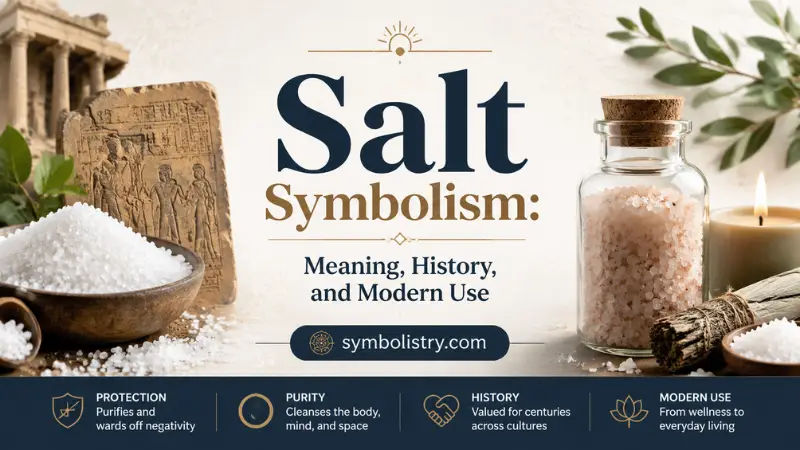
Salt is one of the most ordinary substances in an American kitchen, yet salt symbolism reaches far beyond seasoning food. Its ability to preserve, cleanse, flavor, and remain stable made salt a natural symbol of purity, protection, loyalty, permanence, wisdom, and human worth.
These associations did not come from a single tradition. Religious texts, ancient trade, food preservation, hospitality customs, European folklore, and everyday language all shaped the meanings people attach to salt.
In the United States today, those older ideas remain visible in Christian language, expressions such as “salt of the earth,” superstitions about spilled salt, spiritual cleansing practices, tattoos, jewelry, and even modern slang.
Quick Answer
Salt symbolism most commonly represents purity, preservation, protection, and lasting loyalty in modern American culture. Historically, salt has also symbolized sacred agreements, hospitality, value, wisdom, and spiritual cleansing because it preserved food, was economically important, and appeared in religious rituals.
TL;DR
- Salt represents purity, preservation, protection, and lasting commitment.
- Its preservative quality helped connect salt with permanence and loyalty.
- Biblical traditions associate salt with covenant, goodness, and moral influence.
- Americans still connect spilled salt with bad-luck folklore.
- Modern “salty” slang adds resentment and irritation to salt’s meanings.
- Tattoos and decor often use salt for cleansing or protection themes.
What Salt Is and Why Its Physical Qualities Matter

Most symbolism begins with something people can observe, and salt is a good example.
Common table salt consists primarily of sodium chloride. It appears as small white crystals and has an unmistakably sharp taste. For thousands of years, people have used salt not only to season food but also to preserve meat, fish, vegetables, and other foods.
Before refrigeration, preservation could determine whether a household or community had enough food through winter or during long travel. Salt therefore represented something far more important than flavor. It could help prevent valuable food from spoiling and make supplies easier to transport.
That practical function explains several symbolic associations.
Something that preserves naturally becomes a metaphor for endurance. Something that helps protect food from decay can become associated with purity and resistance to corruption. Something people depend on can come to represent value, necessity, and reliability.
Salt’s symbolic meanings are therefore unusually grounded in its real physical uses.
The Core Meanings of Salt
Although meaning changes by culture and context, several themes appear repeatedly.
| Context | Common Meaning in the USA | Association | Important Note |
| Religious use | Purity and covenant | Faith, devotion, permanence | Especially familiar in biblical imagery |
| Folklore | Protection or luck | Warding off harm | Practices vary by family and tradition |
| Personal symbolism | Preservation | Memory, commitment, endurance | Common in tattoos and symbolic art |
| Everyday language | Integrity and competence | Honesty, usefulness | Seen in “salt of the earth” |
| Modern slang | Resentment | Irritation, bitterness | Seen in the word “salty” |
| Spiritual decor | Cleansing | Boundaries, renewal | Belief-based rather than scientific |
The same substance can therefore express both positive and negative ideas. Salt may represent a person who preserves what matters, but excessive salt can also suggest bitterness, harshness, or emotional irritation.
Why Salt Became a Symbol of Purity and Cleansing
Purification is one of salt’s best-known symbolic roles.
Part of the connection comes from preservation. People observed that salted food resisted certain forms of decay better than untreated food. That visible effect encouraged a metaphorical connection between salt and keeping something free from corruption.
Religious and ceremonial traditions strengthened the association. Salt has appeared in offerings, purification customs, and ritual preparation in several cultures.
In contemporary American spiritual culture, people may place bowls of salt near doors, add salt to ritual baths, or create lines of salt to represent a protective boundary. Similar images also appear frequently in supernatural television, movies, games, and fiction.
These customs should not be treated as one universal tradition. Different religions and folk practices give salt different meanings, and claims that salt literally removes “negative energy” belong to spiritual belief rather than established science.
Symbolically, however, the message is clear: salt creates an imagined division between what should remain and what should be removed.
Preservation Made Salt a Symbol of Permanence
Salt’s role in preserving food produced another major meaning: endurance.
Before mechanical refrigeration became widespread, salting and brining were essential preservation methods. Salt could extend the usefulness of food and support travelers, settlements, armies, and households.
Its historical importance was still obvious in nineteenth-century America. During the Civil War, salt supplies and saltworks were strategically significant because salt was necessary for preserving food. Union forces targeted Confederate salt-producing sites, while shortages affected civilians as well as armies.
That background helps explain why salt can symbolize:
- enduring relationships
- promises meant to last
- preservation of memory
- faithfulness under pressure
- resistance to moral or emotional decay
A salt-themed tattoo dedicated to a deceased relative, for example, may represent the desire to preserve the person’s memory rather than simply protection.
The symbolism comes directly from what salt historically did: it helped keep valuable things from being lost.
Covenant, Loyalty, and Promises That Should Last
Salt also developed strong associations with agreements and loyalty.
In biblical texts, salt appears with offerings, and the expression “covenant of salt” is used for enduring agreements. Leviticus connects salt with offerings, while Numbers describes an everlasting covenant using salt imagery.
The exact cultural background is complex, but the symbolism fits salt’s preservative character. An agreement compared with salt suggests something that should not easily decay or disappear.
Sharing food containing salt could also carry social meaning. Across different societies, eating together has created obligations of hospitality and trust. Salt, as a valued and necessary part of meals, became connected with those relationships.
For modern readers, this gives salt a useful personal meaning: a bond worth keeping.
That is why salt imagery can suit wedding symbolism, friendship gifts, memorial objects, and art about commitment even when the person using it is not referring directly to religion.
Salt in Biblical and Christian Symbolism
For many Americans, the most familiar religious symbolism of salt comes from the Bible.
Salt appears in Hebrew scripture in connection with offerings and covenants. In the New Testament, Jesus tells his followers that they are the “salt of the earth.”
In modern Christian interpretation, the phrase can suggest that believers should have a beneficial influence on the world around them. The metaphor works because salt makes a noticeable difference even when only a small amount is present.
In everyday American English, however, “salt of the earth” has moved beyond a strictly religious setting. It commonly describes someone who is honest, dependable, humble, and genuinely good.
Salt also carries a more severe biblical image.
In the story of Lot, Lot’s wife becomes a pillar of salt after looking back toward Sodom. Because of that story, salt can occasionally suggest judgment, disobedience, consequences, or becoming trapped by the past.
Christian symbolism therefore does not give salt only one meaning. Context determines whether it represents covenant, moral influence, purity, or judgment.
Protection and Spiritual Boundaries
Salt is strongly connected with protection in Western folk culture and modern spiritual imagery.
A line of salt around a doorway, window, room, or person is often imagined as a boundary that harmful forces should not cross. Contemporary paranormal entertainment has made this image especially recognizable to American audiences.
People involved in folk spirituality, modern witchcraft, neopagan practice, or personal ritual may also use salt symbolically when cleansing a room or preparing a protected space.
The underlying logic is simple.
If salt preserves food against decay and has a history of ritual cleansing, it can metaphorically become a material that keeps unwanted influences outside.
For some people, that practice expresses sincere religious or spiritual belief. For others, it is cultural imagery borrowed from folklore and entertainment.
Salt itself should not be presented as scientifically proven protection against supernatural forces. Its importance here lies in the meaning people assign to the act.
Salt in Japanese Purification Traditions
Salt’s cleansing symbolism is not limited to Western religion.
In Japan, salt has an important place in purification customs influenced by Shinto. One of the clearest examples appears in sumo. Before competition, wrestlers may throw salt into the ring as part of ritual purification.
Small arrangements of salt can also appear in particular ceremonial or traditional settings.
For American readers, Japanese salt customs are sometimes grouped too casually with Western ideas about “warding off evil.” That can erase the cultural setting in which the practice developed.
A more accurate comparison is that both traditions may associate salt with cleanliness, boundaries, or preparation, but they do not necessarily share the same religious explanation.
This distinction matters whenever a common object develops similar symbolism independently in different cultures.
What Salt Commonly Means in the United States
American culture inherited salt imagery from several sources at once: Christianity, European folklore, immigration, food traditions, popular language, and modern entertainment.
As a result, Americans are likely to recognize salt in several symbolic roles.
Calling someone the “salt of the earth” praises that person’s honesty and grounded character. Saying a worker is “worth their salt” means the person is capable or competent. Taking a claim “with a grain of salt” means approaching it with skepticism rather than accepting it completely.
These expressions reveal an important shift.
Older symbolism often treated salt as sacred, economically valuable, or ritually significant. Modern American language turns those older associations into descriptions of character, judgment, and credibility.
Salt can therefore symbolize someone who is useful without being flashy: dependable, practical, and necessary.
That interpretation fits particularly well with American ideas of humility and hard work.
Spilled Salt, Bad Luck, and the Left Shoulder
One of the most recognizable salt superstitions says that spilling salt brings bad luck.
A common response is to take a pinch of the spilled salt and throw it over the left shoulder.
Versions of this custom have been documented in American family folklore, although the details vary. Some people specify the left shoulder, some specify which hand should throw the salt, and others simply know that a pinch should be tossed behind them.
The exact origin is harder to establish than popular explanations suggest.
One familiar story links the superstition with Judas and the Last Supper. Leonardo da Vinci’s famous painting includes an overturned salt container near Judas, strengthening the visual association between spilled salt and betrayal. That does not prove the superstition began with the painting.
Another explanation connects spilling salt with waste. When salt was more difficult or costly to obtain, accidentally losing it could easily carry negative associations.
Today, many Americans follow the ritual playfully rather than literally believing disaster will follow.
Salt in this context symbolizes the human desire to reverse an unlucky moment and restore order.
Hospitality, Friendship, and Sharing Food
Salt can also represent welcome and trust.
Its connection with hospitality developed naturally in societies where sharing preserved or seasoned food mattered socially as well as practically. Eating together often signaled that guests had been accepted into a household, at least temporarily.
In some cultures, combinations such as bread and salt became ceremonial signs of welcome.
American hospitality does not usually include a formal salt ritual, but the older idea survives indirectly. Sharing a meal remains one of the simplest symbols of friendship, reconciliation, family connection, and community.
Salt strengthens that symbolism because it represents something ordinary that everyone at the table shares.
This meaning is quieter than supernatural protection or biblical covenant, but it may be one of the most human: salt belongs to the common table.
Value, Work, and the Idea of Being “Worth Your Salt”
Salt’s historic economic importance also shaped language about personal value.
The expression “worth your salt” now describes someone capable of doing their job properly.
A popular explanation claims Roman soldiers were literally paid in salt and that this directly created the English word “salary.” That story should be treated cautiously.
The English word salary ultimately traces through Latin salarium, which is related to salt, but the familiar claim that Roman soldiers simply received salt as their wages is not supported by surviving ancient evidence.
The broader point remains valid: salt was economically and socially important enough to influence language about value.
Symbolically, being “worth your salt” suggests that a person’s contribution is useful, dependable, and earned through competence.
Emotional and Psychological Meanings
Salt works especially well as a psychological symbol because it changes whatever it touches.
A small quantity can sharpen flavor. Too much overwhelms everything else.
That contrast allows salt to represent discernment and balance. Used carefully, it improves. Used excessively, it irritates or dominates.
The physical experience of salt also contributes to emotional symbolism. Salt is associated with tears and sweat, linking it with grief, labor, endurance, physical effort, and survival.
Someone may therefore use salt imagery to represent:
Resilience: continuing despite difficult conditions.
Memory: preserving experiences or relationships.
Grief: tears and the body’s physical expression of loss.
Labor: sweat, effort, and work earned through experience.
Boundaries: deciding what should be allowed into one’s personal space.
These meanings are personal rather than universal, which makes context especially important in tattoos and artwork.
When Salt Symbolizes Bitterness, Irritation, or Conflict
Salt does not always carry a positive meaning.
Modern American slang gives it an especially clear negative association. Someone described as “salty” may be resentful, irritated, or bitter about a situation.
The metaphor makes intuitive sense. Salt can sting a wound, and too much can make food unpleasant.
Natural environments also add harsher associations. Highly saline land or water can appear barren and inhospitable, so salt may symbolize desolation, sterility, hardship, or consequences in literature and visual art.
This is why context matters when interpreting salt imagery.
A bowl of salt beside a candle might suggest purification. An empty salt flat in a photograph may instead communicate loneliness. A character described as salty is probably annoyed rather than spiritually protected.
The object stays the same while the emotional frame changes.
Salt in Tattoos, Jewelry, Decor, and Pop Culture
Salt has become a flexible personal symbol because it can be represented in many simple forms.
A salt tattoo may show crystals, a shaker, a salt cellar, a chemical structure, or the word itself. Depending on the wearer, it may stand for protection, preservation, honesty, resilience, friendship, or a personal connection to the sea and cooking.
Paired designs can change the message. Salt with bread may suggest hospitality. Salt with herbs may emphasize cleansing. Salt with a memorial date may suggest preserving a memory.
In jewelry, salt crystals and salt-inspired designs often lean toward ideas of simplicity, purity, and natural texture.
Home decor sometimes uses salt bowls or decorative salt containers as symbols of cleansing or abundance, particularly within spiritual or folk-inspired interiors.
Popular culture gives salt another role. Supernatural stories frequently depict salt as a barrier against ghosts, demons, or other threatening beings. Repetition across television, games, social media, and movies has made that visual language familiar even to viewers who do not practice any protective ritual themselves.
How Salt’s Meaning Changed Over Time
Salt’s symbolism changed as its practical value changed.
In earlier societies, salt could be difficult to obtain, essential for food preservation, economically valuable, and connected with trade or taxation. Its symbolic importance reflected that reality.
Industrial production and refrigeration transformed daily life. Most Americans can now purchase salt cheaply, while other technologies handle the preservation work that salt once performed on a much larger scale.
Yet the old symbolism did not disappear.
Instead, it migrated into religion, idioms, superstition, personal spirituality, design, entertainment, and slang.
The result is an unusual symbolic history. Salt became less precious as a commodity while remaining highly visible as a metaphor.
Its modern meaning is therefore layered: ancient ideas of preservation and covenant exist beside expressions about honesty, skepticism, irritation, and competence.
Common Misunderstandings About Salt Symbolism
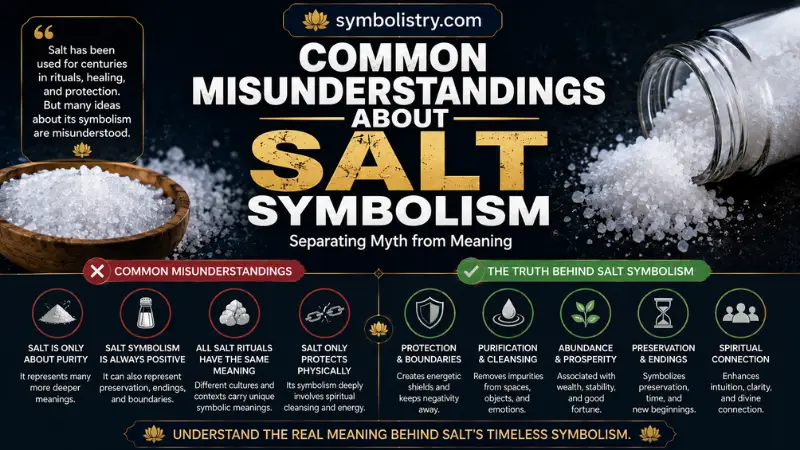
Several popular claims deserve caution.
First, salt does not have one universal spiritual meaning. Purification appears in several traditions, but each tradition has its own history and explanation.
Second, throwing salt over the shoulder does not have one securely documented origin story. Linking every version directly to Judas, the devil, or one ancient civilization oversimplifies a long and changing body of folklore.
Third, the idea that Roman soldiers were straightforwardly “paid in salt” should not be repeated as settled fact. The connection between salary and Latin terminology related to salt is real; the famous payment story is much less certain.
Finally, symbolic cleansing should be distinguished from medical or scientific claims. Salt has real chemical and culinary properties, but those properties do not scientifically prove claims about removing curses, spirits, or negative energy.
Treating folklore as folklore does not make it less interesting. It makes the history more accurate.
FAQs
Is salt a positive symbol?
Usually, yes. Salt commonly represents purity, preservation, loyalty, protection, usefulness, and honesty. However, context can also connect it with bitterness, bad luck, judgment, barrenness, or resentment.
What does salt symbolize spiritually?
In many spiritual settings, salt represents cleansing, protection, boundaries, and preparation of sacred space. Specific practices differ across religions and folk traditions, so no single spiritual interpretation applies everywhere.
What does salt mean in a tattoo?
A salt tattoo may symbolize protection, endurance, preserved memories, honesty, loyalty, or resilience. Personal context matters because there is no standardized tattoo meaning for salt.
Why does spilled salt mean bad luck?
Spilled salt has been treated as unlucky in Western folklore for generations, possibly because salt was once valuable and because religious imagery strengthened negative associations with spilling it. The exact historical origin remains uncertain, even though throwing a pinch over the shoulder became a familiar response.
What does salt symbolize in Christianity?
Christian symbolism connects salt with moral influence, covenant, faithfulness, and goodness. The phrase “salt of the earth” comes from Jesus’ teaching in Matthew and later became a common description of honest, dependable people.
Does salt symbolize protection from evil?
Some religious, folk, and modern spiritual practices use salt as a symbolic protective boundary. That meaning is culturally important, but supernatural protection is a matter of belief rather than a scientifically demonstrated property of salt.
What does calling someone “salty” mean today?
In contemporary American slang, salty usually means annoyed, resentful, or bitter about something. This modern use gives salt a very different emotional meaning from older associations with purity and preservation.
Conclusion
Salt symbolism centers most strongly on purity, preservation, protection, loyalty, and enduring value. Those meanings developed from salt’s practical role in preserving food, its place in religious ritual and covenant language, and its importance in everyday life.
American culture has kept those older associations while adding new ones. Salt can describe an honest “salt of the earth” person, protect a doorway in folklore, represent preserved memories in a tattoo, warn against bad luck when spilled, or describe someone feeling “salty” after a disappointment.
Few symbols show so clearly how an ordinary household object can accumulate meaning. Salt became symbolic not because it was mysterious, but because for much of human history it was useful, necessary, shared, and difficult to replace.