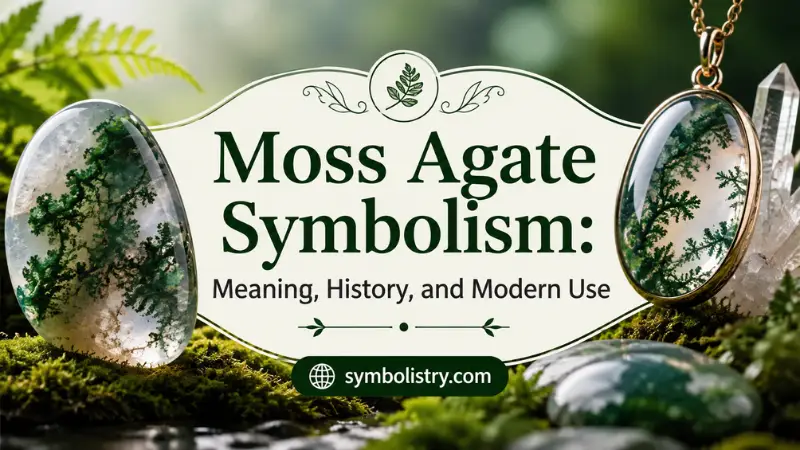
Moss agate is a translucent stone filled with branching, cloudlike, or leafy mineral patterns that can resemble tiny forests trapped beneath glass. Moss agate symbolism centers today on growth, renewal, stability, and a close relationship with the natural world. The moss agate meaning people recognize today is largely influenced by the stone’s natural appearance and its connection with landscapes, plants, and gradual transformation.
Its appeal is partly visual. Each stone has different inclusions, so one piece may suggest moss-covered ground while another looks like tree branches, seaweed, mist, or a distant landscape. Those natural patterns have encouraged people to connect the stone with patience, gradual change, individuality, and new beginnings. These visual qualities are a major reason why Moss Agate Symbolism is often linked with personal growth and nature-inspired meanings.
Moss agate also has a more complicated history than many modern descriptions suggest. Agate has been used in jewelry and amulets for thousands of years, while many specific spiritual claims now attached to moss agate belong to later European folklore and contemporary crystal culture rather than a single ancient tradition. Understanding the history helps separate traditional agate meanings from modern moss agate symbolism.
Quick Answer
Moss agate symbolism commonly represents growth, renewal, grounding, abundance, and connection with nature in modern American culture. Its meanings come largely from its plantlike mineral patterns, while older agate traditions also connected ornamental stones with protection, good fortune, and personal significance.
TL;DR
- Moss agate commonly represents growth, renewal, patience, and nature.
- Moss agate symbolism focuses on hidden beauty and natural transformation.
- Its patterns are minerals, not actual moss or plant material.
- Older agate traditions included jewelry, amulets, and protective objects.
- Americans often associate it with individuality and outdoor lifestyles.
- It has become popular in nature-inspired alternative engagement rings.
- Crystal-healing claims should be understood as beliefs, not medical facts.
What Moss Agate Looks Like and What It Really Is
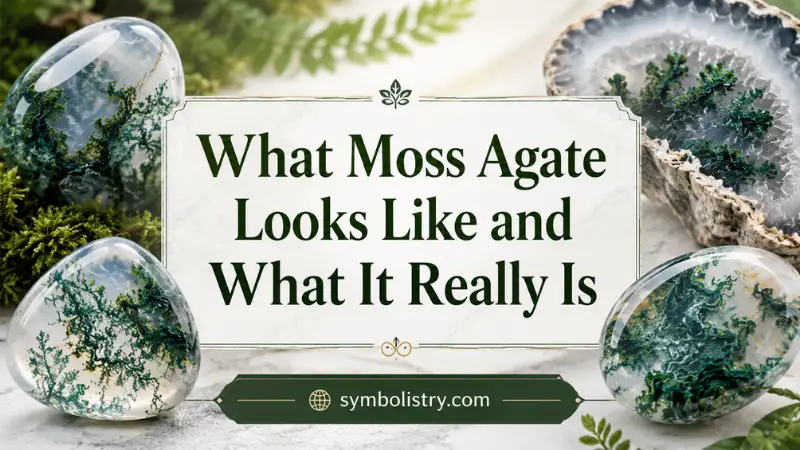
Moss agate usually has a clear, white, grayish, or milky base crossed by irregular green, black, brown, or reddish formations. The markings may look like ferns, moss, roots, branches, clouds, or miniature landscapes.
Despite the name, there is no moss growing inside the stone. Moss agate is a form of chalcedony, a fine-grained quartz material. Its mosslike structures are created by mineral inclusions. Different specimens can contain materials such as chlorite and other minerals, while some American varieties display dark manganese-rich or reddish iron-rich markings.
There is also a technical naming issue. Classic agate is usually defined by visible banding, but many stones sold as moss agate do not have those bands. In strict mineralogical terms, some specimens are better described as included chalcedony. In jewelry and lapidary use, however, “moss agate” is the familiar established name.
This distinction matters because the stone’s symbolism comes from appearance rather than biological content. People are responding to mineral structures that happen to resemble living landscapes.
The Core Meanings People Attach to Moss Agate
The meanings most frequently associated with the stone today are growth, renewal, stability, abundance, patience, and connection with nature. These ideas form the foundation of modern Moss Agate Symbolism and explain why the gemstone remains popular in jewelry and personal collections.
Growth is the strongest theme. The green branching inclusions look as though something living is developing inside the stone. That makes it an intuitive symbol for a person beginning a new phase of life, developing a skill, rebuilding after difficulty, or working slowly toward a goal.
Renewal follows naturally. Green plant imagery suggests returning vegetation, fresh leaves, spring landscapes, and ecosystems recovering after winter. For many people, moss agate symbolism reflects the idea of starting again and creating positive change gradually.
Grounding has a slightly different meaning. In contemporary spiritual language, being grounded means feeling steady, present, and connected to everyday reality. Moss agate’s earthy colors and landscape-like patterns make it a popular visual reminder of balance and stability.
Abundance is also widely attached to the stone in contemporary crystal traditions. The concept usually refers not only to money but also to productive work, healthy relationships, opportunity, and the feeling that something is steadily developing.
Why the Stone Became a Symbol of Growth and Renewal
The connection between moss agate and plant growth does not require an elaborate legend. Much of it comes directly from visual resemblance.
Humans regularly interpret unfamiliar patterns by comparing them with familiar objects. In moss agate, branching mineral structures can easily suggest forests, leaves, algae, roots, or moss-covered stone. Because those images belong to living ecosystems, the gem became a convenient symbol of life continuing and expanding.
Its symbolism also emphasizes slow growth rather than sudden transformation. Moss itself develops gradually across stone, soil, and fallen wood. In the same way, the gem is often chosen to represent progress built through persistence.
That makes it especially suitable for milestones that do not happen overnight: establishing a career, strengthening a relationship, recovering confidence, creating a home, or beginning a long-term personal project.
The stone’s individuality reinforces this theme. Two pieces rarely display the same internal scene. Modern wearers may therefore use it to communicate the idea that personal development does not need to follow one fixed pattern.
Agate’s Older History in Jewelry, Amulets, and Protection
Agate has a much older documented history than the modern spiritual language surrounding moss agate.
Archaeological collections contain agate beads, carved objects, seals, and amulets from ancient West Asia. In Mesopotamia, naturally patterned agates were shaped into beads and other meaningful objects thousands of years ago. Surviving examples include agate amulets from the third millennium BCE and later jewelry made with agate and related chalcedony materials.
It is important, however, not to transfer every ancient belief about agate directly onto moss agate. Ancient objects were often made from banded, eye-patterned, reddish, or other agate varieties. Evidence that people recognized the modern commercial category of moss agate in exactly the same way is far weaker.
What the historical record does show is that patterned stones could carry meanings beyond decoration. They were worn, carved, dedicated, or treated as protective objects because material beauty, rarity, religious belief, and social identity often overlapped.
Modern moss agate lore partly inherits this larger history of meaningful ornamental stones.
From “Mocha Stone” to European Decorative Art
Moss agate has also been called Mocha stone, a traditional name associated with Mocha, the historic Red Sea port in present-day Yemen. Accounts commonly connect the term with the gemstone trade through that region, although the exact early history of the name is less certain than many commercial descriptions imply. These historical connections add another layer to Moss Agate Symbolism, showing how trade, craftsmanship, and natural beauty influenced the way people viewed patterned stones.
By the early modern and modern European periods, moss agate had become valued as an ornamental hardstone. Craftspeople used agate and chalcedony in jewelry, boxes, handles, vessels, and other decorative objects. The detailed patterns inside these stones helped create a connection between artistic expression and the natural world, which continues to influence moss agate symbolism today.
A surviving British Museum object, for example, incorporates a moss-agate bowl into an elaborate nineteenth-century gold-mounted spoon. Gemological historical research also documents moss agate in European hardstone work associated with luxury decorative arts.
This period helped shift moss agate from a geological curiosity into a material appreciated for the pictures suggested by its natural inclusions. Instead of seeking perfectly uniform color, cutters could use each stone’s unusual internal scenery as part of the design. This appreciation for unique natural patterns remains an important part of Moss Agate Symbolism, especially the themes of individuality, growth, and connection with nature.
What Moss Agate Commonly Means in the United States
In the United States, the stone is usually understood through nature, personal growth, individuality, and alternative spirituality rather than through one fixed religious or national tradition.
Nature is the clearest association. Jewelry featuring moss agate often appeals to hikers, gardeners, plant enthusiasts, rock collectors, and people drawn to woodland or botanical design.
Personal growth is another common interpretation. A pendant or ring may mark graduation, a career change, recovery from a difficult period, moving to a new home, or another stage that involves gradual development.
The gemstone also fits a broader American interest in personalized jewelry. Because the inclusions differ dramatically from stone to stone, buyers can choose a specimen that feels individual rather than standardized.
| Context | Meaning in the USA | Common Associations | Notes |
| Everyday jewelry | Growth and individuality | Nature, change, personal style | Each stone has unique patterns |
| Engagement rings | Growing partnership | Commitment, nature, originality | Popular as a diamond alternative |
| Crystal practice | Grounding and abundance | Calm, intention, renewal | Spiritual belief, not medical treatment |
| Home decor | Connection with nature | Plants, earth tones, organic design | Often displayed as polished stones |
| Personal milestones | New beginnings | Career, moving, recovery, goals | Meaning is usually chosen by the owner |
Montana Moss Agate and the American Landscape
Moss agate has a particularly recognizable American expression in material known as Montana moss agate.
It occurs in the Yellowstone River region and is typically transparent or translucent chalcedony with dark branching or mosslike inclusions. Many examples are clearer or more neutral in color than the strongly green material commonly seen in commercial jewelry. Black markings are often associated with manganese minerals, while reddish and brown areas can reflect iron compounds.
For American collectors, this gives the stone another layer of meaning: place.
A Montana specimen can serve as a reminder of Western landscapes, rivers, geology, rockhounding, and the enormous time scales involved in natural formation. Its symbolism is therefore not limited to spiritual belief. It can simply express attachment to land, travel, geology, or regional identity.
This distinction is useful. Someone can value moss agate as a meaningful natural object without believing that it possesses supernatural properties.
Emotional Symbolism: Patience, Stability, and Personal Growth
Emotionally, moss agate is often used to communicate a quiet kind of resilience.
It is not usually associated with dramatic victory or aggressive strength. Its visual language is slower: roots spreading, moss growing, forests developing, landscapes changing season by season.
For that reason, patience is one of its most fitting emotional meanings.
Someone might choose the stone during a period when progress exists but is difficult to notice from day to day. The jewelry becomes a physical reminder that meaningful change can accumulate gradually.
Stability is related but different. Clear chalcedony surrounding branching inclusions can visually suggest something delicate held securely inside stone. Modern wearers may interpret this as remaining centered while life continues to change.
These associations are psychological metaphors rather than properties demonstrated by gemology. Their value comes from what the object reminds its owner to think about or practice.
Abundance, Work, and New Beginnings
Moss agate is frequently called a stone of abundance in modern crystal culture.
That description is sometimes reduced to promises about attracting money, but its symbolic meaning is broader and more useful when understood as cultivation.
A garden produces results because someone prepares the soil, plants, waits, adjusts, and continues caring for it. The same model can be applied metaphorically to work, education, business, creativity, or relationships.
In that sense, moss agate represents abundance earned through steady development rather than instant luck.
This interpretation also explains why it is often connected with new beginnings. Starting something does not guarantee success; it creates the opportunity for growth. A moss agate gift can therefore mark a new job, business venture, move, graduation, creative project, or another beginning that will require time and attention.
Love, Partnership, and Alternative Engagement Rings
Moss agate has become particularly visible in alternative engagement jewelry.
Couples who choose it are often attracted to its organic patterns and the fact that every center stone looks different. Contemporary jewelry guides describe it as an unconventional alternative for buyers who want a ring associated with nature, individuality, friendship, and a relationship that continues to grow.
Symbolically, its strongest relationship meaning is not intense passion. It is development together.
The branching inclusions can represent two lives continuing to change while becoming part of a shared future. Growth, trust, friendship, and adaptability therefore fit moss agate more naturally than ideas of perfection.
There is also a practical side. Chalcedony is reasonably durable, but moss agate is not as resistant to scratching and impact as diamond or sapphire. Stones cut thin to highlight their inclusions may have vulnerable edges, so protective settings and sensible care are useful for rings worn every day.
Spiritual Meanings in Contemporary Crystal Culture
Modern crystal communities have expanded Moss Agate Symbolism and its symbolic vocabulary considerably. Today, many people connect the stone with themes of grounding, renewal, personal growth, and a closer relationship with the natural world.
Common beliefs connect moss agate symbolism with the Earth element, grounding, prosperity, emotional balance, the heart chakra, gardening, fertility, friendship, and fresh starts. Different books, sellers, and practitioners may assign somewhat different meanings, showing that Moss Agate Symbolism continues to develop through personal beliefs and modern spiritual practices.
These associations should be described as spiritual traditions or personal practices, not established physical effects. The meanings connected with moss agate symbolism are based on cultural interpretations, visual qualities, and individual experiences rather than proven scientific properties.
A person may carry the stone during meditation, place it near plants, wear it while setting a personal goal, or keep it on a desk as a reminder to remain patient. These practices are often connected with Moss Agate Symbolism because the stone serves as a personal reminder of balance, growth, and intention. Those practices can have personal or ritual meaning without requiring the gemstone itself to produce measurable biological changes.
Claims that crystals can independently treat anxiety, illness, hormonal problems, pain, or other medical conditions go beyond symbolism. A 2025 placebo-controlled study of healing crystals and anxiety found no specific anxiety-reducing effect beyond placebo responses.
The distinction allows cultural and spiritual practices to be discussed respectfully without presenting them as medical science. Understanding moss agate symbolism in this way helps separate personal meaning, traditional beliefs, and scientific evidence.
Cross-Cultural Context: Agate Beyond Modern Crystal Lore
Moss agate does not have one universal cross-cultural meaning. The interpretation of Moss Agate Symbolism changes depending on the culture, historical period, and the way people understand natural stones.
Much older traditions involve agate as a larger gemstone family, and those meanings vary considerably between places and periods. While modern moss agate symbolism often focuses on growth, renewal, and nature, older agate traditions developed around protection, decoration, spirituality, and personal significance.
In ancient Mesopotamia, patterned agates appeared in beads, carved amulets, and objects connected with religious dedication. In later Islamic cultures, agate could also appear in explicitly religious talismans. These historical uses influenced some modern interpretations of Moss Agate Symbolism, especially ideas related to protection and meaningful objects. Museum examples from Iran include agate pieces inscribed with Qur’anic verses and sacred names and worn for protection.
These traditions should not be flattened into a claim that all cultures believed moss agate meant growth or prosperity. Doing so would combine separate stones, religions, and historical periods into a modern story they did not necessarily share. A careful understanding of moss agate symbolism recognizes that meanings develop through different cultural experiences.
What can safely be said is that agate has repeatedly served as more than decoration. Its natural patterns, durability, and ability to take a polish made it suitable for objects that carried personal, religious, protective, or social significance. This broader history helps explain why Moss Agate Symbolism continues to include themes of individuality, connection, and personal meaning today.
Jewelry, Decor, and Personal Style
Today moss agate appears in rings, earrings, pendants, bracelets, beads, carvings, polished free-form stones, spheres, and small decorative objects.
Cabochon cuts are especially effective because a broad polished surface reveals the inclusions. Faceted and rose-cut stones are also used when designers want additional sparkle while keeping the internal pattern visible.
In home decor, polished specimens are often paired with wood, houseplants, earth-toned interiors, and other natural materials. Their role may be spiritual, decorative, geological, or all three.
Some people also translate the stone’s branching imagery into tattoo concepts. Instead of tattooing a literal gemstone, a design may combine crystal outlines with leaves, roots, mountains, or dendritic patterns to represent growth and a connection to the natural world.
On social media and in handmade jewelry, the stone also works well visually because buyers can choose pieces for their distinctive internal “scenes.” A specimen that resembles a forest may carry a different personal association from one that resembles mist, coral, or a winter tree.
Common Misunderstandings and Unsupported Claims
Several recurring claims about moss agate deserve clarification.
It does not contain real moss. The plantlike forms are mineral inclusions inside chalcedony.
Not every ancient agate belief belongs to moss agate. Agate has an extensive archaeological history, but that does not prove every modern moss agate meaning originated in antiquity.
Its symbolism is not universal. Growth and grounding are widespread contemporary associations, but individuals and cultures can interpret the stone differently.
Spiritual meanings are not scientific properties. A person can use moss agate as a meaningful ritual object, meditation aid, or personal reminder, but claims that it cures medical conditions require evidence that crystal traditions have not established.
Its value does not depend on flawless clarity. In many gemstones, inclusions reduce desirability. In moss agate, the inclusions are the feature that creates the stone’s character.
Keeping these distinctions clear actually makes the symbolism more interesting because it separates geology, documented history, folklore, and personal interpretation instead of treating them as the same thing.
How the Meaning Has Changed Over Time
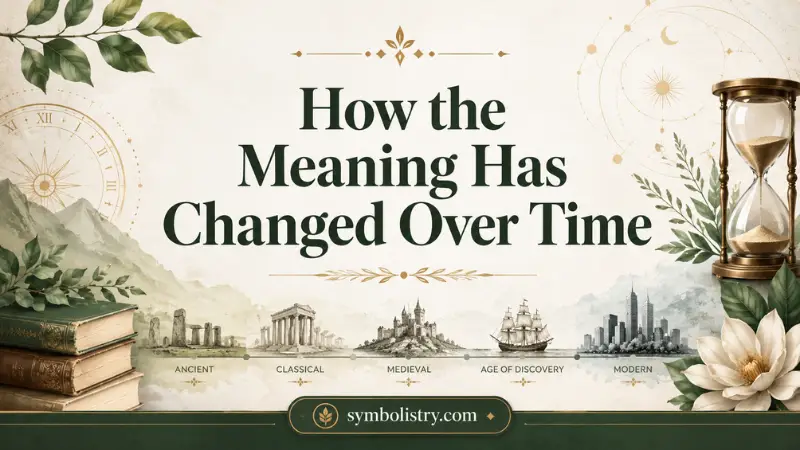
The meaning of moss agate has developed in layers. Moss Agate Symbolism today reflects a combination of geological beauty, historical use, cultural traditions, and modern personal interpretations.
The oldest layer belongs to the much broader history of agate. Ancient communities used agate for jewelry, beads, carved objects, and amulets. The stone could therefore carry social, religious, decorative, or protective importance. These early uses helped shape some ideas later connected with moss agate symbolism, especially themes of protection, value, and personal significance.
Later European interest placed greater emphasis on patterned hardstones as decorative materials. Mosslike inclusions became desirable because they created natural pictures within polished stone. This visual connection with landscapes and organic forms became an important part of Moss Agate Symbolism, especially meanings related to nature, individuality, and renewal.
By the eighteenth and nineteenth centuries, moss agate could appear in luxury objects and jewelry as both a curiosity and an ornamental material. These developments helped transform the stone from a decorative object into a gemstone associated with personal expression and the evolving meanings of moss agate symbolism.
Modern interpretation adds another layer. Nature-centered lifestyles, personalized jewelry, crystal spirituality, botanical design, and alternative engagement rings have made growth and renewal especially prominent meanings.
The result is not one ancient message preserved unchanged. It is an evolving symbolic tradition shaped by geology, visual resemblance, trade, craftsmanship, spiritual practice, and modern personal expression.
FAQs
What does moss agate symbolize spiritually?
Spiritually, moss agate is commonly associated with grounding, renewal, abundance, emotional balance, and connection with nature. These meanings belong to modern metaphysical traditions and personal belief rather than scientifically demonstrated properties.
Is moss agate a lucky stone?
Some European and modern crystal traditions treat moss agate as a symbol of good fortune, prosperity, and successful growth. People may wear it as a lucky object, but there is no scientific basis for claiming that the stone changes probability or guarantees financial success.
What does moss agate mean in love?
In relationships, it commonly represents growth, friendship, stability, patience, and building a life together. Those meanings have helped make moss agate appealing for unconventional engagement rings and anniversary jewelry.
Is moss agate connected to nature?
Yes. Its connection with nature is primarily visual because its mineral inclusions resemble moss, roots, foliage, forests, and other organic forms. This resemblance has made it especially meaningful to gardeners, hikers, plant lovers, and people who identify strongly with outdoor environments.
Does moss agate contain actual moss?
No. The stone contains mineral inclusions rather than preserved plants. Its “moss” appearance comes from natural mineral structures inside chalcedony.
What does a moss agate engagement ring symbolize?
It can symbolize a relationship that grows and changes over time while remaining rooted in trust and companionship. Couples also choose it for individuality because the natural pattern of every stone is different.
Conclusion
Moss agate stands out because nature seems to have drawn a landscape inside the stone. Its branches, clouds, and plantlike forms make growth, patience, renewal, individuality, and connection with the natural world intuitive modern meanings rather than arbitrary labels.
he historical picture adds important context. Agate has an ancient history in jewelry and amulets, while moss-patterned varieties later became valued in decorative art and eventually absorbed newer associations from crystal culture, nature-centered design, and personalized jewelry. These developments helped shape modern moss agate symbolism by connecting the stone with personal meaning, natural beauty, and evolving cultural interpretations.
Over time, Moss Agate Symbolism has expanded beyond simple decoration. The stone’s unique patterns, historical uses, and connection with natural landscapes have influenced how people understand its meanings today. Modern interpretations often combine older ideas about meaningful stones with newer views of growth, individuality, and renewal.
Today, moss agate symbolism works best as a language of gradual development: becoming stronger, beginning again, building something carefully, and recognizing that meaningful change rarely happens all at once. For many people, Moss Agate Symbolism represents patience, steady progress, and appreciation for the small steps that create lasting transformation.
[…] phrase “June bug” is a common American name applied to several scarab beetles. Its current symbolic meaning is largely built from modern observation of the insect, seasonal memories, personal interpretation, and borrowed associations […]