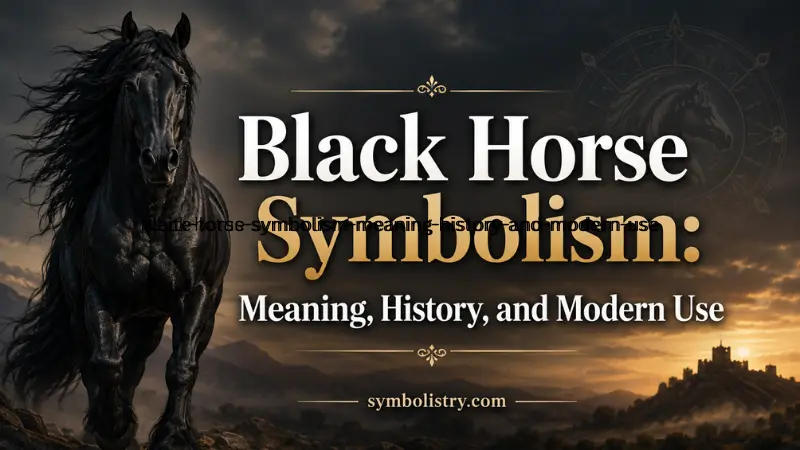
Black horse symbolism brings together two visual ideas that already carry strong associations in American culture: the horse as an image of movement, independence, strength, and untamed life, and black as a color associated with seriousness, elegance, mourning, darkness, and the unknown. Put together, they create a symbol that can feel commanding, free, protective, solemn, or threatening depending on the setting.
A real black horse does not carry a fixed symbolic message, of course. Black is simply one of the base coat colors found in domestic horses, produced through the way genes regulate black pigment across the coat. The symbolism comes from the stories, religions, artworks, films, and cultural traditions that people have attached to the image.
For modern Americans, a black horse may suggest independence and confidence in one context, danger or scarcity in another, and elegance or personal transformation in another. Understanding those differences matters because there has never been one universal interpretation.
Quick Answer
Black horse symbolism commonly represents strength, independence, mystery, determination, and controlled intensity in modern American culture. Historically, the image has also carried darker associations, including scarcity in the biblical Book of Revelation and supernatural or unsettling meanings in some European folklore.
TL;DR
- Black horses commonly suggest strength, independence, mystery, and determination.
- Biblical imagery connects a black horse with scarcity and economic hardship.
- European traditions sometimes gave horses darker supernatural associations.
- American culture often emphasizes freedom, wildness, speed, and individuality.
- Tattoos usually personalize the symbol rather than follow one fixed tradition.
- Black does not automatically make the horse a symbol of death.
What a Black Horse Actually Is
Before interpreting the image, it helps to separate biology from symbolism.
Black is one of the basic coat colors of domestic horses. A genetically black horse produces black pigment and distributes that pigment broadly across its body rather than restricting it mainly to areas such as the mane, tail, and legs. Coat-color genetics can become more complicated when dilution genes and other color traits are involved.
Visually, however, a horse with a dark coat can appear striking because its shape and movement are sharply defined. A black mane, muscular silhouette, and dark body can create an imposing image, particularly in photography, film, tattoos, and illustrations.
That appearance helps explain why artists often use black horses when they want the animal to look dramatic, independent, elegant, intimidating, or difficult to control.
What a Black Horse Commonly Means in the United States
There is no official American meaning assigned to a black horse. Its modern symbolism usually develops from broader associations Americans already have with horses and with the color black.
Common interpretations include:
| Context | Common U.S. Meaning | Associations | Important Note |
| Personal symbolism | Independence | freedom, individuality | Usually positive |
| Tattoos | Strength and resilience | endurance, confidence | Meaning varies by wearer |
| Western imagery | Untamed freedom | open land, speed, rebellion | Influenced by cowboy culture |
| Dark artwork | Mystery or danger | night, uncertainty, tension | Not necessarily evil |
| Religious imagery | Scarcity | famine, high food costs | Comes mainly from Revelation |
| Fashion and decor | Elegance | sophistication, authority | Driven by modern aesthetics |
The horse itself contributes ideas of movement, physical ability, work, travel, warfare, and human partnership. Historically, horses also conveyed rank and status in societies where ownership was expensive. Ancient Greek horse imagery, for example, was closely connected with elite status, warfare, racing, and religious offerings.
Why the Color Black Changes the Meaning
A horse alone often suggests movement, freedom, endurance, or physical strength. Making the horse black changes the emotional tone.
In Western culture, black has long been associated with mourning. Nineteenth-century American and European mourning customs made extensive use of black clothing, eventually creating elaborate social rules around mourning dress.
Black later developed other fashionable associations. During the twentieth century, designers helped establish black clothing as chic, modern, versatile, and sophisticated rather than exclusively mournful.
Those contrasting associations carry over to animal imagery. A black horse can therefore look solemn and ominous in one scene yet refined and majestic in another.
Context determines which interpretation dominates.
Strength, Independence, and Self-Control
One of the most common positive interpretations is personal strength.
Horses are large, fast animals that humans have depended upon for transportation, agriculture, warfare, ranching, competition, and recreation. Their physical capabilities naturally support associations with endurance and action. The Library of Congress documents horses performing numerous roles in American history, from open-range work and farming to military service, racing, and recreation.
A dark horse standing calmly can communicate controlled strength rather than aggression. A running black horse may suggest release from restriction. A rearing horse can imply resistance, challenge, or refusal to submit.
That is why the image often appeals to people who identify with independence but do not necessarily want the softer associations of gentleness or companionship that other horse imagery can emphasize.
Mystery and the Unknown
The black horse also works naturally as an image of uncertainty.
Much of this interpretation comes from visual contrast rather than from one ancient tradition. Dark colors conceal detail. A black animal emerging from shadow, fog, or nighttime scenery appears less immediately readable than the same animal in bright daylight.
Artists and filmmakers can use that effect to create suspense.
In personal symbolism, however, “mystery” does not have to mean danger. It can represent privacy, an unexplored future, independence from other people’s expectations, or aspects of personality that are deliberately kept private.
This interpretation is especially common when the horse is shown alone rather than ridden or restrained.
Ancient Horses Represented Status, Mobility, and Power
It would be misleading to claim that all ancient civilizations shared one specific meaning for a black horse. They did not.
What can be traced historically is the importance of the horse itself.
In ancient Greece, horses appeared prominently in warfare, competitive racing, aristocratic life, religious offerings, and art. Ownership was associated with status because maintaining horses required resources.
Elsewhere, mounted figures could communicate political, military, economic, or spiritual authority. Horses also became culturally important across large regions of Eurasia because they increased human mobility and transformed communication and warfare.
The historical foundation of the modern symbol, therefore, is less “ancient people believed black horses meant one thing” and more “horses already represented mobility, wealth, warfare, and status, while later color traditions altered how individual horses were interpreted.”
The Black Horse in the Bible
The clearest specific historical tradition involving a black horse appears in the Christian Book of Revelation.
In Revelation 6, the third horseman appears on a black horse and carries scales. The surrounding passage describes grain being sold at unusually costly rates, which has traditionally connected this horseman with famine, scarcity, and severe economic hardship.
A frequent modern mistake is to say that the biblical black horse directly represents Death.
It does not.
In the Revelation sequence, Death rides the pale or pale-green horse that follows. The black horse belongs to the preceding vision involving scales, food prices, and scarcity.
That distinction matters because modern artwork sometimes blends the Four Horsemen together and gives every dark-colored horse an automatic association with death.
European Folklore Gave Horses a Darker Side
European traditions did not always treat horses as noble or heroic.
Germanic folklore, for example, sometimes connected horses with threatening supernatural forces and witchcraft. Historical European art therefore preserves both sides of the animal’s reputation: the prestigious mount of rulers and warriors on one hand, and a creature capable of unsettling supernatural associations on the other.
These traditions helped later storytellers use dark horses in gothic fiction, fantasy, horror, and supernatural imagery.
Still, it is inaccurate to turn scattered folklore into a rule that “black horses mean evil.” Horse folklore varies considerably by period and region, and the animal’s color was not always the central feature.
The broader idea of a dark horse appearing at night or carrying a threatening rider is more culturally widespread than one universal black-horse doctrine.
Native American Horse Traditions Require Cultural Care
Claims about “the Native American meaning of a black horse” should be treated cautiously.
There is no single Native American religion or symbolic code. Indigenous nations developed distinct languages, ceremonies, stories, artistic systems, and relationships with horses.
After horses became widely integrated into the lives of many Plains peoples, they transformed travel, hunting, trade, warfare, wealth, and ceremonial practices. The National Museum of the American Indian describes spiritual relationships in which horses could be treated as valued relatives and associated with beauty, energy, healing, and connections to the spiritual world.
Horses also became essential partners in warfare and defense as Native nations faced increasing conflict with settlers and the U.S. military.
However, that history should not be converted into a universal claim that every tribe assigned the same spiritual meaning to a black horse. Specific color meanings need to be connected to a particular nation and tradition rather than generalized across Indigenous cultures.
Black Horses in the American West
American horse symbolism was strongly shaped by the West.
Horses were central to ranching, transportation, military life, Native communities, cattle work, and settlement. Over time, popular culture transformed the working cowboy into one of the most recognizable symbols of the American West, even though the romantic stereotype often simplified the actual multicultural and difficult history of western labor.
Within that imagery, the horse came to suggest mobility and self-reliance.
A black horse adds a more dramatic character. In Western-style posters, fiction, tattoos, and photography, it may represent a rider who operates outside ordinary expectations or an animal that remains difficult to possess completely.
That interpretation owes more to American storytelling than to a formal historical symbolic system.
How The Black Stallion Shaped Modern Imagery
American literature and film also reinforced the idea of the black horse as extraordinary, wild, fast, and difficult to tame.
Walter Farley’s 1941 novel The Black Stallion became the basis for the acclaimed 1979 film. The story centers on a boy’s relationship with a striking black stallion whose speed, temperament, and independence set him apart from ordinary horses.
The film became significant enough to enter the Library of Congress’s National Film Registry and helped maintain the black stallion as a recognizable American cultural image.
For many modern viewers, this kind of storytelling influences symbolism as much as mythology does.
A black stallion can therefore imply exceptional ability, wildness, loyalty earned through trust, and freedom that cannot simply be forced into submission.
Emotional and Psychological Associations
Symbolic interpretations are not psychological diagnoses. Seeing, drawing, wearing, or dreaming about a black horse does not scientifically reveal a hidden personality trait.
Still, people often choose symbols because of the emotions they communicate.
A black horse may visually suggest:
- Confidence when standing upright and alert
- Determination when running toward a destination
- Defiance when rearing or resisting restraint
- Privacy when partly hidden in shadow
- Grief when used in memorial artwork
- Transition when shown traveling through changing scenery
- Control when calm despite obvious physical strength
The exact composition matters.
A relaxed black horse in an open field produces a different emotional message from a black horse carrying an apocalyptic rider.
Black Horse Tattoo Meaning
Black horse tattoos are usually personal rather than strictly traditional.
A running horse may represent freedom after a restrictive period. Someone who has survived a major life change may use the horse to represent endurance and forward movement. A riderless horse can emphasize independence, while a horse with a rider may communicate partnership, discipline, or a shared journey.
Other designs change the message further.
A black horse with flowers can soften the image and suggest growth or remembrance. A horse combined with mountains may emphasize adventure and open space. Flames can imply intensity or rebellion, while wings push the design toward mythic or spiritual themes.
Religious designs may reference the black horse of Revelation, in which case scarcity, judgment, and instability become more relevant than personal freedom.
For tattoos, the strongest interpretation usually comes from the surrounding imagery and the wearer’s intention rather than the horse’s color alone.
Black Horses in Art, Fashion, and Decor
Modern design frequently uses the black horse because its silhouette is visually clean and recognizable.
In wall art, the animal can suit Western, rustic, minimalist, equestrian, or luxury interiors. A photographic black horse against a plain background often communicates sophistication because it combines the horse’s physical form with the modern fashion associations of black.
Jewelry and accessories use similar ideas. Horse-head pendants, horseshoes, equestrian motifs, and dark metal finishes can suggest strength, movement, or an equestrian identity without implying anything supernatural.
On social media, dramatic photography has expanded this aesthetic. Black horses photographed against snow, fog, sunset light, or pale landscapes create sharp visual contrast, encouraging contemporary associations with confidence, elegance, solitude, and cinematic drama.
These uses show how far the symbol has moved beyond older religious or folkloric interpretations.
Is a Black Horse a Positive or Negative Symbol?
It can be either.
Positive interpretations include:
- independence
- endurance
- courage
- confidence
- sophistication
- freedom
- determination
More troubling interpretations include:
- scarcity
- uncertainty
- mourning
- danger
- fear
- approaching conflict
Neither group is automatically correct.
The surrounding story determines the meaning. A running stallion in Western artwork is more likely to communicate freedom than famine. A black horse depicted beside scales in apocalyptic religious art carries a very different message because the biblical context changes the interpretation.
The image is best understood as context-dependent rather than inherently good or bad.
Common Misunderstandings About the Symbol
Several claims about black horses are repeated online without enough historical distinction.
The first is that a black horse universally represents death. The biblical example often used to support that claim actually distinguishes the black horse from the pale horse ridden by Death.
Another misconception is that every culture viewed black horses as supernatural. Historical horse symbolism is far more varied. Horses could represent status, warfare, racing, companionship, spiritual relationships, mobility, agricultural work, and prestige.
A third problem is the tendency to present modern tattoo interpretations as ancient beliefs. Meanings such as “personal transformation” or “independent spirit” may be perfectly valid contemporary interpretations, but they should not automatically be described as traditions thousands of years old.
Separating historical evidence from modern personal symbolism makes the image more interesting, not less.
How the Meaning Has Changed Over Time
The black horse did not begin with one meaning and then slowly evolve into another.
Instead, several traditions accumulated.
Ancient societies supplied the broader associations of horses with wealth, mobility, warfare, prestige, and competition. Christian scripture provided one of the clearest black-horse images through Revelation and its connection with scarcity. European folklore introduced additional supernatural and unsettling associations with horses.
American culture then placed the horse within Western history, cowboy mythology, racing, recreation, literature, and film.
Modern fashion and design added another layer by making black a color of sophistication and minimalist elegance rather than only mourning.
Today’s image is therefore a combination of inherited traditions and modern visual culture.
FAQs
What does seeing a black horse symbolize?
In symbolic art or storytelling, seeing a black horse can suggest independence, strength, uncertainty, or an approaching change. The surrounding scene is more important than the animal’s color alone, so a calm horse and a threatening horse should not be interpreted identically.
What does a black horse mean spiritually?
There is no universal spiritual meaning. Some people use it personally to represent endurance, freedom, or transition, while Christian apocalyptic imagery specifically connects the black horse in Revelation with scarcity and severe economic conditions.
Does a black horse symbolize death?
Not automatically. The common biblical comparison is often confused: Revelation places Death on the pale horse, while the black horse appears with scales and costly grain, linking it more closely with famine or scarcity.
Is a black horse considered lucky?
There is no broadly accepted American tradition declaring black horses inherently lucky or unlucky. Personal beliefs, local folklore, religious traditions, and individual experiences can produce very different interpretations.
What does a running black horse represent?
A running horse commonly communicates movement, energy, freedom, and release from restriction. In modern American imagery, an unrestrained black horse can also suggest individuality, confidence, and refusal to be controlled.
What does a black horse tattoo mean?
A black horse tattoo often represents independence, resilience, strength, or a major personal transition. Religious designs referencing Revelation can carry a different meaning centered on scarcity, instability, or warning.
Are black horses symbols of evil?
No. Some European folklore associated horses with threatening supernatural forces, but other traditions treated horses as prestigious, sacred, useful, heroic, or spiritually important animals. Color alone does not establish an evil meaning.
Conclusion
Black horse symbolism is connected with a mix of cultural traditions, historical meanings, and modern interpretations rather than a single fixed definition. Horses commonly represent movement, endurance, status, labor, partnership, and freedom, while the color black can add meanings of elegance, mystery, seriousness, mourning, or visual strength.
Historically, black horse symbolism appeared in biblical imagery, where the black horse represented scarcity and difficult times. In some European folklore, darker-colored horses were linked with supernatural ideas, while American culture shaped new meanings through Western freedom, independence, racing, literature, and film. The black horse often became a symbol of a powerful animal that represents confidence and individuality.
Today, black horse symbolism most often represents strength, independence, mystery, resilience, and determination. However, darker meanings may appear depending on the religious, artistic, or storytelling context. The most accurate interpretation comes from examining the horse’s role, behavior, and cultural background rather than focusing only on its color.