Introduction
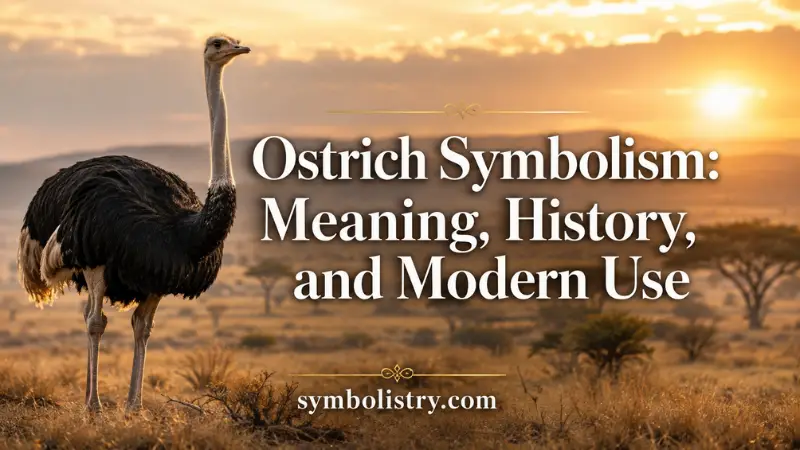
Ostriches are impossible to overlook. They are the world’s largest living birds, known for their long legs, powerful running ability, unusual proportions, and inability to fly despite having large wings. Those striking traits have made the ostrich a memorable subject of stories, religious art, folklore, and popular culture.
In the United States, the bird can suggest very different ideas depending on the setting. It may represent speed, independence, confidence, and survival, while the familiar phrase about “burying your head in the sand” gives it a very different association with avoidance and refusing to face reality.
The history is even more interesting. Ancient Egyptian traditions connected the ostrich feather with Ma’at, the principle of truth, justice, balance, and proper order. Later European traditions developed moral stories around the bird, sometimes portraying it as foolish or neglectful. Modern interpretations combine these older ideas with the animal’s unusual physical characteristics.
Quick Answer
Ostrich symbolism commonly represents avoidance, resilience, independence, and facing reality in modern American culture, depending on the context in which the bird appears. Historically, the ostrich and especially its feather were also associated with truth, justice, balance, religious devotion, and moral lessons.
TL;DR
- Ostriches can symbolize avoidance, resilience, speed, and independence.
- Ancient Egypt connected the ostrich feather with truth and justice.
- Biblical and medieval traditions often treated the bird as a moral example.
- Americans commonly associate ostriches with both humor and denial.
- Ostrich imagery can suggest confidence, individuality, or survival today.
- Modern symbolism depends heavily on the image, setting, and personal intention.
What an Ostrich Represents Symbolically
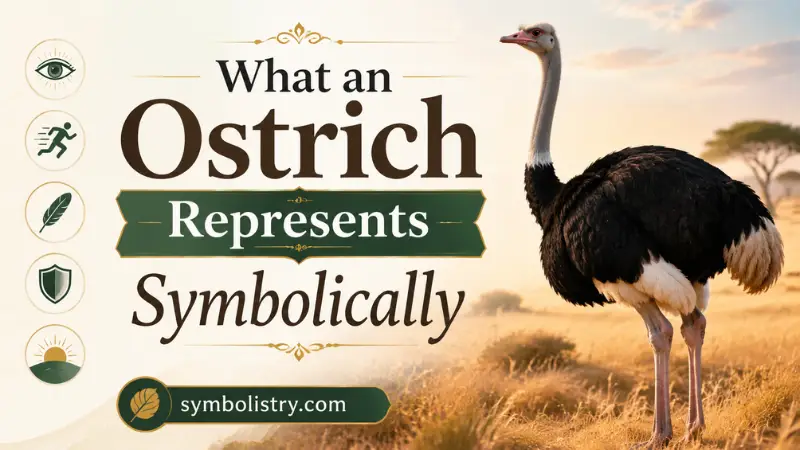
The ostrich carries several symbolic meanings because its physical characteristics are so unusual.
Its enormous size can suggest presence and confidence. Its powerful legs and remarkable running speed can represent endurance, movement, escape, or the ability to survive difficult circumstances.
At the same time, its inability to fly creates an interesting contrast. The ostrich has wings but remains firmly connected to the ground. Symbolically, this can represent having potential without using it in an expected way.
The bird is also commonly associated with avoidance because of the popular belief that ostriches hide their heads in the sand when threatened. In reality, ostriches do not deliberately bury their heads to escape danger. They may lower their heads while tending nests or reacting to threats, which likely helped create the old story.
That distinction matters because modern symbolism often reflects what people believe an animal does rather than what the animal actually does.
What Ostrich Symbolism Means in the United States
In modern American culture, the ostrich has an unusually playful symbolic identity.
One of its strongest associations is avoidance. When someone is described as “burying their head in the sand,” the image suggests refusing to acknowledge an uncomfortable fact. The ostrich therefore becomes a shorthand for denial, procrastination, or deliberate ignorance.
But this is only one side of the symbol.
The real bird is extremely fast, physically strong, alert, and capable of defending itself. Those qualities support more positive interpretations involving resilience, independence, physical strength, and survival.
This creates a useful contrast: the cultural stereotype presents the ostrich as someone who refuses to face problems, while the actual animal represents adaptation and physical competence.
American designers, artists, and writers can therefore use ostrich imagery humorously or seriously. A cartoon ostrich may represent denial, while a realistic ostrich can communicate wildness, speed, individuality, or connection with the natural world.
Ancient Egyptian Ostrich Symbolism
One of the oldest and most significant meanings associated with the ostrich comes from ancient Egypt.
The ostrich feather was closely connected with Ma’at, the Egyptian principle associated with truth, justice, balance, order, and proper conduct. Ma’at was also personified as a goddess who was commonly shown wearing an ostrich feather.
The feather had a particularly important role in Egyptian ideas about the afterlife. In the judgment scene often called the Weighing of the Heart, the deceased person’s heart was weighed against the feather of Ma’at. The image expressed the idea that a person’s life should be measured against truth and moral order.
This gives ostrich symbolism an important historical meaning that is often missing from modern discussions.
The ostrich was not simply an emblem of foolishness. Its feather could represent a standard of truth and justice. The symbol connected something physical and recognizable—the feather—with a much larger idea about how individuals and society should remain in balance.
The Ostrich Feather as a Symbol of Truth
The feather deserves separate attention because its meaning differs from the symbolism of the whole bird.
A feather is light, delicate, and balanced. In ancient Egyptian religious imagery, those qualities became connected with Ma’at and the measurement of moral truth. The feather therefore represented something that could be used to judge whether a person’s life was aligned with the proper order of the world.
For modern readers, this makes an ostrich feather a particularly interesting symbol of honesty.
Someone using an ostrich feather in jewelry, artwork, or personal design might intend meanings such as:
- truthfulness
- fairness
- balance
- moral responsibility
- spiritual judgment
- living according to one’s principles
However, a modern ostrich feather does not automatically carry ancient Egyptian religious meaning. Context matters, especially when the feather is used simply as a fashion element.
Ostrich Symbolism in the Bible and Early Christian Tradition
The ostrich also appears in biblical tradition, most notably in the Book of Job. The passage describes the bird in terms that emphasize its unusual behavior and apparent lack of wisdom, creating a contrast between the ostrich and animals viewed as more conventionally attentive to their young.
This contributed to later Western interpretations of the ostrich as an example of foolishness, disorder, or poor judgment.
Medieval writers expanded these ideas through bestiaries, which were books that combined descriptions of animals with moral and religious lessons. These works were not modern zoological guides; they frequently mixed observation, inherited stories, symbolism, and theological interpretation.
Some medieval traditions connected the ostrich with remarkable stories about its eggs and offspring. Other accounts turned the bird into an allegorical figure in Christian teaching.
As a result, the Western symbolic tradition gradually developed a more negative image of the ostrich than the ancient Egyptian association with Ma’at would suggest.
Medieval Ostrich Symbolism and Moral Lessons
Medieval symbolism often treated animals as illustrations of human behavior.
The ostrich became useful for this purpose because people already regarded it as strange. It looked like a bird but could not fly, had exceptionally long legs, laid enormous eggs, and lived in environments unfamiliar to many European observers.
Stories about its behavior could therefore be interpreted as lessons about memory, responsibility, temptation, faith, or spiritual awareness.
Some medieval texts portrayed the ostrich as forgetful because of beliefs surrounding its eggs. Other traditions developed elaborate stories involving the bird’s offspring and miraculous objects. These stories were symbolic narratives rather than reliable observations of ostrich behavior.
This distinction is important today. Medieval ostrich symbolism tells us more about medieval ideas and religious teaching than it does about the actual psychology of ostriches.
The Ostrich as a Symbol of Avoidance
Avoidance is probably the most recognizable modern interpretation of the ostrich in everyday American language.
The expression about putting one’s head in the sand has become a metaphor for ignoring an obvious problem. It can describe someone who refuses to accept bad news, avoids responsibility, or hopes that an unpleasant situation will disappear without action.
The symbolism works because the imaginary picture is easy to understand: an animal supposedly hides its head and assumes the danger has disappeared.
The problem is that the behavior is based on a misconception.
Ostriches do not bury their heads in the sand when they are frightened. They may lower their heads toward the ground while nesting or when responding to danger, which can look misleading from a distance. The popular expression survived because it works as a metaphor even though its biological premise is inaccurate.
Symbolically, then, the ostrich can represent perceived avoidance rather than actual animal behavior.
The Ostrich as a Symbol of Resilience and Survival
A more grounded interpretation comes from the animal itself.
Ostriches are built for movement. Their long legs allow them to run at high speeds, and their physical strength gives them effective defenses against predators. Their ability to survive in demanding environments makes resilience a reasonable modern symbolic association.
An ostrich image can therefore represent someone who keeps moving despite difficulty.
This interpretation is especially appropriate when the image emphasizes the bird running rather than hiding. A running ostrich suggests action, momentum, endurance, and escape from danger.
For someone choosing an ostrich as a personal symbol, the meaning might be less about avoiding problems and more about refusing to be overwhelmed by them.
The Ostrich and the Meaning of Independence
The ostrich can also symbolize independence because it does not fit conventional expectations.
It has wings but does not fly. It resembles familiar birds but behaves in ways that make it physically distinctive. It occupies an unusual position between what people expect a bird to be and what the ostrich actually is.
That makes the ostrich a useful symbol for individuality.
A person may connect with the bird because they feel comfortable being unconventional. The symbolism can communicate a message such as, “I do not have to behave according to expectations.”
In this sense, the ostrich represents individuality without necessarily representing rebellion.
Emotional and Psychological Meaning of the Ostrich
Psychologically, ostrich imagery can express a tension between avoidance and resilience.
On one side, the symbol can represent the instinct to turn away from difficult information. People sometimes avoid uncomfortable situations because confronting them feels threatening, exhausting, or emotionally costly.
On the other side, the actual animal provides a contrasting image of adaptation. The ostrich survives by using the abilities it possesses rather than trying to behave like another bird.
This makes ostrich symbolism useful for thinking about personal identity. It can raise a simple question: Are you avoiding something, or are you simply choosing a different way to deal with it?
The answer depends on context.
A humorous ostrich illustration may poke fun at denial. A photograph of an ostrich running across an open landscape may suggest freedom and endurance. A feather may suggest truth and balance because of its historical associations.
Positive and Negative Ostrich Meanings Compared
Ostrich symbolism does not have a single emotional direction.
| Context | Meaning in the USA | Common Associations | Notes |
|---|---|---|---|
| Ostrich with head lowered | Avoidance | Denial, ignoring problems | Usually based on popular misconception |
| Running ostrich | Resilience | Speed, survival, endurance | Draws more directly from real behavior |
| Ostrich feather | Truth and balance | Justice, morality, order | Strong historical connection to ancient Egypt |
| Ostrich portrait | Individuality | Confidence, uniqueness | Often depends on artistic context |
| Cartoon ostrich | Humor | Foolishness, denial | Common in popular culture |
| Ostrich in historical art | Moral or religious meaning | Faith, judgment, responsibility | Meaning varies by tradition |
Ostrich Symbolism in Tattoos and Personal Style
An ostrich tattoo can carry several different meanings, so the design matters as much as the animal itself.
A running ostrich may represent determination, freedom, speed, or overcoming obstacles. A cartoon ostrich may intentionally embrace humor and the idea of refusing to take life too seriously.
An ostrich feather tattoo can have a more reflective meaning. It may refer to truth, justice, balance, or ancient Egyptian symbolism, particularly when combined with imagery associated with Ma’at.
Some people may choose the bird simply because it is unusual. In that case, the tattoo can symbolize individuality rather than a specific historical tradition.
The safest interpretation is always the wearer’s own intention. Animal symbolism is not a fixed dictionary in which every image has one universal meaning.
Ostrich Symbolism in Fashion, Decor, and Art
Ostrich feathers have long been used as decorative materials, which gives them a separate cultural history from the symbolism of the living bird.
In modern design, feathers can create an impression of elegance, movement, softness, or theatrical style. Ostrich imagery can also bring humor and eccentricity into home decor, artwork, clothing, or accessories.
A realistic ostrich tends to communicate something different from an ornamental feather.
The bird may suggest nature, unusual beauty, independence, or humor. The feather may emphasize elegance, truth, lightness, or historical associations.
Color can alter the message as well. A natural-toned ostrich image feels earthy and organic, while a stylized black-and-white design may feel graphic and contemporary.
Ostrich Symbolism in Other Cultural Traditions
Ostrich symbolism developed differently across cultures because people encountered the bird in different environments and inherited different stories about it.
Ancient Egypt provides the clearest religious association, particularly through the feather of Ma’at. In biblical and later Christian traditions, the ostrich was often used to discuss wisdom, responsibility, or unusual behavior.
Greek and Roman writers also recorded observations and stories about the bird. Ancient writers recognized its enormous size and speed while also commenting on its inability to fly.
Medieval European writers inherited some of these observations but blended them with moral interpretation.
The result is a layered symbol rather than one universal definition. Truth and justice, foolishness, avoidance, endurance, and individuality all belong to different stages of the ostrich’s symbolic history.
Common Misunderstandings About Ostrich Symbolism
The most common misunderstanding is that ostriches actually hide their heads in sand when frightened.
They do not. The idea became popular because the bird’s nesting and defensive behaviors can appear unusual, and the metaphor is visually memorable.
Another misconception is that every ostrich feather automatically represents Ma’at. The historical connection is real, but an ordinary feather used in modern fashion does not necessarily carry an ancient Egyptian religious message.
It is also misleading to describe ostrich symbolism as universally negative. The bird’s reputation for foolishness belongs mainly to particular literary and cultural traditions. Its speed, strength, survival abilities, and distinctive appearance support much more positive interpretations.
Finally, there is no single “correct” personal meaning. A symbol can carry historical associations while still being used differently by an individual today.
How Ostrich Meaning Has Changed Over Time
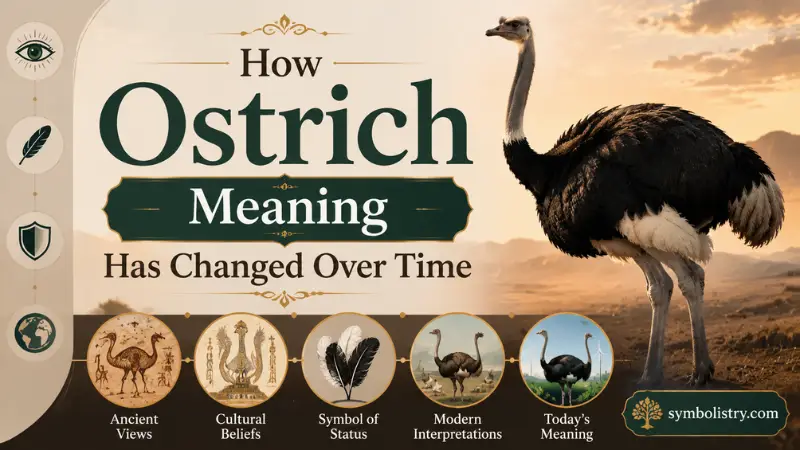
The symbolic history of the ostrich shows how animal meanings evolve.
In ancient Egypt, the ostrich feather became connected with one of the culture’s central ideas about truth, justice, and cosmic order. In biblical and medieval traditions, the bird increasingly became a vehicle for moral instruction, particularly around wisdom and responsibility.
Modern American culture has added another layer through the “head in the sand” metaphor. That association is now so familiar that many people recognize the ostrich as a symbol of denial before thinking about its older religious history.
At the same time, modern appreciation of wildlife has made positive interpretations easier to recognize. The real ostrich is fast, strong, adaptable, and distinctive.
The symbol has therefore shifted from a largely moral or religious teaching device toward something more flexible. Today it can be humorous, critical, empowering, decorative, or historical depending on how it is presented.
Frequently Asked Questions
What does an ostrich symbolize spiritually?
In historical religious traditions, the ostrich feather can represent truth, justice, balance, and moral order, especially in ancient Egyptian culture. Modern spiritual interpretations of ostrich symbolism vary, so they should not automatically be presented as ancient religious beliefs.
Does the ostrich really bury its head in the sand?
No. Ostriches do not intentionally bury their heads in sand to hide from danger. The misconception helped create one of the best-known forms of ostrich symbolism, representing denial, avoidance, or refusing to face an uncomfortable reality.
What does an ostrich feather symbolize?
Historically, an ostrich feather is associated with Ma’at in ancient Egyptian tradition and represents truth, justice, balance, and proper order. This is one of the oldest and most important examples of ostrich symbolism, although a modern decorative feather may have no religious meaning.
What does an ostrich symbolize in a tattoo?
An ostrich tattoo can represent individuality, resilience, humor, independence, or avoidance. In this context, ostrich symbolism often depends on the tattoo design, with a running bird suggesting determination and a feather suggesting truth, balance, or historical meaning.
Is ostrich symbolism positive or negative?
Ostrich symbolism can be either positive or negative depending on context. Avoidance and denial are common negative associations, while resilience, speed, individuality, and survival provide more positive interpretations.
What does a running ostrich symbolize?
A running ostrich commonly suggests speed, endurance, freedom, resilience, and survival. This form of ostrich symbolism is closely connected to the bird’s real physical abilities rather than the inaccurate “head in the sand” stereotype.
Why is the ostrich associated with foolishness?
Biblical descriptions and later European bestiary traditions helped associate the ostrich with foolishness, carelessness, or poor judgment. These traditions shaped Western ostrich symbolism, although medieval animal stories often reflected moral teaching rather than accurate zoological knowledge.
Conclusion
Ostrich symbolism has never had just one meaning. In modern American culture, ostrich symbolism is often connected with avoidance and denial, but the history of ostrich symbolism also includes truth, justice, balance, resilience, speed, independence, and moral responsibility.
The best way to understand ostrich symbolism is to consider the image and context together. An ostrich hiding its head in a cartoon reflects one side of ostrich symbolism, while a running ostrich can represent another. An ostrich feather adds a historical dimension to ostrich symbolism, especially through its connection with Ma’at.
In personal expression, ostrich symbolism may communicate individuality or resilience. In popular culture, ostrich symbolism can be humorous because of the familiar head-in-the-sand stereotype. In historical and religious contexts, ostrich symbolism can point toward truth, judgment, and balance.
The changing meanings of ostrich symbolism show how people reinterpret animals according to their own cultural experiences. Ultimately, ostrich symbolism is most meaningful when its historical background, visual context, and intended message are considered together.