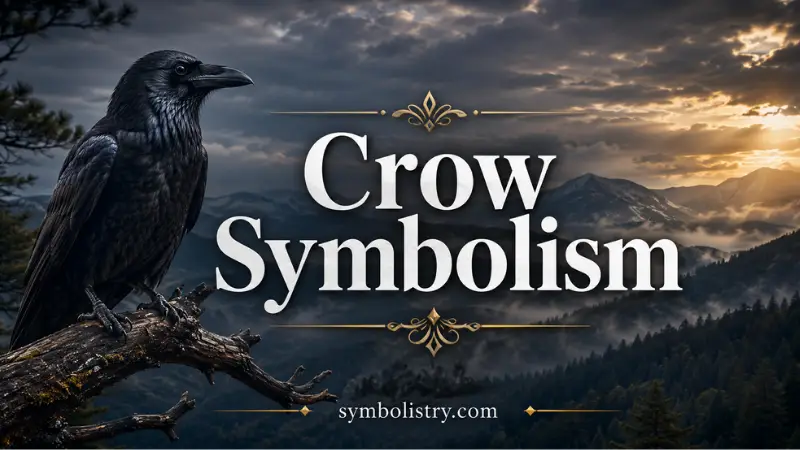
Crows are among the most recognizable birds in the United States. Their black feathers, sharp calls, social behavior, and ability to thrive near people make them difficult to ignore. Crow symbolism has developed from these visible qualities, combining ideas about intelligence and adaptability with older associations involving death, prophecy, and the unknown.
People encounter crow imagery in tattoos, jewelry, seasonal decorations, literature, movies, and social media. Depending on the context, the bird may communicate cleverness, personal transformation, grief, independence, caution, or resistance.
Understanding these meanings requires separating observed crow behavior from folklore. It also requires distinguishing crows from ravens and recognizing that Greek, Irish, Japanese, and Indigenous traditions do not assign the bird one universal interpretation.
Quick Answer
Crow symbolism commonly represents intelligence, adaptability, watchfulness, and transformation in modern American culture. Historically, crows have also been associated with prophecy, battlefields, death, divine messages, and guidance in several distinct cultural traditions.
TL;DR
- Crows often represent intelligence, adaptability, watchfulness, and transformation.
- Black plumage and scavenging created links with death and omens.
- Some traditions treat crows as messengers, guides, or prophetic birds.
- American interpretations combine folklore, wildlife science, horror, and personal identity.
- Tattoos may express resilience, independence, memory, or a major life transition.
- Cultural meanings should be identified specifically rather than blended together.
What a Crow Looks Like and Where It Appears
The American crow is a large, entirely black bird with a heavy bill, broad wings, and a relatively short, square-ended tail. Adults generally measure about 16 to 21 inches long. Their familiar caw is harsher and more direct than the deeper, croaking call associated with ravens. (All About Birds)
Although their feathers appear uniformly black from a distance, sunlight can reveal subtle blue or violet reflections. That shifting surface contributes to the bird’s visual complexity: it may look plain at first, then unexpectedly luminous.
Americans see crows in farm fields, parks, suburbs, parking lots, beaches, roadsides, and city centers. They eat insects, seeds, fruit, small animals, discarded food, nestlings, and carrion. Their willingness to use both natural and human-made environments explains why they frequently represent survival and practical intelligence. (All About Birds)
A solitary crow can appear cautious and observant. A large communal gathering creates a different impression—loud, organized, and socially intense. These contrasting encounters help the bird communicate both independence and community.
What Crows Commonly Mean in the United States
In present-day American culture, the crow carries several meanings rather than one fixed message.
Intelligence comes from the bird’s problem-solving ability and alert behavior. A crow image can suggest someone who notices details, learns quickly, or understands what others overlook.
Adaptability reflects the species’ success in environments altered by people. The bird survives in rural, suburban, and urban settings, making it a fitting emblem for resourcefulness.
Watchfulness develops from the crow’s habit of observing its surroundings before approaching food or unfamiliar objects. In art, a perched crow may imply that something is being noticed, evaluated, or remembered.
Transformation is a modern interpretive meaning rather than a single ancient doctrine. Because the bird moves between forests, farms, streets, cemeteries, and other human spaces, it can represent crossing from one stage of life into another.
Mortality remains part of its imagery, particularly in horror, mourning art, and autumn decoration. This association does not always mean literal death. It may refer to accepting an ending, living with loss, or releasing an identity that no longer fits.
Why the Bird Became Associated With Death
Crows developed dark associations largely because of their appearance and feeding behavior. Black is commonly used in American funeral clothing, horror imagery, nighttime scenes, and visual representations of grief. A black bird placed against a pale sky therefore creates an immediate contrast that artists can use to suggest danger, absence, or uncertainty.
Their consumption of carrion strengthened the connection. Before modern sanitation and wildlife management, scavenging birds could be seen around battlefields, animal remains, and places where death had occurred. Observers did not need a supernatural belief to connect the birds with mortality; the association began with visible behavior.
Over time, folklore transformed proximity into prediction. Instead of merely appearing where something had died, a crow was imagined as warning that death would occur. That shift—from observer to omen—is common in animal folklore.
Modern interpretation often reverses the older fear. Because scavengers remove decaying material from the environment, the crow may now represent natural renewal: death feeds life, endings create space, and ecosystems reuse what appears to have been lost.
Intelligence, Memory, and Adaptability
Scientific knowledge has substantially changed how Americans interpret crows. They are no longer viewed only as noisy scavengers or sinister background animals. Research has documented sophisticated memory, social learning, threat recognition, and problem-solving among corvids.
American crows can recognize individual human faces and connect those faces with positive or negative experiences. They may also communicate information about a perceived threat to other members of their group. (UW Homepage)
These abilities support several contemporary meanings:
- Mental sharpness
- Careful judgment
- Learning from experience
- Remembering mistreatment
- Protecting one’s community
- Adjusting to difficult circumstances
A crow tattoo or emblem can therefore communicate more than general cleverness. It may represent a person who survived by paying attention, learned not to repeat an earlier mistake, or became more selective about whom to trust.
This intelligence can also create an uneasy response. People often feel comfortable around animals they consider predictable. A bird that watches, remembers, and changes its behavior can seem less like scenery and more like an active participant.
Omens, Prophecy, and the Tradition of Reading Birds
Humans have long interpreted the flight, number, direction, and calls of birds as meaningful. Crows became especially suitable for this practice because they are conspicuous, vocal, responsive to environmental changes, and often active near human settlements.
A sudden group of crows may gather because of food, a predator, a communal roost, or social interaction. Earlier observers without access to modern ornithology could interpret the same event as a warning or announcement.
This background helps explain why the bird represents prophecy. The crow does not need to predict the future literally. Symbolically, it notices evidence before other characters do. In a story, its arrival can indicate that danger is already developing, even when the people involved have not recognized it.
That makes the bird an effective symbol for intuition. It suggests reading subtle changes, listening to discomfort, and taking warning signs seriously. This interpretation remains grounded when it describes human awareness rather than claiming that ordinary bird sightings guarantee future events.
Crows and Ravens Are Not the Same Bird
Crows and ravens belong to the same bird family and share black plumage, intelligence, and scavenging behavior. However, they are not interchangeable species.
Ravens are generally larger, with heavier bills, wedge-shaped tails, and deeper croaking calls. American crows are smaller, usually have fan-shaped or square-ended tails, and make the familiar cawing sound. (All About Birds)
Popular culture frequently blends the two. A black bird in a gothic illustration may be called a crow even when its shape resembles a raven. Likewise, meanings drawn from stories about ravens are often placed in articles, tattoos, or merchandise labeled as crows.
Edgar Allan Poe’s famous bird, for example, is specifically a raven. Norse stories about Odin’s birds also concern ravens, not crows. Those traditions can help explain the broader image of the intelligent black corvid, but they should not be presented as exclusively crow-based history.
The distinction matters most when discussing a named myth or religious tradition. In modern personal symbolism, the overlap is usually intentional: the wearer may care more about the shared qualities of intelligence, darkness, memory, and observation than the exact species.
Indigenous North American Traditions Require Specificity
There is no single “Native American meaning” for the crow. Indigenous nations possess distinct languages, histories, ceremonies, oral traditions, and relationships with local wildlife. Combining them into one generic interpretation removes the cultural setting that gives each story meaning.
The Apsáalooke Nation, commonly called the Crow Nation in English, identifies itself with a name often translated as “Children of the Large-Beaked Bird.” This national identity should not be treated as proof that every Indigenous community uses the crow in the same way. (National Museum of the American Indian)
Individual traditions may present crow-like birds as helpers, tricksters, food providers, relatives, clan figures, or participants in creation stories. A recorded Western Shoshoni narrative, for instance, connects Crow with procuring pine nuts and explains why the bird should not be killed. (Smithsonian Research Online)
Many widely circulated Northwest Coast stories actually center Raven. Replacing Raven with Crow for convenience changes the cultural reference. Responsible discussion identifies the nation and the bird whenever that information is known.
For tattoos, merchandise, or spiritual language, the safest approach is to avoid claiming that a generic crow design represents a universal Indigenous teaching. Personal interpretations such as survival, intelligence, or alertness do not require borrowing a sacred identity.
Greek and Irish Mythological Associations
In Greek myth, the crow or raven could function as a messenger connected with Apollo. One surviving artistic interpretation shows Apollo facing a black bird that may represent an oracular animal or the messenger that reported the marriage of Coronis. Later versions explain the bird’s black color as punishment for bringing unwelcome news. (Archaeological Site of Delphi)
This story contributed to several lasting meanings:
- Prophecy
- Truth that causes discomfort
- The burden of delivering bad news
- Punishment directed at the messenger
- Knowledge that cannot be taken back
Irish tradition offers a different context. The Morrígan is associated with battle, fate, sovereignty, prophecy, and crow imagery in medieval Irish literature. Her presence connects the bird not simply with violence but with the outcome and consequences of conflict. (Oxford English Dictionary)
Modern gothic and Pagan-inspired art frequently draws from the Morrígan, but simplified images sometimes reduce her to a generic “crow goddess.” Her role is more complicated than a single animal emblem, and Irish mythology should not be merged loosely with every tradition labeled Celtic.
Guidance and Sacred Direction in Japanese Tradition
Japanese tradition provides an important positive example. Yatagarasu, the legendary three-legged crow, is described as guiding Emperor Jimmu toward Yamato. The figure therefore became associated with divine direction, correct leadership, and finding a path through unfamiliar territory. (Kokugakuin University)
The image continues in modern public culture through the emblem used by Japan’s national soccer organization. Its presence shows how an old sacred guide can become a symbol of direction, unity, and successful movement toward a goal.
In this context, the crow does not announce disaster. It helps a traveler proceed correctly. A person choosing a crow to represent guidance may therefore be drawing on a real historical tradition, although a three-legged Yatagarasu design is culturally more specific than an ordinary crow silhouette.
The Japanese example also challenges the idea that black birds carry universally negative meanings. Color and scavenging behavior may have encouraged fear in some societies, while stories of divine guidance produced respect in others.
Death, Grief, and So-Called Crow Funerals
Crows sometimes gather around a dead member of their species, calling loudly and attracting additional birds. People commonly describe these events as “crow funerals.”
Research indicates that such gatherings provide opportunities for social learning. The birds inspect the situation, identify potential danger, remember nearby threats, and adjust their later behavior. Experiments have shown that crows can associate a person seen near a dead crow with danger after a single encounter. (UW Digital Collections)
Calling the event a funeral may be emotionally understandable, but it can imply a human ceremony that has not been demonstrated. The behavior clearly shows attention to death and collective threat assessment; whether crows experience grief in the same way people do remains a separate question.
Symbolically, these gatherings support meanings of communal memory and protection. A dead crow does not concern only the individual. Information about its death becomes valuable to the group.
For a person coping with loss, this imagery can represent learning from death without forgetting the dead. It combines mourning with awareness: remember what happened, recognize the danger, and protect those who remain.
Positive and Negative Meanings at a Glance
| Context | Common U.S. Meaning | Typical Associations | Important Note |
| Wildlife and science | Intelligence | Memory, learning, problem-solving | Based partly on observed behavior |
| Personal identity | Resilience | Independence, survival, adaptability | Usually chosen as a positive emblem |
| Gothic imagery | Mortality | Cemeteries, darkness, autumn, horror | Often blended with raven imagery |
| Folklore | Warning | Omens, prophecy, approaching change | Not a reliable prediction system |
| Mourning art | Grief and memory | Loss, endings, remembrance | May emphasize acceptance rather than fear |
| Mythological design | Messenger or guide | Apollo, Morrígan, Yatagarasu | Meaning depends on the specific tradition |
The same bird can communicate opposing ideas because symbols depend on context. A crow beside a skull suggests mortality. One carrying a key may imply access to knowledge. A bird in flight can communicate release, while a watchful perched crow may represent patience or suspicion.
Emotional and Psychological Meaning
The crow often appeals to people who identify with being observant rather than openly expressive. Unlike a lion, eagle, or horse, it does not usually symbolize visible physical dominance. Its strength lies in judgment, timing, memory, and the ability to use available resources.
This can make the bird meaningful to someone who has survived an unstable environment. Its message is not necessarily “be fearless.” A more accurate interpretation is “pay attention, adapt, and act when the conditions are right.”
The darker imagery also gives people a way to acknowledge emotions that cheerful symbols cannot easily express. A crow can represent:
- Living with grief
- Accepting an irreversible change
- Protecting emotional boundaries
- Remembering betrayal
- Becoming comfortable with solitude
- Rebuilding after disruption
Some people choose the bird because it does not demand a positive interpretation of every experience. It allows pain, caution, and resilience to exist together.
Why Crows Appear in Tattoos and Jewelry
Crow tattoos are highly flexible because posture, direction, number, and accompanying objects can alter the message.
A single perched crow often suggests observation, patience, or independence. A crow in flight may represent freedom, departure, or movement into a new stage. Two crows can express partnership, shared intelligence, or loyalty, although meanings based on counting birds vary widely across folk traditions.
A crow with a skull emphasizes mortality, grief, or acceptance of death. A crow carrying a key can represent guarded knowledge or access to something concealed. A crow with flowers balances endings with growth, while a design involving the moon may emphasize intuition and nighttime awareness.
Feather imagery is subtler. A black feather can represent a trace left behind, a memory, or evidence that something has passed through one’s life. However, people should avoid assigning a specific Indigenous ceremonial meaning to a generic feather unless the design comes from an identified tradition and is used with appropriate understanding.
In jewelry, smaller silhouettes tend to communicate cleverness, gothic style, or personal independence rather than an elaborate mythological story.
Crows in Gothic Art, Autumn Decor, and Popular Culture
American visual culture regularly places black birds in cemeteries, bare trees, abandoned houses, foggy landscapes, and Halloween scenes. Their shape remains readable even as a simple silhouette, making them effective for posters, book covers, seasonal decorations, and horror imagery.
The bird creates tension because it appears to watch rather than attack. A wolf or monster provides an obvious threat. A crow suggests that the threat may already be present but not yet understood.
Autumn strengthens the association. Harvested fields, shorter days, exposed branches, and decaying vegetation create settings where dark birds become especially visible. The result is a seasonal language of endings and transition rather than death alone.
Contemporary fashion also uses crows in gothic, alternative, and nature-centered styles. In those settings, the image may communicate nonconformity, emotional complexity, ecological awareness, or comfort with subjects that mainstream culture avoids.
Social media has expanded the bird’s lighter side as well. Videos of crows solving problems, interacting with people, collecting objects, or demanding food often present them as curious neighborhood personalities rather than omens.
Common Misunderstandings and Misuse
One common mistake is assuming that every crow sighting carries a supernatural message. The birds move in response to food, nesting, predators, weather, roosting patterns, and social behavior. Personal reflection can be meaningful, but it should not replace ordinary explanations.
Another error is treating all black-bird mythology as crow mythology. Raven traditions, crow traditions, and general corvid imagery overlap, but named stories should retain the correct bird.
Claims about a universal Indigenous meaning are especially misleading. Terms such as “Native crow spirit animal” often combine unrelated traditions into commercial or social-media language. Indigenous stories should be attributed to their particular nations whenever possible.
The phrase “crow funeral” can also be taken too literally. Crows gather around dead birds, but evidence strongly supports danger assessment and social learning. Describing the behavior as identical to a human memorial ceremony goes beyond what research establishes.
Finally, the term “Jim Crow” belongs to the history of racial caricature and legalized segregation in the United States. It should not be presented as an ordinary extension of the bird’s mythological meaning. Its historical significance comes from American racism, performance stereotypes, and discriminatory institutions—not from a traditional belief about crows.
How the Meaning Has Changed in Modern America
Earlier American interpretations inherited many European fears involving black birds, graveyards, bad news, and death. Agricultural conflict also encouraged people to treat crows as thieves or pests, reinforcing ideas of cunning and disorder.
Wildlife research gradually complicated that reputation. Behaviors once dismissed as nuisance activity could also be understood as strategic learning, cooperation, memory, and adaptation. The supposed villain became an intelligent neighbor.
Modern culture has not discarded the darker meanings. Instead, it has added new ones. The crow can still indicate an omen in a horror story while representing resilience in a tattoo, ecological adaptation in a documentary, or curiosity in a viral video.
This evolution explains the bird’s continuing usefulness. Its meaning is neither entirely positive nor entirely negative. It occupies the uncertain territory between caution and curiosity, death and renewal, solitude and social loyalty.
FAQs
What does seeing a crow symbolize?
Seeing a crow is often interpreted personally as a reminder to observe carefully, adapt, or prepare for change. In practical terms, the bird is usually present because of food, nesting, social activity, or a nearby roost rather than a supernatural event.
Is a crow a positive or negative symbol?
It can be either. Positive meanings include intelligence, resilience, guidance, memory, and adaptability, while negative interpretations include death, danger, betrayal, and an unwelcome warning.
What does a crow tattoo mean?
A crow tattoo commonly represents intelligence, survival, independence, transformation, or remembrance. The exact meaning depends on the bird’s posture and accompanying images, such as flowers, keys, moons, skulls, or additional crows.
Does a crow symbolize death?
Crows are associated with death because of their black color, carrion-feeding behavior, and historical presence around places where animals or people had died. In modern art, they may symbolize grief, mortality, or the end of a life chapter rather than predicting a literal death.
What does a crow mean spiritually?
Spiritual interpretations commonly describe the crow as a messenger, guide, observer, or warning figure. These ideas vary by religion and culture, so no single spiritual definition applies to every tradition.
Are crows symbols of bad luck?
Some European and American folk beliefs treat a lone crow as a bad omen, but other traditions connect the bird with guidance, intelligence, protection, or good fortune. A sighting has no scientifically established ability to predict luck.
What is the difference between crow and raven meanings?
Their meanings frequently overlap because both are intelligent black corvids associated with scavenging and observation. However, many famous stories—including those involving Odin and Poe’s poem—specifically feature ravens, while other myths and modern designs clearly use crows.
Conclusion
Crow symbolism in the United States combines intelligence, adaptability, watchfulness, transformation, mortality, and memory. Its darker associations arose from black plumage, scavenging behavior, and older omen traditions, while modern wildlife knowledge has strengthened more positive interpretations involving learning, social awareness, and resilience.
No single definition fits every image or encounter. A crow in a horror scene performs a different role from one in a memorial tattoo, Japanese emblem, Irish mythological design, or neighborhood wildlife video.
The bird remains meaningful because it reflects a realistic form of survival: observe closely, remember experience, adapt to changing conditions, and recognize that endings can contain useful knowledge.