Pheasant symbolism is most often connected with beauty, confident self-expression, visibility, alertness, and rural abundance. The bird’s vivid plumage, elaborate courtship behavior, and close association with farmland and hunting have given it a distinctive place in both personal symbolism and American outdoor culture.
Yet not every pheasant meaning comes from the same tradition. In parts of historic Chinese court culture, particular pheasant species appeared on official rank badges. In the United States, especially across the Great Plains and Midwest, the ring-necked pheasant developed a different identity: an emblem of autumn fields, hunting heritage, wildlife habitat, and regional pride.
That difference matters. Some meanings are supported by documented cultural history, while others are modern interpretations inspired by the bird’s appearance and behavior. Understanding both helps explain why pheasant imagery can suggest elegance in one setting, outdoor tradition in another, and personal confidence in a tattoo or piece of art.
Quick Answer
Pheasant symbolism commonly represents beauty, confidence, self-expression, alertness, and rural abundance in modern American culture. Historically, pheasants have also been connected with social rank in Chinese court dress and, later, with game culture and country life in Europe and North America.
TL;DR
- Pheasants often symbolize beauty, confidence, visibility, and individuality.
- Their courtship displays strengthen associations with attraction and self-presentation.
- Chinese court imagery connected specific pheasants with official rank.
- American meanings often reflect hunting, farmland, autumn, and regional identity.
- Pheasant tattoos commonly express confidence, resilience, or rural roots.
- Not every modern spiritual interpretation has a historical basis.
Why the Pheasant’s Appearance Shapes Its Meaning
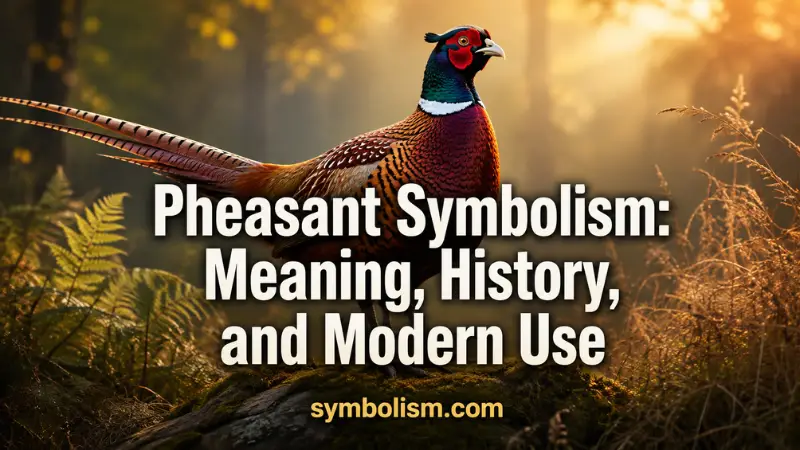
Few game birds create as much visual contrast between the sexes as the common or ring-necked pheasant. Adult males can have an iridescent green head, red facial skin, patterned copper and brown feathers, a long tail, and, in many populations, a prominent white neck ring. Females are generally mottled in browns and tans, providing much better camouflage around grass and vegetation.
That contrast helps explain several modern symbolic interpretations. The male is difficult to overlook, so pheasant imagery naturally lends itself to ideas of visibility, display, individuality, and confidence. The female’s subdued coloring introduces another theme: discretion and the ability to blend into one’s surroundings.
Pheasant behavior adds to this reading. During courtship, a male may strut around a female while displaying his feathers, drooping a wing, and enlarging his facial wattles. Males also use calls and territorial displays during the breeding season.
For modern symbolic use, those behaviors can represent knowing when to be noticed rather than remaining permanently hidden. The pheasant therefore works especially well as an emblem of expressive confidence—not simply physical attractiveness.
Core Meanings of the Pheasant
Pheasant meanings vary by context rather than forming one universal symbolic system. Still, several interpretations appear particularly natural because they connect directly with the bird’s biology or documented cultural history.
| Context | Common Meaning in the USA | Association | Notes |
| Colorful male plumage | Confidence | Visibility, individuality | Often used in art and personal symbolism |
| Courtship display | Attraction | Charisma, expression | Based on actual display behavior |
| Farmland habitat | Rural abundance | Harvest, countryside | Strongest in agricultural regions |
| Hunting culture | Tradition | Outdoors, heritage | Especially relevant in the Midwest |
| Historic Chinese art | Rank and status | Public office, hierarchy | Meaning depended on specific bird and rank |
| Camouflage and escape | Awareness | Adaptability, caution | Mainly a modern interpretive meaning |
The meanings of beauty and confidence are usually the easiest to understand. They arise from the male bird’s striking appearance and display behavior rather than requiring a complicated spiritual explanation.
Status has a firmer historical connection in Chinese material culture, while hunting and rural identity became especially important after pheasants were established in parts of the United States.
Historical Roots and Pheasants in Chinese Culture
The pheasant has deep Eurasian roots. Even the English name carries evidence of this history: “pheasant” ultimately traces through Greek and Latin to the Phasis River in ancient Colchis, in the region of present-day Georgia.
East Asian art provides some of the clearest documented examples of pheasants carrying formal social meaning. During China’s imperial period, birds embroidered on official rank badges identified positions within the civil hierarchy. Golden pheasant imagery, for example, was used for a second-rank civil official under the Qing system. Surviving museum collections also contain badges featuring silver pheasants and other birds associated with particular ranks.
In that setting, the pheasant was not merely a generic emblem of “spiritual awakening.” It participated in a regulated visual language of office, hierarchy, prestige, and public identity.
This historical context explains why pheasant designs can still feel aristocratic or refined when used in textiles, ceramics, wallpaper, or formal interior design. Their connection with status is more historically grounded than many broad claims about luck or supernatural guidance.
It is also important not to treat every pheasant species as interchangeable. Golden pheasants, silver pheasants, common pheasants, and other members of the wider group have appeared in different artistic and cultural contexts. A meaning documented for one image or species should not automatically be applied to all pheasants.
From an Asian Bird to an American Rural Icon
The ring-necked pheasant’s American symbolism is relatively recent because the species is not native to North America. Its original range lies in Eurasia, and pheasants were introduced into North America rather than evolving here as native game birds.
By the early twentieth century, deliberate releases helped establish pheasant populations in agricultural regions. South Dakota became one of the strongest examples of this transformation. The state developed an extensive pheasant hunting tradition, held its first official pheasant season in 1919, and designated the ring-necked pheasant as its state bird in 1943.
This history changed what the pheasant communicated visually.
In an American setting, an image of a ring-necked pheasant standing beside corn stubble or tall grass may evoke the prairie, family hunting trips, working farmland, autumn mornings, habitat conservation, or South Dakota identity. Those associations are very different from the court-rank meanings found in historic Chinese textiles.
The pheasant therefore offers a good example of symbolism changing after a species moves into a new cultural landscape.
What Pheasants Commonly Mean in the United States
There is no single nationwide American interpretation of the pheasant. Geography and personal experience strongly influence what the bird represents.
Across parts of the Midwest and Great Plains, pheasants are closely linked to agricultural landscapes. They use mixtures of grassland, cropland, wetlands, shelterbelts, and other cover, which places them directly within environments shaped by both farming and wildlife management.
As a result, American pheasant imagery can communicate several overlapping ideas:
Country identity. A pheasant painting or sign may immediately create a rural, lodge, farmhouse, or sporting atmosphere.
Autumn tradition. Hunting seasons and changing farm landscapes connect the bird strongly with fall.
Outdoor skill and patience. Hunters may associate pheasants with awareness, discipline, dogs, fieldcraft, and time spent outdoors.
Regional pride. In South Dakota, the connection is especially explicit because the pheasant is the official state bird.
Natural beauty within working landscapes. Unlike imagery of remote wilderness, pheasants often represent wildlife living alongside farms and human-managed land.
For many Americans, then, the pheasant is less a mystical creature than a recognizable symbol of place.
Hunting, Harvest, and the Autumn Landscape
Pheasant hunting significantly shaped the bird’s modern American identity. In states where pheasant populations and hunting traditions are established, the opening of the season can function as a seasonal marker much like other familiar fall activities. South Dakota continues to promote and manage pheasant hunting as an important part of its outdoor culture.
This produces symbolism centered on tradition, harvest season, fellowship, patience, and connection with land.
A pheasant mounted on a lodge wall, embroidered on an outdoor jacket, printed on sporting equipment, or pictured beside a hunting dog may therefore have little to do with spiritual beliefs. It can simply communicate membership in a hunting culture.
At the same time, modern pheasant imagery can point toward habitat stewardship. Healthy populations depend on suitable nesting and winter cover, and wildlife management programs often connect pheasant conservation with broader grassland and agricultural habitat goals.
This gives the bird another contemporary meaning: the relationship between recreation, agriculture, and habitat management.
Emotional and Psychological Meaning
Used as a personal symbol, the pheasant can express a useful tension between being visible and staying aware.
Its brightest characteristics suggest self-confidence. The male does not minimize its appearance during courtship; it displays its plumage and performs conspicuous movements intended to attract attention.
For someone choosing pheasant imagery personally, this can represent the willingness to:
- show individuality without apology,
- develop confidence after a quiet period,
- take pride in personal appearance or creativity,
- become more socially expressive,
- or recognize when an opportunity requires being seen.
Yet pheasants are not simply showy birds. They spend much of their lives close to the ground and depend heavily on vegetation and cover. Females are particularly well camouflaged.
That contrast supports a more balanced psychological reading: confidence does not require constant exposure. A person can be expressive when the situation calls for it while remaining observant and selective at other times.
This interpretation is modern rather than a universal ancient belief, but it follows recognizable characteristics of the bird rather than relying on invented folklore.
Pheasant Symbolism in Tattoos and Personal Style
A pheasant tattoo usually works best as an individualized symbol rather than one with a fixed dictionary definition.
The male ring-necked pheasant suits colorful tattoo styles because its green, red, copper, gold, and brown plumage offers natural visual variety. Long tail feathers also work well in forearm, calf, shoulder, or larger illustrative compositions.
Common personal interpretations include confidence, beauty, individuality, attraction, adaptability, rural heritage, or love of hunting and wildlife.
Context changes the meaning considerably.
A pheasant with native grasses may emphasize a connection to prairie landscapes. One shown alongside a hunting dog can represent sporting tradition or family memories. A highly decorative golden pheasant design may instead emphasize elegance and visual distinction.
A flying pheasant can suggest sudden action or breaking from concealment, while a standing male in full plumage more naturally communicates presence and self-assurance.
Because there is no universal tattoo code for pheasants, the wearer’s reason for choosing the bird remains more important than any online list of supposed meanings.
Pheasants in Decor, Fashion, and Digital Culture
Pheasant imagery fits naturally into American rustic and traditional design because the bird combines bright ornamentation with a strong connection to fields and country life.
It appears on prints, decorative plates, textiles, pillows, wallpaper, tableware, hunting-lodge decor, seasonal arrangements, and country-inspired clothing. In these settings, the bird often communicates autumn, heritage, natural color, or refined rustic style rather than a specific spiritual message.
Pheasant feathers also create visual associations with texture, pattern, and traditional sporting aesthetics. Their earthy browns combined with stronger greens and reds allow designers to suggest nature without relying entirely on muted colors.
Online, pheasant imagery is more flexible. Wildlife photographers may emphasize the bird’s dramatic coloration. Hunters may use it as an outdoor identity marker. Artists and tattoo accounts may highlight elegance or individuality.
Digital culture therefore tends to broaden pheasant meaning instead of preserving one established definition.
Positive and Negative Meanings
Most modern interpretations of the pheasant are positive, but its traits can be read differently depending on context.
On the positive side, colorful plumage can represent confidence, attractiveness, creativity, healthy pride, and individuality. Courtship behavior adds themes of charisma and intentional self-presentation.
Its ability to survive within agricultural landscapes can also inspire associations with adaptability.
The same characteristics can take on less flattering meanings when exaggerated. Display may become vanity, confidence may become showing off, and concern with appearance may suggest superficiality.
Hunting imagery can also be interpreted differently by different audiences. To one person, a pheasant may represent family tradition and responsible outdoor recreation. To another, the same image may primarily evoke the killing of wildlife.
Neither reaction defines the bird universally. Symbolism depends partly on the experiences and values a viewer brings to the image.
Common Misunderstandings and Cultural Misuse
One of the biggest problems with pheasant symbolism online is the tendency to present recent interpretations as ancient universal beliefs.
Claims about “ancient Native American pheasant symbolism,” for example, require particular caution. The common ring-necked pheasant is Eurasian and was introduced into North America, so it could not have been a traditional pre-contact symbol involving that species across Indigenous cultures.
That does not mean a contemporary Indigenous person or artist could never use pheasant imagery. It means broad claims of ancient tribal pheasant traditions should not be made without specific historical evidence.
Another mistake is collapsing every Asian pheasant tradition into a generic claim that “the pheasant means wealth and good luck in Chinese culture.” Chinese visual culture used different birds in specific contexts, including regulated official rank badges. Those documented meanings deserve to remain distinct from modern decorative interpretations.
Religious claims also need restraint. The pheasant does not have a single widely recognized biblical or Christian meaning comparable with established symbols such as the dove, lamb, or cross. A modern Christian may personally interpret a pheasant as an example of created beauty, but that is different from claiming a formal biblical symbolism.
Good interpretation separates personal meaning from historical evidence.
How Pheasant Meaning Has Changed Over Time
Pheasant symbolism developed through several different cultural stages rather than following one continuous tradition.
In Eurasia, pheasants were familiar native birds and became subjects of art, hunting, food culture, and decorative imagery. Their name itself preserves an ancient geographic connection with the region around the Phasis River.
In imperial China, particular pheasant species entered formal systems of visual rank. The bird could therefore communicate an official’s social position rather than simply beauty.
In Europe, pheasants became strongly associated with game management, estates, hunting, and country landscapes.
After introduction to North America, the ring-necked pheasant gradually acquired another identity. In agricultural states, especially South Dakota, an Asian species became so culturally established that it was adopted as a state bird and became a defining image of regional outdoor culture.
Today these layers coexist.
A museum textile, hunting-club emblem, farmhouse print, wildlife photograph, and tattoo can all contain a pheasant while communicating completely different ideas. Modern symbolism is therefore best understood through context rather than assuming one ancient definition applies everywhere.
FAQs
What does a pheasant symbolize spiritually?
In contemporary personal symbolism, a pheasant may represent confidence, individuality, awareness, attraction, or the courage to become more visible. There is no single universal religious doctrine that assigns one spiritual meaning to all pheasants.
Does a pheasant symbolize good luck?
A pheasant can be used positively in art and decor, but it is not a universal good-luck symbol across all cultures. Meanings such as status, beauty, abundance, or fortune should be tied to the specific cultural or artistic context rather than treated as interchangeable.
What does a pheasant tattoo symbolize?
A pheasant tattoo can represent confidence, beauty, individuality, resilience, rural heritage, hunting tradition, or a personal connection with wildlife. Colorful males are especially suited to themes of expressive personality and being comfortable with visibility.
What does a pheasant symbolize in Chinese culture?
Historic Chinese symbolism is more specific than many modern explanations suggest. Under imperial rank systems, particular pheasant species appeared on embroidered badges identifying certain levels of civil officials, connecting those images with status and office.
What does seeing a pheasant mean?
Seeing a pheasant has no objectively established omen attached to it. Someone using the encounter symbolically might connect it with confidence, awareness, seasonal change, or emerging from concealment, but these are personal interpretations rather than predictions.
Is pheasant symbolism part of Native American tradition?
Broad claims of ancient Native American symbolism involving the ring-necked pheasant are historically questionable because the species was introduced to North America from Eurasia. Specific modern uses should be considered individually rather than attributed to Indigenous cultures as a whole.
Conclusion
Pheasant symbolism most naturally centers on beauty, confident self-expression, individuality, awareness, and the relationship between visibility and concealment. In the United States, the bird has also developed strong associations with farmland, fall hunting traditions, outdoor heritage, and regional identity.
Its history adds another layer. Specific pheasant species once carried formal meanings of rank in Chinese court imagery, while the ring-necked pheasant later transformed from an introduced Eurasian bird into one of the most recognizable game birds of the American Midwest.
That variety is what makes the pheasant an interesting modern symbol. Its meaning is strongest when the setting is clear: sometimes it represents a person willing to stand out, sometimes a rural landscape and family tradition, and sometimes a historical language of status that reaches far beyond modern American culture.