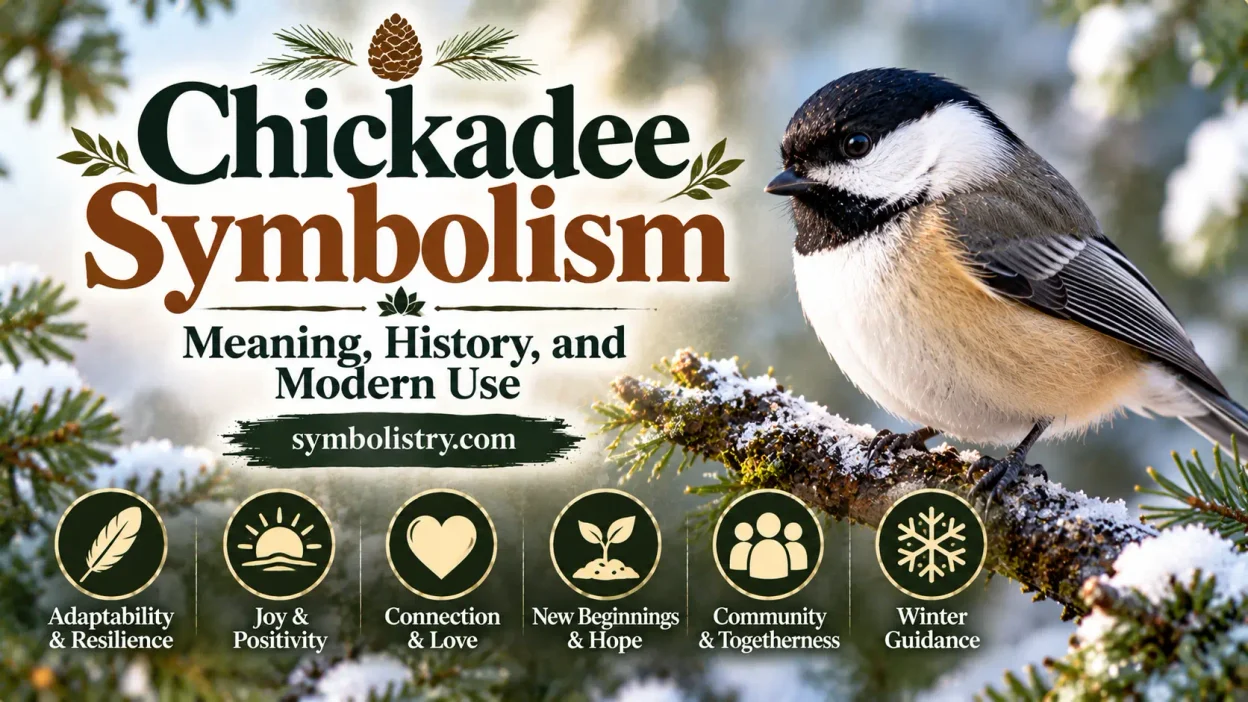
The chickadee is a small North American songbird recognized by its round head, black cap and bib, white cheeks, gray back, and lively behavior. In the United States, the Black-capped Chickadee and Carolina Chickadee are especially familiar in wooded neighborhoods, parks, gardens, and backyard bird feeders. Their curiosity and willingness to approach people have made them one of the easiest wild birds for many Americans to recognize.
Chickadee symbolism reflects those observable qualities. The bird is commonly associated with curiosity, friendliness, resilience, communication, courage, adaptability, and appreciation of ordinary pleasures. These meanings are not simply arbitrary spiritual labels; many come from the bird’s actual behavior, including its social flocking, complex calls, food-caching habits, and ability to remain active through severe winter weather.
The chickadee also has a place in Indigenous storytelling, including documented Cherokee traditions, where it appears in stories connected with knowledge, truth, and observation. Those traditions should be discussed specifically rather than treating all Native American cultures as though they share one belief system.
Quick Answer
Chickadee symbolism commonly represents curiosity, friendliness, courage, resilience, and clear communication in modern American culture. In historical Indigenous traditions, particularly some Cherokee stories, the bird is also associated with knowledge, truth, observation, and successful action.
TL;DR
- Chickadees symbolize curiosity, courage, friendship, and adaptability.
- Their winter survival supports associations with resilience and endurance.
- Cherokee stories connect the bird with knowledge and truth.
- American birdwatchers often associate chickadees with friendliness and familiarity.
- Modern designs use chickadees to express nature, simplicity, and optimism.
- A chickadee tattoo can represent resilience without suggesting aggression.
What the Chickadee Represents at a Glance
The chickadee’s symbolism is unusually close to its everyday behavior. Unlike symbols whose meanings depend mainly on elaborate mythology, this bird invites interpretation through what people can actually observe.
A chickadee is small, but it is not especially timid. It investigates its surroundings, moves rapidly through branches, communicates with flock members, and readily visits feeders. Its behavior can therefore suggest a kind of confidence that does not depend on physical size.
| Context | Meaning in the USA | Common Associations | Notes |
|---|---|---|---|
| Backyard sighting | Familiarity and friendliness | Nature, comfort, curiosity | Often encountered close to homes |
| Winter | Resilience | Endurance, preparation | Remains active in cold conditions |
| Flock behavior | Community | Cooperation, communication | Chickadees maintain complex social relationships |
| Bird calls | Communication | Alertness, honesty, awareness | Calls carry different kinds of information |
| Art and tattoos | Personal resilience | Courage, simplicity, nature | Meaning depends on the owner’s story |
This makes the chickadee especially suitable as a symbol of quiet confidence. It does not represent dominance or physical strength. Instead, it suggests that attentiveness, persistence, and social connection can be forms of strength.
Why Chickadees Are Associated With Curiosity
Curiosity is one of the most natural meanings attached to the bird.
Chickadees investigate people, trees, feeders, branches, and unfamiliar surroundings. Their behavior is energetic rather than passive, and they often seem to inspect their environment closely before moving on. Cornell describes Black-capped Chickadees as active and curious birds that occur in forests, parks, residential neighborhoods, and other places with trees or woody vegetation.
As a symbol, curiosity can therefore mean looking more closely before making assumptions.
Someone who chooses a chickadee image may be expressing an interest in exploration, observation, learning, or maintaining an open mind. In children’s art, educational settings, or nature-oriented design, the bird can also communicate discovery without appearing overly serious.
This is one reason the chickadee feels approachable. Its symbolism is usually about paying attention rather than possessing secret knowledge.
Courage Without Size
A chickadee can also symbolize courage, particularly the idea that courage does not require physical power.
The bird is only a few inches long, yet it remains active around much larger animals and regularly investigates its surroundings. Its willingness to approach feeders and people can make it appear remarkably confident.
There is an important distinction here. Chickadee symbolism is generally not about heroic conquest. It is closer to quiet bravery: showing up, responding to circumstances, protecting one’s space, and continuing ordinary life despite difficult conditions.
That interpretation works particularly well for people who see courage as persistence rather than confrontation. A small bird can represent the ability to remain present when circumstances are intimidating.
Resilience Through Winter
Winter gives the chickadee another important symbolic dimension.
Black-capped Chickadees remain in their northern ranges through cold seasons, and their behavior changes with seasonal conditions. They eat seeds, berries, insects, and other available foods, while storing food for later use. They also use sheltered cavities for nighttime protection.
This makes the bird an effective symbol of preparation and endurance.
The lesson is not simply “be strong.” It is more practical: prepare when resources are available, conserve what matters, and keep functioning when circumstances become harder.
For Americans living in regions with harsh winters, a chickadee can therefore carry a particularly recognizable seasonal meaning. Seeing one outside a window in January can evoke persistence without requiring a dramatic story behind it.
Communication, Attention, and the Chickadee Call
The famous chick-a-dee call is central to the bird’s identity.
Chickadees do not make only one undifferentiated sound. Their vocal system includes calls associated with social interaction and different levels of alarm. In Black-capped Chickadees, the number of “dee” notes can vary with the perceived threat level, while other calls serve different purposes.
That behavior naturally supports symbolic associations with communication, awareness, and paying attention to warnings.
A chickadee can therefore represent the value of saying what needs to be said and listening when someone else signals a problem.
This interpretation is especially relevant in modern life, where communication is often associated with constant digital noise. The chickadee offers a simpler image: communication has a purpose. A call can identify a companion, signal danger, maintain contact, or coordinate a social group.
Friendship, Community, and Social Connection
Chickadees are strongly social birds. Outside the nesting season, they form flocks and often associate with other small woodland birds, including nuthatches, woodpeckers, kinglets, and creepers.
This makes the chickadee a natural symbol of companionship and community.
Its social meaning is not necessarily about belonging to a huge group. Chickadees maintain individual relationships and flock structures while also interacting with other species.
In human symbolism, that can suggest a healthy balance between independence and connection. The message is not “never be alone.” Instead, it can be understood as recognizing the value of people who communicate, cooperate, and remain nearby when conditions change.
For this reason, chickadee imagery can work particularly well in gifts, family artwork, greeting cards, and memorial pieces that emphasize warmth rather than solemnity.
Chickadees in Indigenous Traditions
Chickadee stories should be approached with cultural precision because Indigenous nations across North America have distinct languages, histories, and traditions.
Documented Cherokee material connects the chickadee with ideas involving truth and knowledge, and Cherokee folklore includes stories in which the bird plays an important role. Historical collections also preserve Cherokee chickadee-related folklore, demonstrating that the bird was part of recorded storytelling traditions rather than being merely a modern symbolic invention.
One particularly well-known Cherokee story involves the monster Spearfinger. In versions of the story, the chickadee helps reveal the location of the monster’s vulnerability, making observation and accurate knowledge crucial to the outcome.
The broader lesson should not be reduced to “all Native Americans believe the chickadee means X.” A more responsible interpretation is that specific Indigenous traditions give the bird specific narrative roles, including associations with knowledge, observation, truth, or successful action.
That distinction matters because Native American cultures are not a single symbolic system.
The Chickadee in Crow Tradition and the Meaning of Adaptation
Another important story associated with the chickadee comes from the Crow tradition surrounding Plenty Coups.
The story describes a dream involving a chickadee and a catastrophic storm. The bird became associated with qualities such as listening, observation, and adapting to changing circumstances. The lesson concerned changing behavior in response to a transformed world rather than relying indefinitely on older ways of living.
This provides a particularly strong example of why chickadees can symbolize adaptability.
Adaptability is different from simply being cheerful. It means noticing what has changed and adjusting accordingly. In this sense, the chickadee can represent intelligence expressed through attention rather than force.
It is also a useful reminder that symbolic meanings can come from specific cultural stories and should not be detached from their original communities.
What Chickadee Symbolism Means in Modern American Culture
In contemporary United States culture, most encounters with chickadees happen in ordinary settings rather than formal religious ceremonies.
People see them at backyard feeders, in suburban trees, at nature centers, on hiking trails, and in local parks. Black-capped Chickadees are particularly familiar across northern areas, while Carolina Chickadees are common farther south and in the southeastern United States.
That familiarity gives the bird a distinctly homegrown American nature-symbol quality.
A chickadee often feels less grand than an eagle, less dramatic than a hawk, and less sentimental than a dove. Its appeal comes from its everyday presence.
For many Americans, it can represent the small pleasures of noticing wildlife close to home. A bird outside the kitchen window can become meaningful precisely because it is part of ordinary life.
Emotional and Psychological Meaning
Psychologically, chickadee imagery often works because it combines apparent vulnerability with visible confidence.
The bird is tiny and delicate-looking, yet energetic and persistent. That contrast allows people to project a useful emotional message onto it: being small does not mean being powerless.
The chickadee can also represent lightness during difficult periods. Its behavior does not deny hardship, particularly during winter, but it continues to search for food, communicate, move, and interact.
For someone recovering from a difficult period, the bird may therefore symbolize a return to ordinary pleasures: getting outside, noticing seasonal changes, reconnecting with people, or becoming curious about life again.
These are personal interpretations rather than scientifically fixed psychological meanings. The emotional value of an animal symbol depends heavily on an individual’s memories and circumstances.
Chickadee Symbolism in Tattoos and Personal Style
A chickadee tattoo can communicate resilience without using aggressive imagery.
Someone may choose the bird to represent surviving a difficult period, staying curious, honoring a loved one connected with nature, or remembering a particular place. A winter branch can emphasize endurance, while flowers or spring foliage can shift the meaning toward renewal and growth.
A pair of chickadees may emphasize companionship or partnership. A chickadee perched alone can suggest independence and quiet confidence.
Because the bird is visually distinctive, tattoos do not need extensive symbolic decoration. The black cap, white cheeks, small body, and characteristic posture are enough for recognition.
In personal style, chickadee imagery can also express an appreciation for regional nature without looking overly formal or imposing.
Chickadees in Home Decor, Art, and Digital Culture
Chickadees fit naturally into American nature-themed decor.
They appear in bird prints, calendars, garden illustrations, stationery, holiday ornaments, educational materials, and wildlife photography. Their recognizable shape also makes them easy to use in minimalist illustrations.
The bird’s winter associations make it especially suitable for seasonal artwork. A chickadee on a snowy branch can suggest endurance and peacefulness without relying on religious imagery.
Online, the symbol can work in a similar way. A chickadee photograph may communicate an appreciation for birds, gardening, hiking, conservation, or simple outdoor moments.
In digital culture, the meaning is usually personal rather than fixed. The same photograph might represent a favorite backyard visitor to one person and resilience after hardship to another.
Chickadee Symbolism in Relationships and Family Life
The bird’s social behavior makes it a natural choice for relationship symbolism.
Two chickadees can represent companionship, mutual attention, and shared experience. A parent-and-young image may emphasize care and family continuity, although the exact meaning depends on the artistic context.
Unlike symbols that strongly imply romance, the chickadee is flexible. It can represent friendship just as easily as partnership.
That makes it appropriate for gifts between friends, family members, or partners. Its symbolism tends to emphasize warmth and familiarity rather than possession or exclusivity.
Spiritual Interpretations Without Overstating Them
Modern spiritual and symbolic writing often describes chickadees as signs of joy, guidance, luck, hope, or positive change. These interpretations are common in contemporary animal-symbolism culture, but they should not be confused with universal religious doctrine.
A person who experiences a memorable chickadee encounter may choose to treat it as personally meaningful. For example, seeing one during a difficult morning might become a reminder to remain observant, hopeful, or connected with ordinary life.
There is no scientifically established message that a chickadee is required to deliver when it appears. The symbolic meaning comes from cultural tradition, personal belief, and the qualities humans associate with the bird.
That distinction allows spiritual interpretations to remain meaningful without presenting personal symbolism as objective fact.
Common Misunderstandings About the Symbol
One of the biggest misunderstandings is the claim that chickadees have one universal Native American meaning.
They do not. Different Indigenous nations have different languages, stories, and relationships with birds. A Cherokee story should not automatically be described as a Plains, Anishinaabe, Crow, or generalized “Native American” belief.
Another common mistake is treating every modern spiritual interpretation as ancient tradition. Associations such as positivity, hope, adaptability, and good luck are widely used today, but some are modern symbolic interpretations based on observed bird behavior rather than inherited religious doctrine.
The safest approach is to distinguish three things: documented cultural traditions, meanings derived from natural behavior, and personal spiritual interpretation.
How Chickadee Meaning Has Evolved
The chickadee’s symbolic history has changed as people’s relationship with the bird has changed.
In Indigenous storytelling, particular chickadee characters could carry narrative roles involving knowledge, truth, observation, or adaptation. Later American natural-history writing emphasized the bird’s friendliness, activity, and usefulness in the woodland environment.
Modern backyard birding has added another layer. Because chickadees readily visit feeders and live close to people, many Americans experience them as familiar neighbors rather than distant wilderness creatures.
That has shifted the bird toward meanings of comfort, everyday nature, resilience, and approachable curiosity.
Its symbolism has therefore become less dependent on formal mythology and more connected to lived experience. A person does not need to know a traditional story to understand why a chickadee might represent cheerfulness or persistence.
Frequently Asked Questions
What does a chickadee symbolize spiritually?
In modern spiritual symbolism, chickadees are often associated with joy, hope, curiosity, resilience, communication, and adaptability. These interpretations are personal or contemporary rather than universal religious teachings.
What does a chickadee symbolize in Native American traditions?
There is no single Native American interpretation. Specific traditions, including documented Cherokee stories, connect the chickadee with knowledge, truth, observation, and important forms of guidance.
What does a chickadee tattoo mean?
A chickadee tattoo can symbolize resilience, curiosity, friendship, courage, or a personal connection with nature. The surrounding imagery often changes the emphasis; winter scenery can suggest endurance, while flowers can suggest renewal.
Is seeing a chickadee considered good luck?
Some modern folklore and animal-symbolism traditions interpret chickadee encounters positively, including as signs of good fortune or encouraging news. There is no universal rule that seeing one predicts a particular event, so the meaning is best understood as cultural or personal.
Why are chickadees associated with resilience?
Chickadees remain active through cold seasons and use food-caching and sheltered cavities to manage difficult conditions. Their ability to continue functioning in winter naturally lends itself to symbolic ideas of preparation and endurance.
Does a chickadee symbolize friendship?
Yes, especially in modern symbolic interpretation. Chickadees live in social groups, communicate frequently, and interact with other woodland birds, making them a fitting symbol for companionship and community.
What does a chickadee symbolize compared with a larger bird like an eagle?
The chickadee usually suggests quiet courage, curiosity, community, and everyday resilience rather than authority or dominance. Its symbolism emphasizes persistence and attentiveness on a small scale.
Conclusion
The meaning of the chickadee comes from a combination of observable behavior, cultural storytelling, and personal experience. Its small size, curiosity, social nature, complex communication, and ability to remain active through winter explain why it has become associated with courage, resilience, friendship, adaptability, and attention.
For Americans today, chickadee symbolism often feels especially relatable because the bird is encountered in ordinary places: backyards, parks, neighborhood trees, and winter landscapes. It does not need to represent something grand to be meaningful. Its strongest message may be that persistence, curiosity, and connection can exist in a very small form.
That makes the chickadee a fitting symbol for people who value quiet courage, honest communication, close relationships, and the ability to adapt without losing their sense of joy.