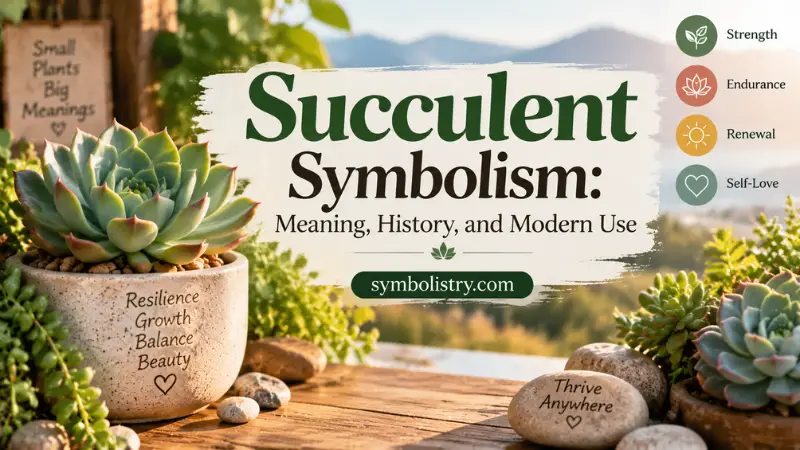
Succulent symbolism often centers on resilience, patience, protection, growth, and the ability to thrive with limited resources. These meanings come naturally from the plants themselves: succulents store water in thick leaves, stems, or roots and can survive periods when ordinary plants struggle. In the United States, they are also associated with simple living, home decoration, personal growth, and thoughtful gifts.
Unlike a rose or lily, a succulent does not have one fixed symbolic tradition. The category includes thousands of plants from many unrelated plant families, so the meaning depends partly on the species, its appearance, cultural setting, and the reason someone gives or displays it.
That flexibility is part of the appeal. A small echeveria on a desk can suggest patience and steady growth, while a jade plant may carry associations with prosperity. An aloe plant can suggest healing and protection, and a cactus can communicate endurance in difficult surroundings.
Quick Answer
Succulent symbolism commonly represents resilience, steady growth, patience, and self-preservation in modern American culture, especially in homes, gifts, gardens, and personal decor. Because succulents store water and survive dry conditions, they have also become natural symbols of endurance, while particular species add meanings such as prosperity, healing, protection, or remembrance.
TL;DR
- Succulents commonly symbolize resilience, patience, growth, and self-preservation.
- Their water-storage ability explains many modern associations with endurance.
- Jade plants are often connected with prosperity and good fortune.
- Cacti can represent strength, boundaries, and survival in harsh environments.
- Americans commonly use succulents in gifts, weddings, homes, tattoos, and decor.
- Meanings vary by species, culture, personal experience, and context.
What Succulents Represent at Their Core
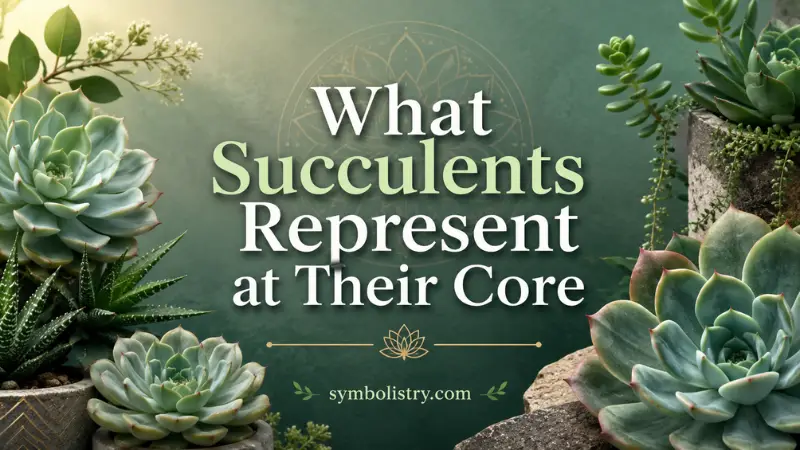
The most recognizable symbolic quality of a succulent is resilience.
Succulents are adapted to environments where water may be scarce or unpredictable. Their fleshy leaves, stems, or roots act as storage structures, allowing them to make use of water when it is available and endure periods of dryness.
That physical trait gives the plant an obvious symbolic message: save what you have, endure difficult periods, and continue growing when conditions improve.
This is why succulents can represent more than toughness. They can also suggest patience. A succulent does not need constant attention to remain alive, but it still requires the right conditions. Its symbolism therefore works well for the idea that meaningful growth can happen gradually.
Another common association is self-preservation. The plant does not survive by constantly receiving resources from its surroundings. Instead, it has evolved ways to conserve and manage what it receives.
For a modern reader, that can translate into an emotional message about conserving energy, setting limits, and becoming more independent.
Why Succulents Became Symbols of Resilience
The connection between succulents and resilience begins with biology rather than mythology.
Succulence refers to the development of specialized tissues capable of storing usable water. These adaptations occur across many unrelated plant groups, which means “succulent” describes a useful plant trait rather than one single botanical family.
Many succulents also have additional adaptations that reduce water loss. Depending on the species, these can include waxy surfaces, compact forms, reduced leaves, specialized roots, or forms of photosynthesis that help limit water loss.
To an observer, the result is striking. A plant may remain firm and alive despite conditions that would cause many other plants to wilt.
That makes endurance one of the strongest symbolic interpretations available.
A succulent can therefore be given to someone starting over, recovering from a difficult period, moving into a new home, or beginning a demanding stage of life. The message does not have to be supernatural. It can simply mean, “You can adapt, take care of yourself, and keep going.”
Ancient Roots and the Development of Succulent Meaning
There is no single ancient civilization that established one universal meaning for all succulents.
This distinction matters because many modern articles treat succulents as though they have always belonged to one organized symbolic tradition. In reality, succulent plants occur across different regions, climates, and plant families, and their cultural histories are equally diverse.
People have long used particular succulent species for food, medicine, landscaping, household purposes, religious practices, and ornamental gardening. Those practical relationships sometimes contributed to symbolic meanings.
For example, plants associated with healing naturally developed connections with restoration or protection in some settings. Plants that survived drought could become reminders of endurance. Plants with unusual shapes or long lifespans could acquire associations with strength or continuity.
The broad modern idea of the succulent as a symbol of resilience is therefore best understood as an interpretation built from observable plant characteristics and later cultural associations, rather than an ancient universal doctrine.
The word itself comes from a Latin term meaning “juicy,” referring to the moisture-rich nature of these plants. That physical characteristic remains central to understanding why succulents look and behave so differently from ordinary garden plants.
What Succulents Symbolize in the United States
In the United States, succulents have become strongly connected with low-maintenance living, contemporary interiors, gardening, and personal growth.
Their popularity is especially visible in homes, offices, patios, windowsills, wedding arrangements, plant shops, and small containers. Their compact forms also work well in apartments and workspaces where a large garden may not be practical.
American interpretations tend to be less formal than the symbolic traditions surrounding flowers such as roses or lilies. Someone may place a succulent on a desk because it represents calm persistence, while another person may simply like its shape.
Still, several meanings appear repeatedly:
- Resilience because the plant tolerates dry conditions.
- Growth because it continues developing even with limited resources.
- Patience because healthy growth can be gradual.
- Independence because many varieties do not require constant care.
- Protection particularly with thorny or defensive species.
- Prosperity especially with jade plants.
- Healing especially with aloe.
- Connection to nature through indoor gardening and biophilic design.
In American culture, these meanings often overlap rather than exist separately.
Succulent Meanings by Plant Type
Different succulents can communicate different ideas. Treating every species as though it carries exactly the same symbolism misses an important part of the subject.
| Succulent or Type | Common U.S. Association | Symbolic Idea | Why It Fits |
|---|---|---|---|
| Jade plant | Prosperity and good fortune | Financial growth | Rounded leaves are often compared with coins |
| Aloe | Healing and protection | Recovery and care | Traditionally valued for practical medicinal uses |
| Cactus | Endurance and boundaries | Strength and survival | Thrives in dry environments and may have spines |
| Echeveria | Beauty and individuality | Personal growth | Rosette form gives it a distinctive ornamental character |
| Christmas cactus | Celebration and continuity | Family and seasonal connection | Associated with holiday traditions and repeat blooming |
These associations are not universal rules. A plant’s meaning can change according to the person giving it, the occasion, the culture involved, and the species itself.
Jade Plants and the Symbolism of Prosperity
The jade plant, commonly known as Crassula ovata, has one of the strongest symbolic identities among popular succulents.
Its rounded, fleshy leaves are frequently compared with coins, helping explain its association with wealth, prosperity, financial success, and good fortune in popular East Asian-inspired plant traditions.
In American homes and businesses, jade plants are sometimes given as housewarming gifts or placed in offices because of these associations.
The phrase “money plant” is also used for several different plants, so it is important not to assume that every plant sold under a money-related name is the same species or carries the same cultural history.
The jade plant’s symbolism is particularly interesting because its meaning combines cultural association with visual resemblance. Its coin-like leaves provide an easy symbolic connection between the living plant and the idea of accumulated wealth.
For that reason, a jade plant can communicate an optimistic wish for steady prosperity rather than sudden luck.
Aloe Symbolism: Healing, Care, and Protection
Aloe has a different symbolic character.
Certain aloe species have a long history of practical use, and aloe vera is especially familiar because of the gel found inside its leaves. That practical relationship with soothing and skin care has helped make aloe a modern symbol of healing, comfort, restoration, and protection.
The plant’s appearance reinforces the idea. Aloe leaves are thick and protective, with pointed edges and a firm outer structure that shields the moisture-rich interior.
Symbolically, that creates an interesting contrast: outer protection surrounding inner nourishment.
An aloe plant can therefore work as a meaningful gift for someone going through change or recovery. It can express care without requiring a highly spiritual interpretation.
However, traditional medicinal uses should not be confused with proof that keeping an aloe plant in a room provides medical protection. Its symbolism comes from cultural associations and the plant’s practical history, not from supernatural properties.
Cactus Symbolism: Strength, Boundaries, and Survival
Cacti are technically succulents, although not every succulent is a cactus.
In the United States, cactus symbolism is especially influenced by the landscapes of the Southwest. Cacti can evoke deserts, heat, scarcity, independence, and the ability to survive in challenging conditions.
Their spines add another symbolic layer.
A cactus can represent boundaries because its defenses discourage unwanted contact. This makes cactus imagery useful when someone wants a symbol of strength that also communicates personal limits.
At the same time, cactus symbolism does not have to mean emotional hardness. A cactus stores water inside its body despite existing in a dry environment. That can suggest someone who appears tough externally but preserves considerable emotional or personal resources internally.
The plant’s distinctive shape also makes it popular in Western-style decor, tattoos, artwork, and fashion.
Succulents and the Meaning of Personal Growth
Growth is another important interpretation, but succulent growth is slightly different from the symbolism of a fast-growing vine or towering tree.
Succulents often encourage an idea of slow, sustainable development.
A small plant may produce new leaves, offsets, roots, or rosettes over time. Some varieties can be propagated from leaves or cuttings, turning one plant into several.
That process makes succulents particularly appropriate symbols for:
- starting a new chapter
- building confidence
- developing a skill
- recovering from setbacks
- creating healthier routines
- becoming more independent
The message is not “grow as quickly as possible.” It is closer to grow according to your conditions and resources.
That distinction makes succulent imagery especially compatible with modern conversations about patience and sustainable personal development.
Emotional and Psychological Meaning
People often choose symbols because they want an object to represent a feeling they cannot easily express.
Succulents can communicate a relatively quiet emotional message.
A succulent gift may say, “I believe you can get through this.” A plant placed in a new home may represent a fresh beginning. A growing collection can become a visible reminder of a person’s changing interests or accomplishments.
The plants can also represent healthy boundaries.
This is particularly clear with thorny species. The cactus does not survive by being completely open to its surroundings. It has defenses. In symbolic terms, that can represent learning when to protect personal space without abandoning growth.
There is also a psychological appeal in caring for a living thing that does not require constant attention. For some people, a small plant becomes a simple daily connection to nature and a visible reminder of gradual change.
That does not mean succulents have a universal psychological effect. Their emotional meaning depends heavily on personal experience.
Why Succulents Are Popular in Gifts
Succulents work well as gifts because they can carry several messages without being overly formal.
A bouquet eventually fades, while a potted succulent can continue growing. That makes it suitable for occasions involving new beginnings, appreciation, friendship, congratulations, or encouragement.
Common gifting situations include:
- housewarmings
- birthdays
- graduations
- new jobs
- weddings
- anniversaries
- thank-you gifts
- friendship gifts
- office celebrations
A jade plant can emphasize prosperity, while aloe can suggest care and recovery. A flowering succulent can focus more on beauty and celebration.
The container can also influence the message. A simple ceramic pot may create a calm, modern feeling, while a decorative planter can make the plant part of a larger home-design statement.
Succulents in Weddings and New Beginnings
Succulents have become common in modern wedding design because they are visually distinctive and can survive well beyond the event.
Their symbolism fits the occasion naturally. A wedding marks the beginning of a shared life, making growth, endurance, commitment, and continuity relevant themes.
Small succulents may appear in centerpieces, bouquets, favors, escort displays, or table decorations.
Unlike traditional floral symbolism, succulent wedding symbolism tends to feel contemporary and understated. The plant can suggest that a relationship is something to nurture over time rather than something defined only by a single beautiful moment.
For couples who prefer nontraditional wedding decor, succulents can also represent individuality. Their unusual shapes and colors make it possible to create arrangements that do not resemble conventional floral designs.
Succulent Symbolism in Tattoos and Personal Style
Succulent tattoos are often chosen for personal reasons rather than because the wearer follows a formal symbolic tradition.
A cactus may represent surviving a difficult period. An aloe design may commemorate healing. A jade plant might represent prosperity or a personal connection to a home, family member, or important stage of life.
The choice of species matters.
A sharply outlined cactus can communicate toughness and boundaries, while a soft echeveria rosette may emphasize beauty, individuality, or quiet growth.
Tattoo placement can add another layer of personal meaning, but there is no universal rule that assigns one interpretation to a particular location.
The strongest tattoo symbolism usually comes from the story behind the design rather than from a fixed dictionary of meanings.
Succulents in Home Decor and Digital Culture
Succulents became especially recognizable as symbols of modern indoor plant culture because they combine distinctive shapes with relatively simple care requirements.
Their geometric forms fit contemporary interiors particularly well. Rosette-shaped plants can look almost architectural, while upright cacti can provide strong visual lines.
On social media, succulents also became associated with plant collecting, minimalist decor, desk setups, gardening projects, propagation, and lifestyle photography.
This changed their cultural meaning somewhat.
A succulent is no longer only a desert-adapted plant. It can also represent a modern relationship with nature inside an urban environment.
That is an important shift in American culture. The plant may be physically far from its natural habitat, yet it becomes part of someone’s home identity and daily routine.
Cross-Cultural Meanings and Important Differences
Succulent meanings should not be treated as universal across cultures.
Jade plants, for example, have strong associations with prosperity and good fortune in some Chinese cultural and feng shui-inspired contexts. Those ideas have also become popular in American gardening and interior-design culture.
Aloe has been valued for practical and medicinal purposes in different regions, which contributes to its modern association with healing and protection.
Cacti have cultural histories connected to Indigenous peoples and communities of the Americas, and some species have important culinary, medicinal, religious, or ecological significance.
These traditions should not be reduced to generic claims about “spiritual energy.”
The safest interpretation is to distinguish documented cultural practices from modern symbolic associations. A plant can have an established cultural role in one community while being used mainly as decorative symbolism somewhere else.
Common Misunderstandings About Succulent Meaning
One of the biggest misunderstandings is that every succulent automatically symbolizes wealth.
That association is especially strong with jade plants, but it does not apply equally to all succulents.
Another misconception is that succulents have one ancient symbolic meaning shared by every culture. They do not. Succulents are a broad botanical category, and their cultural meanings developed in different places around different species.
It is also misleading to claim that a succulent guarantees luck, money, healing, or protection. These are symbolic interpretations, not predictable effects.
Finally, “low maintenance” does not mean “no care.” Succulents still need appropriate light, soil, drainage, temperature, and watering practices. Symbolically, this actually creates a useful distinction: resilience does not mean that conditions are irrelevant.
How Succulent Meaning Has Evolved
The meaning of succulents has shifted as the plants moved from natural landscapes into gardens, collections, homes, and commercial design.
Their earliest significance was closely tied to their physical usefulness and unusual adaptations. As ornamental gardening expanded, their unusual shapes made them desirable collector’s plants.
In the modern United States, the meaning has become more personal.
A succulent can now represent resilience after hardship, a minimalist lifestyle, a new home, a hobby, financial hopes, environmental awareness, or simply affection for plants.
Social media and interior design have accelerated this change by turning individual species into recognizable lifestyle objects.
Yet the original biological feature remains at the center of the symbolism: the ability to conserve resources and continue living through periods of scarcity.
That is why the resilience interpretation remains more broadly applicable than any single cultural association.
A Simple Way to Interpret a Succulent Symbol
If you are trying to understand what a particular succulent means, start with three questions.
First, what species is it? A jade plant and a cactus may both be succulents, but their cultural associations are different.
Second, why is it being used? A wedding centerpiece may represent lasting growth, while a desk plant may represent calmness and persistence.
Third, what does it mean to the person who chose it? Personal experience can be more important than any traditional interpretation.
This approach avoids forcing one symbolic meaning onto every plant.
For example, if someone gives you a jade plant after starting a business, prosperity is probably an important part of the message. If a friend gives you an aloe plant during a difficult period, care and recovery may be more relevant.
Symbolism works best when the object and the situation are considered together.
FAQ About Succulent Symbolism
Are succulents symbols of good luck?
Some succulents, particularly jade plants, are associated with good fortune and prosperity in certain cultural traditions. How
What does a succulent tattoo symbolize?
A succulent tattoo often represents surviving hardship, personal growth, resilience, independence, or protection. The exact meaning depends on the species and the personal experience connected to the tattoo.
What does giving someone a succulent mean?
Giving someone a succulent can express encouragement, friendship, appreciation, or wishes for steady growth. The species can make the message more specific, such as prosperity with jade or healing and care with aloe.
What does a succulent symbolize in the United States?
In modern American culture, succulents commonly represent resilience, personal growth, independence, and connection with nature. Jade plants may additionally represent prosperity, while cacti often suggest endurance and boundaries.
What does a succulent symbolize spiritually?
Succulents are commonly interpreted as symbols of resilience, patience, protection, growth, and endurance. Spiritual interpretations vary, so there is no single meaning that applies to every species or tradition.
Do succulents symbolize love?
They can symbolize lasting affection, commitment, patience, and a relationship that continues to grow over time. However, succulents do not have the same widely established romantic symbolism as roses.
What does a cactus symbolize compared with other succulents?
A cactus often carries stronger associations with endurance, self-protection, boundaries, and survival in harsh conditions. Its spines add a defensive quality that is less prominent in soft-leaved succulents.
Conclusion
Succulent symbolism is best understood through the plants’ actual characteristics and the meanings people have built around particular species. Across modern American culture, the strongest themes are resilience, patience, growth, protection, self-preservation, and prosperity, with jade, aloe, and cactus offering more specific associations.
What makes succulents especially relevant today is their combination of beauty and adaptation. They do not symbolize perfection or effortless success; instead, they suggest making careful use of available resources, protecting what matters, and continuing to grow when circumstances are not ideal.
For that reason, a succulent can be a simple but meaningful symbol of steady growth and the ability to endure without losing the capacity to flourish.