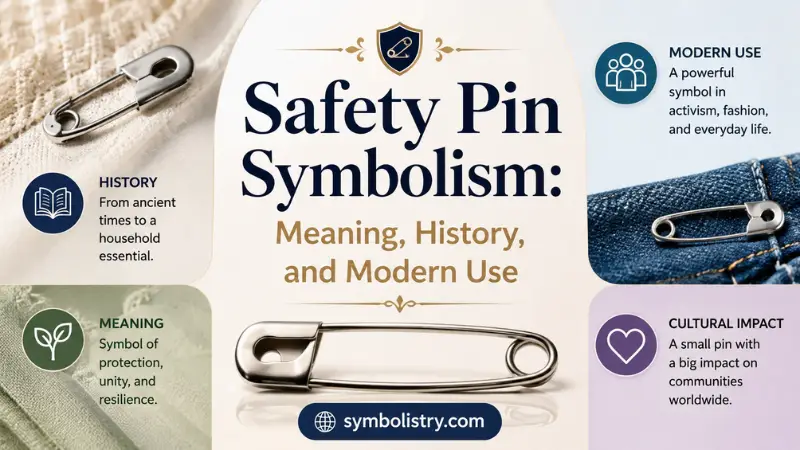
A small metal fastener may seem like an unlikely cultural symbol, but safety pin symbolism has developed several recognizable meanings in American life. Depending on where it appears, the pin can suggest protection, resilience, rebellion, solidarity, repair, or a deliberately do-it-yourself identity.
Those meanings did not emerge all at once. The modern safety pin began as a practical nineteenth-century invention. Punk culture later turned it into an anti-fashion statement, while social movements used it as a sign of allyship. In some communities outside the United States, safety pins also carry protective charms or appear in folk practices connected with warding off harm.
That history makes context especially important. A safety pin on a punk jacket can communicate something very different from one worn alone on a lapel or attached to a protective amulet.
Quick Answer: What Does a Safety Pin Symbolize?
Safety pin symbolism commonly represents protection, solidarity, resilience, and holding things together in modern American culture. It can also symbolize punk rebellion and nonconformity, while some cultural traditions use safety pins with charms as forms of spiritual protection.
TL;DR
- Safety pins commonly suggest protection, security, and keeping things together.
- Punk culture transformed them into symbols of rebellion and DIY identity.
- Americans used safety pins as allyship symbols after the 2016 election.
- Some cultures attach protective charms to pins against misfortune or envy.
- Tattoos and jewelry often personalize the pin as resilience or survival.
What a Safety Pin Looks Like and Why Its Design Matters
A standard safety pin is made from a single piece of bent metal wire. One end forms a sharp point, the middle includes a coiled spring, and the opposite end forms a clasp that covers the point when closed.
Its symbolism is unusually connected to this physical structure.
The object contains something sharp, yet its design controls and covers the danger. It joins pieces of material that might otherwise separate. It can temporarily repair torn clothing. Once fastened, it stays closed until someone intentionally releases it.
These characteristics help explain why people easily associate the pin with ideas such as:
- protection
- security
- repair
- endurance
- connection
- keeping oneself together
Unlike many symbolic objects, these meanings are not based primarily on mythology. They grow directly from what the object does.
The Core Meanings in Modern American Culture
There is no single official meaning attached to a safety pin. Still, several interpretations appear repeatedly in American fashion, activism, jewelry, tattoos, and personal expression.
| Context | Common Meaning in the USA | Typical Association | Important Note |
| Everyday symbolism | Protection | Safety, security, care | Comes from the pin’s protective clasp |
| Punk fashion | Rebellion | DIY culture, nonconformity | Strongly associated with 1970s punk |
| Activism | Solidarity | Allyship, opposition to harassment | Became prominent in the U.S. in 2016 |
| Tattoos and jewelry | Resilience | Repair, survival, staying together | Meaning is usually personal |
| Alternative fashion | Individuality | Outsider identity, creative independence | May be aesthetic rather than political |
The same pin can therefore communicate several ideas at once. A person may wear one because of punk history, while another may see it as a reminder of surviving difficult circumstances.
Protection and the Idea of Being Safe
The most intuitive interpretation comes from the object’s name and function.
A safety pin prevents its sharp end from remaining exposed. Once closed, the clasp surrounds the point and reduces the chance of accidental injury. Because of that construction, protection is almost built into the object’s visual language.
Symbolically, a closed pin can represent:
Personal safety. The covered point suggests danger brought under control.
Protecting someone vulnerable. Pins have long been associated with fastening clothing, including garments for infants.
Emotional boundaries. In modern personal symbolism, some people interpret the clasp as a metaphor for protecting what is private or fragile.
Reliability. A properly closed pin stays secured despite pulling or movement.
This does not make the safety pin a universal protective symbol. Rather, its physical purpose makes protection one of the easiest meanings for viewers to understand.
Why It Can Represent Resilience and Repair
Few household objects demonstrate temporary repair as clearly as a safety pin.
A torn hem, broken strap, loose button area, or ripped piece of fabric can often be held together with a pin until a permanent repair becomes possible. That everyday experience has produced another modern metaphor: something can be damaged without being completely lost.
In tattoos and jewelry especially, people sometimes use the pin to express ideas such as:
- “I survived.”
- “I am still holding together.”
- “Damage does not make something useless.”
- “Repair can be imperfect and still work.”
The symbolism is particularly effective because a safety pin does not hide the tear. When placed visibly across damaged fabric, it shows both the break and the effort to keep the material intact.
For that reason, resilience is usually a more grounded interpretation than vague claims about transformation or destiny.
The Modern Safety Pin Began as a Practical Invention
The familiar spring-loaded safety pin is closely associated with American inventor Walter Hunt of New York.
Hunt received a U.S. patent on April 10, 1849, for what he described as a type of dress pin. His design used one piece of wire to combine a point, coiled spring, and protective catch. The spring pushed the sharp end securely into the clasp.
Hunt reportedly sold the rights to the invention for $400, a modest sum compared with the commercial importance safety pins later achieved.
Earlier cultures had already created pins and brooch-like fasteners. Ancient Roman fibulae, for example, fastened garments with mechanisms that can look surprisingly familiar to modern eyes. However, it would be misleading to claim that modern safety-pin symbolism descends directly from ancient Roman religious or symbolic traditions.
For most of its early modern history, the safety pin was simply useful household hardware. Its major symbolic roles developed much later.
How Punk Turned an Ordinary Fastener Into a Rebellious Symbol
The most influential cultural transformation of the safety pin occurred during the punk movement of the 1970s.
Punk fashion deliberately rejected polished, expensive, respectable clothing. Torn shirts, distressed fabrics, chains, improvised accessories, reused materials, and visible repairs became part of its visual vocabulary.
Safety pins fit that world perfectly.
They were cheap. Anyone could find them. They repaired ripped clothing without making it look repaired in the traditional sense. Instead of hiding damage, punks often made the fastener visible.
British designers and cultural figures associated with the early punk scene helped turn this rough DIY look into an internationally recognizable style. Safety pins appeared on torn garments alongside chains, provocative graphics, bondage-inspired clothing, leather, and other confrontational elements.
Within that setting, the safety pin came to suggest:
Rejection of conventional fashion. The wearer did not need expensive accessories to create an identity.
DIY independence. Clothing could be cut, repaired, altered, and assembled by the wearer.
Nonconformity. An object normally hidden inside a sewing kit became decorative.
Social rebellion. The unfinished look challenged expectations about respectable dress.
American punk, alternative rock, grunge, and later subcultures inherited parts of this visual language.
Why Safety Pins Still Appear in Alternative Fashion
The safety pin never disappeared after punk’s original 1970s moment. Instead, fashion repeatedly reinterpreted it.
Today it can appear as:
- earrings
- necklaces
- oversized brooches
- bracelets
- jacket decorations
- bag charms
- chains
- decorative fasteners
Luxury jewelry may reproduce a humble safety pin in gold or precious stones, creating an intentional contradiction. An object associated with emergency repairs and cheap DIY clothing becomes an expensive accessory.
That tension is part of its appeal.
In American streetwear and alternative fashion, safety pins can still communicate edginess, independence, punk influence, or creative disregard for conventional styling. However, not every person wearing safety-pin jewelry is making a political or subcultural statement.
Sometimes it is simply a design choice.
How the Safety Pin Became a Sign of Solidarity
A second major modern meaning emerged in 2016.
Following the United Kingdom’s Brexit referendum in June, people began wearing visible safety pins to show solidarity with immigrants and others experiencing racist or xenophobic harassment. The idea was that a person wearing the pin could identify themselves as someone willing to stand beside people who felt threatened.
The word “safety” made the object especially suitable. The message was essentially: I intend to be a safe person around you.
The gesture crossed the Atlantic later that year.
After the November 2016 U.S. presidential election, some Americans began attaching safety pins to jackets, shirts, bags, and social-media profiles. Wearers generally intended them to signal support for people they believed might face racism, anti-immigrant hostility, religious discrimination, homophobia, or other forms of harassment.
This gave the pin a distinctly American political meaning for a period: visible allyship.
Why the American Allyship Meaning Became Controversial
The solidarity campaign was never universally accepted.
Some people appreciated the pin as a quiet sign that another person opposed harassment. Others argued that wearing an inexpensive symbol required almost no sacrifice and could allow someone to declare themselves an ally without actually helping anyone.
Critics particularly questioned whether people from socially privileged groups should be able to appoint themselves as “safe” simply by attaching a pin to their clothing.
The disagreement produced an important distinction:
Symbolic support is not necessarily practical support.
A pin may communicate an intention, but it cannot guarantee how the wearer will behave when someone is actually insulted, threatened, excluded, or discriminated against.
As a result, the solidarity meaning still exists, but it is best understood with its historical debate attached. For some Americans the symbol represented reassurance; for others it became an example of performative allyship.
Protective Pins and Charms in Other Cultural Traditions
Outside mainstream American political and fashion contexts, safety pins can play very different roles.
In parts of Turkey and the wider Mediterranean region, protective beads or small amulets may be attached to clothing using safety pins. One well-known example is the blue eye-shaped nazar charm associated with protection against the evil eye—the belief that harmful envy or an ill-intentioned gaze can bring misfortune.
Pins carrying protective objects have also been used on children’s clothing.
It is important to distinguish the two elements. In many cases, the charm carries the primary protective meaning while the safety pin serves as the attachment method. Over time, however, the pin itself can become associated with the protective practice.
Safety-pin use connected with spiritual protection has also been documented among some communities in Nigeria, including practices involving pregnant women. Beliefs vary by community and family and should not be generalized to all Nigerians, Muslims, Christians, or Africans.
These customs demonstrate why the object cannot be assigned one universal cultural meaning.
Is the Safety Pin a Religious Symbol?
Not in any broad or formal sense.
A safety pin is not a standard sacred emblem comparable to a Christian cross, Jewish Star of David, Islamic crescent in cultural usage, Hindu Om, or Buddhist dharma wheel.
When safety pins appear in religious or folk-protective settings, they generally function as practical carriers for amulets, beads, written prayers, ribbons, or other protective objects.
Individual families may also develop their own traditions around them.
Therefore, seeing someone wearing a safety pin should not automatically lead to assumptions about that person’s religion. Its strongest recognized meanings in the United States remain practical protection, punk-influenced rebellion, fashion, resilience, and modern solidarity.
Emotional and Psychological Meanings
The safety pin works well as a personal emotional symbol because its mechanics create simple metaphors.
Something sharp becomes contained.
Something torn becomes connected.
Something loose becomes secured.
Something vulnerable receives protection.
That makes the object useful for representing emotional containment, endurance, self-protection, recovery, or the effort to remain functional during difficult circumstances.
Some people also associate safety-pin jewelry with mental-health support or survival. These interpretations should be treated as personal or community-specific rather than universal codes. There is no single standardized mental-health meaning recognized whenever someone wears a safety pin.
The best interpretation is therefore usually the wearer’s own.
What a Safety Pin Tattoo Can Mean
Safety pin tattoos are especially common within punk, alternative, minimalist, and symbolic tattoo styles.
Possible meanings include survival, self-protection, rebellion, connection, repair, or refusing to fall apart.
Placement and surrounding imagery can change the message.
A pin closing an illustrated tear may suggest repair. A pin beside punk imagery can emphasize anti-establishment identity. A pin holding two objects together might represent commitment or connection. A small closed pin worn alone may simply stand for safety.
An open safety pin can feel different from a closed one. Because the point is exposed, some viewers may read it as vulnerability, unfinished repair, tension, or risk rather than security.
None of these meanings is automatic. Tattoos are personal, and the wearer may choose the design simply because of its visual style or family significance.
Jewelry Can Mean Protection, Rebellion, or Nothing Beyond Style
A safety-pin necklace or earring is especially difficult to decode without context.
Someone wearing a large pin with chains, leather, patches, and distressed clothing may be referencing punk culture. A delicate gold safety-pin necklace might represent resilience or family protection. A pin carrying an evil-eye charm may connect to a protective cultural tradition.
Another person may simply like industrial-looking jewelry.
This ambiguity is part of the object’s modern life. Safety pins have moved between utility, subculture, activism, folk protection, and luxury fashion, so no single interpretation owns the design.
Before assigning a meaning to someone’s jewelry, surrounding symbols and personal explanation matter more than the pin alone.
How the Meaning Changed Over Time
The evolution of the safety pin is unusually clear because each era added another layer rather than completely replacing the previous one.
In the nineteenth century, it was primarily a practical fastening tool.
By the 1970s, punk culture turned its cheapness and exposed mechanics into an anti-fashion statement. Practical repair became rebellion.
By the late twentieth and early twenty-first centuries, designers transformed punk references into jewelry and high fashion.
In 2016, activists gave the object another public message: solidarity with people vulnerable to harassment.
At the same time, protective folk uses continued in communities where safety pins carried charms, beads, or amulets.
Today all of those meanings can coexist.
That history explains why a safety pin can feel simultaneously ordinary and loaded with meaning. It remains a household tool while also functioning as a cultural sign whenever someone deliberately puts it on display.
Common Misunderstandings About the Symbol
One common mistake is assuming every visible safety pin represents the 2016 solidarity movement. That interpretation depends heavily on context and is far less automatic than it was during the campaign’s peak.
Another is claiming the safety pin has always symbolized rebellion. It did not. Its punk meaning emerged more than a century after the modern design was patented.
It is also inaccurate to describe the object as a universal religious protection symbol. Protective practices involving pins exist, but their beliefs, charms, and customs vary considerably between communities.
Finally, safety-pin jewelry does not necessarily reveal the wearer’s politics, mental health, religion, or subculture.
The safest interpretation is simple: notice the context before assigning the meaning.
FAQs
What does wearing a safety pin symbolize today?
It can symbolize protection, solidarity, resilience, punk identity, or nonconformity, depending on context. In the United States, the pin also retains an association with the 2016 allyship movement, although that meaning is not universal today.
Does a safety pin mean someone is an ally?
Sometimes. Visible safety pins were used after the 2016 U.S. election to signal support for marginalized people, but the movement also faced criticism for substituting symbolic gestures for meaningful action. A safety pin alone cannot prove someone’s beliefs or behavior.
What does a safety pin necklace mean?
A safety-pin necklace may represent protection, resilience, rebellion, connection, or punk-inspired fashion. Modern jewelry has borrowed the design so widely that it can also have no special symbolic meaning beyond personal style.
What does a safety pin tattoo symbolize?
Common interpretations include survival, repair, protection, staying together, and resistance to conformity. Punk-inspired tattoos may emphasize rebellion, while a pin closing a tear can visually represent recovery or repair.
Is a safety pin supposed to protect against the evil eye?
In some cultural traditions, a safety pin is used to attach an evil-eye bead or another protective amulet to clothing. The protective belief usually belongs to the wider cultural practice and charm rather than to every ordinary safety pin.
Is wearing safety pins still considered punk?
Safety pins remain one of punk fashion’s most recognizable visual references. However, mainstream and luxury fashion have used the design for decades, so wearing one does not automatically mean someone identifies with punk culture.
Is the safety pin a positive or negative symbol?
It is usually neutral to positive when representing protection, resilience, repair, or solidarity, while punk use emphasizes defiance rather than negativity. Controversy mainly surrounds whether symbolic allyship without action has meaningful value.
Conclusion
A safety pin became symbolic because its ordinary function already contains several useful metaphors: it protects a sharp point, joins separated material, and holds damaged fabric together. Punk culture added rebellion and DIY independence, while modern activism added solidarity and some cultural traditions connected pinned charms with protection from harm.
The meaning of safety pin symbolism therefore depends less on a fixed definition than on where the object appears and why it is being worn. On a patched jacket it may signal punk heritage; on a lapel it may recall allyship; in jewelry or tattoos it may represent survival, protection, or personal identity.
Its cultural importance comes from that flexibility. An object designed simply to fasten fabric became a way to communicate how people think about safety, repair, belonging, and resistance.