Introduction
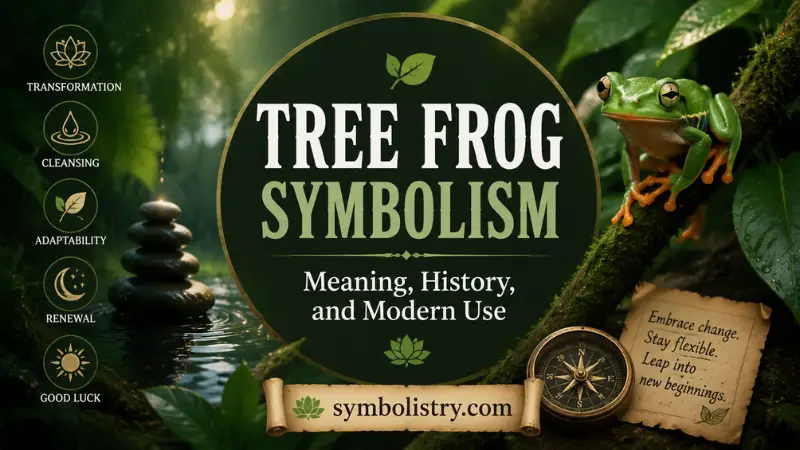
Tree frogs are small amphibians often recognized by their climbing ability, distinctive calls, and close relationship with vegetation and water. Because they move between land, plants, and water during different stages of life, tree frog symbolism often centers on adaptability, transformation, renewal, and finding safety in changing environments.
Unlike symbols based only on appearance, this animal invites meaning from observable behavior. Tree frogs climb, camouflage themselves, change with environmental conditions, emerge at night, and depend on healthy water and plant habitats. Those characteristics give people several natural ways to interpret the animal.
In the United States, tree frogs are especially familiar in gardens, forests, wetlands, ponds, and warm-weather landscapes. Their nighttime calls can become part of the sound of summer, while their ability to cling to leaves and branches makes them an appealing image for artwork, tattoos, nature-themed decor, and personal symbolism.
Understanding tree frog symbolism also requires separating broad frog symbolism from meanings specifically connected with tree-dwelling species. Ideas such as transformation and renewal come from frogs generally, while climbing, camouflage, patience, and movement between levels are more closely connected with the tree frog itself.
Quick Answer
Tree frog symbolism commonly represents adaptability, transformation, renewal, resilience, and connection with nature in modern American culture. More broadly, frogs have long been associated with water, fertility, seasonal change, and transformation because of their life cycle and close relationship with wetlands.
TL;DR
- Tree frogs commonly symbolize adaptability and personal transformation.
- Their climbing ability suggests progress, flexibility, and changing perspective.
- Green coloration often connects them with nature and renewal.
- Frog life cycles support symbolism involving rebirth and change.
- American interpretations often emphasize ecology, resilience, and natural awareness.
- Modern designs use tree frogs for tattoos, decor, art, and identity.
What a Tree Frog Represents at First Glance
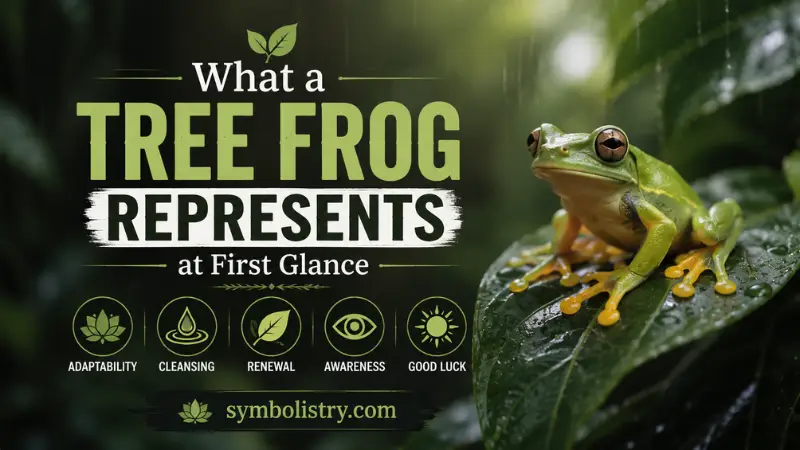
The physical appearance of a tree frog strongly influences how people interpret it. Many species are small, green, and closely associated with leaves, branches, shrubs, and damp environments.
Tree frogs also have specialized toe pads that help them grip surfaces. This ability makes climbing one of their most recognizable traits and gives tree frog symbolism a natural connection with flexibility, balance, and the ability to move through difficult surroundings.
The image of a small frog sitting on a leaf can therefore suggest calmness rather than aggression. It may represent someone who does not need to dominate a space to survive within it.
The animal’s relatively small size can also influence interpretation. Instead of suggesting physical power, the tree frog often communicates resourcefulness: making effective use of limited size, changing surroundings, and available shelter.
The Core Meaning of Tree Frog Symbolism
At its broadest, tree frog symbolism can be organized around five major ideas: adaptability, transformation, renewal, resilience, and environmental connection.
Adaptability comes from the animal’s ability to live among changing surfaces and conditions. A tree frog may move between vegetation, water, and ground-level environments depending on what it needs.
Transformation comes partly from the frog life cycle. A tadpole develops into an adult frog through one of the most recognizable forms of biological change in the animal world.
Renewal is connected with water, rainfall, breeding seasons, and the frog’s emergence during warmer and wetter periods. In symbolic language, these patterns can represent starting again after a difficult period.
Resilience comes from survival itself. Tree frogs are small and vulnerable animals, yet their adaptations allow them to avoid predators, find food, reproduce, and survive seasonal changes.
Finally, their dependence on vegetation and water creates an obvious connection with nature. This makes the animal particularly suitable for modern environmental and ecological symbolism.
Why Climbing Gives the Tree Frog a Special Meaning
One of the clearest differences between ordinary frog imagery and tree frog symbolism is the importance of vertical movement.
A tree frog does not simply move across the ground. It climbs stems, leaves, branches, and other surfaces, using specialized toe pads to maintain its grip. Symbolically, that behavior can suggest progress through stages rather than one dramatic leap toward a destination.
A tree frog climbing upward may therefore represent ambition, gradual improvement, or gaining a new viewpoint. The image works especially well for someone who has experienced a period of change and wants to express continued movement.
Climbing can also represent balance. The frog must maintain contact with an unstable surface, which creates a useful metaphor for handling uncertainty without losing direction.
For this reason, tree frog symbolism can suit people who see personal development as an ongoing process rather than a single achievement.
Transformation and the Frog Life Cycle
Transformation is one of the strongest meanings associated with frogs generally. The change from egg to tadpole and eventually to an adult frog provides an obvious biological example of development.
This does not mean every frog image automatically represents spiritual rebirth. The symbolic interpretation depends on context. A scientific illustration may simply represent biology, while a personal tattoo might use the same life cycle as a metaphor for recovery or identity change.
The transformation theme becomes especially relevant when tree frog symbolism appears in personal stories about starting over. Someone moving to a new city, changing careers, recovering from a difficult period, or entering a new stage of life might choose a frog image because it communicates development without suggesting perfection.
The important idea is not that the past disappears. Instead, the creature changes form while remaining part of the same life story.
Green Color and Natural Renewal
Green is an important visual element in many tree frog images. Although not every tree frog is green, several familiar species are strongly associated with green foliage and vegetation.
In American visual culture, green commonly suggests nature, growth, freshness, and renewal. These associations can strengthen tree frog symbolism when the animal is shown against leaves, moss, rain, or other natural settings.
A green tree frog may therefore communicate a desire to reconnect with the outdoors or live with greater awareness of the natural world.
Color should still be interpreted carefully. A green frog does not automatically have a universal meaning of healing or prosperity. The surrounding imagery matters, especially when the animal appears in artwork, fashion, or decorative design.
Water, Rain, and Seasonal Change
Frogs have an unusually visible relationship with water. They reproduce in aquatic environments, depend on moisture, and often become more noticeable during wet periods.
Tree frogs can therefore symbolize the relationship between changing conditions and new opportunities. Their calls after dark, especially during breeding periods, can become strongly associated with rain, warmth, and seasonal transitions.
This environmental connection gives tree frog symbolism another layer: renewal does not happen in isolation. Growth depends on conditions.
For a person, that idea can represent recognizing when circumstances are changing and responding instead of resisting them. The symbol can suggest that adaptation is sometimes more useful than trying to control everything around you.
Resilience Without Physical Strength
Tree frogs are not large or physically intimidating animals. Their survival depends on specialized adaptations, camouflage, quick movement, climbing ability, and environmental awareness.
That makes resilience one of the more interesting interpretations of tree frog symbolism. Resilience here does not mean overpowering an obstacle. It means finding a workable response to the obstacle.
This distinction can matter in personal symbolism. A person who identifies with the tree frog might be expressing the belief that strength can involve flexibility, patience, and knowing when to move.
The animal’s survival strategy offers a quieter definition of courage: stay alert, use your surroundings, and adjust when circumstances change.
Tree Frog Symbolism in the United States
In the United States, tree frog symbolism is often shaped more by nature appreciation and popular animal imagery than by one formal religious tradition.
Tree frogs occur across parts of the country, and several species are familiar to Americans through backyard gardens, wooded areas, wetlands, ponds, and nighttime sounds. Their presence can make them feel connected to local landscapes rather than distant mythology.
For many Americans, a tree frog can suggest summer, rain, childhood exploration, camping, gardening, or a fascination with wildlife. A child finding one on a porch or window can turn an ordinary evening into a memorable experience.
Environmental awareness adds another modern interpretation. Because amphibians are closely tied to water and habitat conditions, frog imagery can appear in educational and conservation contexts.
This gives tree frog symbolism a distinctly contemporary American dimension: the animal can represent not only personal change but also attention to the health of ecosystems.
Cultural and Folklore Connections
Frog symbolism appears in many cultures, although meanings differ significantly between traditions. Frogs have been associated with rain, fertility, abundance, transformation, and water in various parts of the world.
Ancient Egyptian traditions included frog imagery connected with fertility and childbirth, particularly through the goddess Heqet. In other cultures, frogs became associated with rainfall because their activity and calling can increase around wet conditions.
These traditions should not automatically be transferred to tree frogs specifically. Much of the older symbolism concerns frogs as a broader animal category rather than the modern biological classification of tree frogs.
That distinction is important when discussing tree frog symbolism responsibly. A contemporary tattoo of a tree frog may borrow general frog meanings while adding personal associations based on climbing, camouflage, color, or a particular species.
Emotional and Psychological Meaning
Symbolic animals often become useful because they give people a visual language for emotions that can be difficult to describe directly.
A tree frog may represent someone who feels comfortable adapting rather than remaining fixed. Its ability to move between surfaces can become a metaphor for navigating different social roles, environments, or stages of life.
Tree frog symbolism can also represent emotional patience. A frog sitting quietly on a leaf does not appear hurried, even though it remains alert to movement around it.
For someone recovering from stress or major change, the image can communicate a preference for gradual progress. It says less about dramatic victory and more about remaining capable while circumstances shift.
Tree Frog Symbolism in Tattoos
Tree frog tattoos are often chosen for their unusual appearance as much as their symbolic meaning. Bright colors, large eyes, curved limbs, leaves, water droplets, and climbing poses give artists plenty of visual options.
A person might choose tree frog symbolism in a tattoo to represent adaptation after a major life transition. Another person may simply love amphibians, forests, tropical imagery, or a particular species.
The pose can change the interpretation. A frog climbing upward may emphasize progress, while one sitting among leaves can suggest patience or environmental connection.
Adding flowers, rain, branches, mushrooms, or water can also create a more specific story. The final meaning belongs to the wearer rather than to a fixed symbolic dictionary.
Tree Frogs in Jewelry, Decor, and Art
Outside tattoos, frog imagery appears in garden decorations, paintings, ceramics, clothing, jewelry, children’s illustrations, and nature-themed home decor.
In these settings, tree frog symbolism often becomes lighter and more playful. A colorful frog on a garden ornament may simply celebrate wildlife, while a detailed botanical illustration can emphasize ecological beauty.
The animal also works well in designs intended to communicate individuality. Tree frogs have distinctive shapes and colors, making them visually recognizable without requiring an elaborate symbolic explanation.
In American homes, a tree frog image can therefore function as both decoration and personal expression. It may reflect a love of gardening, wildlife, outdoor recreation, or a general appreciation for small creatures that are easy to overlook.
A Quick Comparison of Tree Frog Meanings
| Context | Common Meaning | Main Association | Typical Use |
|---|---|---|---|
| Climbing tree frog | Progress and adaptability | Movement upward | Tattoos and personal art |
| Green tree frog | Renewal and nature | Vegetation and growth | Decor and illustrations |
| Frog near water | Change and renewal | Rain and wetlands | Nature-themed designs |
| Camouflaged frog | Awareness and flexibility | Survival | Personal symbolism |
| Frog life cycle | Transformation | Development and change | Spiritual or reflective art |
Positive and Negative Interpretations
Most modern interpretations of tree frogs are positive, but symbolism is not automatically favorable.
The positive side of tree frog symbolism includes flexibility, survival, growth, awareness, renewal, and environmental connection. These meanings are especially appropriate when the frog is shown climbing, resting among healthy plants, or interacting with water.
A more negative interpretation could involve instability or excessive adaptation. Someone who constantly changes to fit circumstances might view the frog as a reminder that flexibility can become avoidance if personal values are never firmly established.
The frog’s nocturnal habits can also inspire associations with the unknown, secrecy, or hidden activity. These meanings are contextual rather than universal.
The important point is that animal symbolism can hold contrasting meanings without becoming contradictory. A quality such as adaptability can be useful in one situation and unhealthy in another.
Common Misunderstandings About Tree Frog Symbolism
One common mistake is treating every interpretation found online as an ancient tradition. Many modern animal-symbol meanings are recent personal or spiritual interpretations rather than documented beliefs from historical cultures.
Another mistake is assuming that every tree frog carries exactly the same meaning. Species differ in appearance, habitat, behavior, and cultural visibility, so symbolism can change with the image.
It is also misleading to treat frogs as universal symbols of one concept. Their associations with fertility, rain, transformation, luck, and renewal appear in different contexts and traditions, but they do not form one worldwide belief system.
Good tree frog symbolism therefore begins with context. Ask what the animal is doing, where it appears, what colors surround it, and what the person using the image wants it to communicate.
Modern Spiritual Interpretations
Modern spiritual communities sometimes use frog imagery when discussing change, renewal, emotional release, or new beginnings. These interpretations can be meaningful to individuals, but they should be distinguished from documented historical religious traditions.
In this setting, tree frog symbolism may function as a personal reminder to remain adaptable during periods of uncertainty. The animal’s movement between water and vegetation can be interpreted as a metaphor for navigating different emotional or personal states.
Some people may also view encountering a frog unexpectedly as personally meaningful. That interpretation is subjective rather than a universal rule. A frog appearing near someone’s home does not automatically carry one predetermined spiritual message.
The strongest personal interpretation usually comes from the circumstances surrounding the encounter.
How the Meaning Has Evolved
The meaning of frogs has changed as people have gained new ways to understand animal behavior and ecology. Earlier traditions often interpreted frogs through agriculture, rainfall, reproduction, fertility, and seasonal patterns.
Modern audiences can add different layers. Ecology, conservation, personal development, tattoo culture, and social media imagery have expanded the symbolic possibilities.
This evolution explains why tree frog symbolism can now mean something quite different from older frog traditions. A person today may see a tree frog primarily as an emblem of environmental awareness or personal adaptability rather than fertility or rainfall.
The animal remains the same, but the cultural lens changes.
Why Tree Frog Symbolism Still Works Today
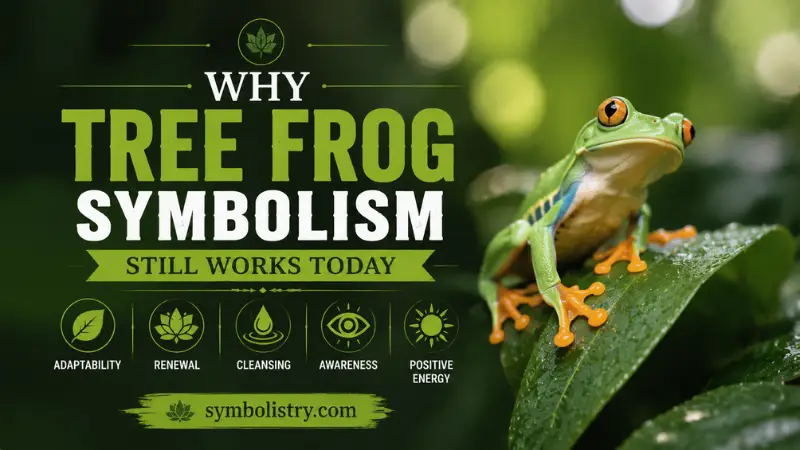
The appeal of tree frog symbolism comes partly from the fact that its meanings can be connected to observable characteristics.
The frog really does transform. It really does climb. Many species really do use camouflage. They really do depend on water and vegetation. These facts give the symbolism a physical foundation rather than requiring an entirely abstract interpretation.
That makes the animal especially suitable for modern audiences who want symbolic meaning without completely separating it from nature.
A tree frog can represent change while still being a real animal with a specific ecological role. That combination makes the symbol flexible enough for personal expression while remaining grounded in the natural world.
FAQs About Tree Frog Symbolism
What does a tree frog symbolize spiritually?
In modern spiritual interpretation, a tree frog may represent transformation, adaptability, renewal, and movement through changing circumstances. These ideas are contemporary interpretations and should not automatically be presented as ancient religious beliefs.
What does a green tree frog symbolize?
A green tree frog commonly combines frog associations with the visual meanings of green, including nature, freshness, and growth. The exact interpretation depends on whether the image is being used for decoration, personal symbolism, or cultural storytelling.
What does seeing a tree frog symbolize?
Some people interpret an unexpected tree frog encounter as a reminder of change, flexibility, or renewal. However, there is no universal rule that assigns one spiritual message to every encounter.
What does a tree frog tattoo symbolize?
A tree frog tattoo can represent personal transformation, adaptability, resilience, environmental appreciation, or a love of nature. The frog’s pose and surrounding elements can make the meaning more specific.
Is tree frog symbolism positive or negative?
It is usually interpreted positively, especially when associated with adaptability, renewal, resilience, and connection with nature. Negative meanings such as instability or excessive flexibility depend on the context in which the image is used.
Why are frogs associated with transformation?
Frogs undergo a visible life-cycle change from aquatic tadpoles to adults, making them a natural metaphor for development. Tree frog symbolism builds on that broader frog association while adding meanings connected with climbing, camouflage, and adaptation.
Does a tree frog symbolize good luck?
Some modern symbolic traditions associate frogs with luck or abundance, but this is not a universal meaning for tree frogs. In the United States, a tree frog is more commonly interpreted through nature, change, resilience, or personal symbolism.
Conclusion
Tree frog symbolism brings together several meanings that arise naturally from the animal itself: adaptability, transformation, resilience, renewal, awareness, and connection with nature. Its climbing ability adds ideas of progress and balance, while its life cycle provides one of the clearest natural examples of transformation.
In modern American culture, the tree frog can be used for personal expression, tattoos, artwork, garden decor, environmental themes, and simple appreciation of wildlife. Its meaning does not need to be mystical to be meaningful; the animal’s real behavior already provides a useful language for thinking about change.
The most grounded interpretation is perhaps the simplest: adapt without losing your footing, change without forgetting where you came from, and pay attention to the environment around you.