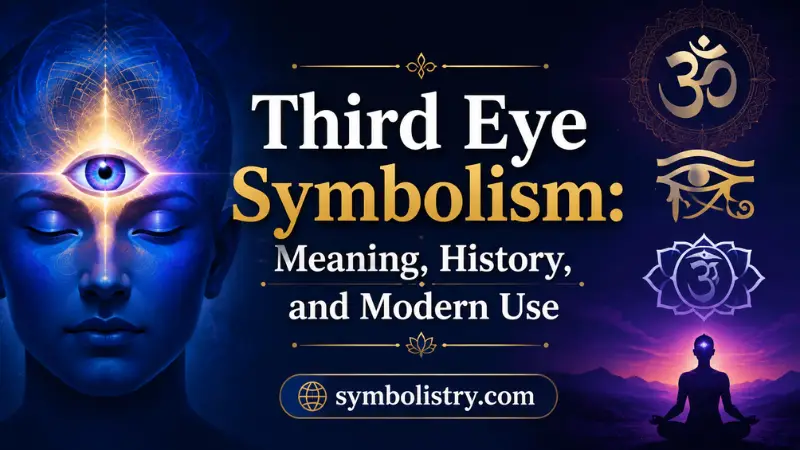
The image of an extra eye centered on the forehead is difficult to overlook. In third eye symbolism, that unusual placement is the point: the eye represents a form of perception that goes beyond ordinary physical sight.
Today, Americans encounter the third eye in yoga studios, meditation art, tattoos, jewelry, album graphics, clothing, wellness products, and social media. It commonly suggests intuition, self-awareness, spiritual insight, and the ability to recognize what is not immediately obvious.
Those modern meanings did not appear from a single source. Hindu religious imagery, yogic ideas about the ajna chakra, Buddhist forehead imagery, Western esotericism, and modern wellness culture have all shaped the way people understand the symbol. Keeping those traditions distinct makes the third eye more interesting—and prevents several common historical mistakes.
Quick Answer: What Does Third Eye Symbolism Mean?
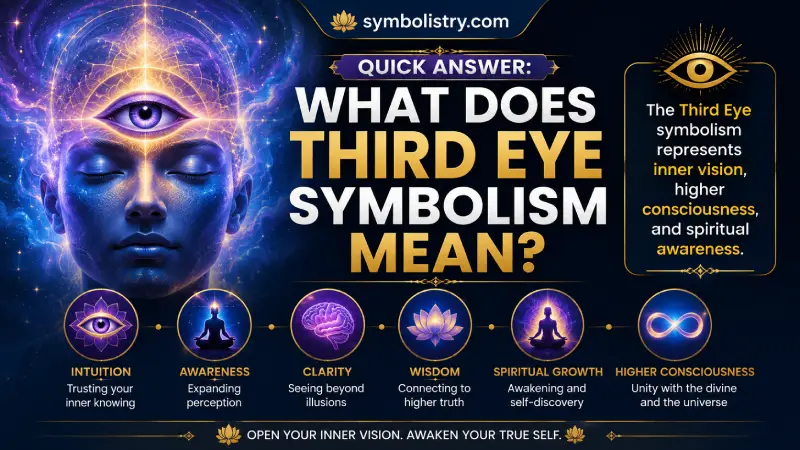
Third eye symbolism commonly represents intuition, heightened awareness, inner perception, and spiritual awakening in modern American culture. Its older associations include the ajna chakra in Hindu yogic traditions, Shiva’s divine third eye, and related Asian religious images connected with wisdom and awakened perception.
TL;DR
- The third eye mainly symbolizes intuition, awareness, and inner vision.
- Hindu traditions connect it with ajna, meditation, and spiritual perception.
- Shiva’s third eye can represent wisdom, ascetic power, and destruction of illusion.
- Modern American meanings were strongly shaped by Western esoteric and wellness culture.
- Indigo chakra imagery is largely a modern Western standardization.
- The pineal gland connection should not be mistaken for established mystical science.
What the Third Eye Symbol Looks Like
The simplest version shows a single eye in the middle of the forehead, positioned above and between the two physical eyes. This placement visually communicates the idea of seeing something that ordinary eyesight cannot detect.
Modern designs vary widely. The eye may be surrounded by rays, stars, geometric lines, lotus petals, moons, or chakra imagery. Some artwork uses blue, violet, or indigo because those colors became strongly associated with the brow chakra in modern Western chakra systems.
Traditional religious art does not follow one universal design. Shiva, for example, may be shown with a vertical eye on his forehead. Buddhist figures may display an urna, a forehead mark associated with the marks of a Buddha rather than a literal anatomical third eye.
Another important distinction concerns the Eye of Providence, the eye often shown inside a triangle and familiar from the Great Seal of the United States. Although contemporary artists sometimes combine it with third-eye themes, the two symbols developed through different historical traditions and should not automatically be treated as the same symbol.
The Core Meanings of the Third Eye
Most modern interpretations revolve around one basic idea: perceiving more than appearances reveal.
From that central idea come several related meanings:
Intuition. The third eye can symbolize trusting perceptions that arise before every detail can be logically explained.
Insight. It suggests recognizing patterns, motives, or truths that may not be obvious at first glance.
Self-awareness. Looking inward is as important as looking outward. For this reason, the symbol often represents honest examination of one’s thoughts, motives, habits, and emotions.
Spiritual awakening. In religious and metaphysical settings, the eye may represent greater awareness of spiritual reality.
Discernment. A third eye can suggest the ability to distinguish truth from illusion, appearance from substance, or impulse from wisdom.
Expanded perspective. Modern secular users sometimes adopt the symbol simply to represent curiosity, open-mindedness, and a willingness to question first impressions.
These meanings overlap, but they are not identical. Someone wearing a third-eye necklace may be expressing personal intuition without making any claim about psychic powers or religious belief.
The Ajna Chakra and Hindu Yogic Tradition
One of the most important roots of modern third-eye imagery is ajna, commonly called the brow or third-eye chakra in English-language yoga culture.
Chakras belong to South Asian systems of subtle-body practice, especially traditions connected with yoga and Tantra. Different historical texts describe different numbers and arrangements of chakras, so the familiar seven-chakra diagram should not be treated as the only ancient model. The highly standardized seven-center system familiar to Americans today developed through both Indian traditions and later Western reinterpretation.
Ajna is generally located symbolically around the area between the eyebrows. Its Sanskrit name is often translated in terms of command, authority, or direction. In yogic interpretation, it is associated with concentrated awareness, inner perception, and disciplined consciousness rather than ordinary physical vision.
This helps explain why the third eye became such a useful visual metaphor. Physical eyes observe the outside world; the symbolic inner eye represents a different kind of knowing.
Modern descriptions frequently connect ajna with intuition, and those associations have become especially influential in American meditation and wellness culture.
Shiva’s Third Eye: Wisdom, Fire, and Spiritual Power
The third eye also has an important place in Hindu images of Shiva, one of Hinduism’s principal deities. Shiva is frequently represented with an eye in the center of his forehead, making it one of his recognizable visual attributes. Museum collections preserve examples of this imagery from different regions and centuries.
Shiva’s third eye does not simply mean “intuition” in the casual modern sense. Its symbolism is more complex. It can express wisdom, divine perception, ascetic discipline, and destructive force.
A famous story makes that destructive aspect especially clear. While Shiva is absorbed in meditation, Kama, the god of desire, attempts to arouse him. Shiva responds by opening his third eye, whose fire burns Kama to ashes. The episode connects the eye with the intensity of ascetic concentration and the ability to overcome uncontrolled desire.
For modern readers, this story is sometimes simplified into “the third eye destroys illusion.” That interpretation captures part of the symbolism, but the traditional myth is richer. The eye can destroy, illuminate, discipline, and reveal. It is not merely a gentle emblem of inner peace.
Is the Buddhist Forehead Mark a Third Eye?
Buddhist art creates one of the most common points of confusion.
Many images of Buddhas show a small mark between the eyebrows called an urna. Traditional descriptions identify it as one of the bodily marks of a Buddha, and artists often portray it as a dot, jewel, curl, or raised mark.
Because of its location, modern viewers sometimes call the urna a third eye. Certain Buddhist artistic interpretations can indeed connect the forehead mark with extraordinary or inward vision. The Metropolitan Museum of Art, for example, describes an urna in Himalayan imagery as an inward-looking eye in a specific context.
Still, it is inaccurate to claim that the Buddhist urna and Hindu ajna chakra are simply two names for exactly the same thing. They developed within different religious frameworks.
The broader connection lies in awakening, extraordinary perception, and wisdom, not in a single universal doctrine shared unchanged across Asian religions.
How Third-Eye Ideas Reached the Modern West
The meaning Americans give the third eye today is partly the result of cultural exchange during the nineteenth and twentieth centuries.
Western occultists, scholars, spiritual seekers, and yoga teachers increasingly engaged with Indian religious ideas. The Theosophical Society, founded in New York in 1875, became especially important in the Western transmission and reinterpretation of Asian spiritual concepts. Its writers combined material from Indian religions with Western occult, philosophical, and metaphysical systems.
Chakra ideas gradually entered English-language books and spiritual movements. During the twentieth century, Western teachers increasingly linked chakras to psychology, glands, colors, personality traits, and stages of personal development.
By the late twentieth century, chakra language had moved far beyond small esoteric groups. It appeared in yoga classes, alternative spirituality, self-help books, popular entertainment, bodywork, and wellness businesses.
That transition matters because many associations that Americans now assume are ancient were actually standardized relatively recently.
Why Indigo Became the Color of the Third Eye
Search for third-eye artwork today and indigo or dark blue appears almost immediately.
Yet the idea that every chakra has one fixed color matching the rainbow is not a universal rule inherited unchanged from ancient India. Researchers tracing Western chakra history place the development of fixed spectrum-color associations mainly in twentieth-century Western esoteric and healing traditions.
The familiar arrangement became:
red for the root, orange for the sacral area, yellow for the solar plexus, green for the heart, blue for the throat, indigo for the third eye, and violet for the crown.
By the late twentieth century, books, workshops, yoga culture, and commercial products had made this color sequence feel traditional to many Americans.
Indigo now carries its own symbolism around the third eye: quiet concentration, nighttime awareness, introspection, and mental depth. Those are legitimate modern symbolic associations, but calling the entire color system an unchanged ancient teaching oversimplifies its history.
What the Third Eye Commonly Means in the United States
In the United States, the symbol rarely has only one religious meaning.
For a practicing Hindu, it may connect directly to spiritual concepts grounded in a living religious tradition. For a yoga practitioner, it may represent meditative focus or ajna. For someone interested in New Age spirituality, it can suggest psychic perception or an expanded state of consciousness.
Others use it much more loosely.
A musician may place a third eye on an album cover to suggest altered perception or creative vision. A clothing designer may use it as an emblem of individuality. A person choosing a tattoo may associate it with surviving deception and learning to trust personal judgment.
The modern American third eye therefore occupies an unusual space between religious symbol, spiritual metaphor, psychological emblem, and pop-culture image.
| Context | Common U.S. Meaning | Typical Association | Important Note |
| Yoga and meditation | Inner awareness | Ajna, concentration | Rooted partly in South Asian traditions |
| Spirituality | Awakening | Intuition, higher perception | Meanings vary greatly |
| Tattoos | Personal insight | Truth, growth, discernment | Often individualized |
| Fashion and decor | Alternative identity | Mysticism, creativity | May be largely aesthetic |
| Pop culture | Seeing beyond appearances | Mystery, altered perception | Often detached from religion |
| Wellness culture | Mental or energetic balance | Indigo chakra imagery | Many features are modern adaptations |
Emotional and Psychological Meaning
The third eye works well as a psychological symbol because it represents observation directed toward the self.
Someone who identifies with the symbol may be expressing a desire to understand why they react as they do rather than simply following impulses. In that sense, an “open third eye” becomes a metaphor for increased self-awareness.
It can also represent perspective. Physical sight shows what is immediately present. Symbolic inner sight asks what lies behind an event: What assumption am I making? What pattern am I missing? What motive is influencing me?
This does not require belief in supernatural perception. Many Americans use third-eye language figuratively in the same way people speak of “seeing clearly” after understanding a difficult situation.
Emotionally, the image often communicates calm attentiveness, curiosity, independence, and confidence in one’s judgment. In darker artwork, however, it can also suggest hyperawareness, paranoia, unwanted knowledge, or the disturbing feeling of seeing something that cannot be unseen.
Why the Third Eye Appears in Tattoos
Third-eye tattoos are especially flexible because the wearer can choose how literally or spiritually to interpret them.
For some people, the tattoo represents intuition and self-trust. It can mark a period in which they learned to recognize unhealthy relationships, question appearances, or rely more confidently on their own judgment.
For others, it represents spiritual development, meditation, or a relationship with Hindu-inspired yogic practice.
Artists may combine the eye with lotus flowers, moons, stars, snakes, hands, sacred geometry, or chakra imagery. These added elements change the design’s message. A lotus can emphasize spiritual growth, while celestial imagery may shift the emphasis toward cosmic consciousness or mystery.
Placement matters too. A third eye tattooed symbolically near the forehead creates a direct reference to the traditional location, while an eye on the arm, chest, or back functions more as an emblem.
Because some designs borrow directly from living religious traditions, understanding what accompanying Sanskrit, deity, or chakra imagery means is more respectful than choosing it solely for appearance.
Jewelry, Decor, Fashion, and Digital Culture
The third eye has become common outside explicitly religious environments.
Necklaces and rings use the eye as a small emblem of awareness or protection through vigilance. Meditation rooms may feature third-eye or chakra artwork to establish a contemplative atmosphere. Fashion brands use eye motifs because they immediately convey spirituality, eccentricity, artistic identity, or countercultural style.
Digital culture has loosened the meaning even further.
On social media, phrases such as “open your third eye” can mean anything from becoming more self-aware to rejecting mainstream assumptions. Sometimes the phrase is playful. At other times, it appears alongside conspiracy theories or claims that a person has discovered knowledge hidden from everyone else.
That range illustrates how symbols evolve. A religiously informed image of spiritual perception can become, in another setting, shorthand for skepticism, nonconformity, or secret knowledge.
Is the Third Eye the Pineal Gland?
Modern spiritual discussions frequently identify the third eye with the pineal gland, a small endocrine organ located deep in the brain.
There is a historical reason this comparison appealed to Western thinkers. The pineal gland has attracted philosophical speculation for centuries, including René Descartes’ famous association of it with the soul. Modern metaphysical systems later connected the gland with third-eye concepts.
Biologically, however, the pineal gland is best established for its role in producing melatonin and helping regulate circadian rhythms in response to the light-dark cycle.
There is no accepted scientific evidence that the pineal gland functions as a hidden visual organ that detects spiritual realities or grants psychic perception.
That distinction does not make third-eye symbolism meaningless. Symbols do not require literal anatomy to communicate ideas. It simply means that spiritual symbolism and established physiology should not be presented as the same type of claim.
Positive and Negative Meanings
The third eye is usually presented positively, but its symbolism can change with context.
Positive interpretations include:
- wisdom
- discernment
- intuition
- spiritual awakening
- self-knowledge
- mental clarity
- awareness beyond appearances
Darker interpretations can include obsession, surveillance, forbidden knowledge, paranoia, or psychological overload.
Horror art sometimes uses a forehead eye because an extra eye makes the human face look unfamiliar. Surreal artists use it to suggest altered consciousness. Conspiracy-oriented imagery may turn it into an emblem of hidden information or a supposed ability to recognize secret control.
These modern uses show why context matters. An eye surrounded by lotus petals communicates something very different from an eye surrounded by surveillance cameras.
Common Misunderstandings About the Third Eye
Several ideas are repeated so often that they can sound historically certain when they are not.
The first is that all ancient religions taught the same third-eye doctrine. They did not. Hindu chakra concepts, Shiva’s third eye, and Buddhist urna imagery overlap in themes of extraordinary perception, but they belong to different traditions.
Another mistake is treating the modern seven-color chakra chart as a fixed ancient system. Chakra traditions are older, but many familiar Western details—including standardized rainbow colors and certain psychological correspondences—developed much later.
The third eye is also sometimes confused with any image of a single eye. The Eye of Providence, the Eye of Horus, the evil-eye amulet, and Shiva’s third eye all have distinct histories even when contemporary art combines them.
Finally, “third eye opening” should not automatically be interpreted as a medical or scientific event. In traditional spiritual settings, it is symbolic and experiential language connected with practice and awareness.
Using Third-Eye Imagery Respectfully
Cultural exchange has always influenced art and symbolism, so using a third-eye design outside its original cultural setting is not automatically disrespectful.
The problem comes when complex traditions are reduced to false claims.
Saying that the third eye can represent intuition or self-awareness is reasonable in modern American symbolism. Claiming that every Hindu or Buddhist tradition teaches one identical system is not.
Religious images also deserve more care than generic eye designs. A tattoo depicting Shiva, Sanskrit mantras, or a specific chakra diagram carries cultural and devotional meanings beyond its visual style.
Respectful use begins with a simple distinction: personal interpretation can coexist with historical accuracy. A person may give a symbol an individual meaning without rewriting where its older meanings came from.
How the Meaning Changed Over Time
The third eye did not travel through history as one fixed image with one definition.
In Hindu religious contexts, third-eye imagery became strongly associated with divine perception, asceticism, wisdom, and Shiva’s extraordinary power. Yogic and Tantric systems developed subtle-body concepts in which centers such as ajna were used within disciplined spiritual practices.
Buddhist traditions produced their own forehead imagery connected with awakened beings and extraordinary qualities, though these should not simply be folded into the Hindu chakra system.
Western esoteric movements then encountered and reinterpreted Asian religious concepts. During the nineteenth and twentieth centuries, writers increasingly combined chakras with Western occultism, psychology, anatomy, colors, and personal-development systems.
By the late twentieth and early twenty-first centuries, Americans could encounter the third eye without entering a temple or studying an esoteric text. It had become part of yoga, wellness branding, tattoos, festivals, fashion, music, and internet culture.
The basic metaphor nevertheless remained surprisingly stable: ordinary eyes see surfaces; the third eye represents another level of understanding.
FAQs
Is the third eye a positive symbol?
Usually, yes. It commonly represents awareness, intuition, wisdom, and personal insight. In darker artistic contexts, however, it can symbolize paranoia, unwanted knowledge, surveillance, or disturbing perception.
What does a third eye tattoo symbolize?
A third eye tattoo often represents intuition, self-awareness, spiritual growth, or the ability to see beyond appearances. Its exact meaning depends on the wearer and on additional imagery such as lotuses, moons, geometric patterns, or deities.
Is the third eye a Hindu symbol?
The third eye has major roots in Hindu religious and yogic traditions, particularly through Shiva and the ajna chakra. Modern third-eye imagery has also absorbed ideas from Buddhism, Western esotericism, New Age spirituality, and popular culture, so not every modern use is specifically Hindu.
Does Buddhism have a third eye?
Buddhist art sometimes contains forehead imagery that modern viewers compare with a third eye, especially the urna shown between a Buddha’s eyebrows. The urna has its own Buddhist history and should not simply be described as another name for the Hindu ajna chakra.
Does an open third eye mean psychic powers?
Some modern metaphysical traditions associate the third eye with clairvoyance or psychic perception. More broadly, people use “opening the third eye” metaphorically for greater awareness, insight, or spiritual understanding, and such supernatural claims are matters of belief rather than established science.
Is the third eye connected to the pineal gland?
Modern esoteric systems often connect them, but the relationship is primarily symbolic or spiritual. Medical science identifies the pineal gland mainly as an endocrine organ involved in melatonin production and circadian regulation.
Conclusion
At its broadest, third eye symbolism represents the ability to perceive what ordinary sight misses. That can mean intuition, spiritual awareness, careful self-examination, wisdom, or the ability to look past appearances.
Its history is more layered than the familiar indigo eye seen on modern posters and jewelry. Hindu traditions surrounding ajna and Shiva, Buddhist forehead imagery, Western esotericism, and American wellness and popular culture have each contributed different ideas.
Understanding those differences makes the symbol more meaningful. The third eye does not need one universal definition; its enduring usefulness comes from a simple human idea—the possibility that learning to see clearly involves more than simply opening our physical eyes.