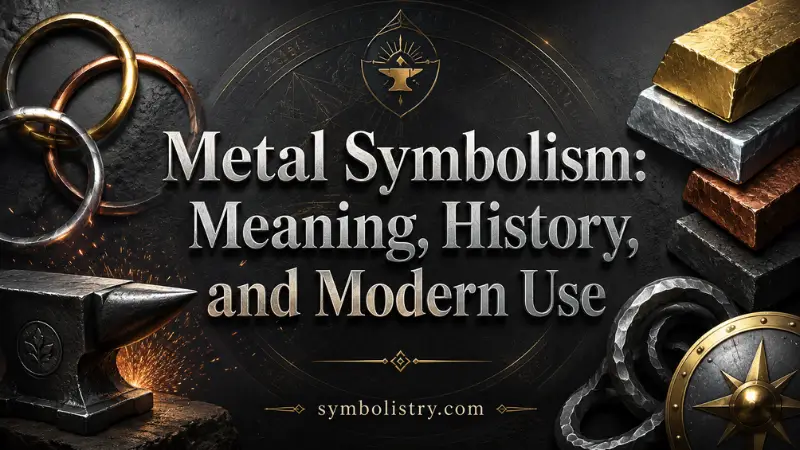
Metal symbolism is closely connected with ideas of strength, wealth, permanence, protection, status, transformation, and human achievement. Metals became symbols because people noticed their unusual physical qualities: gold resists corrosion, silver reflects light, iron can be forged into tools and weapons, and bronze combines different metals into a durable material.
Unlike a flower or animal with a more recognizable symbolic tradition, metal does not have one universal meaning. Gold can suggest success and divinity, while iron may represent endurance or defense. Silver can suggest purity and reflection, copper can be linked with beauty and healing traditions, and bronze often carries associations with achievement, craftsmanship, and public honor.
These meanings remain visible in modern American life. People encounter them in wedding rings, medals, jewelry, architecture, religious objects, military traditions, home decor, tattoos, fashion, coins, and awards. Understanding the material itself often explains why a particular metal came to represent a particular idea.
Quick Answer
Metal symbolism commonly represents strength, value, durability, achievement, and protection in modern American culture, especially through jewelry, awards, architecture, money, and personal objects. Historically, individual metals also became associated with the sun, moon, gods, warfare, purity, prosperity, and transformation in different cultures.
TL;DR
- Gold commonly represents achievement, wealth, excellence, and lasting value.
- Silver is often associated with reflection, purity, the moon, and refinement.
- Iron commonly symbolizes strength, endurance, defense, and practical power.
- Copper can represent beauty, connection, healing traditions, and craftsmanship.
- Bronze often communicates achievement, honor, endurance, and public recognition.
- Meanings change according to culture, historical period, object, and personal context.
Why Metals Became Symbols in the First Place
Metals are unusual materials because humans can transform them.
Stone can be shaped, wood can be carved, and clay can be molded, but metal presents a particularly dramatic process. Ore must be extracted, heated, separated, hammered, cast, polished, or alloyed before it becomes a useful object.
That transformation encouraged symbolic associations with creation, mastery, power, and change.
A piece of raw ore and a finished sword are made from related material, yet they look completely different. Human skill bridges that gap. Ancient metalworkers therefore occupied an important position in many societies because their work required specialized knowledge and access to valuable resources.
Metals also differ visibly. Gold is bright and yellow, silver is pale and reflective, copper has a reddish-orange color, and iron develops dark or reddish surfaces through corrosion. These physical differences gave people an easy way to connect materials with natural forces, social values, and religious ideas.
Rarity mattered, too.
A material that was difficult to obtain could become a marker of status. A material that was unusually durable could become associated with permanence. A material that made superior weapons could acquire associations with military authority.
The symbolism was therefore not arbitrary. It often began with something people could see, touch, trade, use, or transform.
Gold Symbolism: Wealth, Achievement, and the Sun
Gold has probably developed the most widely recognized symbolic identity of all metals.
Its yellow brilliance, resistance to tarnishing, rarity, and high economic value encouraged associations with wealth, excellence, immortality, authority, and the sun.
Ancient Egyptian traditions provide one especially clear example. Gold was connected with the sun and divine qualities, and gold was used extensively for jewelry, temple objects, funerary items, and images of gods. Egyptian gold objects survive in large numbers because the material was valuable both practically and symbolically.
The association between gold and the sun also appears beyond Egypt. Gold’s ability to catch and reflect light makes the comparison almost inevitable: the material seems to contain sunlight.
That physical appearance helps explain why gold frequently appears in crowns, sacred objects, royal ornaments, and ceremonial objects.
In modern America, gold has retained many of these associations but usually in secular forms.
A gold medal represents first place. A gold wedding band can represent lasting commitment. Gold jewelry can communicate luxury, financial success, celebration, or family heritage.
Gold therefore has two closely related meanings: value and achievement.
When someone receives a gold award, the material is not merely decorative. It communicates that the achievement occupies a highest or exceptional category.
Silver Symbolism: Purity, Reflection, and the Moon
Silver has a different visual personality.
Its pale surface reflects light rather than producing the warm glow associated with gold. That quality helped create associations with the moon, purity, clarity, reflection, and the sacred in several historical traditions.
Ancient Egyptian evidence is particularly specific. Egyptians associated silver with the moon, ritual purity, and the bones of the gods, contrasting it with gold’s relationship to the sun and divine flesh.
Silver also became valuable because it could be shaped into vessels, jewelry, mirrors, ornaments, coins, and ceremonial objects.
Its reflective surface naturally supports symbolic ideas of self-examination and clarity. A mirror does not simply show light; it returns an image to the viewer. That makes silver imagery especially compatible with ideas of reflection, awareness, and truth.
In the United States, silver has several modern identities.
It can represent elegance without the extravagance often associated with gold. Silver jewelry is common across age groups and styles, and sterling silver objects often have an understated appearance.
Silver also has an important financial history in the United States. Early American monetary systems used both gold and silver, and silver played a major role in domestic coin circulation during the nation’s early economic development.
That history adds another layer to its symbolic meaning: silver can represent value that is practical, established, and accessible, rather than purely luxurious.
Iron Symbolism: Strength, Defense, and Endurance
Iron has a very different symbolic character from precious metals.
It is not valued primarily for its shine. Its importance comes from what it can do.
Iron can become tools, agricultural equipment, nails, structural components, blades, armor, and countless other objects. As ironworking developed, the material changed warfare and agriculture in many societies.
That history made iron a natural symbol of strength, toughness, endurance, discipline, and defense.
The symbolic connection became especially strong in Europe and other regions where iron was linked with weapons and protective objects. Folklore in several traditions also treated iron as a substance capable of warding off supernatural threats. The familiar horseshoe is one surviving example of this protective association.
Iron’s symbolism can therefore be divided into two related categories:
Physical strength: the ability to withstand force.
Protective strength: the ability to keep danger outside.
The second meaning explains why iron appears so naturally in gates, fences, armor, locks, tools, and defensive structures.
In modern American language, “iron” can also suggest discipline. An “iron will” describes someone who remains determined despite pressure.
The material has therefore moved from literal strength to character strength.
Copper Symbolism: Connection, Beauty, and Transformation
Copper occupies an interesting position between precious and practical metals.
It has a distinctive reddish color, conducts electricity and heat well, can be worked into useful objects, and can develop a green patina over time.
That visible aging makes copper especially interesting symbolically.
A polished copper surface can appear warm and lively. An aged surface can suggest history, weathering, and transformation. The same object may therefore communicate different ideas depending on its condition.
Ancient and later traditions also connected copper with Venus and related ideas of beauty, attraction, love, and harmony. These associations developed within classical and alchemical traditions in which metals were linked with planets and other symbolic systems.
Copper also has important ritual roles in South Asian traditions, including the use of copper vessels and objects in religious practice. Such traditions should be understood within their specific cultural and religious contexts rather than reduced to a generic claim that copper is universally “spiritual.”
In American culture, copper often has a more practical and design-oriented identity.
It appears in cookware, plumbing, architecture, jewelry, sculpture, lighting, and interior design. Its warm color makes it especially popular when designers want a material that feels both industrial and decorative.
Its symbolism can therefore center on craftsmanship, warmth, adaptability, and transformation.
Bronze Symbolism: Achievement, Craftsmanship, and Public Honor
Bronze is technically an alloy rather than a naturally occurring pure metal. Traditionally, it is made primarily from copper and tin, although historical bronze compositions vary.
That fact is symbolically interesting because bronze represents combination and transformation.
Two different materials become a new material with different properties.
Ancient civilizations used bronze for weapons, tools, vessels, sculptures, ritual objects, and ornaments. In ancient China, bronze casting became closely connected with elite ritual culture, including decorated vessels used in ceremonies associated with ancestors and political authority.
Bronze also became important in ancient Mediterranean art. Greek and Roman artists used it for sculptures, weapons, vessels, and other objects.
Its modern American symbolism is particularly visible in awards.
A bronze medal generally represents third place, but that does not mean bronze has a negative meaning. The material still communicates recognized achievement.
Bronze is also frequently used for statues and monuments because it is durable and can preserve detailed forms. Public sculptures made from bronze can therefore symbolize memory, civic identity, historical figures, or collective achievement.
A Quick Comparison of the Major Metals
The symbolic meaning becomes easier to understand when the most familiar metals are placed side by side.
| Metal | Common U.S. Meaning | Historical Associations | Common Modern Uses |
|---|---|---|---|
| Gold | Success, wealth, excellence | Sun, divinity, royalty | Jewelry, awards, wedding rings |
| Silver | Elegance, purity, reflection | Moon, ritual purity, value | Jewelry, awards, decor, coins |
| Iron | Strength, defense, endurance | Weapons, protection, craftsmanship | Tools, architecture, decor |
| Copper | Warmth, beauty, adaptability | Venus, ritual use, craftsmanship | Jewelry, cookware, architecture |
| Bronze | Achievement, honor, permanence | Ritual objects, sculpture, authority | Medals, monuments, sculpture |
These meanings are useful starting points, not universal rules. The same metal can communicate different ideas depending on what has been made from it and why.
Ancient Metal Symbolism and Religion
Religious traditions frequently gave metals meanings beyond their practical value.
One reason is straightforward: religious objects often need to communicate ideas visually. Material becomes part of that communication.
A gold object can communicate honor or divinity before anyone explains its meaning. Silver can create an impression of brightness and purity. Bronze can convey durability and ceremonial importance.
Ancient Egyptian material symbolism provides particularly strong evidence of this approach. Gold and silver were not simply interchangeable expensive materials; their different colors and properties supported different divine associations.
Ancient Chinese bronze traditions show another pattern. Bronze vessels were not merely containers. Their elaborate forms and inscriptions could participate in ritual and express social and political relationships.
This is an important point when interpreting metal symbolism today.
A historical culture may have treated a metal as sacred because of a specific religious system, while a modern American may choose the same metal because it looks attractive.
The material is the same, but the symbolic context is different.
Metals, Alchemy, and the Idea of Transformation
Metal symbolism became especially elaborate in alchemical traditions.
Alchemy connected metals with planets, colors, processes of transformation, and philosophical ideas. Gold represented an ideal state in many alchemical systems, while other metals could be positioned along a symbolic path toward refinement.
The familiar image of an alchemist attempting to transform lead into gold captures a broader idea: ordinary material becoming something more valuable.
Historical alchemy was more complicated than this popular image suggests, but transformation remained central to its language and practice.
Metals were especially suitable for this kind of symbolism because they visibly change under heat.
Ore can become liquid. Liquid metal can become a tool or ornament. A rough surface can be polished. An alloy can be created by combining materials.
That sequence makes metallurgy a natural metaphor for personal transformation.
Modern readers sometimes borrow alchemical symbolism to describe self-improvement, creativity, or psychological change. This is a modern interpretive use rather than evidence that ancient people held one uniform system of metal meanings.
Metal Symbolism in the United States
American culture gives metals a particularly strong connection to achievement and public recognition.
The most obvious example is the medal.
Gold, silver, and bronze have become a familiar hierarchy in sports and competitions. The materials allow viewers to understand an achievement almost instantly.
This tradition extends beyond athletics.
The United States has used gold and silver medals to honor military leaders, public figures, inventors, rescuers, and other individuals. The Comitia Americana medals, for example, were authorized during the Revolutionary War period to honor significant battles and military officers.
The symbolism remains visible in contemporary American life.
A gold award suggests the highest distinction. Silver indicates a major accomplishment. Bronze communicates recognized success.
Even when the actual object contains little or none of the named precious metal, the material category remains meaningful.
That tells us something important about symbolism: people do not always need the physical substance for its cultural meaning to survive.
Metals in Jewelry and Personal Identity
Jewelry is one of the most personal places where metal symbolism appears.
A gold ring may communicate family wealth, commitment, achievement, or tradition. Silver may suggest simplicity, individuality, elegance, or a preference for cooler tones.
The choice can also reflect identity.
Someone might wear a heavy iron or steel ring because it feels rugged and industrial. Another person may choose copper jewelry because of its color and handmade appearance.
In engagement and wedding rings, metal can become part of a relationship’s visual identity. Gold often carries traditional associations with permanence and value, while platinum can communicate durability and exclusivity.
These meanings are not fixed.
A person may choose a particular metal simply because they like how it looks against their skin. Personal preference can coexist with cultural symbolism without requiring one to replace the other.
Metals in Weddings, Anniversaries, and Milestones
Metal has a strong role in American celebration traditions.
Wedding rings themselves are an obvious example. Their circular form traditionally suggests continuity, while the metal communicates durability and value.
Anniversary traditions add another layer. Silver and gold have long been associated with major marriage milestones, especially the 25th and 50th anniversaries. The custom became more standardized in Europe during the nineteenth century and spread through English-speaking cultures.
These traditions work because the material mirrors the milestone.
A long marriage is difficult to reduce to one object, but silver or gold provides a physical marker of time and endurance.
The symbolism is therefore not simply “metal equals love.” It is more specific:
A durable material becomes a way of representing a durable relationship.
Emotional and Psychological Meaning of Metals
Metal imagery often communicates emotional qualities that people admire in themselves or others.
Gold can suggest confidence, accomplishment, or high standards.
Silver may communicate calmness, restraint, sophistication, or clarity.
Iron often feels tougher and more defensive. It can symbolize determination, boundaries, and emotional endurance.
Copper can feel warmer and more approachable because of its reddish color and association with handmade objects.
Bronze often suggests grounded achievement. Unlike gold, which can feel prestigious, bronze can communicate the idea of something earned through work and preserved through time.
These emotional impressions are influenced by color, texture, weight, cultural associations, and context.
A polished gold object feels different from a rusted iron beam. A delicate silver necklace communicates something different from an industrial steel structure.
The material’s physical appearance therefore contributes directly to the emotional message.
Metal Symbolism in Tattoos, Fashion, and Decor
Metal imagery has become common in modern visual culture because it combines recognizable shapes with strong associations.
A tattoo of a sword can use iron or steel imagery to suggest courage, defense, discipline, or conflict. A gold-colored tattoo design may suggest success or personal achievement.
Metallic finishes in fashion can create associations with technology, futurism, luxury, rebellion, or industrial culture.
Home decor uses metals more subtly.
Brass can create a traditional or warm appearance. Steel can suggest modernity and efficiency. Copper can add warmth to an industrial interior. Silver-colored finishes can create a cleaner, cooler look.
These meanings are not necessarily ancient.
Much of modern design symbolism developed from industrialization, consumer culture, architecture, fashion, and changing ideas about luxury.
That is why a metal surface in a contemporary American kitchen can communicate something very different from a metal object used in an ancient temple.
Metals, Money, and Social Status
Metal has been connected to money for thousands of years because durable, divisible materials make useful forms of stored and exchanged value.
Gold and silver became especially important in coinage because their scarcity, durability, and recognizability supported their economic roles.
In the early United States, both gold and silver were central to debates about currency and monetary policy. Their economic history became part of American political and cultural history as well.
Today, Americans generally use paper currency, digital payments, bank accounts, and electronic financial systems rather than treating physical precious metal as everyday money.
Yet the symbolic connection remains.
People still describe something as “worth its weight in gold.” Gold continues to suggest financial value even when no physical gold is present.
This is a good example of symbolic evolution: an economic function can become a metaphor after the original function changes.
Metal, Power, and Public Memory
Metal objects can also represent authority because governments and institutions have historically used durable materials for public statements.
Monuments, plaques, statues, medals, coins, military insignia, and ceremonial objects all use metal to make ideas physically durable.
The material can outlast the person who receives the award or the generation that commissions the monument.
That gives metal a symbolic relationship with memory and permanence.
Bronze statues are particularly effective in this role because bronze is durable and can reproduce complex details. Gold and silver, meanwhile, can signal distinction and prestige.
American public life contains many examples of metal objects being used to recognize achievement. The Smithsonian’s collections include Congressional and military medals whose materials, forms, and designs help communicate honor and national recognition.
Common Misunderstandings About Metal Symbolism
One common mistake is assuming that every metal has one universal meaning.
It does not.
Gold may represent divine radiance in one historical context and financial success in another. Iron can symbolize protection in folklore but industrial labor in modern American culture.
Another mistake is treating modern spiritual associations as ancient facts.
Online symbolism lists sometimes claim that every metal has a single fixed planetary, emotional, or spiritual function. Historical traditions were much more varied than these simplified charts suggest.
There is also a tendency to assume that precious metals are always “positive” symbols.
Gold can represent greed, inequality, vanity, or excessive wealth. Silver can represent coldness or emotional distance. Iron can symbolize violence because of its long association with weapons.
A symbol does not need to be morally positive or negative.
Its meaning depends on how people use it and what story surrounds it.
How Metal Meanings Have Changed Over Time
Metal symbolism has changed because the role of metals has changed.
When gold was difficult to obtain, it naturally communicated rarity and elite status. When silver became widely used in coinage, its symbolic connection with money became stronger.
When ironworking transformed agriculture and warfare, iron became associated with practical strength and military power.
Industrialization changed the picture again.
Steel became essential to bridges, skyscrapers, railroads, automobiles, factories, and machines. Metal increasingly came to symbolize not only personal strength but also modern industry, engineering, productivity, and technological progress.
In contemporary America, metals can carry several meanings simultaneously.
A steel skyscraper may represent economic ambition. A gold medal may represent personal excellence. A silver ring may represent family tradition. A copper lamp may simply suggest warmth and craftsmanship.
The material has not lost its old meanings. Instead, new meanings have accumulated around them.
Why Metal Remains a Strong Symbol Today
Metal continues to work as a symbol because its physical qualities remain easy to understand.
It is heavy. It can be hard or malleable. It can shine or tarnish. It can be melted, cast, forged, polished, engraved, and combined with other materials.
Those qualities create a vocabulary for human ideas.
Gold gives us a language for excellence and value.
Silver gives us a language for reflection and refinement.
Iron gives us a language for strength and defense.
Copper gives us a language for warmth, craftsmanship, and transformation.
Bronze gives us a language for achievement, endurance, and public remembrance.
Other metals add still more possibilities. Steel can suggest industrial strength and modern engineering. Platinum can suggest rarity and permanence. Aluminum can suggest lightness, modernity, and mass production.
The important point is that symbolic meaning develops from the relationship between material, culture, and human experience.
FAQ About Metal Symbolism
What does silver symbolize in different cultures?
Silver has been associated with the moon, purity, reflection, and sacred qualities in some historical traditions. In modern American culture, it more commonly suggests elegance, refinement, value, and understated style.
What metal symbolizes wealth?
Gold most commonly symbolizes wealth, luxury, prosperity, and high achievement. Silver can also represent financial value, although its cultural image is usually less associated with extreme luxury.
What metal represents strength?
Iron is one of the clearest traditional symbols of strength because of its historical use in tools, weapons, armor, and structures. In modern culture, steel can carry similar associations with endurance, engineering, and physical power.
What does metal symbolize spiritually?
Metal can symbolize strength, protection, transformation, durability, value, and connection with natural or celestial forces. Specific spiritual meanings depend on the metal and the religious or cultural tradition involved.
What does iron symbolize in folklore?
Iron has often represented protection and defense in European folklore, including traditions involving iron objects used to repel supernatural threats. Its practical history as a material for weapons and tools reinforced its association with strength.
Why is gold associated with the sun?
Gold’s bright yellow color and ability to retain its appearance helped encourage comparisons with sunlight. Ancient Egyptian traditions provide a strong historical example of gold being associated with the sun and divine qualities.
Is bronze a positive symbol?
Bronze commonly carries positive associations with achievement, craftsmanship, endurance, and recognition. Its use in medals and public monuments gives it a particularly strong connection with accomplishments that deserve to be remembered.
Conclusion
Metal symbolism reflects the qualities people have observed in metals for thousands of years: strength, rarity, durability, transformation, brightness, and usefulness. Gold tends to represent wealth and excellence, silver reflection and refinement, iron strength and defense, copper warmth and craftsmanship, and bronze achievement and endurance.
In modern American culture, these meanings appear in everyday objects rather than only in religious or historical settings. Wedding rings, medals, coins, sculptures, jewelry, architecture, and decorative objects all turn physical materials into statements about value, identity, achievement, or memory.
The most useful way to interpret a metal symbol is to ask not only which metal is being used, but also what object it forms, who uses it, and what the surrounding culture values.