Introduction
Greek mythology symbolism remains one of the most recognizable symbolic systems in American culture. Images of Athena’s owl, Medusa’s snakes, Poseidon’s trident, Aphrodite’s shell, Hermes’ wings, and the Greek laurel wreath appear in tattoos, jewelry, books, movies, fashion, artwork, and education.
What makes these symbols interesting is that they were not originally created as simple one-word meanings. Ancient Greek stories connected gods, heroes, animals, plants, weapons, and natural forces with particular myths and religious traditions. Over time, those associations became visual shorthand for ideas such as wisdom, love, power, protection, transformation, knowledge, and mortality.
Today, Americans often use these symbols outside their original religious setting. Someone may choose an Athena tattoo to represent intelligence, a Medusa design to express resilience, or a pomegranate to represent transformation. Understanding the original stories makes those modern interpretations easier to appreciate without confusing today’s meanings with ancient beliefs.
Quick Answer
Greek mythology symbolism commonly represents human experiences such as wisdom, love, courage, power, protection, transformation, mortality, and the struggle between order and chaos. Historically, these meanings developed through Greek myths, religious traditions, sacred objects, animals, plants, and attributes associated with particular gods and heroes.
TL;DR
- Greek mythology turns human qualities into memorable gods, heroes, and creatures.
- Athena’s owl represents wisdom, observation, and thoughtful judgment.
- Medusa can symbolize danger, protection, resilience, and resistance.
- Persephone represents transition, separation, return, and seasonal change.
- Hermes is associated with communication, travel, movement, and adaptability.
- Modern Americans often use Greek symbols for identity and personal expression.
What Is Greek Mythology Symbolism?
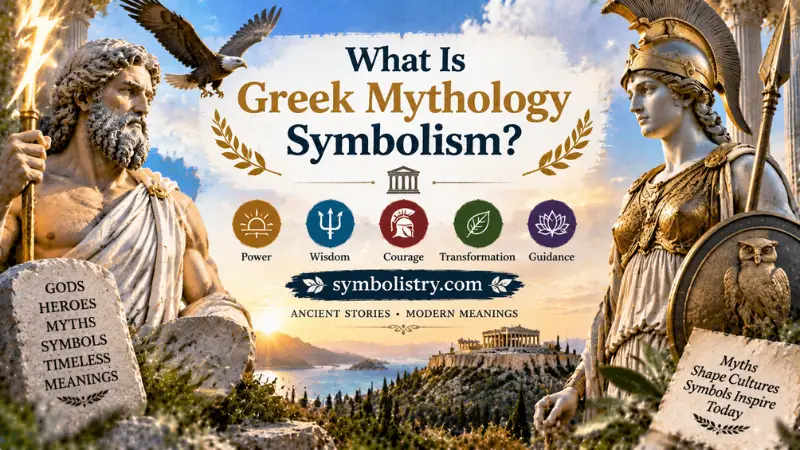
Greek mythology symbolism is the use of characters, objects, animals, plants, stories, and images from ancient Greek traditions to communicate broader ideas.
The simplest examples are familiar. Athena is connected with wisdom and strategic thinking, while her owl became a recognizable visual attribute. Poseidon’s trident identifies his connection with the sea and his divine authority. Hermes’ winged sandals communicate movement and his role as a messenger.
But Greek mythology symbolism is more complicated than assigning one meaning to every figure.
Ancient Greek religion included many gods, local traditions, temples, festivals, rituals, and stories. A deity could have several roles, and one object could have different meanings depending on the myth or setting.
This is important when reading Greek symbols today. Modern websites and social media often reduce a complex figure to a single word. Historical interpretation usually requires more context.
For example, Medusa can represent danger because of her deadly gaze, but images of her severed head were also used as protective imagery. Persephone is connected with the Underworld, yet her story is also closely related to agriculture, seasonal change, separation, and return.
The symbol becomes clearer when the story behind it is understood.
What Does Greek Mythology Symbolize?
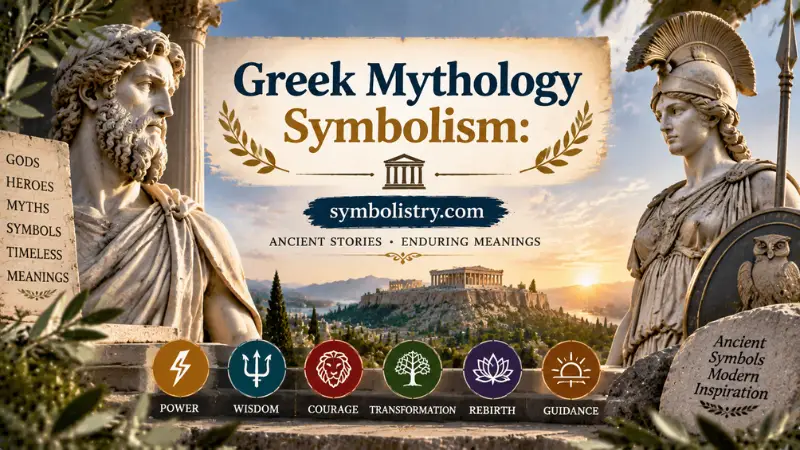
The seven most useful categories for understanding Greek mythology symbolism are:
- Wisdom and knowledge
- Power and authority
- Love and desire
- Transformation and renewal
- Protection and defense
- Fate, mortality, and human limits
- Courage, adventure, and overcoming obstacles
These meanings overlap, but each has a different focus.
Wisdom is about understanding and judgment. Power concerns authority and control. Love involves attraction and desire. Transformation concerns major changes in identity or circumstances. Protection focuses on defending against danger. Mortality reminds people that humans have limits. Courage concerns facing challenges despite fear.
This framework makes Greek mythology symbolism easier to understand because it separates ideas that are often mixed together.
The same character may represent more than one category. Athena can represent wisdom and strategic strength. Medusa can represent danger and protection. Persephone can represent both loss and renewal.
That complexity is part of what keeps these symbols useful.
1. Wisdom and Knowledge
Wisdom and knowledge are among the strongest meanings associated with Greek mythology symbolism.
Athena provides the clearest example. She is traditionally associated with wisdom, strategic warfare, crafts, and the protection of Athens. Her owl became one of the most recognizable symbols connected with her.
The owl itself reinforces the idea because people have long associated nocturnal birds with observation and alertness. In modern America, the owl is now widely recognized as a symbol of intelligence and learning, even when the person using it has no connection to ancient Greek religion.
Athena adds another layer to that meaning.
Her wisdom is not simply the ability to know facts. Her mythology connects intelligence with strategy, planning, skill, and practical judgment. That makes her symbolism especially attractive to students, educators, professionals, artists, and people who value thoughtful decision-making.
An Athena tattoo, owl pendant, or classical illustration can therefore communicate several related qualities.
The central idea is using knowledge wisely rather than simply possessing information.
2. Power and Authority
Power is another major theme in Greek mythology symbolism.
Zeus is the most obvious example. As the chief Olympian deity, Zeus is associated with the sky, thunder, divine authority, and the ordering of the gods.
His thunderbolt became a strong visual representation of force and command.
Poseidon provides another example. His trident represents his authority over the sea and has become one of the most recognizable mythological weapons in modern culture.
These symbols are often used today to communicate leadership, strength, confidence, or control.
However, Greek mythology does not present power as automatically positive.
The gods frequently make mistakes, become jealous, abuse authority, or create problems through pride and anger. The myths can therefore be read as stories about the responsibilities and dangers that come with power.
In modern American culture, a Zeus or Poseidon image may simply represent strength. A more historically informed reading recognizes that Greek mythology often asks what happens when powerful beings act according to desire rather than restraint.
3. Love and Desire
Love and desire form another major category of Greek mythology symbolism.
Aphrodite is the best-known figure associated with these ideas. She represents beauty, attraction, desire, and sexual love, although her mythology is more complicated than a simple symbol of romance.
Greek myths frequently show desire as a force that can produce happiness as well as conflict.
Attraction can bring people together, but it can also produce jealousy, competition, betrayal, and violence. This makes Aphrodite a symbol not only of romantic love but of the complicated power of desire.
The shell associated with Aphrodite has become especially recognizable in Western art. Modern artists may use shells, roses, mirrors, or feminine classical imagery to evoke beauty and attraction without directly depicting the goddess.
In American culture, Aphrodite-inspired symbolism can appear in fashion, beauty imagery, tattoos, jewelry, and artwork.
Its modern meaning often emphasizes confidence and self-expression, while the ancient stories present desire as a force capable of changing people’s lives in unpredictable ways.
4. Transformation and Renewal
Transformation is one of the most useful ideas within Greek mythology symbolism because Greek myths contain many stories about people changing form, identity, circumstances, or status.
Persephone provides a particularly strong example.
Her movement between the world of the living and the Underworld creates associations with seasonal change, separation, return, and renewal. The pomegranate becomes important because eating its seeds connects her to the Underworld for part of the year.
For modern readers, Persephone can represent a major transition.
Someone beginning a new phase of life may use her imagery to represent leaving an old identity behind. A pomegranate tattoo may symbolize growth after hardship, while a design showing Persephone between flowers and darkness may emphasize the contrast between two worlds.
Transformation does not always mean positive change.
Greek mythology often shows that transformation can involve loss, uncertainty, or consequences. That makes these stories more realistic than modern definitions that describe every transformation as a simple improvement.
The broader message is that change can alter a person’s life while still leaving connections to the past.
5. Protection and Defense
Protection is an especially interesting part of Greek mythology symbolism because some frightening images were themselves used to ward off danger.
Medusa is the clearest example.
The Gorgon is terrifying because her gaze can turn people to stone. Yet the image of the Gorgon’s head, known as the gorgoneion, was also used in ancient Greek art as a protective or apotropaic image.
This creates a symbolic paradox.
The frightening face was intended to frighten away threats.
That history helps explain why Medusa has remained so useful as a modern symbol. Her image can represent danger, defense, resistance, and the ability to confront something frightening.
Modern American interpretations sometimes connect Medusa with survival, female anger, personal strength, or overcoming harmful experiences. These interpretations are largely modern rather than simple translations of ancient Greek belief.
A Medusa tattoo can therefore mean different things to different people.
For one person it may represent protection. For another, resilience. For someone else, it may simply express an interest in classical mythology.
6. Fate, Mortality, and Human Limits
Greek mythology also deals constantly with mortality and the limits of human control.
This is one reason Greek mythology symbolism can feel more serious than a collection of decorative images.
Heroes may be exceptionally strong or intelligent, yet they cannot always escape fate. Kings can lose everything. Warriors can become famous and still die. Characters who challenge the gods may discover that human ambition has boundaries.
The story of Icarus is often used in modern culture as an example of this theme. Although Icarus is not one of the Olympian gods, his story has become a familiar warning about overconfidence and ignoring limits.
The Greek Fates provide another direct connection with destiny. Their stories have contributed to modern ideas about predetermined events and the difficult boundary between choice and fate.
For Americans today, these symbols may appear in tattoos, literature, motivational artwork, or discussions about ambition.
The message is not necessarily that people should avoid ambition.
Instead, the myths often encourage awareness of consequences.
7. Courage, Adventure, and Overcoming Obstacles
Heroes are central to Greek mythology symbolism, and their stories often represent courage in the face of danger.
Heracles, Perseus, Theseus, and Odysseus all face difficult challenges, although their stories differ greatly.
Heracles is associated with extraordinary strength and completing seemingly impossible tasks. Perseus confronts Medusa and other dangers. Theseus enters the labyrinth to confront the Minotaur. Odysseus survives a long and difficult journey home.
Modern audiences often interpret these stories as symbols of perseverance.
A person facing a difficult career, recovery, personal conflict, or major life transition may identify with the basic structure of the heroic journey: a challenge appears, the individual must act, and the outcome involves consequences.
However, Greek heroes are rarely perfect.
They can be arrogant, violent, impulsive, or morally complicated. Their stories are therefore not simple instructions for becoming a hero.
Instead, they explore what courage looks like when the person facing the challenge is imperfect.
Why Greek Gods Have So Many Different Symbols
One reason Greek mythology symbolism can become confusing is that ancient gods were not represented by one fixed symbol.
Athena might appear with an owl, helmet, spear, shield, or olive tree. Apollo can be connected with music, prophecy, the lyre, and other attributes. Hermes can be recognized through wings, his staff, and travel-related imagery.
These attributes helped viewers identify figures in ancient art.
They also developed through mythology and religious practice.
This explains why modern lists that assign one object to each god can be useful but incomplete. The object is only one part of a larger symbolic system.
The context matters.
An owl by itself may simply represent intelligence. An owl shown beside Athena carries a much more specific mythological association.
Likewise, an olive branch may represent peace in modern America, while an olive tree in a Greek mythological setting can connect with Athena, Athens, cultivation, and civic identity.
Greek Mythology Symbolism in Ancient Greek Religion
The ancient religious setting is essential for understanding Greek mythology symbolism accurately.
Greek religion was not organized around one central scripture or one standardized set of beliefs. Different cities and communities had their own religious practices, festivals, sanctuaries, and local traditions.
Temples were dedicated to particular deities, and offerings and rituals formed part of relationships between communities and their gods.
Myths were closely connected with this religious environment, but not every story functioned as a literal religious rule.
Poets, playwrights, artists, and storytellers could adapt familiar stories for different purposes.
That means there was never one official ancient Greek “symbolism list.
Meanings developed through repeated use.
A particular animal might become associated with a god because it appeared in stories, artwork, or religious practice. An object might gain meaning because it represented a divine role or appeared in an important myth.
This historical context prevents modern readers from assuming that every symbolic meaning found online existed in exactly the same form in ancient Greece.
Greek Mythology Symbolism in the United States
In the United States, Greek mythology symbolism is usually encountered through education, entertainment, art, fashion, literature, and personal expression rather than formal worship.
Many Americans first learn about Greek gods and heroes in school. Later, those figures appear in movies, novels, video games, television, museums, graphic novels, and social media.
This repeated exposure makes the imagery familiar.
American culture also tends to personalize mythology.
A person may choose Athena because they value intelligence. Someone else may choose Medusa because they connect with resilience. A Persephone image may represent a difficult transition, while Hermes may appeal to someone whose life involves travel or communication.
This personal approach explains why Greek mythology remains relevant even to people who do not practice ancient Greek religion.
The symbol becomes a visual language for identity.
That modern use should not be confused with ancient worship, but it can still be culturally meaningful.
Greek Mythology Symbolism in Tattoos and Personal Style
Tattoos are one of the clearest examples of modern Greek mythology symbolism.
Greek figures have highly recognizable visual features, which makes them easy to adapt into body art.
Medusa’s snakes, Athena’s helmet, Hermes’ wings, Poseidon’s trident, Apollo’s lyre, and Persephone’s pomegranate can all communicate ideas without lengthy explanations.
The surrounding imagery can change the meaning.
A Medusa surrounded by flowers might emphasize transformation or resilience. Athena with an owl may emphasize wisdom. Persephone surrounded by pomegranates may focus on transition and the Underworld.
Modern tattoo culture also allows people to combine several mythological symbols.
Someone might pair an olive branch with Athena to express wisdom and peace. Another person might combine a Greek column with a laurel wreath to suggest achievement and classical heritage.
The meaning ultimately belongs partly to the person wearing the design.
Historical context provides the foundation, while personal experience determines the final message.
Emotional and Psychological Meaning
The emotional appeal of Greek mythology symbolism comes from the fact that the myths dramatize recognizable human experiences.
People experience jealousy, ambition, grief, desire, fear, pride, love, uncertainty, and the need to overcome obstacles.
Greek mythology gives those experiences memorable characters.
A person struggling with pride may relate to stories about characters who ignore warnings. Someone dealing with loss may connect with Persephone’s separation and return. Someone pursuing a difficult goal may identify with the trials faced by Greek heroes.
This does not make mythology a form of psychological treatment.
Its value is symbolic.
A story can provide a framework for thinking about an experience without claiming to scientifically explain it.
That is why mythological symbols often become especially meaningful during major life transitions.
They give people an image through which they can describe something difficult to put into ordinary words.
Positive and Negative Meanings of Greek Mythology
Greek myths rarely divide their symbols into completely positive and negative categories.
Wisdom can lead to good decisions, but intelligent characters can also manipulate others. Love can create happiness, but desire can produce jealousy. Power can protect society, but uncontrolled authority can cause suffering.
This complexity is important when interpreting Greek mythology symbolism.
| Symbol | Common U.S. Meaning | Historical Association | Modern Use |
|---|---|---|---|
| Athena’s Owl | Wisdom and intelligence | Athena | Education, tattoos, jewelry |
| Medusa | Protection and resilience | Gorgon and protective imagery | Tattoos, art, identity |
| Olive Tree | Peace and prosperity | Athena and Athens | Decor, jewelry, cultural imagery |
| Pomegranate | Renewal and transition | Persephone and the Underworld | Tattoos, art, personal symbolism |
| Laurel Wreath | Achievement and honor | Victory and Apollo associations | Awards, fashion, tattoos |
The table also shows why a symbol should not be assigned a single permanent definition.
Its meaning changes according to context.
How Greek Mythology Symbolism Changed Over Time
The meaning of Greek mythology symbolism changed as Greek stories moved beyond the ancient world.
Roman culture adopted and adapted many Greek gods and myths. Later European artists repeatedly returned to classical subjects, especially during the Renaissance and afterward.
These artistic traditions helped preserve Greek mythological figures in Western visual culture.
Modern American culture then added another layer.
Greek myths became part of school curricula, popular literature, movies, television, games, and contemporary art. Characters that once belonged to ancient religious traditions could now function as fictional characters, artistic subjects, cultural references, or personal symbols.
Medusa is an especially clear example.
Ancient representations could serve protective purposes, while modern artists may interpret her as a symbol of resistance or resilience.
Persephone has also received new readings emphasizing independence and personal transformation.
These changes do not necessarily invalidate older meanings.
They show how symbols accumulate interpretations as they move between historical periods.
Cross-Cultural Connections and Shared Symbolism
Greek mythology developed within a wider ancient Mediterranean world, so some symbols have parallels in other cultures.
The serpent, sun, moon, bird, tree, sea, and underworld appear in many religious and mythological traditions. Their presence in different cultures does not mean that they always have the same meaning.
For example, snakes can represent danger in one tradition and healing or renewal in another.
Likewise, birds may symbolize prophecy, freedom, wisdom, death, or communication depending on the culture.
This is why Greek mythology symbolism should be understood within its own historical context.
Greek traditions can be compared with Roman, Egyptian, Norse, or other traditions, but they should not automatically be treated as interchangeable.
Modern popular culture sometimes blends these traditions together because the imagery looks compatible.
Historical interpretation requires more care.
Greek Mythology Symbolism in Art, Decor, and Popular Culture
Classical imagery remains common in American visual culture.
Greek columns, marble statues, laurel wreaths, Greek key patterns, mythological paintings, and figures such as Athena and Medusa appear in homes, restaurants, clothing, jewelry, book covers, museums, and digital artwork.
Movies and television have made Greek gods even more recognizable.
Modern fantasy frequently changes their personalities or stories to suit contemporary audiences. Video games may turn gods into playable characters, while novels may retell myths from the perspective of a character who received little attention in older versions.
These adaptations keep Greek mythology symbolism visible but can also blur the line between ancient tradition and modern fiction.
A fictional version of Athena should not automatically be treated as evidence of how ancient Greeks understood her.
The distinction is simple: adaptation is a modern creative interpretation, while historical mythology comes from ancient literary, artistic, and religious evidence.
Common Misunderstandings About Greek Mythology Symbolism
One common mistake is believing that every Greek god has exactly one meaning.
Athena is not only wisdom. Aphrodite is not only romance. Zeus is not simply strength. Their stories contain multiple roles and contradictions.
Another misunderstanding is assuming that modern meanings were always ancient meanings.
A Medusa tattoo representing personal survival is a contemporary interpretation. It should not automatically be presented as an ancient Greek definition.
A third problem is treating Greek mythology as one completely standardized system.
Local traditions and different authors could emphasize different aspects of a deity or story.
Finally, popular culture sometimes presents rewritten myths as if they were original versions.
This does not make modern adaptations useless. It simply means readers should recognize when they are encountering a contemporary retelling rather than an ancient account.
Greek Mythology Symbolism: History vs. Modern Meaning
| Figure or Symbol | Historical Focus | Modern American Meaning | Common Setting |
|---|---|---|---|
| Athena | Wisdom, strategy, civic protection | Intelligence and independence | Tattoos, education, art |
| Zeus | Divine authority and sky | Leadership and power | Film, art, fantasy |
| Aphrodite | Love, beauty, desire | Romance and confidence | Jewelry, fashion, tattoos |
| Medusa | Gorgon, danger, protection | Resilience and empowerment | Tattoos, artwork |
| Persephone | Underworld and seasonal cycle | Transformation and renewal | Tattoos, literature |
This comparison shows how Greek mythology symbolism has moved from an ancient religious environment into a modern cultural one.
The historical meanings still matter because they explain where the imagery came from.
Modern meanings matter because they explain why Americans continue to choose these symbols.
Neither should automatically replace the other.
Is Greek Mythology Symbolism Religious Today?
Some Greek mythological images have religious origins, but using them today does not automatically mean someone is practicing a religion. Greek mythology symbolism can also appear in art, fashion, tattoos, jewelry, and personal expression without a religious purpose.
An Athena tattoo may be cultural or personal. A Greek statue may be decorative. A Medusa necklace may represent resilience. A laurel wreath may symbolize achievement.
At the same time, modern practitioners of Hellenic religious traditions may use ancient gods and symbols in religious ways. In this context, Greek mythology symbolism may have a spiritual or devotional meaning rather than simply serving as an artistic reference.
Therefore, context is essential.
The same image can function as a historical reference, an artistic design, a personal symbol, or a religious object depending on who is using it and why. This is especially important when interpreting Greek mythology symbolism, because a modern personal meaning may differ from the role a symbol originally had in ancient Greek culture.
This is one reason the symbolism should be described carefully rather than assigning a single meaning to everyone.
FAQ About Greek Mythology Symbolism
What does Athena symbolize?
Athena commonly represents wisdom, strategy, practical intelligence, craftsmanship, and civic protection. Her owl is especially associated with wisdom and observation.
What does Medusa symbolize?
Medusa can symbolize danger, fear, protection, and the consequences of confrontation. In modern American culture, she is also frequently interpreted as a symbol of resilience, resistance, or personal empowerment.
What is the most famous Greek mythology symbol?
There is no single universally recognized symbol, but Athena’s owl, Medusa, Poseidon’s trident, the laurel wreath, and the Greek key are among the most familiar in modern Western culture. Their meanings differ depending on historical and modern context.
What does Greek mythology symbolism mean?
Greek mythology symbolism refers to the meanings associated with Greek gods, heroes, creatures, objects, plants, and stories. Common themes include wisdom, love, power, protection, transformation, mortality, courage, and knowledge.
Are Greek mythology symbols still relevant today?
Yes. Greek mythological imagery remains common in American education, entertainment, art, fashion, tattoos, literature, and digital culture. Its continued popularity comes partly from the fact that ancient stories can be reinterpreted around modern experiences without losing their recognizable characters and images.
What does Greek mythology symbolism mean in tattoos?
In tattoos, Greek mythological imagery is often used to express personal qualities such as wisdom, strength, resilience, independence, love, or transformation. The specific character and surrounding objects usually determine the intended message.
What does Persephone symbolize?
Persephone is associated with the Underworld, seasonal change, separation, return, and renewal. Modern interpretations often use her story as a metaphor for major personal transitions.
Conclusion
Greek mythology symbolism brings together stories about wisdom, power, love, protection, transformation, mortality, courage, and the limits of human control. Its symbols developed through ancient myths, religious practices, artistic traditions, and recognizable attributes connected with gods and heroes.
Modern Americans often use these images in ways that are more personal than religious. Athena can represent intelligence, Medusa can express resilience, Persephone can represent change, and Hermes can suggest movement or communication. These interpretations are modern layers added to much older stories.
The best way to understand Greek symbols is to look at both sides: where the image came from and what it communicates today. When historical context and personal interpretation are kept separate, Greek mythology becomes more than a collection of decorative figures—it becomes a flexible visual language for describing human experiences.