
Introduction
Calendula symbolism has developed around the flower’s bright color, long history of cultivation, traditional uses, and changing cultural associations. The golden-orange calendula is often connected with warmth, healing, comfort, remembrance, renewal, and resilience.
Calendula, scientifically known as Calendula officinalis, is commonly called pot marigold. Despite that common name, it is different from the marigolds most Americans grow in gardens, which usually belong to the genus Tagetes. That botanical distinction matters because the two groups have different histories and cultural associations.
For Americans today, the flower can have both practical and personal meaning. It appears in gardens, botanical artwork, skincare products, tattoos, gifts, and decorative designs. Its bright appearance makes it naturally cheerful, while its older associations with devotion and grief give it a more complex emotional character.
Quick Answer
Calendula symbolism commonly represents healing, warmth, comfort, renewal, and remembrance in modern American culture. Historically, calendula has also been associated with devotion, traditional herbal practices, seasonal cycles, and sorrow through European flower-language traditions.
TL;DR
- Calendula represents healing, warmth, comfort, renewal, and remembrance.
- Golden petals contribute associations with sunlight, optimism, and vitality.
- Traditional herbal use helped connect calendula with care and recovery.
- Medieval European traditions linked the flower with Marian devotion.
- Victorian flower language sometimes gave calendula somber meanings.
- Modern Americans use calendula in gardens, tattoos, gifts, and artwork.
What Calendula Symbolism Commonly Means Today
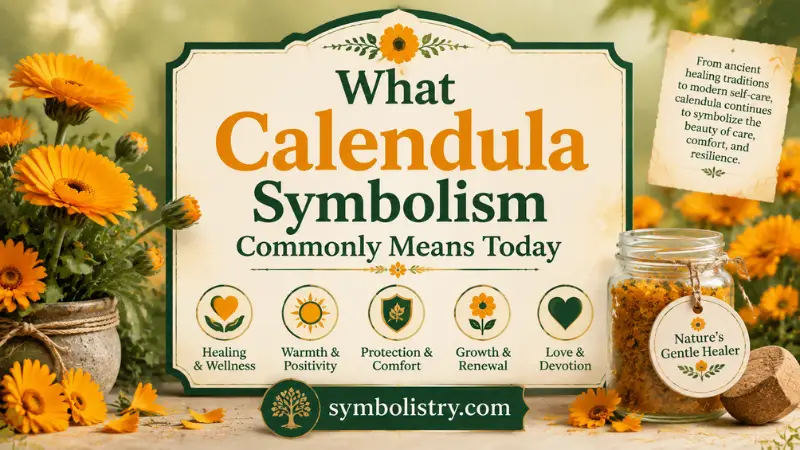
The most familiar calendula symbolism today centers on healing and warmth.
Part of this meaning comes from the plant’s long history as a useful herb. Calendula flowers have traditionally been incorporated into preparations for the skin, which helped establish an association between the plant and soothing care.
Its appearance contributes another layer. Yellow and orange petals naturally suggest sunlight, warmth, happiness, and vitality. When those visual qualities are combined with the flower’s traditional uses, calendula becomes an understandable symbol of comfort and restoration.
The meaning does not have to be medical. A person may choose calendula simply to represent emotional recovery, encouragement after a difficult experience, or the decision to begin again.
That distinction is important because calendula symbolism describes cultural meaning, not a medical claim about what the plant can treat.
What the Calendula Flower Looks Like
Understanding calendula symbolism begins with the flower itself.
Calendula plants produce daisy-like flower heads with numerous narrow petals. Depending on the variety, the blooms may range from pale yellow to vivid orange, with some cultivars displaying darker centers or layered petals.
The plant is relatively familiar in gardens and can be grown as an ornamental flower as well as a useful herb.
Its visual identity has always contributed to its meaning. A golden flower naturally invites comparisons with sunlight, while repeated flowering can suggest continuity and renewal.
Unlike flowers associated with luxury or fragility, calendula often has an approachable character. It looks cheerful while remaining practical, which helps explain why modern interpretations frequently emphasize care, resilience, and everyday happiness.
Why Calendula Represents Healing and Care
Healing is one of the strongest modern interpretations of calendula symbolism.
Calendula has a long record of traditional use in European herbal practices. Its flowers have been used in preparations for the skin and in other traditional applications, although historical use should not automatically be treated as proof of modern medical effectiveness.
Symbolically, however, the connection is easy to understand.
People often turn plants associated with care into symbols of recovery. A calendula flower can represent the emotional process of getting better, caring for someone, recovering confidence, or rebuilding after a difficult period.
This makes the flower especially appropriate for personal gifts and artwork connected with encouragement.
A calendula tattoo might commemorate recovery from a difficult chapter. A bouquet might be given to someone who needs reassurance. A botanical illustration might simply express appreciation for nature and traditional plant knowledge.
The Golden Color and Its Symbolic Meaning
Color is central to calendula symbolism because the plant’s most recognizable feature is its golden or orange bloom.
Yellow is commonly associated with sunlight, optimism, friendliness, and happiness. Orange can suggest warmth, enthusiasm, creativity, and vitality.
These associations are not universal psychological rules. People and cultures interpret colors differently, and personal experience can change how a particular shade feels.
Still, the visual effect of calendula is difficult to overlook.
Its warm colors can make the flower feel welcoming rather than solemn. Even when calendula is used in a memorial context, its bright appearance can shift the emphasis toward positive memories instead of sadness alone.
This helps explain why the flower can comfortably represent both happiness and remembrance.
Calendula Symbolism and Remembrance
One of the more interesting layers of calendula symbolism involves remembrance.
Modern readers often expect the flower to represent healing and happiness, but older European flower traditions sometimes assigned more somber meanings to marigold-related flowers. Victorian flower-language dictionaries included associations such as grief, sorrow, jealousy, and despair, although the meanings were not completely consistent from one source to another.
This creates a useful contrast.
A bright flower can acknowledge loss without becoming a purely mournful symbol. In a memorial arrangement or tattoo, calendula may therefore represent someone who has died while emphasizing the warmth of the memories that remain.
The flower can communicate an idea such as: the loss matters, but so does the life that was shared.
That interpretation is particularly suitable for modern memorial art because it avoids reducing remembrance to sadness alone.
Calendula Symbolism in Medieval Christian Tradition
Religious history adds another dimension to calendula symbolism.
During the medieval period, calendula became associated in parts of Europe with the Virgin Mary. Names such as “Mary’s gold” or “Marygold” developed around flowers associated with Marian devotion, reflecting the broader Christian practice of connecting flowers with religious figures and virtues.
The flower’s golden appearance supported associations with honor and devotion.
However, it would be misleading to claim that every calendula flower in medieval Europe had a religious meaning. Plants served practical purposes too, and symbolic associations varied by location and context.
For modern Americans interested in Christian flower symbolism, calendula can therefore represent devotion, reverence, care, and remembrance. That is a specific historical layer rather than a universal definition.
The Name Calendula and the Calendar
The botanical name Calendula is generally connected with the Latin word calendae, referring to the first day of a Roman month.
The connection has often been discussed in relation to the plant’s tendency to flower for extended periods under suitable conditions. Its recurring blooms make the idea of regular cycles particularly appropriate.
This contributes another aspect of calendula symbolism: continuity.
The flower can represent the return of familiar things after change. Seasons move forward, plants grow again, and life continues through repeated cycles.
That interpretation does not require supernatural beliefs. It comes directly from observing a plant’s seasonal behavior and turning that observation into a human metaphor.
Calendula and Victorian Flower Language
The Victorian language of flowers became popular during the 19th century, particularly as people used bouquets to communicate feelings that might otherwise be difficult to express openly.
Calendula symbolism in this tradition is more complicated than many modern flower guides suggest.
Different Victorian sources assigned different meanings to marigold-related flowers. Some emphasized grief, sorrow, jealousy, or despair, while other interpretations focused on warmth and affection.
There was no single authority controlling flower language.
The result is that a modern article should not present one Victorian meaning as an absolute historical fact. Instead, the flower’s historical record shows how symbolic meanings can change according to social setting.
This also explains why today’s interpretation may sound more positive than some 19th-century versions.
Calendula Symbolism in the United States
In the United States, calendula symbolism is generally informal rather than part of a widely recognized social code.
Americans are most likely to encounter calendula as a garden flower, botanical ingredient, decorative image, or personal-care plant. Its symbolic meaning often develops through personal association rather than a fixed cultural rule.
A gardener may connect it with patience and growth. Someone recovering from a difficult experience may see it as a reminder of resilience. Another person may simply appreciate its cheerful color.
Calendula also works well for Americans interested in botanical or family-history themes because it has a recognizable European cultural history without being as conventional as the rose or lily.
Its relative lack of a single dominant American meaning gives people room to define it for themselves.
Emotional and Psychological Meaning of Calendula
The emotional side of calendula symbolism comes from the combination of visual warmth and historical associations.
The bright flower can suggest optimism, while its connection with traditional care suggests comfort. Its repeated blooming can represent persistence, and its associations with remembrance allow it to acknowledge difficult experiences.
This makes calendula particularly useful as a symbol of balanced resilience.
Resilience does not mean pretending that painful events never happened. Instead, the flower can represent continuing to grow while carrying memories of what came before.
That message may appeal to people marking major life transitions, personal recovery, family milestones, or periods of emotional change.
Calendula as a Symbol of Personal Growth
Personal growth is another natural interpretation of calendula symbolism.
Plants provide an uncomplicated metaphor for development. A seed becomes a plant, a flower appears, the season changes, and new growth eventually follows.
Calendula’s recurring blooms strengthen that comparison.
Someone might choose calendula after graduating, beginning a new career, moving to another place, ending a difficult relationship, or recovering from a period of uncertainty.
The symbolism does not suggest that growth is instant. Instead, it emphasizes the idea that progress can happen gradually and repeatedly.
For this reason, calendula can represent patience as much as transformation.
Calendula Tattoos and Their Meanings
A calendula tattoo can carry several interpretations depending on its design.
A bright orange flower may emphasize optimism and vitality. A detailed botanical tattoo may focus more on natural beauty, plant knowledge, or appreciation for traditional herbal culture.
A calendula combined with a name or date can become a memorial design. Adding other flowers can shift the meaning toward friendship, family, love, recovery, or personal growth.
The symbolism is especially flexible because calendula does not have one dominant tattoo meaning in American culture.
That allows the wearer to establish a personal story rather than relying entirely on a traditional flower dictionary.
A simple calendula may say “healing” to one person and “remembering” to another.
Calendula in Gardens and Home Decor
Gardening is one of the most natural modern settings for calendula symbolism.
The flower’s warm colors can make outdoor spaces feel welcoming and lively. It can be planted in garden beds, containers, cottage-style gardens, and herb gardens.
In home decor, calendula may appear in botanical prints, fabric patterns, ceramic designs, stationery, and artwork.
These uses tend to emphasize its visual qualities rather than historical religious meanings.
A botanical print can communicate an appreciation for nature. A kitchen illustration may reflect the plant’s traditional practical uses. A bright floral arrangement may simply create a feeling of warmth.
The meaning depends heavily on context.
Calendula in Gifts and Special Occasions
Calendula can also work as a meaningful gift because its symbolism is broad enough to fit different situations.
For someone recovering from a difficult period, it can represent encouragement. For a friend beginning a new chapter, it can suggest optimism and renewal.
In a memorial context, the flower can express remembrance and affection without relying exclusively on traditional funeral flowers.
It can also be appropriate for gardeners, herbal enthusiasts, or people who appreciate botanical artwork.
Unlike roses, calendula does not strongly imply romantic love in modern American culture. That makes it useful when the intended message is friendship, support, gratitude, or personal encouragement.
Calendula in Traditional Herbal Culture
The practical history of calendula has strongly influenced calendula symbolism.
People in different periods have cultivated the plant for ornamental, culinary, coloring, and traditional herbal purposes. Its flowers have been incorporated into various preparations, particularly those associated with skin care.
Modern products continue to use calendula as a botanical ingredient, including creams, lotions, soaps, and other personal-care products.
This ongoing practical relationship reinforces the symbolic connection between the flower and care.
At the same time, historical herbal use should not be confused with modern medical advice. Symbolism can describe why people associate a plant with healing without claiming that the plant can cure a particular condition.
Calendula Symbolism in Other Cultures
The meaning of calendula changes when it enters different cultural settings.
European Christian traditions contributed associations with Marian devotion. European flower-language traditions later added more emotional meanings, including grief and sorrow.
In South Asian cultures, marigolds have major ceremonial and religious importance, but caution is necessary here because many culturally important marigolds belong to Tagetes, not Calendula officinalis.
This botanical distinction prevents a common mistake: assuming every flower called “marigold” carries the same history.
Cultural symbolism is shaped by species, language, religion, geography, and historical use. The same color does not guarantee the same meaning.
Positive and Negative Meanings Compared
The different layers of calendula symbolism can be compared more clearly by context.
| Context | Symbolic Meaning | Emotional Tone | Common Modern Use |
|---|---|---|---|
| Golden flower | Warmth and optimism | Positive | Gardens and decor |
| Traditional herbal history | Care and healing | Comforting | Botanical products and artwork |
| Marian tradition | Devotion and reverence | Spiritual | Religious or historical imagery |
| Victorian flower language | Grief and sorrow | Somber | Historical interpretation |
| Memorial use | Remembrance and affection | Reflective | Tattoos and memorial art |
| Seasonal growth | Renewal and persistence | Hopeful | Personal symbolism |
The table shows why no single definition can capture every interpretation.
Common Misunderstandings About Calendula Symbolism
One common misunderstanding is that calendula and all marigolds are the same plant.
They are not. Calendula belongs to its own botanical group, while the marigolds most familiar in American landscaping generally belong to Tagetes. Their cultural histories overlap in some places but should not be automatically merged.
Another mistake is claiming that calendula symbolism has one ancient, universal definition.
Historical evidence does not support that kind of certainty. Religious traditions, flower-language sources, botanical practices, and modern personal interpretations all contribute different layers.
It is also inaccurate to say that calendula has always represented healing.
Its traditional herbal use helped create that association, but older sources also connect marigold-related flowers with devotion, grief, and other emotions.
The better approach is to recognize the flower’s symbolism as evolving rather than fixed.
How Calendula Symbolism Has Changed Over Time
The history of calendula symbolism demonstrates how cultural meanings develop.
In medieval Europe, the flower could participate in religious traditions and practical plant culture. Later, Victorian flower language gave it emotional associations that were sometimes considerably more somber.
Modern American culture has shifted the emphasis again.
Today, healing, warmth, positivity, renewal, and resilience are easier for most people to associate with calendula than Victorian ideas of despair or jealousy.
The flower has also entered new settings, including tattoos, botanical skincare, social media imagery, garden design, and personal artwork.
Its meaning has therefore expanded rather than simply replacing one interpretation with another.
Why Calendula Remains a Meaningful Symbol
The continuing appeal of calendula symbolism comes from the flower’s ability to hold contrasting ideas together.
It can be cheerful without being shallow. It can represent healing without denying hardship. It can symbolize remembrance while still emphasizing warmth and continued life.
That balance makes calendula particularly useful for personal symbolism.
A person may choose the flower because they survived something difficult. Another may use it to honor someone they miss. A gardener may value it simply as a bright and useful plant.
The flower does not need one official meaning to be meaningful.
Its strongest modern interpretations usually come from combining its appearance, historical associations, practical uses, and the personal experience of the person choosing it.
Frequently Asked Questions
Is calendula a flower of remembrance?
It can be. The flower’s connection with older traditions involving grief and its bright, comforting appearance make it suitable for memorial symbolism, particularly when someone wants to emphasize loving memories rather than sadness alone.
What does calendula symbolize spiritually?
In historical European Christian contexts, calendula has been connected with devotion to the Virgin Mary. Modern spiritual interpretations vary, so contemporary meanings should not automatically be presented as ancient religious beliefs.
What does a calendula tattoo symbolize?
A calendula tattoo can symbolize healing, personal growth, resilience, remembrance, optimism, or affection. The meaning can become more specific through accompanying dates, names, botanical elements, or other flowers.
Is calendula a symbol of healing?
Yes, healing is a common modern interpretation because calendula has a long history of traditional herbal use. Symbolically, it can represent recovery, care, restoration, and encouragement without making a medical claim.
What does calendula symbolize?
Calendula commonly symbolizes healing, warmth, comfort, renewal, resilience, and remembrance. Older European traditions also associate the flower with devotion and, in some flower-language sources, grief or sorrow.
Is calendula symbolism positive or negative?
It can be either depending on the historical context. Modern American interpretations generally lean toward healing, warmth, renewal, and resilience, while some older flower-language traditions assigned more somber meanings.
Is calendula the same as marigold?
Calendula is commonly called pot marigold, but it is botanically different from the common garden marigolds of the genus Tagetes. Confusing the two can lead to inaccurate claims about their cultural symbolism.
Conclusion
Calendula carries a wide range of meanings because its history combines practical plant use, religious tradition, flower language, seasonal observation, and modern personal expression. Calendula symbolism is closely connected with the flower’s golden color, which encourages associations with warmth, optimism, and vitality. At the same time, calendula symbolism reflects the plant’s traditional uses, helping explain its connection with care, comfort, and recovery.
Calendula symbolism is best understood as a layered tradition rather than a single definition. In one context, calendula symbolism can represent healing after hardship, while in another, calendula symbolism may express remembrance of someone important. Historical religious traditions also give calendula symbolism associations with devotion, while modern interpretations often connect the flower with personal growth and resilience.
The emotional range of calendula symbolism is one reason the flower remains meaningful today. Rather than representing happiness alone, calendula symbolism can acknowledge difficult experiences while still pointing toward hope and renewal. This balance allows calendula symbolism to work particularly well in memorial art, personal tattoos, gardens, gifts, and botanical designs.
In modern American culture, calendula symbolism is often shaped by personal experience rather than a strict symbolic code. Someone may choose the flower because calendula symbolism reminds them of recovery, while another person may see it as an expression of warmth, encouragement, or appreciation for nature. Ultimately, calendula symbolism shows how a familiar flower can connect the past with the present while leaving room for each person to give the bloom a meaning of their own.