Introduction
African violets are small flowering houseplants recognized for their soft leaves and clusters of purple, blue, pink, white, or multicolored flowers. In American homes, they are commonly found on windowsills, shelves, desks, and other bright indoor spaces, where their flowers can become part of everyday routines. African violet symbolism has developed around these qualities, especially the plant’s ability to remain attractive and continue flowering with regular care.
For many people, an African violet represents more than decoration. The plant can suggest devotion, faithfulness, affection, patience, care, and continuity because it requires ongoing attention and can remain in a home for years.
Unlike flowers whose symbolism comes from ancient mythology or religious traditions, much of the meaning connected with African violets is relatively modern. Their cultural associations developed through horticulture, the language of flowers, gift-giving, American houseplant culture, and the personal memories people attach to individual plants.
Understanding African violet symbolism therefore requires looking at both the flower itself and the circumstances in which people encounter it. A plant given to a mother, inherited from a grandparent, placed in a home, or chosen for a tattoo can carry different meanings even when the flower is identical.
Quick Answer
African violet symbolism commonly represents devotion, faithfulness, affection, patience, and thoughtful care in modern American culture. The plant is also associated with home, remembrance, continuity, and lasting relationships because it can be maintained and enjoyed over many seasons.
TL;DR
- African violet symbolism commonly centers on devotion and faithfulness.
- The plant’s modern meaning developed through horticulture and flower traditions.
- Purple blooms often suggest admiration, dignity, and affectionate devotion.
- American culture connects African violets strongly with homes and gifts.
- Long-lasting plants can represent continuing relationships and remembrance.
- Personal experiences can give the same flower a unique meaning.
What Is an African Violet?
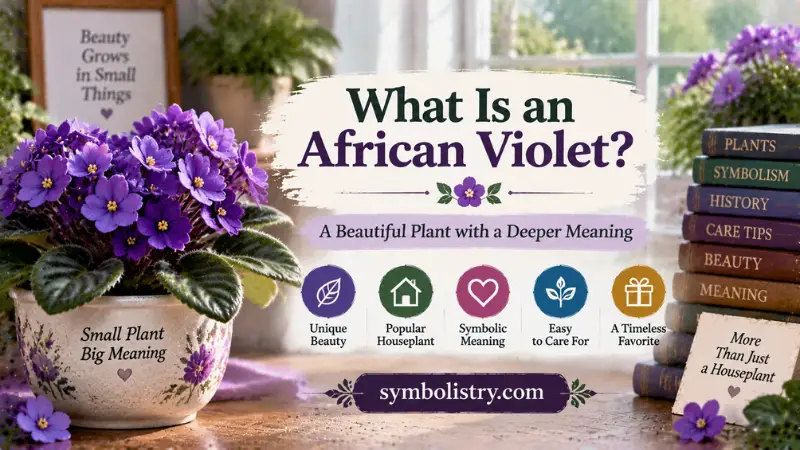
The African violet is a compact flowering plant traditionally associated with the botanical name Saintpaulia. Modern classification places the former Saintpaulia group within Streptocarpus, but “African violet” remains the familiar name used by gardeners and plant lovers.
The plant has rounded, softly hairy leaves arranged around a central growing point. Its flowers rise above the foliage and may appear in purple, violet, blue, pink, white, or combinations of these colors.
These physical qualities help explain African violet symbolism. The plant is relatively small and delicate-looking, but it can continue producing flowers when properly maintained. That contrast between softness and persistence makes it easy to associate with patience, consistency, and steady care.
African violets are also strongly connected with indoor life. Unlike flowers that people mainly encounter in outdoor gardens or temporary bouquets, African violets often become permanent parts of living spaces.
That difference is important because a long-term houseplant can accumulate personal memories. The plant may remind someone of a parent, grandparent, childhood home, friendship, or important period of life.
What Does an African Violet Symbolize?
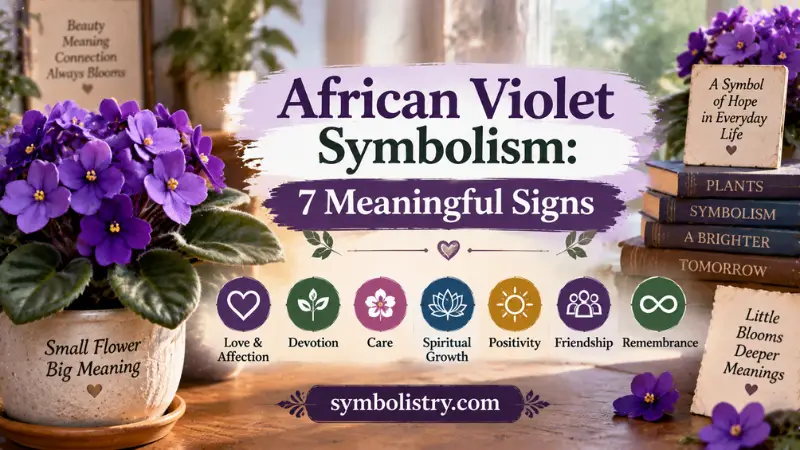
The central ideas behind African violet symbolism are devotion, faithfulness, affection, patience, care, remembrance, and continuity.
These meanings do not all come from one historical source. Some are connected with broader violet symbolism, while others developed from the African violet’s popularity as a long-lasting houseplant.
The seven most useful interpretations are:
- Devotion
- Faithfulness
- Affection
- Patience and care
- Remembrance
- Home and continuity
- Renewal and personal growth
Each meaning emphasizes a different quality of the plant.
1. Devotion
Devotion is one of the clearest interpretations of African violet symbolism. The idea comes from the plant’s relationship with consistent care.
An African violet is not usually maintained through one dramatic act. Instead, it depends on repeated small actions. Someone waters it, provides suitable light, removes damaged flowers, watches for new growth, and continues caring for it over time.
That makes the plant a useful metaphor for devotion.
Devotion does not have to mean romantic love. A person can be devoted to a family member, friend, personal goal, creative practice, or responsibility.
When an African violet is given as a gift, it can therefore communicate a quiet message of lasting attention. The meaning is less about grand emotion and more about showing that someone or something is worth continuing to care for.
This is one reason African violet symbolism often feels intimate. The flower can represent affection expressed through actions rather than words.
2. Faithfulness
Faithfulness is closely related to devotion but carries a slightly different emphasis.
Devotion involves actively caring for something, while faithfulness suggests remaining dependable or committed over time. The African violet’s ability to remain a living plant and flower repeatedly makes this interpretation especially suitable.
In traditional flower symbolism, violets have also been connected with faithfulness and loyalty. Because the African violet resembles true violets, some of that older association has influenced how people interpret the plant.
Still, it is important not to claim that African violets inherited an ancient symbolic system unchanged. Their own history as a cultivated houseplant is much more recent.
In modern African violet symbolism, faithfulness can describe romantic commitment, friendship, family loyalty, or simply staying connected with someone through changing circumstances.
An African violet can therefore make an appropriate gift when the intended message is, “Our connection continues.”
3. Affection
African violet symbolism can also represent gentle affection.
The plant’s compact size and soft appearance give it a personal character. It does not have the visual drama of a large bouquet of roses or lilies. Instead, its appeal is often quieter and more domestic.
That makes it useful for expressing warmth without making an exaggerated statement.
An African violet may be given to a friend, parent, partner, coworker, or relative. The exact meaning depends on the relationship.
For a romantic partner, it may represent tenderness and continuing affection. For a friend, it can communicate appreciation. For a family member, it may express warmth and gratitude.
The key idea is that African violet symbolism often communicates affection in a restrained, everyday form.
4. Patience and Care
Patience is another important interpretation.
A living plant does not respond instantly to attention. Growth happens gradually. Flowers appear when conditions are suitable, and maintaining a healthy plant requires consistency.
That makes an African violet a natural reminder that some worthwhile things take time.
The plant can symbolize the patience required to build a relationship, develop a skill, recover from a difficult period, or maintain a family tradition.
Care is closely connected to this meaning. An African violet becomes a visual reminder that something living depends on regular attention.
This is particularly relevant in American houseplant culture, where caring for indoor plants can become part of daily or weekly routines.
In this sense, African violet symbolism is not only about receiving care. It can also represent the act of giving care.
Ancient Roots and the Recent History of the African Violet
African violet symbolism should not be confused with ancient flower traditions.
The African violet itself does not have the kind of long classical history associated with the rose, lotus, olive branch, or true violet. Its story as a recognized cultivated plant began much more recently in East Africa and Europe.
The plant was discovered in the Usambara region of what is now Tanzania in the late nineteenth century by Walter von Saint Paul-Illaire. Material was sent to Germany, where botanist Hermann Wendland described the plant and established the genus name Saintpaulia.
The plant quickly attracted horticultural interest. Later breeding produced many new colors, flower forms, and sizes, helping African violets become widely cultivated indoor plants.
This history matters when discussing African violet symbolism because it shows why the plant’s meanings should be described as modern rather than ancient.
Its symbolic identity developed alongside its popularity.
Instead of being connected primarily with gods, myths, or ancient religious ceremonies, the African violet became connected with windowsills, homes, gardening, gifts, personal collections, and everyday relationships.
How True Violet Symbolism Influences African Violet Meaning
The name “African violet” naturally encourages comparison with the true violet.
Botanically, however, African violets are not members of the genus Viola. They belong to a different plant family. Their resemblance is primarily visual, which explains the common name.
This distinction matters because some interpretations of African violet symbolism come from older ideas associated with violets generally.
Traditional flower language has connected violets with qualities such as modesty, loyalty, faithfulness, and quiet affection. These associations provide part of the cultural background through which people interpret African violets.
But the African violet developed additional meanings from its own history.
A true violet may evoke springtime, gardens, modesty, or older literary traditions. An African violet is more likely to evoke a cared-for windowsill, an inherited houseplant, a thoughtful gift, or a long-term hobby.
That is why African violet symbolism is best understood as a combination of related flower traditions and modern houseplant culture.
African Violet Symbolism in the United States
The United States has played a major role in the African violet’s modern identity.
Commercial growing of African violets began in the United States during the twentieth century, and interest expanded among both commercial growers and hobbyists. The African Violet Society of America was organized in 1946, reflecting the plant’s established place among American indoor-plant enthusiasts.
American houseplant culture gave African violet symbolism a particularly domestic character.
The plant became something people could keep inside the home rather than something encountered only in gardens. It could sit on a kitchen windowsill, living-room table, bedroom shelf, or office desk.
That everyday setting shaped its emotional meaning.
For many Americans, an African violet may suggest:
- Home
- Family
- Routine
- Care
- Friendship
- Appreciation
- Continuity
- Personal memory
The plant’s meaning can become especially strong when it has been kept for years.
A person may remember who gave them the plant, where it was originally placed, or who taught them how to care for it. At that point, African violet symbolism becomes partly autobiographical.
The flower represents not just a general idea but a particular story.
African Violet Symbolism and Motherhood
Motherhood is another modern association sometimes connected with African violets.
The relationship makes sense because caring for a plant provides a simple visual metaphor for nurturing. An African violet needs attention, patience, and regular maintenance, much as family relationships require continuing care.
The plant may therefore be used as a Mother’s Day gift or as an expression of appreciation for a mother’s everyday efforts.
However, African violet symbolism should not be reduced to motherhood.
An African violet given to a mother can represent gratitude, but the same plant given to a friend may represent loyalty. Given to a partner, it may communicate affection. Given to someone grieving, it may represent remembrance.
The occasion determines the message.
This is an important rule for interpreting flower symbolism generally: the object matters, but the relationship and circumstances matter too.
African Violet Symbolism by Flower Color
Color adds another layer to African violet symbolism.
Modern African violets are available in many colors and combinations, so people can interpret the flower partly through broader color symbolism.
| Flower Color | Common Meaning | Emotional Impression | Possible Context |
|---|---|---|---|
| Purple or violet | Devotion, admiration, dignity | Thoughtful and affectionate | Appreciation or meaningful gifts |
| Blue | Loyalty, calm, trust | Peaceful and steady | Friendship or reassurance |
| Pink | Tenderness, warmth, affection | Gentle and personal | Family or romantic gifts |
| White | Sincerity, innocence, remembrance | Peaceful and simple | Sympathy or meaningful occasions |
| Bicolor | Individuality, balance, variety | Cheerful and expressive | Decor or personal gifts |
These interpretations are not universal rules.
A person may choose a purple African violet simply because purple is their favorite color. Someone may choose a white variety because it matches their home.
Color symbolism works best as an additional clue rather than a strict dictionary.
When interpreting African violet symbolism, the reason for choosing the flower should usually carry more weight than the color alone.
Why African Violets Can Represent Lasting Relationships
One of the strongest ideas associated with African violet symbolism comes from the difference between a living houseplant and a cut bouquet.
Cut flowers are often associated with temporary beauty. They are arranged for a particular occasion and eventually fade.
An African violet can remain in a home much longer.
With appropriate care, it can continue producing flowers and new growth. The plant therefore becomes a continuing presence rather than a temporary display.
That makes it a useful symbol of lasting relationships.
A friend might give an African violet to mark many years of friendship. A parent might keep one received from a child. A couple might associate a particular plant with an important anniversary.
In these situations, African violet symbolism comes from continuity.
The plant stays while circumstances change around it.
That quality can make the flower especially meaningful for people who prefer subtle symbols of commitment instead of dramatic ones.
African Violet Symbolism in Gifts and Special Occasions
African violets can be thoughtful gifts because they combine flowers with an ongoing living presence.
They may be suitable for:
- Mother’s Day
- Birthdays
- Housewarming celebrations
- Thank-you gifts
- Friendship gestures
- Anniversaries
- Retirement
- Sympathy
- Appreciation
- Personal milestones
The meaning of African violet symbolism changes depending on the occasion.
For Mother’s Day, the plant may express gratitude and appreciation. For a housewarming, it can represent warmth and care for a new home.
For a friendship, the plant can symbolize loyalty and continuity. For sympathy, it may represent remembrance and an ongoing emotional connection.
This flexibility is one reason the African violet works well as a gift.
It does not force the recipient into one narrow emotional interpretation.
Emotional and Psychological Meaning
African violet symbolism also has an emotional dimension because caring for a living plant creates an ongoing relationship between a person and an object in their environment.
A decorative object can be placed somewhere and ignored. A plant requires attention.
The owner notices new leaves, developing buds, fading flowers, and changes in growth. These small observations can turn the plant into part of a daily routine.
As a result, African violet symbolism may communicate several psychological ideas:
Consistency: The plant becomes part of a regular routine.
Nurturing: Caring for it gives a physical form to the idea of looking after something.
Continuity: A surviving plant can represent something that remains present through changing circumstances.
Comfort: A flowering plant can make a room feel more personal and welcoming.
Renewal: New growth and new flowers provide visible reminders of change.
These meanings should not be treated as universal psychological effects. A person’s response to a plant depends heavily on their memories, personality, culture, and circumstances.
African Violets as Symbols of Home and Domestic Life
Home is one of the most important settings for African violet symbolism in modern America.
African violets are particularly suited to indoor cultivation, which allows people to keep them close to everyday living spaces.
A small plant on a windowsill can represent a home that is cared for without requiring elaborate decoration.
This gives the plant a different emotional character from flowers used mainly in formal ceremonies.
An African violet can suggest:
- Domestic comfort
- Hospitality
- Family routines
- Personal responsibility
- Gardening traditions
- Familiarity
- Stability
For some older Americans, African violets may also evoke earlier generations of houseplant culture.
A plant can therefore become connected with memories of a grandmother’s kitchen, a parent’s windowsill, or a family member’s gardening hobby.
In these situations, African violet symbolism becomes inseparable from the meaning of home.
African Violet Symbolism in Remembrance
Remembrance is one of the most personal interpretations of African violet symbolism.
An African violet may become a memorial without having been intentionally chosen as one.
Suppose someone inherits a plant that belonged to a grandparent. Every time the plant flowers, it may remind them of that person.
The symbolic meaning comes from the relationship rather than from a universal flower dictionary.
This distinction is important.
African violets are not universally recognized as mourning flowers in the same way certain flowers may be associated with funerals or memorial ceremonies. Yet an individual African violet can become deeply connected with loss and memory.
The plant’s continued growth can also provide a sense of continuity.
A person who keeps a loved one’s plant alive may feel that they are preserving a small piece of that person’s presence in the home.
That is a personal form of African violet symbolism, and it can be more meaningful than any standardized interpretation.
Religious and Spiritual Associations
African violet symbolism is generally cultural, emotional, and personal rather than tied to one established religion.
Some people may use flowering plants in spiritual spaces because flowers broadly suggest life, renewal, beauty, gratitude, or care.
An individual may also interpret a blooming African violet as a personal reminder of hope, peace, or renewal.
However, it would be misleading to claim that African violets have one universal religious meaning across Christianity, Judaism, Islam, Hinduism, Buddhism, or other major faiths.
The plant does not have a single religious interpretation shared by all these traditions.
This distinction helps keep African violet symbolism culturally accurate.
A personal spiritual association is meaningful to the individual who holds it, but it should not automatically be presented as an established religious teaching.
African Violet Symbolism in Tattoos, Art, and Personal Style
African violets are less common tattoo subjects than roses, lilies, sunflowers, and lotuses, but that relative rarity can make them more personal.
Someone might choose an African violet tattoo because the flower reminds them of:
- A parent or grandparent
- A childhood home
- A meaningful friendship
- Devotion to someone
- Personal growth
- A family tradition
- A favorite houseplant
- A specific life period
In tattoo culture, African violet symbolism often becomes highly individualized.
A purple flower could represent devotion or admiration. A white flower might be chosen for remembrance. A design containing a windowsill could emphasize home, while adding a date could connect the flower with a particular memory.
This is why personal symbolism is often more important than standardized flower meanings.
The person wearing the design ultimately determines what the image represents.
African Violet Symbolism in Modern Decor and Social Media
Modern houseplant culture has given African violet symbolism another setting.
African violets are compact and colorful, making them suitable for apartments, offices, kitchens, bedrooms, and other indoor spaces.
On social media, people often share photographs of blooming plants as part of gardening and home-decor communities.
A photograph of an African violet does not necessarily contain a hidden symbolic message. Sometimes it simply documents a successful bloom or celebrates a favorite plant.
Context becomes especially important online.
A photograph captioned with a story about a grandmother may carry a remembrance theme. A picture posted after receiving the plant as a gift may suggest appreciation. A simple close-up of flowers may have no symbolic intention at all.
Therefore, African violet symbolism should not be assigned automatically to every photograph or decorative use.
Common Misunderstandings About African Violet Symbolism
One common misunderstanding is that African violets have one ancient meaning that has remained unchanged for thousands of years.
They do not.
The plant entered European scientific and horticultural culture in the late nineteenth century, so its own documented cultural history is comparatively recent.
Another misunderstanding involves its botanical identity. Despite the common name, an African violet is not a true violet belonging to the genus Viola.
A third mistake is assuming that every African violet symbolizes romance.
Romantic affection is certainly possible, but African violet symbolism also includes friendship, family affection, appreciation, devotion, care, and remembrance.
Another problem occurs when color meanings are treated as fixed laws.
There is no universal rule saying that every purple African violet means devotion or every white African violet means mourning. Personal preference and context can completely change the intended message.
Finally, some symbolic websites present spiritual claims as if they were universal historical facts. A more careful interpretation separates established cultural associations from modern personal or spiritual beliefs.
Historical Meaning vs. Modern Meaning
Understanding African violet symbolism becomes easier when historical facts and modern interpretations are kept separate.
| AspectHistorical BackgroundModern Symbolic Meaning | ||
|---|---|---|
| Origin | East African mountain regions | Natural heritage and rarity |
| Scientific recognition | Late nineteenth century | Interest in botanical history |
| Violet name | Based on visual resemblance | Connection with older violet meanings |
| Houseplant culture | Expanded during modern horticulture | Home, comfort, care, continuity |
| Gift culture | Grew with commercial cultivation | Affection, appreciation, devotion |
| Personal ownership | Became common among hobbyists | Memory, family connection, identity |
The historical side explains where the plant came from and how it became popular.
The symbolic side explains what people later associated with it.
These two subjects overlap, but they should not be treated as identical.
That distinction makes African violet symbolism more useful because it allows readers to understand which meanings are historically grounded and which are personal or modern interpretations.
Positive and Negative Meanings of African Violets
African violet symbolism is overwhelmingly positive.
The most common positive associations include:
- Devotion
- Faithfulness
- Affection
- Patience
- Care
- Appreciation
- Remembrance
- Continuity
- Domestic comfort
- Renewal
There is no widely established negative symbolic tradition surrounding African violets.
Unlike some flowers that have long been associated with jealousy, betrayal, death, or danger, African violets are generally interpreted through positive emotional qualities.
Still, personal experiences can change this.
A person might associate a particular African violet with an unhappy relationship, an unwanted gift, or a difficult period in life.
This shows why African violet symbolism cannot be reduced to a fixed list.
A symbol has a common cultural meaning, but individual memories can add another layer.
How African Violet Meaning Has Evolved
The development of African violet symbolism can be understood as a series of cultural changes.
First came the plant’s discovery and scientific recognition in East Africa and Europe.
Second came horticultural development. Breeders created new varieties, colors, and flower forms, making the plant more attractive to collectors and ordinary gardeners.
Third came commercial cultivation. African violets became increasingly available as indoor plants in the United States. American growers and hobbyists helped establish a strong culture around the plant.
Fourth came domestic symbolism.
Once the plant became a familiar part of American homes, it began to represent more than botanical beauty. It became associated with care, routine, family, and personal space.
Finally, individual owners gave plants their own stories.
A plant inherited from a relative could become a memorial. A gift from a friend could represent loyalty. A plant purchased during a major life transition could become a reminder of personal growth.
That is how African violet symbolism continues to evolve.
African Violet Symbolism Compared With Other Flowers
African violets share some qualities with other flowers but communicate a somewhat different emotional tone.
Roses are strongly connected with romantic love. Lilies may suggest purity, mourning, or religious traditions. Sunflowers often suggest warmth, optimism, and happiness.
African violet symbolism tends to be quieter.
The plant often suggests steady affection rather than dramatic romance.
That distinction makes it suitable for situations where someone wants to communicate care without making the gesture overly formal or intense.
An African violet can be especially appropriate when the relationship is based on everyday connection.
A small plant on a windowsill may say something simple: this relationship matters, and it is worth maintaining.
Is African Violet Symbolism Religious or Spiritual?
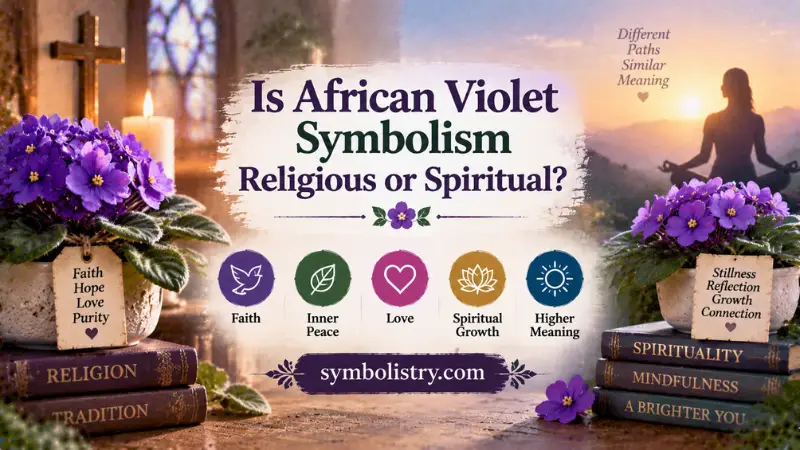
For most Americans, African violet symbolism is not primarily religious.
Its meanings are more commonly connected with gardening, family life, gifts, affection, memory, and personal experience.
Some people may give the flower a spiritual meaning, especially when they associate blooming with renewal, hope, gratitude, or continuing life.
That interpretation can be personally meaningful without being part of a formal religious tradition.
The best approach is therefore to consider context.
A memorial plant, a Mother’s Day gift, a houseplant on a windowsill, and a decorative arrangement can all involve African violets while communicating different ideas.
FAQ About African Violet Symbolism
What does an African violet mean as a gift?
As a gift, an African violet can communicate affection, appreciation, loyalty, devotion, or a wish for a lasting relationship. The occasion and relationship usually determine which interpretation fits best.
Do African violets symbolize love?
Yes, African violet symbolism can represent love, especially steady affection and devotion. The meaning does not have to be romantic and can also describe family love, friendship, or appreciation.
What does a purple African violet symbolize?
Purple African violet symbolism is often associated with devotion, admiration, dignity, and affectionate appreciation. These meanings are common interpretations rather than universal rules.
What does African violet symbolism mean?
African violet symbolism commonly represents devotion, faithfulness, affection, patience, care, and continuity. In American culture, it is also connected with home life, thoughtful gifts, and personal memories.
Is an African violet a true violet?
No. Despite the name, the African violet is not a true violet from the genus Viola. Its name comes from the visual resemblance of its flowers, while botanically it belongs to a different plant family.
Can an African violet symbolize remembrance?
Yes. African violet symbolism can represent remembrance when a particular plant is connected with someone who has died or with an important period of the past. This meaning is usually personal rather than a universal historical rule.
Are African violets associated with motherhood?
African violet symbolism can include motherhood and appreciation for nurturing, particularly in modern gift culture. However, motherhood is not the plant’s only meaning, and the association should not be treated as an ancient religious tradition.
Conclusion
African violet symbolism centers on qualities that develop through continued care: devotion, faithfulness, affection, patience, remembrance, continuity, and renewal. Its meaning is less connected with ancient mythology than with modern horticulture, American houseplant culture, gift-giving, and personal memory.
The plant’s small size and recurring flowers make it particularly suited to quiet forms of symbolism. An African violet can represent a relationship that has lasted, a home filled with familiar memories, appreciation for someone’s care, or a personal reminder to continue growing.
In the end, the meaning of an African violet depends on both cultural associations and personal experience. Its most fitting message is often simple: care that continues can become something worth remembering.