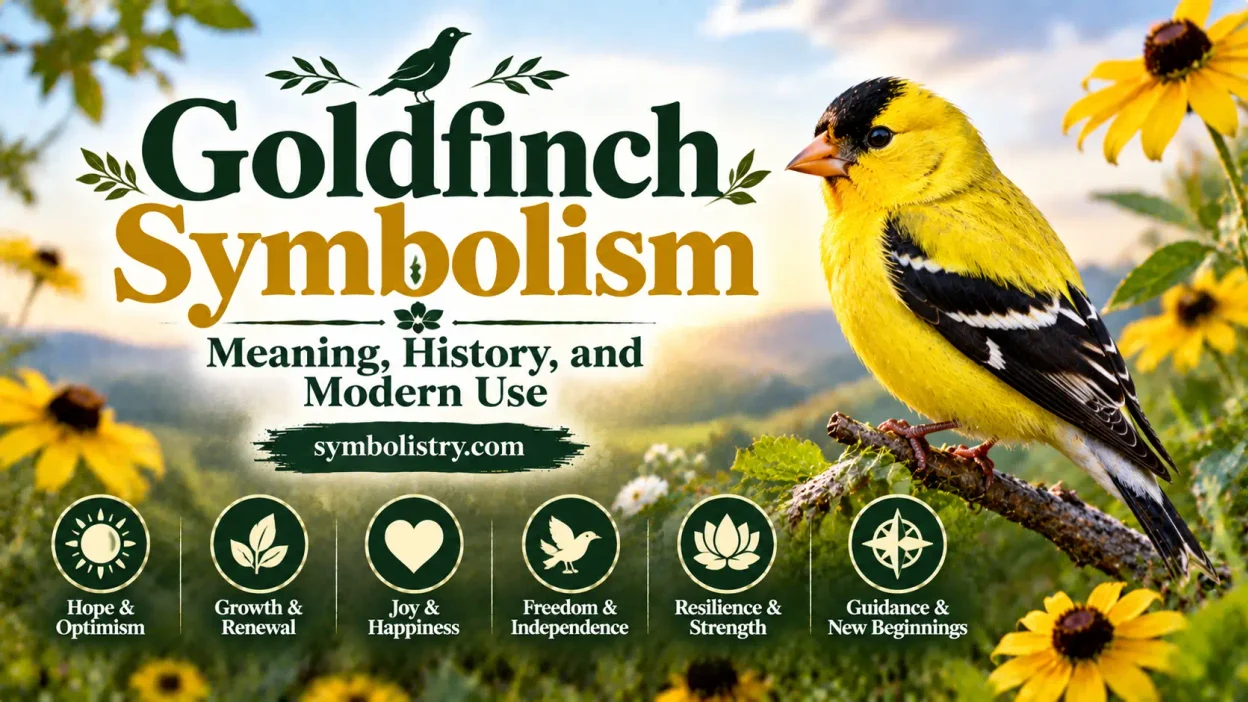
The goldfinch is a small songbird whose bright plumage, lively movements, and cheerful calls make it easy to recognize and enjoy. In the United States, the American goldfinch is especially familiar, appearing in backyard gardens, wildflower meadows, and bird feeders. Its golden-yellow feathers naturally invite associations with sunshine, happiness, and the return of warmer weather.
Goldfinch symbolism goes beyond the bird’s attractive appearance. For many people, it represents optimism, freedom, resilience, and the ability to find beauty in ordinary moments. Its changing plumage also offers a reminder that appearances shift with the seasons, even when the living creature remains the same.
The goldfinch has a separate, well-documented history in European religious art, where it sometimes represents suffering, sacrifice, and redemption. Understanding these different interpretations helps explain why the bird can convey both cheerful everyday meanings and more serious historical ones.
Quick Answer
Goldfinch symbolism commonly represents joy, optimism, renewal, and appreciation for life’s small pleasures in modern American culture. Historically, the European goldfinch also appeared in Christian art as a symbol associated with Christ’s suffering, the soul, and redemption.
TL;DR
- Goldfinches commonly represent happiness, hope, and everyday beauty.
- Yellow plumage connects the American goldfinch with sunshine and summer.
- European Christian art associated the goldfinch with sacrifice and redemption.
- Its seasonal appearance suggests renewal and changing circumstances.
- Tattoos and artwork use the bird to express freedom and optimism.
- The American goldfinch represents regional pride in three U.S. states.
What a Goldfinch Looks Like and Why It Matters
The American goldfinch is a small finch with a short, conical bill suited to eating seeds. During the breeding season, the male has vivid yellow plumage, contrasting black wings, white wing markings, and a black cap. The female is generally more subdued, with olive-yellow coloring, while males become less brightly colored outside the breeding season.
These physical characteristics influence the bird’s modern symbolism. Its yellow feathers suggest sunlight, warmth, and cheerfulness, while its quick movements and undulating flight can give an impression of playfulness and freedom.
Goldfinches also have a close relationship with plants such as sunflowers, thistles, and other seed-bearing flowers. Seeing one feeding among wildflowers connects the bird with gardens, seasonal growth, and the natural world.
The European goldfinch looks different, with a distinctive red face, black-and-white head markings, and yellow patches on its dark wings. That distinction matters because many historical religious interpretations belong specifically to the European species, not automatically to the American goldfinch.
The Core Symbolic Meanings of the Goldfinch
The goldfinch does not have one universally accepted symbolic meaning. Its interpretation depends on cultural background, personal experience, and the setting in which it appears. Nevertheless, several themes recur in contemporary American interpretations.
Joy and Optimism
The bird’s bright coloring makes joy one of its most intuitive associations. A goldfinch perched on a garden fence or feeding among sunflowers can bring a flash of color to an otherwise ordinary day.
As a symbol, it can encourage a person to notice small pleasures without pretending that life’s difficulties do not exist. Its message is less about constant happiness and more about remaining receptive to moments of delight.
Renewal and New Beginnings
Goldfinches change their appearance with the seasons, and their activity is closely tied to the availability of seeds and nesting materials. These natural cycles make the bird a fitting emblem of renewal.
People may associate a goldfinch with starting over after a difficult period, developing a new interest, or approaching a changing season with curiosity. The symbolism comes from observing the bird’s life rather than from a single universal legend.
Freedom and Independence
A wild goldfinch can fly between trees, visit open fields, and move wherever food and shelter are available. That mobility makes it a natural image of independence.
In personal symbolism, the bird may represent the desire to make one’s own choices, explore new possibilities, or live with fewer unnecessary restrictions. It can also remind viewers that appreciating a living creature means respecting its freedom.
Resilience and Adaptability
Although the goldfinch looks delicate, it is adapted to feeding on seeds from plants that many people overlook. Its survival depends on finding suitable food, nesting materials, and habitat.
This provides a grounded basis for associating the bird with resourcefulness. The goldfinch can represent the ability to work with available resources and adjust to changing conditions rather than relying on strength or size alone.
Ancient Roots and Early Symbolism
The goldfinch’s historical symbolism developed through different traditions rather than from one original belief. Its strongest documented symbolic history comes from European art, particularly Christian paintings created during the Middle Ages and Renaissance.
In European Christian imagery, small birds could carry religious associations beyond their ordinary role in a scene. The European goldfinch became particularly connected with the Passion of Christ, referring to his suffering and crucifixion.
One traditional explanation links the goldfinch to the crown of thorns. Because the bird feeds among thorny plants, artists and viewers could associate it with the suffering Christ would endure. Another Christian legend tells of a small bird attempting to remove a thorn from Christ’s crown, acquiring a red marking in the process.
These stories should be understood as religious traditions and legends, not established historical events. They help explain the bird’s place in European devotional art, but they do not define its meaning in every culture.
Over time, the goldfinch also appeared in domestic paintings, decorative objects, and representations of everyday life. Its meaning therefore depended increasingly on context: it might suggest religious sacrifice in one image and the pleasure of keeping or observing a bird in another.
Goldfinch Symbolism in the United States
In America, the goldfinch is more commonly associated with wildlife, gardens, and seasonal beauty than with the religious symbolism found in European Renaissance paintings.
The American goldfinch is the official state bird of Iowa, New Jersey, and Washington. Its recognition gives it a place in regional identity and public culture. In these states, the bird can represent local wildlife, familiarity with the landscape, and appreciation for the natural environment.
Its presence around homes also makes its symbolism accessible. Unlike an animal encountered only in distant wilderness, a goldfinch may visit a feeder just outside a kitchen window. That familiarity allows people to connect the bird with quiet routines, family gardens, and the pleasure of noticing nature close to home.
American interpretations often include:
- Summer and sunshine: The male’s bright breeding plumage evokes warm weather and flowering gardens.
- Everyday happiness: A visit to a feeder can become a welcome interruption to a busy day.
- Regional identity: State-bird status connects the species with civic pride.
- Environmental appreciation: Planting native flowers and providing suitable habitat can express care for local wildlife.
These are cultural interpretations, not official definitions attached to every goldfinch sighting.
The Meaning of Yellow in Goldfinch Symbolism
Color is one of the clearest reasons the goldfinch attracts symbolic attention. In common American visual culture, yellow is associated with sunlight, warmth, cheerfulness, visibility, and energy. It frequently appears in spring decorations, summer designs, and artwork intended to feel bright or welcoming.
The male American goldfinch’s vivid summer plumage makes these associations especially natural. A goldfinch in an illustration can communicate optimism without requiring additional symbols or explanatory text.
Yellow can also suggest attention and alertness. In some settings, its brightness makes a design feel lively or energetic rather than peaceful. The goldfinch therefore works particularly well when an artist wants to combine gentleness with visual vitality.
However, color associations are not universal psychological laws. Yellow may carry different meanings across societies and individual experiences. A goldfinch’s significance also depends on the scene, the species, and the viewer’s personal connection to the bird.
Spiritual and Religious Interpretations
Some people interpret a goldfinch sighting as a spiritual reminder of hope, guidance, or gratitude. A bird appearing during a period of uncertainty may feel like an invitation to pause, pay attention, or reconnect with what matters.
For someone who has recently experienced loss or a major life change, the sighting may become personally meaningful. The bird can serve as a reminder of a loved one, a cherished place, or a moment when life felt more manageable.
Such interpretations are personal beliefs rather than claims that goldfinches deliver supernatural messages. There is no universal religious rule that a sighting predicts a particular event.
The historical Christian interpretation is more specific. In European religious art, the goldfinch could foreshadow Christ’s Passion or represent ideas about the soul and redemption. That tradition differs from modern spiritual interpretations centered on optimism and everyday encouragement.
Keeping these distinctions clear allows the bird to have personal meaning without confusing contemporary belief with documented religious history.
Goldfinches Across Cultures
The goldfinch’s cultural meanings vary according to the species and tradition involved.
In European Christian art, the European goldfinch is associated with Christ’s suffering, redemption, and, in some interpretations, the soul. Artists could use its appearance to introduce religious meaning into a scene depicting the Virgin Mary and the infant Jesus.
In European domestic and decorative traditions, goldfinches also appeared as familiar songbirds valued for their color and calls. Their presence could communicate a connection to the household, nature, or the pleasures of observing birds.
In the United States, the American goldfinch has a more prominent association with native wildlife and outdoor spaces. Its state-bird status in Iowa, New Jersey, and Washington gives it a civic role that is distinct from its European religious history.
Claims about a single goldfinch meaning shared by all Indigenous American nations should be treated cautiously. Indigenous communities have distinct traditions, and a cultural interpretation should be tied to a specific community and reliable evidence rather than generalized across many peoples.
The broad lesson is that the goldfinch’s symbolism is shaped by the people observing it, the stories they inherit, and the circumstances in which the bird appears.
Emotional and Psychological Associations
A goldfinch can influence how a person feels without possessing a fixed psychological meaning. Bright color, birdsong, and movement may draw attention away from routine concerns and toward the immediate surroundings.
For someone who enjoys birdwatching, seeing a goldfinch might produce excitement because it is recognizable and beautiful. For another person, the same bird may recall a childhood garden or time spent with a family member.
This personal association is an important part of symbolism. The bird’s meaning can grow from repeated experiences rather than from a formal cultural tradition.
Goldfinches may also represent a balanced form of optimism. Their small size and ordinary habitat make them reminders that enjoyment does not always require grand achievements or dramatic changes. Sometimes it comes from noticing what is already present.
That interpretation should not be mistaken for a promise that a bird sighting will improve someone’s circumstances. Rather, the goldfinch can become a meaningful prompt to notice beauty, acknowledge emotions, and remain open to new experiences.
Goldfinch Symbolism in Dreams
A goldfinch in a dream may suggest joy, independence, renewal, or a wish for greater freedom, depending on the dreamer’s circumstances. These are interpretive possibilities, not established meanings that apply to everyone.
A brightly colored goldfinch might remind someone of a happy period or an opportunity they are considering. A bird flying away could evoke a concern about independence, change, or something difficult to hold on to.
A goldfinch in a cage might bring up questions about restriction or responsibility. For one person, it could represent feeling confined; for another, it might simply reflect a memory of a bird they saw during the day.
When interpreting such a dream, consider the emotional tone, the setting, and the associations the bird holds for you. Those details are generally more useful than assuming that every goldfinch dream predicts luck, money, romance, or a specific future event.
What a Goldfinch Can Mean in Art and Literature
Goldfinches have a notable place in European art, where their small size and recognizable markings made them useful visual details. In religious paintings, the bird could carry theological meaning within a larger scene.
Raphael’s Madonna of the Goldfinch, painted in the early sixteenth century, is a well-known example. The bird held by the infant Jesus is traditionally interpreted as a reference to the Passion that awaits him.
Another famous work is Carel Fabritius’s The Goldfinch, painted in 1654. The painting depicts a European goldfinch attached to a perch. Its subject invites reflection on beauty and captivity, although it is important not to reduce the painting to a single symbolic interpretation.
In contemporary American art and literature, goldfinches may instead evoke nature, memory, tenderness, or the vivid details of an ordinary day. Their meaning depends on the work itself: a bird in a pastoral scene does not necessarily carry the same message as one in a religious painting or a story about confinement.
Modern Uses in Tattoos, Jewelry, and Home Decor
Goldfinch imagery works well in personal design because it is recognizable, compact, and visually distinctive. Its yellow coloring and delicate shape suit both detailed illustrations and simple line drawings.
Goldfinch Tattoos
A goldfinch tattoo may express optimism, independence, resilience, or a personal connection to nature. Some people choose it to commemorate a fresh start, while others associate it with a meaningful place or loved one.
A bird shown in flight can emphasize freedom and movement. A goldfinch perched on a branch may communicate calmness, patience, or appreciation for the natural world. The owner’s intention matters more than any universal tattoo dictionary.
Jewelry and Accessories
Goldfinches appear on pendants, earrings, brooches, and nature-inspired accessories. Their imagery may appeal to people who want to carry a reminder of hope, a favorite garden, or a personal memory.
The use of gold-colored materials can reinforce associations with sunlight and warmth, although a goldfinch design does not automatically symbolize wealth simply because of its name.
Home Decor and Gifts
Bird illustrations, ceramic ornaments, prints, and garden decorations can bring goldfinch imagery into everyday surroundings. The bird is particularly suited to spring and summer designs, floral arrangements, and gifts for birdwatchers.
A goldfinch gift can express encouragement or appreciation, but the meaning becomes clearer when it reflects the recipient’s interests or a shared memory.
Digital Culture
On social media, photographs of goldfinches often accompany posts about gardening, seasonal change, wildlife, or peaceful moments outdoors. Some people use the bird as a personal symbol of hope or remembrance.
There is no single online meaning that everyone recognizes. Captions, images, and the circumstances surrounding a post shape how viewers understand the bird.
Comparing Goldfinch Meanings by Context
| Context | Common Interpretation | Key Association | Important Distinction |
|---|---|---|---|
| American backyard | Joy and everyday beauty | Sunshine, birdsong | Usually based on personal experience |
| State-bird symbolism | Regional pride | Local wildlife | Official status applies in three states |
| European Christian art | Sacrifice and redemption | Christ’s Passion | Historically specific religious imagery |
| Tattoos and jewelry | Hope and independence | Personal identity | The wearer’s intention guides meaning |
| Dreams and spiritual reflection | Renewal or encouragement | Change and memory | Interpretations are subjective |
| Bird-themed home decor | Nature and seasonal warmth | Gardens and flowers | Often decorative rather than religious |
Common Misunderstandings About Goldfinch Symbolism
One common mistake is treating every goldfinch as a symbol of happiness. Although joy is a popular modern association, the European goldfinch has a more complex history in Christian art, including connections with suffering and sacrifice.
Another misunderstanding is assuming that a goldfinch sighting always predicts good fortune. Some people regard the bird as an encouraging sign, but this is a personal or spiritual interpretation rather than a verified prediction.
The name can also cause confusion. In North America, the American goldfinch is usually the bird people mean, whereas European art history generally refers to the European goldfinch. Their appearances, habitats, and cultural histories are not interchangeable.
Finally, goldfinch symbolism should not be confused with the biological meaning of the bird’s behavior. A goldfinch visiting a feeder is ordinarily looking for food, not delivering a message about the observer’s future. People can still find the encounter meaningful without assuming that nature is sending a definite instruction.
How Goldfinch Symbolism Has Changed Over Time
The goldfinch’s symbolic role has shifted as people’s relationships with birds have changed. In European religious painting, it could communicate a specific Christian idea through familiar visual conventions. In domestic settings, it could be admired for its appearance and song.
In modern American culture, the American goldfinch is more closely associated with outdoor recreation, gardens, wildlife photography, and regional identity. Its role as a state bird gives it public recognition, while its presence at feeders makes it part of everyday life.
Personal symbolism has also become more visible through tattoos, jewelry, social media, and nature-inspired gifts. In these settings, the bird can express an individual’s values or memories without requiring a shared religious or historical framework.
The result is not one meaning replacing another. Older religious associations remain relevant when interpreting European art, while contemporary meanings reflect the experiences of people who encounter goldfinches in their own surroundings.
Frequently Asked Questions
What does it mean when you see a goldfinch?
A goldfinch sighting is often associated with happiness, hope, and appreciation for nature. If the encounter feels meaningful, you might connect it with a personal memory or a change happening in your life, although the sighting does not predict a specific event.
Is a goldfinch a symbol of good luck?
Some people interpret goldfinches as signs of good fortune because of their bright appearance and cheerful associations. This is a personal or cultural belief rather than a universal tradition shared by all communities.
What does a goldfinch tattoo symbolize?
A goldfinch tattoo can represent optimism, freedom, resilience, or a new beginning. It may also commemorate a loved one or express an enduring connection to birds and the natural world.
What does a goldfinch symbolize in Christianity?
In European Christian art, the goldfinch is often associated with Christ’s Passion, including his suffering and crucifixion. Its appearance in paintings of the Virgin Mary and the infant Jesus can foreshadow these events, drawing on traditional religious interpretations and legends.
Does a goldfinch symbolize a loved one who has passed away?
Some people associate a goldfinch with remembrance, comfort, or a continuing emotional connection to someone who has died. This interpretation is personal rather than a universal religious teaching, and the bird may become meaningful through memories shared with the person.
What is the difference between American and European goldfinch symbolism?
The American goldfinch is commonly associated with joy, summer, gardens, and regional identity in the United States. The European goldfinch has a more established history in Christian religious art, where it can symbolize suffering and redemption.
Does a goldfinch symbolize renewal?
Yes, renewal is a common modern interpretation, partly because the American goldfinch’s appearance changes with the seasons. People may use the bird to represent a fresh start, personal growth, or the possibility of approaching change with optimism.
Conclusion
Goldfinch symbolism brings together joy, hope, freedom, and renewal, with meanings shaped by the bird’s appearance, behavior, and cultural history. In the United States, the American goldfinch is especially associated with sunshine, backyard wildlife, and the simple pleasure of noticing nature close to home. In European Christian art, the goldfinch carries a different historical significance connected with sacrifice and redemption.
Whether it appears in a garden, a painting, a tattoo, or a piece of jewelry, the goldfinch can express something personal without having to mean the same thing to everyone. Its most lasting appeal lies in that combination of recognizable beauty and flexible meaning: a small bird that invites people to pay attention to the world around them.