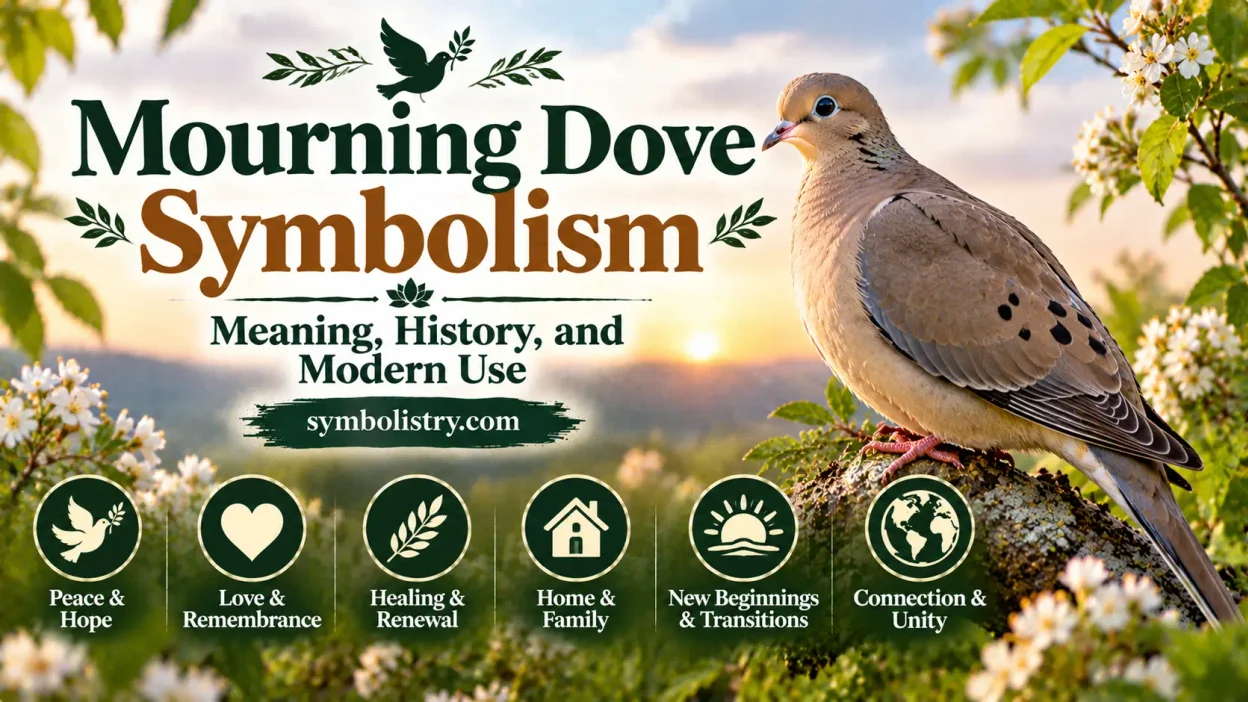
The mourning dove is a familiar sight across the United States, where its soft gray-brown feathers, slender silhouette, and gentle cooing make it a common presence in gardens, parks, and suburban neighborhoods. Mourning dove symbolism often centers on peace, love, grief, hope, and the quiet continuation of life after loss. Its name and distinctive call give it a special place in how people think about remembrance and emotional healing.
Unlike symbols that depend on elaborate myths or formal religious teachings, the mourning dove draws much of its meaning from everyday observation. It often appears calm and unthreatening, forms lasting pair bonds, and produces a call that many listeners describe as sorrowful. These qualities make it easy to associate the bird with tenderness, devotion, and reflection.
In American culture, mourning doves can carry both personal and spiritual meaning. Someone grieving a loved one might interpret an unexpected visit from one as a comforting reminder of that person, while another observer may simply appreciate the bird as a sign of peace in an ordinary moment. Understanding the difference between cultural symbolism and personal belief helps explain why this modest bird has such a lasting emotional appeal.
Quick Answer
Mourning dove symbolism commonly represents peace, love, remembrance, and comfort after loss in modern American culture. Its associations with grief and renewal are reinforced by its plaintive call, while the dove’s broader history connects it with devotion, gentleness, and spiritual hope.
TL;DR
- Mourning doves commonly symbolize peace, tenderness, and emotional comfort.
- Their mournful-sounding calls contribute to associations with grief and remembrance.
- Long-term pair bonds make them emblems of affection and devotion.
- In American culture, sightings can become personal reminders of deceased loved ones.
- Religious dove imagery connects the bird family with hope and spiritual renewal.
- Tattoos, memorial art, and home decor use the dove to express enduring love.
1. What Makes the Mourning Dove a Recognizable Symbol?
The mourning dove (Zenaida macroura) is a slender bird with muted gray, tan, and brown coloring, a small head, dark eyes, and a long, tapered tail. Its understated appearance differs from the bright plumage of many other birds, giving it an association with simplicity and quietness rather than spectacle.
Its most recognizable feature is its low, repetitive call. People often hear it early in the morning or during quiet periods of the day. Because the sound can resemble a soft lament, it has helped establish the bird’s connection with sorrow and reflection.
Mourning doves also live close to people. They visit lawns, feeders, telephone wires, fences, and open spaces around homes. This familiarity makes them accessible symbols: a person does not need to travel to a remote landscape or study a rare animal to encounter one.
The bird’s symbolism grows from this combination of ordinary presence and emotional suggestion. It can seem peaceful without appearing distant, and melancholy without appearing threatening.
2. The Core Meanings of Mourning Dove Symbolism
Several related meanings recur when people interpret the mourning dove.
Peace is one of the most common. The bird’s gentle behavior and lack of an aggressive appearance make it a natural emblem of calm, reconciliation, and the wish for conflict to end.
Love and devotion arise partly from the species’ breeding behavior. Mourning doves form pair bonds and share responsibilities connected with nesting and raising their young. Observers may see these behaviors as expressions of loyalty, partnership, and family commitment.
Grief and remembrance are closely linked to the bird’s name and call. Its sound can remind listeners of sadness, while its sudden appearance during a period of bereavement may become personally meaningful.
Hope and renewal offer a different side of its symbolism. Mourning doves continue feeding, nesting, and raising young across much of their range. Their presence can suggest that life continues even after difficult experiences.
These meanings are connected but not interchangeable. A dove in a wedding illustration may represent devotion, while one included in a memorial design may communicate loss and enduring affection. Context determines which association becomes most important.
3. Why the Mourning Dove Is Associated With Grief
The word mourning is central to the bird’s emotional identity. Its call has a plaintive quality that many people interpret as a lament, especially when heard in isolation or during a quiet moment. The sound can encourage reflection even though the bird is not literally expressing human sadness.
The association becomes particularly strong when someone encounters a mourning dove after a death. A bird perched near a window, resting in a garden, or calling outside a memorial gathering may become linked to a specific person or memory.
Grief also changes how people notice their surroundings. Ordinary details that once seemed insignificant can acquire emotional importance, especially when they connect with a loved one’s habits, favorite places, or familiar experiences. A mourning dove may become one of those details.
This does not mean the bird predicts a death or carries an objectively established message from the deceased. Rather, it can provide a meaningful focus for memory, affection, and reflection. Its symbolic value comes from the relationship between the bird, the observer, and the moment in which it appears.
4. Historical Origins of Dove Symbolism
Doves have represented a range of ideas across different societies for thousands of years. Their associations with love, fertility, gentleness, and sacred presence developed through religious traditions, mythology, artistic conventions, and observations of their behavior.
In ancient Mediterranean cultures, doves were associated with deities connected to love and fertility, including Aphrodite in Greek tradition. Such associations helped establish the dove as an image of affection and attraction in art and cultural storytelling.
Biblical traditions also gave the dove important symbolic roles. In the story of Noah, a dove returns with an olive leaf, signaling that the floodwaters are receding and that the world is becoming habitable again. This episode helped establish the dove as a sign of hope, restoration, and peace.
These historical associations generally concern doves as a broader group, not exclusively the American mourning dove. It is important to distinguish the symbolism of the species from the long cultural history of dove imagery as a whole.
The mourning dove acquired its particular emotional identity through its own appearance, behavior, and voice, combined with meanings people already attached to doves.
5. Mourning Dove Symbolism in American Culture
In the United States, mourning doves are part of everyday life rather than distant folklore. They appear in residential neighborhoods, rural fields, public parks, and open spaces near farms. Because people encounter them so frequently, their symbolic meaning often develops through personal experience.
The bird’s call is particularly recognizable in American summers. Hearing it from a backyard tree or outside an open window can create a sense of stillness and familiarity. For some people, the sound recalls childhood homes, grandparents’ gardens, or peaceful mornings spent outdoors.
Mourning doves also occupy a place in American wildlife culture. They are common across much of the country and are recognized as a game bird in many states. This practical relationship with the species exists alongside its emotional symbolism, showing that the same animal can have different meanings depending on context.
In memorial settings, the dove’s gentle appearance can offer a visual expression of sympathy. A condolence card featuring a dove, for example, may communicate comfort without making specific claims about religion or the afterlife. Its meaning is accessible to many people, including those who simply associate birds with freedom and peace.
6. Religious Meaning: Peace, the Holy Spirit, and Hope
Doves have a significant place in Christian imagery, although the mourning dove should not automatically be treated as a specifically biblical symbol.
In the New Testament, the Holy Spirit descends like a dove during Jesus’ baptism. Christian art frequently uses a dove to represent the Holy Spirit, divine presence, spiritual guidance, and renewal. The image may appear in churches, baptismal decorations, religious paintings, and personal devotional objects.
The story of Noah provides another influential association. A dove returns to the ark carrying an olive leaf after the floodwaters begin to recede. In later Christian interpretation and wider Western visual culture, the dove and olive branch became an established image of peace and reconciliation.
For someone who views a mourning dove through a Christian lens, seeing the bird may evoke these broader traditions of hope and divine care. However, an ordinary mourning dove is not necessarily intended to communicate a religious message, and the biblical stories do not specifically identify the species as the bird in question.
Outside Christianity, people may interpret the dove through their own spiritual or philosophical beliefs. Some see it as an emblem of the soul, while others understand it simply as a reminder to approach suffering with patience and compassion.
7. Indigenous Traditions and Other Cultural Interpretations
Bird symbolism varies considerably among Indigenous nations and other cultural communities. There is no single Native American interpretation of the mourning dove, and it would be misleading to assign the same spiritual role to every Indigenous tradition.
Some Indigenous stories and cultural teachings give birds roles connected with relationships, protection, communication, or the natural world. The meanings depend on the particular nation, story, language, and ceremonial context. Claims that every Indigenous culture considers a mourning dove a messenger from the dead should therefore be treated cautiously.
In ancient Greek and Roman traditions, doves were associated with Aphrodite and Venus, deities connected with love and desire. These associations contributed to the bird’s lasting relationship with romance and partnership in Western art.
Other cultural settings may emphasize the dove’s gentleness, domestic associations, or connection with the natural world. Yet a dove’s meaning in one tradition cannot automatically be transferred to another, particularly when a specific species is involved.
The most respectful approach is to identify the tradition being discussed rather than presenting all dove-related beliefs as a universal system. The mourning dove’s modern American symbolism combines several influences, but it also includes personal meanings that have no single historical source.
8. The Emotional and Psychological Meaning of the Mourning Dove
The mourning dove can represent an emotional state that is difficult to express directly. Its appearance and call provide an image for feelings such as longing, tenderness, loneliness, and the desire for peace.
Its symbolism is especially relevant to grief because mourning rarely follows a simple path. People may experience sadness alongside gratitude, relief, affection, or renewed appreciation for ordinary life. The bird’s quiet presence can serve as a reminder that these feelings can coexist.
There is also a psychological reason an ordinary bird may become significant during an emotional period. When someone is grieving or thinking intensely about a loved one, familiar details can take on greater personal importance. A song, scent, photograph, or animal encounter may become linked to a memory.
This does not make the experience meaningless. Personal symbols can help people acknowledge emotions, remember relationships, and create rituals around loss. Their value often comes from what they help someone recognize or express.
The mourning dove can therefore represent a gentle form of emotional acceptance: the understanding that sadness need not disappear before a person can continue living, loving, and finding comfort in daily experiences.
9. What Does It Mean When a Mourning Dove Visits You?
A mourning dove appearing near your home may feel significant, especially if you have recently experienced a loss or a major change. Its interpretation depends on your circumstances, beliefs, and the associations you already have with the bird.
Common personal interpretations include:
- After a loss: A reminder of someone who has died or a comforting connection to their memory.
- During a difficult period: An invitation to slow down and make room for reflection.
- In a relationship: A reminder of loyalty, tenderness, or the importance of peaceful communication.
- During a transition: A personal symbol of hope, recovery, or the beginning of a different chapter.
- During an ordinary day: A simple reminder to notice wildlife and appreciate the present moment.
Some people interpret unexpected animal encounters spiritually, believing they carry messages or reassurance. Others regard them as coincidences that become meaningful through memory and attention.
Neither interpretation needs to be imposed on everyone. There is no reliable evidence that a mourning dove’s visit predicts a future event or proves that a deceased person is communicating. You can appreciate the encounter’s personal meaning without treating it as a literal warning or supernatural certainty.
10. Mourning Dove Symbolism in Dreams
Dream interpretations are subjective, and there is no universally accepted system that assigns one fixed meaning to every bird appearing in a dream. Nevertheless, mourning doves can provide useful imagery for thinking about emotional experiences.
A calm dove might reflect a wish for reconciliation, security, or relief from conflict. If the dream occurs during bereavement, the bird may represent memories of someone who has died or the dreamer’s desire to feel connected to that person.
A dove calling repeatedly could bring attention to an emotion that has not been fully acknowledged. The sound may reflect sadness, longing, or a memory that remains present in the dreamer’s thoughts. It does not, by itself, indicate that another death is approaching.
A flying dove might suggest movement, freedom, or a willingness to move forward. If the bird appears injured or unable to fly, the image could reflect vulnerability or concern about a relationship, although the dreamer’s personal associations matter more than any standard interpretation.
Rather than asking only what the bird predicts, consider what it makes you feel. The emotions surrounding the dream often provide a more grounded starting point than a rigid symbolic definition.
11. Mourning Dove Tattoos, Jewelry, and Personal Style
Mourning dove imagery appears in tattoos and personal accessories because it can express several related ideas without requiring elaborate imagery.
A mourning dove tattoo may commemorate a parent, partner, friend, or family member who has died. Some designs include dates, initials, names, or a short phrase to connect the bird with a particular person. Others use a single dove to express a continuing bond with someone who is no longer alive.
The bird can also represent peace after hardship. Someone who has experienced a difficult relationship, major life transition, or period of emotional struggle might choose a dove as a reminder of the life they want to build afterward.
In jewelry, small dove pendants and engraved charms offer a quieter expression of affection or remembrance. A dove may be given as a memorial gift, worn as a personal keepsake, or chosen because its appearance suggests gentleness and simplicity.
Design details affect interpretation:
- A dove carrying an olive branch emphasizes peace and reconciliation.
- A pair of doves suggests partnership and mutual affection.
- A flying dove may express freedom, release, or moving forward.
- A dove accompanied by a name or date often signals remembrance.
- A dove placed beside a heart combines affection with emotional connection.
The species may not always be identifiable in stylized designs. A white bird with an olive branch, for example, is generally recognized as a broad dove symbol rather than a precise representation of a mourning dove.
12. Mourning Doves in Memorials, Weddings, and Home Decor
Mourning dove symbolism adapts easily to different occasions because its central associations are not limited to grief.
At funerals and memorial services, dove imagery can represent peace, loving remembrance, or hope for those left behind. It can be included in printed programs, floral arrangements, framed photographs, memorial jewelry, and commemorative artwork. For religious families, the image may also express faith in spiritual peace.
At weddings, doves generally represent partnership, affection, and commitment. Their association with pair bonds makes them suitable for invitations, decorative illustrations, and wedding keepsakes. In this setting, the emphasis shifts from sorrow to the promise of shared life.
Home decor often uses dove imagery to create a peaceful or contemplative atmosphere. A painting of a dove in a garden may suggest a connection with nature, while a small figurine may serve as a reminder of a loved one.
The meaning is shaped by the setting. The same image can express condolence on a memorial card, devotion on a wedding invitation, or quietness in a living room. Its flexibility helps explain why dove imagery remains recognizable even when the viewer does not know its historical background.
13. Mourning Dove Symbolism Compared With Other Dove Meanings
Although mourning doves belong to the same broader bird family as other familiar doves and pigeons, their symbolism is not identical in every context.
| Context | Common Meaning in the USA | Main Association | Important Distinction |
|---|---|---|---|
| Mourning dove alone | Remembrance and tenderness | Plaintive call and familiar presence | Often carries personal emotional meaning |
| White dove | Peace and hope | Religious art and ceremonial imagery | Color contributes to the interpretation |
| Dove with olive branch | Peace after conflict | Reconciliation and restoration | Closely linked with the Noah narrative |
| Pair of doves | Love and commitment | Partnership and courtship | Frequently used in wedding imagery |
| Dove in Christian art | Holy Spirit and divine presence | Baptism and religious devotion | Meaning depends on the biblical context |
| Dove on a memorial | Comfort and remembrance | Grief and spiritual hope | May be religious or entirely personal |
These distinctions help prevent a common misunderstanding: the meanings associated with white doves, biblical doves, and mourning doves overlap, but they are not interchangeable in every situation.
14. Common Misunderstandings About Mourning Dove Symbolism
One widespread misunderstanding is that the mourning dove’s call means the bird is grieving. The sound may resemble a lament to human listeners, but it serves biological purposes, including attracting a mate and communicating with other birds.
Another misconception is that seeing a mourning dove is a definite sign that someone will die. This interpretation may circulate in personal folklore or isolated traditions, but it is not a universal cultural belief or a scientifically established prediction. Encountering the bird should not be treated as evidence that a tragedy is coming.
It is also inaccurate to assume that every dove represents peace in every setting. A dove may be connected with love, religious devotion, innocence, remembrance, or other ideas depending on its surrounding imagery and cultural context.
Finally, the bird’s symbolic meaning should not obscure its actual life. Mourning doves are living animals with feeding, nesting, courtship, and survival behaviors. Their calls and movements have natural explanations, even when people attach personal significance to them.
Recognizing this distinction allows people to appreciate symbolism without confusing cultural interpretation with biological fact.
15. How Mourning Dove Meaning Has Evolved in Modern Life
The mourning dove’s symbolic identity has developed through a combination of older dove traditions and contemporary personal experience.
Historically established dove imagery supplied associations with love, peace, and spiritual hope. The mourning dove’s own name and call added a more particular connection with sorrow and remembrance. As the species became familiar in American neighborhoods and gardens, people encountered it in the everyday settings where private meanings often form.
Modern memorial culture has helped maintain its connection with grief. Photography, tattoos, keepsakes, and online remembrance posts allow people to use bird imagery to express feelings that may be difficult to put into words.
Social media has also made personal animal symbolism more visible. Someone may share a photograph of a dove after a loved one’s death, describing the encounter as comforting or meaningful. Such accounts can help other people express their own experiences, but they should not be mistaken for proof of a universal spiritual message.
In contemporary American life, the mourning dove can hold religious, emotional, artistic, and ecological significance at once. Its meaning has not replaced older traditions; instead, personal remembrance and familiar encounters have added new layers to them.
FAQ: Mourning Dove Symbolism
What does a mourning dove symbolize spiritually?
Mourning doves are often interpreted spiritually as signs of peace, comfort, remembrance, and hope. Some people connect their appearance with a sense of closeness to a deceased loved one, although that interpretation depends on personal faith rather than an objectively verifiable message.
Is a mourning dove a sign from a deceased loved one?
Some people find comfort in interpreting a mourning dove’s appearance as a reminder of someone who has died. There is no scientific evidence that the bird is literally delivering a message from the deceased, but the encounter can still hold genuine personal meaning.
What does it mean when a mourning dove visits your house?
A visit may symbolize peace, affection, reflection, or remembrance if those ideas are meaningful to you. From a natural perspective, mourning doves commonly visit residential areas in search of seeds, suitable perches, and nesting opportunities.
Is mourning dove symbolism positive or negative?
Its symbolism is generally gentle and reassuring, although its name and call can evoke sadness. The bird can represent grief without implying bad luck, impending death, or an unfavorable future.
What does a mourning dove tattoo mean?
A mourning dove tattoo often represents remembrance, enduring love, emotional recovery, or peace after a difficult experience. Names, dates, flowers, and olive branches can make the design more personal or emphasize a particular association.
What does a mourning dove mean in Christianity?
Dove imagery in Christianity is associated with the Holy Spirit, peace, and hope, especially in depictions of Jesus’ baptism and the story of Noah. These meanings apply to dove symbolism broadly; the Bible does not specifically establish the mourning dove as a messenger from deceased people.
Why is the mourning dove associated with sadness?
Its drawn-out, plaintive-sounding call resembles a lament to many human listeners, and its common name reinforces that impression. The call has natural communication functions, but people may interpret its sound emotionally because of their memories, experiences, and cultural associations.
Conclusion
Mourning dove symbolism brings together peace, devotion, grief, remembrance, and hope. Its distinctive call helps explain its association with sorrow, while its familiar presence and pair-bonding behavior contribute to its connections with affection and continuity. Religious and historical dove imagery adds further meanings, particularly in American memorial art and Christian traditions.
The mourning dove does not need to carry a supernatural message to become meaningful. For one person, it may be a reminder of someone dearly missed; for another, it may represent a quieter life, a lasting relationship, or the comfort of being outdoors. Its significance rests in the meeting point between the bird’s natural qualities and the meaning people find in their own experiences.