
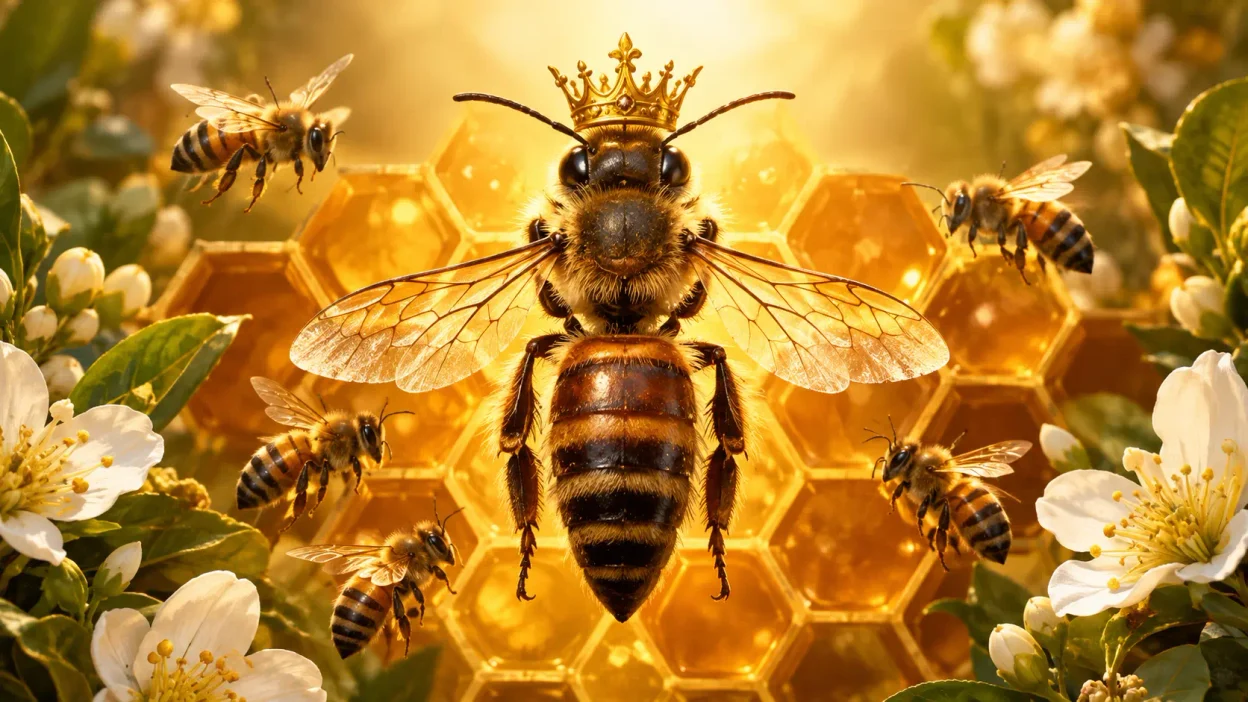
A queen bee can suggest authority, feminine confidence, leadership, fertility, and social influence—but the meaning changes sharply depending on context. In modern American culture, queen bee symbolism often describes a woman who stands at the center of a group, whether she is admired for her confidence or criticized for using status to control others.
The image is more complicated than a crown and a hive. A real honey bee queen is essential to reproduction, but she does not rule the colony like a monarch issuing commands. That scientific reality has created an interesting gap between nature and human imagination: people turned the queen bee into a symbol of personal power even though a hive depends on cooperation among thousands of individuals.
Today, Americans encounter queen bee imagery in jewelry, tattoos, fashion, workplace language, social media, and popular culture. Depending on who uses it, the queen bee may represent independence and ambition, motherhood and creation, popularity and influence, or the darker side of hierarchy.
Quick Answer
Queen bee symbolism most commonly represents female leadership, confidence, status, and influence in modern American culture. It also draws on the honey bee’s role in reproduction and colony life, giving the image historical associations with fertility, community, productivity, and social order.
TL;DR
- The queen bee commonly symbolizes female confidence and influence.
- Her biological role connects the image with fertility and continuity.
- Americans use the symbol positively and critically.
- Real queens do not command a hive like monarchs.
- Tattoos and jewelry often emphasize independence and self-worth.
- Workplace language gives “queen bee” a controversial negative meaning.
What a Queen Bee Is and What Makes Her Visually Distinctive
The queen bee is the primary reproductive female in a honey bee colony. She has a longer abdomen than worker bees and is usually surrounded by attendants that feed, groom, and interact with her.
In symbolic art, however, people often make the queen easier to recognize than she would be in nature. She may be shown wearing a crown, surrounded by a golden halo, placed above other bees, or decorated with jewels. These additions are human inventions. They visually translate the biological word queen into familiar ideas about royalty, rank, and authority.
This distinction matters because most modern queen bee symbolism comes from a combination of natural observation and human storytelling. The actual insect contributes ideas about reproduction and colony continuity. The crown and royal imagery contribute ideas about status, command, and personal importance.
The Core Meaning: Leadership and Female Authority
For many Americans, the queen bee is first and foremost a symbol of a woman who knows her own position and occupies it confidently.
This meaning appears especially in personal branding and fashion. A queen bee necklace, tattoo, or decorative image can communicate, “I am in charge of my own life,” without using a literal portrait of a woman. The bee adds another layer to the message because it is small but highly effective, social but capable of defending itself.
The image can also represent earned authority rather than inherited privilege. Bees are strongly associated with work and organized activity, so the queen bee often suggests a woman whose influence exists within a larger network of relationships, responsibilities, or achievements.
That is one reason the symbol appeals to people who want to express both femininity and authority. It does not rely on traditionally masculine imagery such as a sword or lion. Instead, it combines leadership with an unmistakably female biological role.
Why Fertility and Creation Are Part of the Symbol
A queen bee’s biological importance is closely tied to reproduction. She is the mother of most of the colony’s members, making her an obvious symbol of fertility, motherhood, and the continuation of life.
Symbolically, fertility does not have to mean literal motherhood. A queen bee can also represent the ability to create something that grows beyond the individual: a family, business, artistic project, community, or legacy.
This broader interpretation is particularly common in contemporary personal symbolism. Someone may identify with the queen bee because she sees herself as a builder or originator. The image suggests that creation requires continuity and care, not simply a dramatic act of leadership.
There is also a useful contrast here. Modern culture often imagines leadership as giving orders. The queen bee offers another model: being central to the continuation of a community while depending on the work and cooperation of others.
The Hive Adds Community to the Meaning
A queen bee cannot be understood completely without the hive.
Honey bees live in highly organized colonies where individuals perform specialized tasks. Worker bees gather food, care for young, maintain the hive, defend the colony, and perform many other jobs. The queen’s reproductive role is important, but the colony survives through collective activity.
Because of this, queen bee imagery can symbolize a leader’s relationship to a community rather than individual dominance alone. The positive interpretation is not “one person does everything.” It is “a central figure exists within a functioning network.”
This makes the symbol useful for describing mothers, founders, mentors, organizers, and community leaders. A queen bee may stand out, but she is still connected to the larger group.
The hive also introduces ideas of belonging. In symbolic terms, the queen bee can represent being at home within one’s own community or knowing one’s role without losing connection to others.
A Common Misunderstanding: The Queen Does Not Rule the Hive
The popular image of the queen bee as a tiny dictator is scientifically misleading.
Honey bee colonies make many important decisions collectively through the activities of worker bees. Workers determine and carry out much of the colony’s daily labor, and collective processes play a major role in decisions such as foraging and selecting new nest sites.
The queen’s primary biological role is reproduction and chemical communication. She produces pheromones that contribute to the colony’s social organization, but she does not sit at the center of the hive directing every worker.
This misunderstanding is actually important to the symbol’s evolution. Humans heard the word queen and applied their own ideas about monarchy. The result was a cultural image that became more hierarchical than the biology itself.
Modern symbolism therefore contains two different queen bees:
- The biological queen: a reproductive female within an interdependent colony.
- The cultural queen: a figure of rank, influence, confidence, or social dominance.
Understanding both makes the symbol much more interesting.
Ancient Bee Symbolism and the Roots of Royal Meaning
The queen bee as a distinct modern personality symbol is relatively recent, but bees have carried symbolic meaning for thousands of years.
In ancient Egypt, bee imagery was connected with royal identity and political authority. The bee was associated with Lower Egypt and appeared in royal titles, helping establish an early relationship between the insect and sovereignty.
Greek and Roman traditions also treated bees as examples of social order, productivity, and organized communal life. Ancient writers were fascinated by the apparent discipline of the hive, although they did not always understand its biology correctly. For centuries, Europeans commonly assumed the colony’s reproductive leader was male and described it as a king.
That historical mistake is revealing. The hive was used as a model for human government long before people correctly understood the sex of its reproductive leader. When natural history eventually established that the central reproductive bee was female, the royal symbolism remained—but the figure at the center changed.
The queen bee therefore inherited older associations with organized society while gaining newer associations with female authority.
Bees in Religious and Cultural Traditions
Bee symbolism appears in many cultural traditions, although the specific idea of the “queen bee” does not carry the same meaning everywhere.
In ancient Greek traditions, bees could be associated with priestesses, sacred knowledge, and the natural world. Honey also carried associations with nourishment and offerings. In Hindu traditions, bee imagery can appear in stories involving divine power, desire, and protection.
Christian symbolism often focused on beeswax, honey, industry, order, and the organization of the hive. Beeswax candles became especially important in religious settings, connecting bees indirectly with light and worship.
European folklore developed its own intimate relationship with bees. In some communities, people followed customs of “telling the bees” about important family events, including births and deaths. These practices treated the hive as part of the household’s continuing life.
What connects these traditions is not one universal queen bee meaning. Rather, human beings repeatedly noticed the same qualities in bees: their social organization, their production of honey and wax, their reproductive life, and their ability to defend themselves.
What the Queen Bee Symbolizes in the United States
In the United States, the queen bee has become strongly connected with individual identity and social position.
The most positive modern interpretation centers on confidence. A person who calls herself a queen bee may be signaling that she is ambitious, self-assured, stylish, influential, or unwilling to minimize herself for others.
The symbol also fits American ideas about entrepreneurship and self-definition. Small businesses use bee and queen imagery to suggest creativity, leadership, craftsmanship, and community. The queen bee can represent the person who started something and built a circle around it.
At the same time, American culture gives the phrase a less flattering meaning. In schools and social groups, a “queen bee” may be the dominant person whose popularity gives her influence over who belongs and who does not.
This dual meaning is central to the symbol. In the United States, being a queen bee can mean being admired—or being feared.
Queen Bee Meaning in Social Groups and Popular Culture
Popular culture has helped turn “queen bee” into a recognizable social archetype.
The queen bee is often portrayed as the person at the top of an informal hierarchy. She may set trends, influence friendships, determine what is considered acceptable, or control access to a desirable social group.
This character can appear in stories about middle school, high school, college, workplaces, and elite social circles. The archetype is usually female, although the broader pattern of status competition is not limited to women.
Why is the image so recognizable? Because a bee colony offers a convenient metaphor for human groups. People notice leadership, followers, insiders, outsiders, and competition for position. The metaphor simplifies those complicated relationships into a single visual figure: the queen at the center.
The problem is that fiction can make dominance look more natural or inevitable than it really is. Human communities are more complicated than a hive, and real bee biology does not justify stereotypes about how women should behave.
The Workplace Meaning and “Queen Bee Syndrome”
One of the most controversial uses of the term appears in workplace culture.
“Queen bee syndrome” has been used to describe situations in which a woman in a senior position distances herself from, competes with, or undermines other women who are trying to advance. The phrase became established in discussions of gender and workplace dynamics during the late twentieth century.
The label is controversial for good reason. It can unfairly turn structural problems into accusations against individual women. Women working in environments where leadership opportunities are scarce may face pressures that men do not experience, including tokenism, discrimination, and expectations that they represent all women.
As a result, contemporary discussions increasingly ask whether the label itself reinforces a double standard. An ambitious or demanding man may simply be called competitive, while similar behavior by a woman may attract the more gendered “queen bee” label.
The phrase should therefore be used carefully. It can describe genuinely harmful behavior, but it should not become a shortcut for criticizing confident women or blaming them for workplace inequality.
Positive and Negative Meanings at a Glance
| Context | Meaning in the USA | Common Associations | Notes |
|---|---|---|---|
| Jewelry | Confidence and femininity | Gold, crowns, honey | Usually positive |
| Tattoos | Independence and identity | Strength, loyalty, creation | Often personalized |
| Social groups | High status and influence | Popularity, trendsetting | Can be positive or negative |
| Workplace language | Senior female authority | Competition, gatekeeping | Often controversial |
| Home decor | Warmth and abundance | Honey, flowers, hospitality | Usually unrelated to hierarchy |
The table shows why context matters. A crowned bee on a pendant and the phrase “queen bee” in an office conversation may communicate almost opposite things.
Emotional and Psychological Meaning
Emotionally, the queen bee often appeals to people who want a symbol of self-possession.
The image communicates visibility. Unlike a hidden or passive symbol, the queen bee implies a willingness to occupy space and be recognized. This can make it attractive to people rebuilding confidence after periods of feeling overlooked or underestimated.
It can also represent belonging without sameness. The queen is part of a colony, yet visually and biologically distinct from the workers. Symbolically, this can express the desire to remain connected to a group while preserving a strong individual identity.
The bee’s sting adds another psychological layer. The image can suggest boundaries: sweetness and productivity do not mean a person is defenseless.
For this reason, queen bee symbolism often balances qualities that might otherwise seem contradictory—care and authority, community and individuality, beauty and self-protection.
Queen Bee Tattoos and What They Usually Mean
Queen bee tattoos are especially popular among people looking for a symbol that combines femininity with assertiveness.
A simple queen bee may represent leadership, self-confidence, or personal growth. A crown added above the bee usually makes the message more explicitly about self-worth and authority.
Flowers can shift the meaning toward fertility, beauty, nature, or renewal. Honeycomb patterns often emphasize community and structure. A swarm surrounding the queen may represent family, friendship, or a supportive social network.
Placement and style matter as well. A delicate design can emphasize elegance, while a bold traditional tattoo may focus on resilience and protection.
There is no universal tattoo meaning, of course. The most useful interpretation comes from the design’s details and the wearer’s own reason for choosing it.
Jewelry, Fashion, and Personal Style
Queen bee jewelry often functions as a compact form of identity symbolism.
Gold is especially common because it resembles honey and reinforces associations with luxury and royalty. Crowns, gemstones, and honeycomb patterns can turn the bee into a statement about confidence or status.
Fashion uses the symbol differently. A queen bee graphic on clothing may be playful, glamorous, rebellious, or openly assertive. In some cases, the wearer is embracing the title as a joke: “Yes, I know I’m in charge.”
The symbol also works well because bees are visually adaptable. A realistic bee can look natural and sophisticated, while a cartoon bee can feel cheerful and approachable. The addition of a crown immediately changes the tone.
Queen Bee Imagery in Homes and Decor
Bee imagery is common in American kitchens, gardens, nurseries, and gift culture. Honey jars, honeycomb patterns, floral prints, and bee-shaped decorations often communicate warmth and hospitality.
The queen bee adds a more personal dimension. A decorative sign that says “Queen Bee,” for example, may playfully identify the woman considered the center of a household or family.
In this setting, the symbol usually does not imply literal control. It is more often affectionate or humorous. The “queen” is the person whose preferences, personality, or care give a home its character.
This use connects the symbol with domestic creativity. A queen bee can represent someone who organizes, hosts, nurtures, decorates, or brings people together.
Social Media and the Modern Reclaiming of the Queen Bee
Digital culture has made it easier to reclaim words that once sounded insulting.
On social media, “queen bee” may be used as a compliment, a self-description, or a playful celebration of confidence. Users pair bee imagery with messages about boundaries, ambition, entrepreneurship, friendship, and self-respect.
The symbol works particularly well in visual spaces because its message can be understood quickly. A crown plus a bee suggests status immediately, while the insect itself adds ideas of work, organization, and nature.
At the same time, social media can intensify the negative side of queen bee imagery. Online communities create their own popularity hierarchies, and accusations of cliquishness, exclusion, and gatekeeping can spread quickly.
The modern queen bee is therefore both an identity symbol and a social critique.
From Monarchy to Interdependence: How the Meaning Has Changed
The meaning of the queen bee has changed as human knowledge has changed.
Early observers saw the hive as an organized society and interpreted it through the political systems they knew. If they lived under kings and queens, the colony seemed to have its own royal court.
Scientific understanding later showed that the queen’s primary role was reproductive rather than political. This complicated the old metaphor. The queen was central, but the workers were not simply obedient subjects.
Modern culture then shifted the image again. The queen bee became an archetype of female social power—sometimes admired, sometimes criticized.
Today, the symbol is moving toward a more nuanced interpretation. It can still represent leadership, but increasingly it also raises questions about collaboration, gender expectations, and the difference between influence and domination.
Common Misunderstandings About the Symbol
The biggest misunderstanding is assuming that every queen bee symbol means dominance.
In jewelry or tattoos, the image is often about confidence rather than controlling other people. In family or home decor, it may simply be affectionate and humorous.
Another mistake is treating the phrase as automatically positive. In discussions of social hierarchy or workplace behavior, “queen bee” can carry criticism and may imply exclusion or gatekeeping.
It is also inaccurate to imagine that a biological queen controls every aspect of hive life. Human ideas about monarchy have shaped the symbol more strongly than the actual behavior of honey bee colonies.
These distinctions are worth remembering because symbolism depends on context. The same crowned bee can communicate empowerment to one person and social superiority to another.
Does the Queen Bee Have a Spiritual Meaning?
Some modern spiritual practices interpret the queen bee as a sign of feminine authority, creation, abundance, or purposeful community. These interpretations often combine older bee symbolism with contemporary ideas about personal empowerment.
There is no single religious definition, however. Bees appear in different ways across cultural and religious traditions, and the specifically crowned, personality-centered queen bee is largely a modern symbolic construction.
For readers interested in spirituality, the most grounded approach is to separate historical tradition from personal meaning. Someone can use the queen bee as a spiritual symbol without claiming that every culture understood it in exactly the same way.
Why the Symbol Still Matters in 2026
The queen bee remains relevant because modern Americans continue to negotiate questions about leadership and identity.
Who gets to be ambitious without being called arrogant? What is the difference between influence and control? Can a person be both nurturing and authoritative? These questions give the symbol more staying power than a simple decorative trend.
The image also fits a culture that values individual expression. A person can adapt the queen bee to her own story through a tattoo, piece of jewelry, business logo, fashion choice, or online identity.
At the same time, the symbol reminds us that status is never its only meaning. Behind the crown is a living creature whose existence depends on an elaborate social system. That tension between individuality and interdependence is one of the queen bee’s most useful modern ideas.
Frequently Asked Questions
What does a queen bee symbolize for a woman?
For a woman, a queen bee often symbolizes confidence, leadership, independence, and influence. It can also represent creativity or motherhood because of the queen’s reproductive role within the colony.
Is queen bee symbolism positive or negative?
It can be either. Jewelry, tattoos, and personal branding usually emphasize empowerment, while social and workplace contexts may use “queen bee” to criticize dominance, exclusion, or gatekeeping.
What does a queen bee tattoo mean?
A queen bee tattoo commonly represents self-worth, feminine strength, leadership, and resilience. Additional elements such as crowns, flowers, honeycomb, or other bees can make the meaning more personal.
Does the queen bee actually control the hive?
No, not in the way a human monarch controls a kingdom. The queen’s main role is reproduction and chemical communication, while worker bees collectively perform and organize much of the colony’s activity.
Is the queen bee a religious symbol?
Bees have religious and sacred associations in several traditions, including ancient Mediterranean and Christian contexts. The specific modern queen bee image is more often a cultural symbol of authority and identity than a universally defined religious emblem.
What does “queen bee” mean in American culture?
In American culture, it can describe a confident and influential woman or the dominant person within a social group. The phrase may be complimentary, playful, or critical depending on the situation.
Conclusion
At its most positive, queen bee symbolism represents confident leadership, feminine identity, creativity, and the ability to hold an important place within a community. Its biological roots add fertility and continuity, while centuries of bee imagery contribute associations with work, order, honey, and collective life.
Its more controversial meanings are equally important. The queen bee can symbolize social dominance, exclusion, or the unfair expectations placed on women in positions of authority. That tension is precisely why the image remains useful: it asks us to distinguish confidence from control and leadership from hierarchy.
A queen bee may wear a symbolic crown, but the enduring meaning of the image lies in the balance between standing out and remaining connected to the hive around her.

[…] personal change, especially when its eyespots and metamorphosis are emphasized. Historically, its meaning is less standardized than its modern symbolic use, with much of its contemporary interpretation developing from the broader symbolism of moths, […]