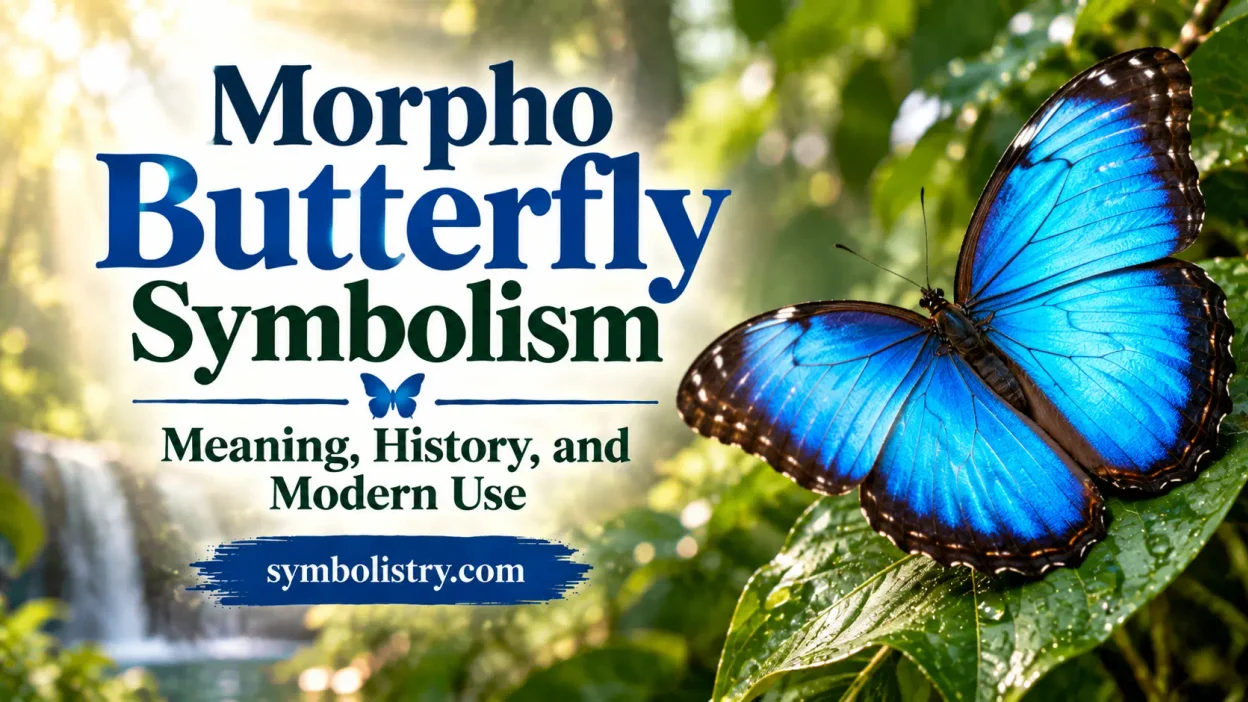
The morpho butterfly symbolism people recognize today often centers on transformation, beauty, freedom, and renewal. With its large wings and striking blue iridescence, the morpho looks unlike an ordinary garden butterfly, and that unusual appearance has encouraged different cultures to attach distinctive meanings to it.
Morpho butterflies belong to a group of tropical butterflies native to Central and South America. Their brilliant blue wings are especially associated with males of several species, while the undersides of the wings are often brown or patterned for camouflage. The contrast between brilliant visibility and concealment gives the butterfly an especially useful place in discussions of identity, change, and appearance.
For Americans encountering the morpho in artwork, jewelry, tattoos, photography, conservation displays, or decorative objects, the butterfly is usually interpreted through the broader symbolism of butterflies: personal change, freedom, renewal, and the transition from one stage of life to another. The distinctive blue color adds associations with calm, individuality, openness, and emotional clarity.
Quick Answer
Morpho butterfly symbolism commonly represents transformation, freedom, renewal, and individuality in modern American culture, especially in tattoos, art, jewelry, and personal-growth imagery. Its historical associations are more varied, with some Indigenous Amazonian traditions treating the morpho as sacred while others connected it with sorcery, danger, or the spirit world.
TL;DR
- Morpho butterflies commonly symbolize transformation and personal renewal.
- Their blue wings add associations with freedom, calm, and individuality.
- Amazonian traditions give morphos varied and sometimes contrasting meanings.
- American culture usually interprets the butterfly through broader butterfly symbolism.
- Tattoos and artwork often use morphos to represent life changes.
- The butterfly’s biology reinforces themes of contrast, adaptation, and change.
What the Morpho Butterfly Looks Like
The morpho is best known for its enormous, luminous blue wings. The genus contains numerous species, and not every morpho is uniformly blue, but several of the most familiar species display the brilliant metallic or iridescent blue that has made the group famous.
The color itself is unusual. Morpho wings do not simply contain ordinary blue pigment. Microscopic structures in the wing scales interact with light to produce the intense blue appearance, creating an iridescent effect that changes with viewing angle.
This matters symbolically because the butterfly can appear to change depending on how light reaches it. From one angle, its wings may look intensely blue and reflective; when the wings close, the underside can become much less conspicuous.
That physical contrast has made the morpho a natural metaphor for the difference between public identity and private life, visibility and concealment, or what a person reveals and what they keep to themselves.
What Morpho Butterflies Commonly Symbolize
There is no single universal dictionary of morpho butterfly symbolism. Meanings depend on cultural setting, personal interpretation, and whether the symbol is being treated as a general butterfly, a blue butterfly, or specifically a morpho.
In contemporary American symbolism, several ideas appear most often:
Transformation comes from the butterfly’s life cycle. Caterpillar, chrysalis, and adult butterfly provide an obvious visual sequence for personal change.
Freedom comes from flight. A butterfly moving through open air is easily associated with independence, movement, and release from previous limitations.
Renewal reflects the transition from one biological stage to another. People often use butterfly imagery after major life changes, including recovery, relocation, career changes, or the beginning of a new chapter.
Individuality is especially relevant to the morpho because its appearance is so distinctive. The vivid blue wings can represent someone who wants to express identity rather than blend into the background.
Beauty with concealment comes directly from the butterfly’s contrasting wing surfaces. The brilliant upper wings and subdued underside demonstrate that appearance can change dramatically according to circumstances.
These meanings are modern interpretations rather than a single ancient doctrine shared by all cultures.
Ancient and Indigenous Amazonian Connections
The morpho’s strongest historical cultural associations come from the tropical regions where these butterflies naturally occur.
Those traditions should not be reduced to one generalized idea of “Amazonian symbolism.” Indigenous communities have different languages, histories, ceremonies, and relationships with animals. As a result, the morpho can carry contrasting meanings.
Some accounts describe morphos as sacred or spiritually significant creatures. Other ethnographic records describe much darker associations. In research concerning the Cubeo of the northwest Amazon, for example, the morpho was associated with sorcery and harmful supernatural practices.
Other Amazonian traditions treated the butterfly more positively. Accounts concerning Indigenous communities in Colombia describe ceremonial recognition of the morpho, while other rainforest traditions have regarded these butterflies as special or sacred beings.
The important point is that there is no single Indigenous Amazonian meaning of the morpho butterfly. Any article or artwork claiming that every Amazonian culture viewed it as a universal symbol of transformation or good fortune oversimplifies a much more diverse cultural landscape.
Why the Blue Color Matters
The morpho’s blue color contributes substantially to its modern symbolic appeal.
Blue is frequently associated in American visual culture with calmness, openness, trust, distance, and the sky or water. When combined with butterfly imagery, it can create a meaning that feels more contemplative than the bright yellow or orange often associated with energetic butterflies.
The morpho’s blue is also unusual because it is structural rather than simply a flat surface color. The microscopic arrangement of wing scales produces the intense optical effect.
That physical fact supports an interesting symbolic reading: what appears to be a simple color is actually the result of complex structure.
For modern viewers, this can make the morpho a fitting image for individuality. Something that looks effortless from a distance may actually depend on intricate construction underneath.
Transformation and the Butterfly Life Cycle
Transformation is probably the most familiar modern meaning attached to butterfly imagery.
The morpho itself does not transform more dramatically than other butterflies, but its spectacular adult form makes the life cycle especially visually persuasive. A crawling caterpillar eventually becomes a winged insect capable of flight.
In American culture, this makes butterfly imagery common in representations of personal growth. Someone might choose a butterfly tattoo after leaving a difficult period, beginning a new career, completing recovery, moving to a new place, or marking another major transition.
The morpho adds a particular emphasis on becoming visibly different. Its adult form is not merely a continuation of the caterpillar’s appearance; it is strikingly different in shape, behavior, and visual presence.
As symbolism, therefore, the morpho can suggest not just change, but becoming recognizable as a different version of oneself.
The Morpho as a Symbol of Freedom
Flight gives butterfly symbolism another familiar dimension: freedom.
A morpho’s large wings make this association particularly easy to understand. Its movement through rainforest spaces can be interpreted as independence, mobility, and release.
In modern American design, this makes morpho imagery attractive for people who want to express a desire for greater personal autonomy. The symbol may appear after leaving a restrictive relationship, changing careers, moving away from home, or simply adopting a more independent identity.
However, the symbol does not have to represent escape from something negative. It can also represent the freedom to explore, create, travel, or define one’s own direction.
Visibility, Camouflage, and Hidden Identity
One of the most interesting meanings comes from the contrast between the morpho’s upper and lower wings.
When the wings are open, the butterfly can display an intense blue flash. When the wings close, the less conspicuous underside can make it much harder to detect against the surrounding environment.
This is not a symbolic behavior in itself; it is an adaptation that helps the butterfly survive. Morpho coloration can confuse predators, while the darker underside provides concealment.
But human observers can reasonably interpret the contrast metaphorically.
The morpho can represent the idea that a person may have a highly visible identity in one setting and a private, protected identity in another. It can also suggest adaptability: showing confidence when necessary while knowing when to become less noticeable.
This makes the morpho especially relevant to modern conversations about identity and self-presentation.
Morpho Butterfly Symbolism in the United States
There is no long-standing, nationwide American tradition devoted specifically to the morpho butterfly comparable to established symbols such as the bald eagle or American flag.
Instead, Americans generally encounter morphos through museums, zoos, butterfly exhibitions, nature photography, jewelry, decorative art, fashion, tattoos, and popular culture.
The meaning is therefore usually constructed from several familiar elements:
| Context | Common U.S. Interpretation | Common Associations | Notes |
|---|---|---|---|
| Tattoos | Personal transformation | Growth, freedom, new beginnings | Often marks a life transition |
| Jewelry | Beauty and individuality | Elegance, self-expression | Blue color is visually distinctive |
| Home decor | Calm natural beauty | Nature, openness, renewal | Often used as an accent image |
| Photography | Wonder and contrast | Color, movement, fragility | Popular because of iridescent wings |
| Conservation | Tropical biodiversity | Rainforest protection, ecology | Connects beauty with habitat awareness |
This American interpretation is largely contemporary. It should not be mistaken for an ancient American cultural tradition specifically centered on Morpho butterflies.
Emotional and Psychological Meaning
People often choose butterfly symbols because they want an image that acknowledges change without making the change itself the entire story.
The morpho works particularly well for this because its visual identity combines delicacy with dramatic color. It can communicate vulnerability and confidence at the same time.
For one person, a morpho tattoo may mean surviving a difficult period. For another, it may represent independence. Someone else may simply associate it with tropical travel, childhood memories, nature, or an appreciation for unusual beauty.
The emotional meaning is therefore personal rather than fixed.
A useful distinction is between shared symbolism and private symbolism. Transformation and freedom are widely recognizable butterfly themes. A specific morpho may additionally represent a person, place, memory, or experience known only to the individual who chose it.
Morpho Butterflies in Tattoos and Personal Style
Morpho butterfly tattoos are particularly suited to designs where color is central.
The large wings provide room for detailed linework, while the blue coloration can be represented through shading, gradients, or highly saturated ink. Some designs show the butterfly realistically; others combine it with flowers, geometric patterns, celestial imagery, names, dates, or landscapes.
In American tattoo culture, the morpho can therefore communicate several ideas at once.
A realistic morpho may emphasize appreciation for nature. A butterfly emerging from another object may focus on transformation. A solitary blue butterfly may emphasize individuality or freedom.
Placement can also change the impression. A small morpho on the wrist or ankle may feel intimate and personal, while a large design across the back or shoulder can function as a prominent statement of identity.
There is no requirement that a tattoo follow a traditional meaning. Personal symbolism is one of the main reasons butterfly imagery remains so adaptable.
Jewelry, Fashion, and Decorative Use
The morpho’s blue color makes it especially attractive for visual design.
Jewelry inspired by morpho wings, blue enamel butterflies, printed fabrics, hair accessories, wall art, and decorative objects often use the insect primarily as an emblem of beauty and individuality.
In contemporary American fashion, butterfly imagery can also carry associations with youth, femininity, nostalgia, or self-expression. Those associations are not universal and can change with trends.
The morpho’s distinctive appearance separates it from a generic butterfly design. For someone familiar with the insect, using a morpho can signal an interest in tropical nature or natural history rather than simply choosing a conventional butterfly motif.
Religious and Spiritual Interpretations
Butterflies have spiritual interpretations in many cultures, but the morpho should not automatically be assigned a religious meaning.
Some people interpret butterflies as signs of renewal, the continuation of life, or remembrance of someone who has died. In contemporary personal spirituality, a blue butterfly may also be viewed as a comforting sign during periods of grief or transition.
These are personal or culturally specific interpretations, not scientific facts about morpho behavior.
It is also important to distinguish modern spiritual symbolism from documented Indigenous traditions. Some Amazonian accounts connect morphos with sacred or supernatural ideas, but those meanings vary considerably among communities.
Common Misunderstandings About Morpho Symbolism
One common mistake is assuming that every blue butterfly is a morpho. Many butterfly species have blue coloration, while morpho refers to a particular group of tropical butterflies.
Another mistake is treating “Amazonian symbolism” as one unified belief system. Indigenous communities across the Amazon have different traditions, and documented morpho meanings range from sacred associations to negative connections with sorcery.
A third misunderstanding is the claim that morphos universally symbolize good luck, rebirth, or messages from deceased people. Those interpretations can be meaningful to individuals, but they should be presented as particular beliefs rather than universal facts.
Finally, the morpho’s brilliant blue should not be described simply as ordinary pigmentation. Its famous color is produced by microscopic structures that manipulate light, which is one reason its appearance is so distinctive.
How the Meaning Has Changed Over Time
Morpho symbolism has developed through several overlapping layers.
In the butterfly’s native regions, local communities developed their own relationships with the insect, producing meanings that could be sacred, ceremonial, protective, ominous, or associated with supernatural forces.
Later natural-history writing emphasized the morpho’s extraordinary appearance, size, flight, and coloration. European and American audiences increasingly encountered the insect through scientific collections, exploration accounts, museums, and natural-history displays.
In contemporary popular culture, the emphasis has shifted again. The morpho is often treated as an image of beauty, transformation, freedom, and individuality.
The result is not one continuous symbolic tradition. It is a mixture of Indigenous cultural meanings, natural-history fascination, general butterfly symbolism, blue-color associations, and modern personal interpretation.
Why the Morpho Still Appeals to Modern Audiences
The morpho remains visually compelling because several ideas come together in one creature.
It changes dramatically during its life cycle. It flies. Its wings can flash with brilliant blue and then become comparatively subdued. Its coloration is produced by microscopic physical structures rather than a simple layer of blue pigment. Its natural environment connects it with tropical forests and biodiversity.
For an American audience, these characteristics make the morpho flexible enough to represent both personal and ecological themes.
It can stand for a new beginning in a tattoo, individuality in jewelry, tropical beauty in artwork, or rainforest conservation in a museum exhibit. The same butterfly can therefore carry different meanings without requiring one interpretation to cancel another.
Frequently Asked Questions
What does a morpho butterfly symbolize?
A morpho butterfly commonly symbolizes transformation, freedom, renewal, and individuality in modern American symbolism. Its brilliant blue color can add associations with calmness, self-expression, and visual distinctiveness.
What does a blue morpho butterfly mean spiritually?
There is no single universally accepted spiritual meaning for a blue morpho. Some people interpret it as a sign of renewal, remembrance, or personal change, while documented Indigenous Amazonian traditions contain a wider range of interpretations, including sacred and negative associations.
What does a morpho butterfly tattoo symbolize?
A morpho tattoo often represents a major life transition, personal growth, freedom, or a new beginning. The specific meaning usually depends on the person’s experience and the other elements included in the tattoo.
Is a morpho butterfly a symbol of transformation?
Yes, transformation is one of the most common modern interpretations of morpho imagery because it is a butterfly. However, the idea comes primarily from broader butterfly symbolism and the insect’s metamorphosis rather than from one universal morpho-specific tradition.
Are morpho butterflies considered sacred?
Some Indigenous communities in the Amazon have regarded morpho butterflies as sacred or spiritually significant, but beliefs differ between communities. Other documented traditions have associated morphos with sorcery or harmful supernatural forces, so “sacred” should not be treated as a universal description.
Why are morpho butterflies blue?
The famous blue color of many morphos comes from microscopic structures in their wing scales that interact with light and produce structural coloration. The effect creates the intense iridescent blue for which the butterflies are known.
Does seeing a morpho butterfly mean something special?
For some people, seeing one can become a personal symbol of change, beauty, or a memorable moment. There is no scientific basis for treating an encounter as a universal omen, so its personal significance depends on the observer’s beliefs and circumstances.
Conclusion
The modern meaning of morpho butterfly symbolism is built from several layers rather than one fixed tradition. Transformation and freedom come from familiar butterfly imagery, while the morpho’s extraordinary blue wings add ideas of individuality, visibility, beauty, and contrast.
Its historical cultural meanings are more complicated than many modern symbolic summaries suggest. Indigenous Amazonian traditions have interpreted morphos in different ways, including sacred and negative associations, while contemporary American culture generally encounters the butterfly through art, nature education, fashion, tattoos, jewelry, and personal symbolism.
The morpho ultimately works as a symbol because its real biology already contains striking contrasts: metamorphosis, flight, camouflage, brilliant color, and structural complexity. Those qualities give people a concrete natural image through which to express change without reducing that change to a single universal meaning.