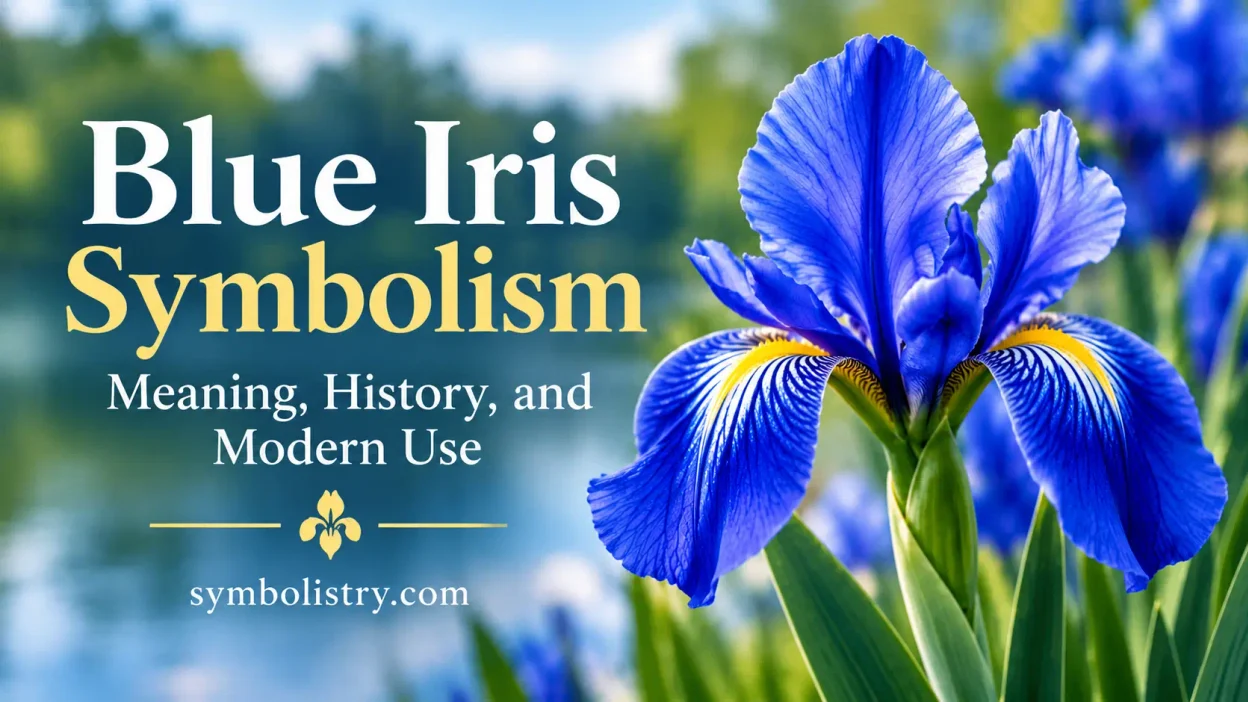
The blue iris symbolism comes from several overlapping traditions: the flower’s association with the Greek goddess Iris, the Victorian language of flowers, religious art, and the cultural meanings attached to the color blue. In modern American culture, blue irises are most often associated with faith, hope, trust, wisdom, and remembrance rather than a single fixed meaning.
The iris is also an unusually historical flower. Its name reaches back to ancient Greek mythology, while stylized iris forms became connected with European heraldry and the fleur-de-lis. In the United States, irises later became familiar garden plants, subjects of art, flowers for memorial settings, and symbols used in personal expression.
Because meanings vary by setting, a blue iris on a sympathy card does not communicate exactly the same thing as a blue iris tattoo or a bouquet given to a friend. Understanding the context is essential to understanding the symbol.
Quick Answer
Blue iris symbolism commonly represents faith, hope, trust, and wisdom in modern American culture, especially in flowers, memorials, artwork, and personal gifts. Historically, the iris has also been connected with divine messages, passage between worlds, remembrance, and virtues such as courage and faith.
TL;DR
- Blue irises commonly symbolize faith, hope, trust, and wisdom.
- Greek mythology connects the iris with messages and the rainbow.
- Victorian flower language gave irises several virtue-based meanings.
- American memorial traditions can associate irises with remembrance and respect.
- Blue adds associations of calmness, sincerity, and emotional steadiness.
- Modern tattoos and art often make the meaning personally specific.
What Does a Blue Iris Look Like?
An iris is recognizable by its distinctive flower structure: three upright petals, often called standards, and three downward-facing petals known as falls. Depending on the species and cultivar, the blooms can range from pale blue and lavender to deep violet, white, yellow, or combinations of several colors.
“Blue iris” is a broad description rather than the name of one particular species. Garden irises include many species and cultivated varieties, and some flowers described casually as blue are actually blue-violet or lavender.
That visual ambiguity matters symbolically. Blue irises often combine the traditional meanings of the iris with the cultural associations of blue itself. The result is usually a message that feels calmer and more contemplative than the brighter symbolism sometimes attached to yellow or red flowers.
In the United States, blue or blue-violet irises may appear in gardens, floral arrangements, artwork, memorial plantings, tattoos, stationery, and decorative designs.
The Core Meaning of Blue Iris Symbolism
The most common interpretation centers on faith and hope.
Faith does not necessarily mean religious belief. In ordinary American use, it can mean confidence in another person, trust in the future, loyalty, or the ability to keep believing during uncertainty. Hope similarly suggests looking toward something better without claiming that the outcome is guaranteed.
Wisdom is another established association. The iris’s long history in art, mythology, and flower symbolism has helped give it an intellectual and reflective quality.
The blue color modifies these meanings. Blue is commonly associated with calmness, trust, sincerity, stability, and contemplation. Consequently, a blue iris can suggest quiet confidence rather than dramatic emotion.
Other meanings can include:
- remembrance
- respect
- spiritual reflection
- communication
- courage
- loyalty
- emotional calm
- renewal after difficulty
These should be treated as contextual associations rather than universal rules. Flower symbolism has never operated as a single standardized dictionary.
Ancient Roots and the Greek Goddess Iris
The iris has one of the clearest mythological explanations for its name.
In Greek mythology, Iris was associated with the rainbow and served as a messenger between the gods and humans. The Greek word iris referred to the rainbow, linking the flower’s name with this mythological figure.
That association helped establish the iris as a flower connected with messages, transitions, and communication.
Ancient traditions also connected irises with death and burial. Research into European and Mediterranean plant symbolism notes that iris flowers were associated with graves in antiquity, with the tradition continuing in parts of the Mediterranean and later Ottoman world.
This history helps explain why the iris can carry two apparently different ideas: hope and mourning.
They are not necessarily contradictory. A flower associated with remembrance can also symbolize continuing life, transition, or hope after loss.
How the Iris Became a Symbol of Virtue
The iris accumulated additional meanings as it moved through European art and culture.
In medieval religious and artistic traditions, iris-like flowers were associated with protection, faith, and Christian imagery. The relationship between the iris, lily, and fleur-de-lis also became complicated because artists and heraldic designers did not always reproduce flowers botanically accurately.
The fleur-de-lis is particularly important. Although its exact botanical identity has been debated, the stylized emblem has historically been associated with lilies and irises. In medieval Christian art, the flower form became connected with the Virgin Mary and with ideas of purity and spiritual virtue.
Later French heraldry gave the stylized flower a prominent political and cultural role. The emblem became strongly associated with French monarchy and continued into later heraldic traditions.
This history is important because not every three-petaled flower symbol should automatically be interpreted as a literal blue iris. Botanical flowers and stylized symbols have often influenced one another without being identical.
Blue Iris Meaning in Victorian Flower Language
The Victorian era added another layer to iris symbolism through floriography, commonly called the language of flowers.
During the nineteenth century, flowers could be selected to communicate sentiments that were difficult or inappropriate to state directly. The custom became popular in Britain and North America, particularly through arranged bouquets and small floral gifts.
Iris meanings varied among flower dictionaries, but commonly included ideas such as wisdom, faith, courage, hope, eloquence, and admiration.
Color could further refine the message. Modern summaries of traditional flower language commonly associate blue irises with faith and hope, while purple irises are more often connected with wisdom or royalty and white irises with purity.
It is worth remembering that Victorian flower symbolism was not a universal code. Different dictionaries sometimes assigned different meanings to the same flower. The tradition is best understood as a cultural vocabulary rather than a rigid system.
What Blue Irises Mean in the United States
The American interpretation is shaped less by one formal tradition than by several overlapping ones.
In contemporary U.S. culture, blue irises can communicate:
| Context | Meaning in the USA | Common Associations | Notes |
|---|---|---|---|
| Gift giving | Hope and trust | Friendship, encouragement | Meaning depends on relationship |
| Memorials | Remembrance and respect | Grief, continuity | Often appropriate for reflective settings |
| Gardens | Renewal and beauty | Spring, patience, growth | Usually aesthetic as well as symbolic |
| Tattoos | Personal faith or memory | Identity, resilience | Highly individual |
| Art and decor | Calm and reflection | Blue, nature, elegance | Often less literal than floral gifts |
Unlike some religious symbols, the iris does not have one dominant meaning in American public life. Someone choosing blue irises may simply like their appearance.
Still, when the flower is deliberately selected for symbolic reasons, hope, remembrance, faith, and trust are among the most understandable interpretations.
Blue Iris Symbolism in Mourning and Memorials
The iris has a long connection with death and remembrance, making it particularly interesting in memorial symbolism.
Flowers have been used in cemeteries and funerals for centuries as expressions of respect, remembrance, and the continuation of life. Iris motifs appear in cemetery horticulture and on gravestones, where their presence can communicate remembrance without relying on explicit written language.
In a modern American memorial setting, a blue iris may therefore suggest:
- “I remember you.”
- “Your memory remains important.”
- “I hope for peace.”
- “I am honoring what you meant to me.”
- “Life continues despite loss.”
The color blue can make the symbolism feel restrained and contemplative. It is generally less associated with romantic passion than red and less visually celebratory than bright yellow.
That makes blue irises particularly suited to expressions of quiet remembrance.
Blue Iris Meaning in Religion and Spiritual Art
The iris has appeared in Christian and European religious art, but it is important not to claim that the blue iris is a specific biblical symbol.
The iris is not identified as a standard biblical flower with a universally established meaning. Some modern websites make stronger biblical claims, but those should be distinguished from documented historical associations.
The more defensible religious connection comes through European Christian art, where iris and lily forms sometimes overlapped and where the fleur-de-lis became associated with the Virgin Mary and Christian virtues.
For someone using a blue iris in a religious context today, the flower can therefore suggest faith, hope, devotion, remembrance, or spiritual reflection. But those meanings should not be presented as a single official Christian doctrine.
What the Blue Color Adds to Iris Symbolism
The flower and its color contribute separate layers of meaning.
Blue is commonly perceived in American visual culture as a color of calm, reliability, trust, and restraint. It is also strongly associated with sky and water, which can give blue imagery an expansive or peaceful quality.
When combined with the iris, these associations produce a symbol that can feel particularly appropriate for:
Faith: confidence maintained during uncertainty.
Hope: looking toward a future that has not yet arrived.
Trust: reliability and emotional sincerity.
Wisdom: thoughtful judgment rather than impulsive action.
Peace: emotional steadiness after conflict or loss.
The symbolism is therefore less about one hidden message and more about the interaction between flower, color, and context.
Why Blue Irises Appear in Art
The iris has attracted artists partly because its structure and color make it visually distinctive.
Vincent van Gogh’s famous iris paintings are one of the strongest examples in modern Western art. His work helped establish irises as recognizable subjects within popular visual culture, although viewers should not assume that every depiction carries one fixed symbolic message.
Blue and violet irises can also create strong contrasts with green foliage and surrounding colors. In artwork, the flower may function simultaneously as a botanical subject, an emotional color choice, and a reference to earlier artistic traditions.
This is one reason modern iris symbolism is often more flexible than Victorian flower dictionaries suggest.
Blue Iris Tattoos and Personal Identity
A blue iris tattoo usually has a more personal meaning than a flower arrangement.
Someone might choose one to represent:
- faith after a difficult period
- remembrance of a loved one
- personal growth
- loyalty to family
- hope for the future
- a connection to gardening or nature
- admiration for the flower itself
- an important relationship
The iris is especially suitable for memorial tattoos because its historical associations already include remembrance and graves.
A blue iris paired with a date, initials, name, or another symbol can transform a general floral meaning into a specific personal story.
For this reason, asking the wearer what the tattoo means is more reliable than applying a fixed symbolic definition.
Blue Iris in Gardens, Weddings, and Home Decor
In gardens, symbolism is often secondary to appearance, but blue irises can still create a particular emotional impression.
Their spring or early-season flowering can suggest renewal and the return of color after winter. In home gardens, that can naturally support themes of patience, continuity, and seasonal change.
At weddings, blue irises can complement themes of trust, loyalty, hope, and commitment. They are not a universal wedding flower in the way roses may be, but their symbolism can fit ceremonies emphasizing enduring relationships.
In home decor, blue iris imagery tends to communicate elegance and calm. A painting, fabric pattern, or floral arrangement may therefore use the flower more as an atmosphere-setting image than as a coded message.
Blue Iris Symbolism in Other Cultures
The iris does not carry one universal cross-cultural meaning.
In ancient Greek tradition, its name connected it with the rainbow and divine messaging. In parts of ancient and later Mediterranean traditions, irises also had associations with graves and the passage of souls.
In Japan, the blue iris has been associated with bravery, demonstrating how significantly symbolism can change between cultures.
European traditions added other meanings through Christianity, heraldry, gardening, and flower language.
These differences are useful because they show why a dictionary-style definition such as “blue iris always means hope” is too simplistic. Symbolism develops from local history, religion, art, language, and social practice.
Common Misunderstandings About Blue Iris Symbolism
One common misunderstanding is that every iris automatically represents the same thing.
Another is treating Victorian flower language as a universal code. It was a historical convention with varying interpretations, not a standardized international system.
It is also easy to confuse the iris flower with the fleur-de-lis. The two are historically connected in artistic and heraldic traditions, but the fleur-de-lis is a stylized emblem rather than simply a botanical drawing of a blue iris. Its history includes French monarchy, Christian imagery, heraldry, and later civic and organizational uses.
Finally, claims that a blue iris has a specific supernatural meaning should be separated from historical symbolism. Dreams, spiritual interpretations, and personal associations can be meaningful to individuals, but they are not established universal definitions of the flower.
How Blue Iris Meaning Has Changed Over Time
The history of the iris shows that symbols evolve rather than remain fixed.
In ancient traditions, the flower was associated with the rainbow, divine communication, graves, and transition. Medieval Europe added religious and heraldic meanings. Victorian culture transformed flowers into a vocabulary for interpersonal communication. American culture later absorbed these traditions while also giving the iris ordinary roles in gardens, art, memorials, and personal expression.
The modern blue iris therefore carries layers rather than one inherited definition.
A contemporary American may see an iris and think of a grandmother’s garden. Another may associate it with a memorial. An artist may see color and form. Someone choosing a tattoo may associate it with survival or faith.
All of those interpretations can coexist because symbolism is shaped by context.
Frequently Asked Questions
What does a blue iris symbolize?
A blue iris commonly symbolizes faith, hope, trust, wisdom, and remembrance. In particular settings, it can also suggest calmness, loyalty, or emotional reflection.
What does a blue iris tattoo mean?
A blue iris tattoo often represents personal faith, hope, remembrance, or resilience. Its meaning is usually highly individual, especially when combined with names, dates, or other imagery.
Are blue irises associated with mourning?
Yes. The iris has historical connections with graves and remembrance, and iris motifs can appear in cemetery and memorial contexts. In modern America, a blue iris can therefore work as a restrained symbol of remembrance and respect.
Does the blue iris have a biblical meaning?
There is no universally established biblical meaning specifically assigned to the blue iris. Its religious associations are more strongly connected with later Christian art, European symbolism, and traditions surrounding the iris and fleur-de-lis.
What does a blue iris mean in the language of flowers?
In traditions of floriography, blue irises are commonly associated with faith and hope. Victorian flower symbolism varied between sources, so these meanings are better treated as traditional associations than strict rules.
Is the iris a symbol of hope?
Yes, hope is one of the commonly attributed meanings of the iris, particularly in modern flower symbolism. Blue irises reinforce that interpretation through the color’s associations with calmness, trust, and steadiness.
What is the difference between an iris and a fleur-de-lis?
An iris is a real flowering plant, while the fleur-de-lis is a stylized emblem historically associated with lilies and irises. Their visual and cultural histories overlap, but they should not be treated as identical symbols.
Conclusion
Blue iris symbolism brings together several traditions: the Greek association with Iris and the rainbow, European religious and heraldic imagery, Victorian flower language, and modern American ideas about color and remembrance. Its most recognizable contemporary meanings are faith, hope, trust, wisdom, and remembrance.
What makes the blue iris especially versatile is its ability to communicate without demanding a single interpretation. In a memorial, it can honor someone who is gone; in a garden, it can suggest renewal; in a tattoo, it can preserve a private memory; and in a gift, it can express confidence and hope.
The blue iris symbolism we recognize today is therefore less a fixed code than a history of meanings layered onto one distinctive flower.