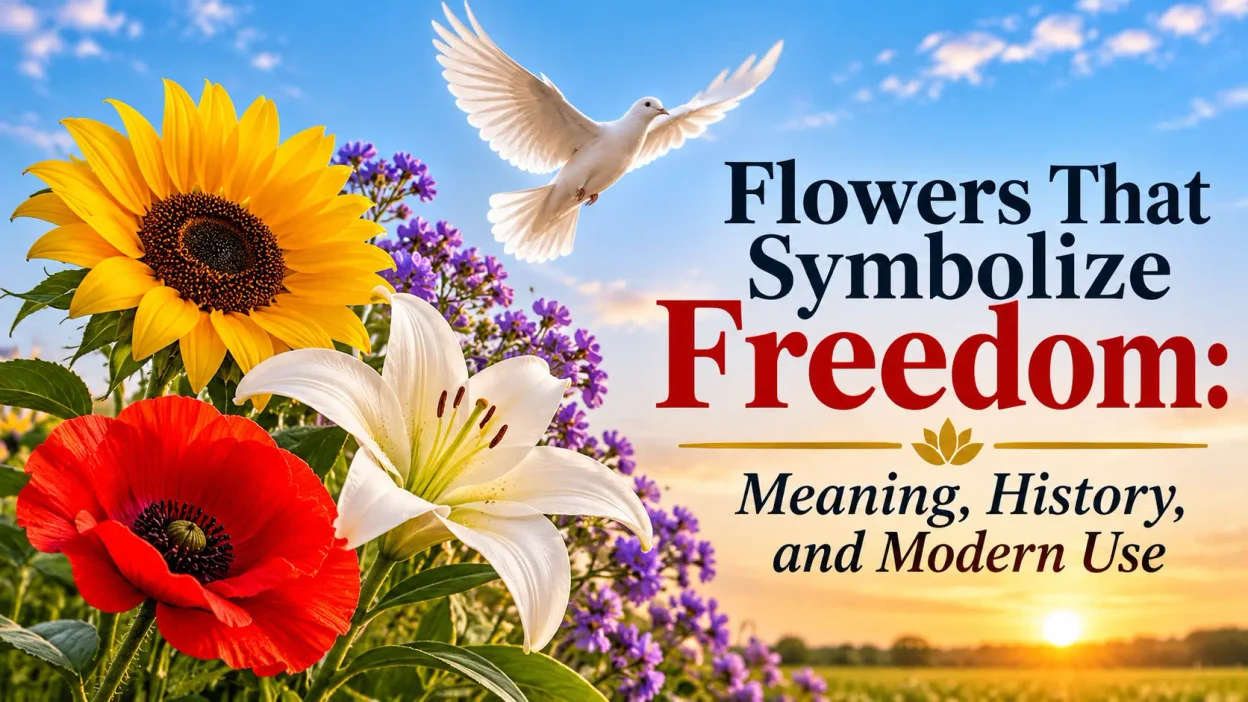
Flowers that symbolize freedom offer a natural way to express independence, hope, courage, and the desire to live without restrictions. From sunflowers reaching toward the open sky to wildflowers growing freely across meadows, different blooms can represent the ability to choose one’s own path and begin again.
In the United States, flowers often carry meanings connected to national identity, political movements, personal expression, and remembrance. They appear at Independence Day celebrations, memorial services, public demonstrations, weddings, and community gatherings. A flower can communicate freedom without using a flag, slogan, or political statement.
However, no single flower has an official or universally accepted meaning of freedom. Some associations come from historical events, others from cultural traditions, and many develop through a flower’s appearance, growing habits, or emotional associations.
Understanding these differences makes it easier to choose flowers that express independence, personal liberty, resilience, and the hope of a more open future.
Quick Answer
Flowers that symbolize freedom commonly represent independence, personal liberty, hope, courage, and the ability to grow without restriction in modern American culture. Sunflowers, wildflowers, iris, poppies, and lotus flowers can express these ideas through their historical associations, natural characteristics, and meanings in different cultural traditions.
TL;DR
- Sunflowers represent optimism, independence, and looking toward a brighter future.
- Wildflowers suggest natural freedom, individuality, and life without restriction.
- Iris flowers are associated with hope, courage, and personal strength.
- Poppies connect freedom with sacrifice, remembrance, and peace.
- Lotus flowers represent spiritual liberation and transformation.
- Flower colors and arrangements can communicate different ideas about liberty.
1. Sunflower: Independence, Confidence, and Hope
The sunflower is one of the strongest American floral associations with freedom, particularly because of its connection to the women’s suffrage movement. Its bright yellow petals, upright stem, and open flower head naturally suggest confidence, optimism, and an independent outlook.
Its historical connection is especially interesting. In 1867, Kansas suffragists adopted the sunflower, which was the state flower, as an emblem of their campaign for women’s voting rights. Yellow and gold subsequently became recognizable colors of the American suffrage movement.
The sunflower also appeared in the campaign to secure ratification of the Nineteenth Amendment, which prohibited denying the right to vote on the basis of sex. The flower therefore carries a documented American association with political participation and the struggle for equal rights. National Park Service+1
Today, sunflowers can represent:
- The freedom to make independent decisions.
- Confidence in one’s identity.
- Equal opportunities and civil rights.
- Hope for a better future.
- The courage to challenge unfair restrictions.
A sunflower bouquet can be an appropriate gift for someone beginning an independent chapter, celebrating a personal achievement, or pursuing a goal that required persistence.
2. Wildflowers: Freedom Without Boundaries
Wildflowers are perhaps the most natural representation of freedom. Unlike flowers cultivated in formal gardens, they grow in fields, forests, roadsides, and open landscapes without necessarily depending on careful human arrangement.
Their symbolism comes largely from their growing habits. Wildflowers survive changing weather, spread through seeds, and adapt to different environments. They suggest a life that develops according to natural conditions rather than strict expectations.
In American culture, wildflower imagery frequently evokes open countryside, national parks, rural landscapes, and the freedom associated with spending time outdoors.
Different wildflowers can communicate slightly different ideas:
- Black-eyed Susans: Resilience, cheerfulness, and endurance.
- Bluebonnets: Regional identity, natural beauty, and belonging in Texas.
- California poppies: Wild beauty, independence, and connection with the natural landscape.
- Daisies: Simplicity, innocence, and an uncomplicated approach to life.
- Purple coneflowers: Strength, endurance, and the ability to flourish in difficult conditions.
Wildflowers are especially appropriate when freedom means living authentically rather than following somebody else’s expectations.
3. Iris: Courage, Hope, and Personal Independence
The iris is associated with hope, wisdom, courage, and faith. Its distinctive petals and upright structure give it an appearance that can suggest dignity and self-confidence.
The flower takes its name from Iris, the personification of the rainbow in ancient Greek mythology. Iris was understood as a messenger between the gods and humanity. The rainbow connection helped establish associations with communication, transitions, and the movement between different worlds.
The iris does not have one universally established meaning of political freedom. Its connection to independence is more interpretive: hope can encourage people to move beyond difficult circumstances, while courage allows them to defend their choices.
Different iris colors can add further meaning:
- Blue iris: Hope, trust, and confidence.
- Purple iris: Wisdom, dignity, and personal conviction.
- White iris: Purity, renewal, and peaceful intentions.
- Yellow iris: Optimism, encouragement, and positive change.
In contemporary floral arrangements, iris flowers can communicate encouragement to someone leaving a difficult situation, starting a new career, or embracing a more independent life.
4. Red Poppy: Freedom Remembered Through Sacrifice
The red poppy has a particularly important place in American remembrance traditions. Its connection with freedom is closely tied to military sacrifice, the cost of war, and the lives lost defending a country.
The association developed during World War I. Red poppies grew across parts of the battlefields of France and Belgium, and their appearance became widely connected with the suffering of soldiers. Canadian physician John McCrae’s 1915 poem In Flanders Fields helped establish the flower as an international emblem of remembrance.
In the United States, the American Legion adopted the poppy as its official flower in September 1920. The American Legion Auxiliary subsequently helped establish a nationwide poppy distribution program. The Veterans of Foreign Wars also adopted the Buddy Poppy tradition. The American Legion Centennial Celebration+2
For Americans, the red poppy can represent:
- Respect for fallen military personnel.
- Gratitude for sacrifices made during wartime.
- Remembrance of those who served.
- The human cost of protecting national freedoms.
- Hope for peace.
The flower is particularly visible around Memorial Day and Veterans Day.
Unlike a sunflower, which can represent personal independence, a red poppy carries a more solemn message. It reminds people that political freedom and national independence have sometimes come at considerable human cost.
5. Lotus: Spiritual Freedom and Liberation
The lotus represents spiritual awakening, enlightenment, renewal, and the ability to rise above difficult circumstances. It is especially meaningful in Hindu and Buddhist traditions.
The flower grows from the mud beneath the water, yet its blossom emerges above the surface. This natural process has made it an enduring image of spiritual development and the possibility of remaining clear-minded despite difficult surroundings.
In Buddhism, the lotus is associated with enlightenment and the movement beyond ignorance and attachment. In Hindu traditions, it appears in religious art as an emblem connected with divinity, creation, beauty, and spiritual development.
The Smithsonian’s presentation of lotus symbolism also identifies hope, rebirth, resilience, and enlightenment as important associations. Smithsonian Museum+1
Its connection with freedom is primarily spiritual rather than political. It suggests liberation from:
- Fear and destructive attachments.
- Ignorance and confusion.
- Limiting habits and unhealthy patterns.
- Emotional burdens.
- Conditions that prevent personal growth.
In American culture, lotus imagery appears in meditation spaces, yoga studios, jewelry, tattoos, and wellness-related artwork. People often choose it to represent a personal transformation or a decision to approach life differently.
6. Bird of Paradise: Individuality and the Freedom to Be Different
The bird of paradise is known for its unusual shape, which resembles a colorful bird in flight. Its distinctive orange and blue petals make it one of the most recognizable tropical flowers.
Its association with freedom comes partly from its resemblance to a bird. Birds are widely used as symbols of movement, independence, and the ability to travel beyond familiar surroundings.
The flower also suggests individuality. It does not look like a conventional rose or daisy, and its unusual structure makes it a natural choice for expressing a personality that does not fit conventional expectations.
In modern floral design, the bird of paradise can communicate:
- Personal originality.
- Creative independence.
- Confidence in one’s differences.
- Ambition and forward movement.
- A desire to explore unfamiliar opportunities.
It is particularly suitable for someone celebrating a major life change, artistic achievement, relocation, or decision to follow an unconventional career.
7. Dandelion: Letting Go and Choosing Your Own Direction
The dandelion has a simple appearance, but its seed head gives it an especially recognizable association with freedom.
When the flower matures, its seeds separate from the plant and travel through the air. This natural process has made the dandelion a familiar image of wishes, possibilities, release, and new beginnings.
In popular American imagery, blowing dandelion seeds often represents the act of letting go of something and allowing life to move in a different direction.
Its symbolism includes:
- Freedom from the past.
- Emotional release.
- Independence from other people’s expectations.
- The courage to embrace uncertainty.
- New opportunities and personal possibilities.
Dandelions are also known for growing in places where carefully cultivated flowers may struggle. This contributes to their association with resilience and adaptability.
A dandelion tattoo or illustration can be particularly meaningful for someone who has left a restrictive environment, ended an unhealthy relationship, or chosen to start over.
8. Lavender: Peace, Personal Space, and Inner Freedom
Lavender is commonly associated with calmness, tranquility, devotion, and healing. Although it is not a traditional American emblem of political freedom, it can express another important dimension of liberty: the freedom to live peacefully.
Personal freedom is not limited to voting rights or national independence. It also involves having the space to make decisions, establish boundaries, and live without constant pressure.
Lavender’s soft purple color and familiar fragrance reinforce its associations with relaxation and emotional comfort.
Its modern symbolic meanings include:
- Peace after a difficult period.
- Emotional independence.
- Respect for personal boundaries.
- A quieter and more balanced life.
- Freedom from unnecessary conflict.
Lavender is often used in home decoration, gifts, wedding arrangements, and self-care settings. A lavender bouquet may be particularly appropriate for someone beginning a peaceful new chapter.
9. Gladiolus: Strength and the Courage to Stand Firm
Gladiolus is recognized by its tall flowering stem and a sequence of blossoms that open along its length. Its name comes from the Latin word gladius, meaning sword.
This connection has helped establish associations with strength, moral integrity, courage, and determination.
Freedom sometimes requires more than the desire to live independently. People may have to defend their rights, speak against injustice, or remain committed to their principles when facing pressure.
Gladiolus represents this more determined side of independence.
Its symbolic associations include:
- Standing up for personal beliefs.
- Maintaining dignity under pressure.
- Courage during difficult transitions.
- Strength against unfair treatment.
- Commitment to personal principles.
In American floral arrangements, gladiolus can be used to recognize achievement, honor someone who has overcome hardship, or celebrate a person who has remained true to their values.
10. Daffodil: New Beginnings and the Promise of Change
Daffodils are among the most recognizable flowers of spring. Their appearance after winter makes them natural symbols of renewal, optimism, and fresh opportunities.
Their connection to freedom is closely related to the idea of beginning again. A person who leaves a restrictive situation may experience uncertainty, but the possibility of a different future can be as encouraging as the arrival of spring.
American women’s suffrage history provides another interesting connection. Maine suffragists used the golden jonquil, a type of daffodil, as a recognizable emblem in the campaign for women’s voting rights. The flower’s gold color also connected it with hope for the future. Folklife Today
Today, daffodils can represent:
- The beginning of an independent chapter.
- Hope after a difficult period.
- Positive personal change.
- New opportunities.
- Confidence in the future.
They are particularly suitable for graduation gifts, retirement celebrations, housewarming arrangements, and occasions marking a significant personal transition.
11. Morning Glory: The Freedom to Grow and Change
Morning glory flowers open with the morning light and commonly close later in the day. Their daily cycle makes them suitable symbols of renewal, possibility, and the changing nature of life.
The plant also grows as a climbing vine, spreading through available space and attaching itself to nearby structures. This growth pattern can suggest ambition and the willingness to explore new directions.
Morning glory is not an established historical emblem of American liberty. Its connection to freedom is primarily a modern symbolic interpretation.
It can represent:
- The opportunity to begin again each day.
- Personal development.
- Adaptability during change.
- Freedom to explore new possibilities.
- The importance of living according to one’s own values.
For someone who has experienced a major transition, morning glory can communicate that life does not have to remain defined by earlier circumstances.
12. Bluebonnet: Freedom, Open Landscapes, and American Identity
The Texas bluebonnet is closely connected with regional pride, natural beauty, and the American appreciation of open landscapes.
Recognized as the state flower of Texas, bluebonnets appear across roadsides, fields, and countryside during spring. Their seasonal appearance has made them an important part of Texas identity.
The flower’s connection with freedom is not based on a specific historical liberty movement. Instead, it comes from its association with open land, outdoor exploration, regional belonging, and the independent spirit often celebrated in Texas culture.
Bluebonnets can symbolize:
- Connection with nature.
- Pride in regional identity.
- A sense of belonging.
- Freedom to explore open spaces.
- Appreciation for an uncomplicated way of life.
In photographs, paintings, and home decorations, bluebonnets frequently evoke the experience of driving through the Texas countryside in spring.
They are especially meaningful for people who associate freedom with nature, home, and the ability to live according to their own choices.
13. How Flower Colors Change the Meaning of Freedom
The color of a flower can influence its emotional message. Two bouquets containing the same flower may communicate different ideas when their colors change.
Color associations are not universal rules, but American floral traditions and common design conventions give certain colors recognizable emotional qualities.
| Flower color | Freedom-related meaning | Common associations |
|---|---|---|
| Yellow | Hope and independence | Optimism, confidence, new beginnings |
| White | Peaceful liberty | Purity, honesty, reconciliation |
| Red | Courage and sacrifice | Bravery, remembrance, determination |
| Blue | Personal expression | Calmness, trust, possibility |
| Purple | Individuality | Wisdom, dignity, independence |
| Orange | Confidence and change | Energy, ambition, creativity |
Yellow is particularly relevant to American freedom symbolism because of its historical use in the women’s suffrage movement.
White can communicate peaceful change, while red may express the sacrifices associated with protecting civil liberties.
Purple is often selected when freedom means expressing individuality or refusing to conform to expectations.
Choosing a color intentionally can make a floral gift more personal. For example, a yellow and white bouquet might communicate optimism and peaceful independence, while red and purple flowers could express courage and personal conviction.
14. Flowers That Symbolize Freedom in American Culture
Flowers have played different roles in American public life. Some became associated with organized political campaigns, while others gained meaning through remembrance, regional identity, and personal expression.
Three particularly relevant examples illustrate how these meanings develop.
Women’s suffrage and the sunflower
The sunflower became a recognizable emblem of Kansas suffragists in 1867. Later, yellow and gold appeared in the broader American suffrage movement. This association gives the sunflower a documented connection with women’s political participation and the struggle for equal rights.
Military remembrance and the red poppy
Following World War I, the red poppy became an American emblem of remembrance. Its use by veterans’ organizations connected the flower with military sacrifice and the freedoms that service members helped defend.
Regional identity and the bluebonnet
The Texas bluebonnet demonstrates how a flower can represent belonging and local identity without being directly connected to a political movement. Its importance comes from its relationship with the landscape and traditions of a particular region.
These examples show that floral symbolism is not simply a matter of appearance. A flower’s meaning can develop through collective experiences, public events, and the values people attach to it.
15. Why Flowers Make People Think About Freedom
Flowers can communicate independence because their natural characteristics often resemble experiences people associate with personal liberty.
A flower opening can suggest opportunity. Seeds traveling through the wind can suggest movement and possibility. A plant growing through difficult conditions can represent resilience.
These connections are not necessarily universal psychological responses. They develop through personal experience, cultural traditions, visual associations, and the meanings people learn from their communities.
Several emotional ideas help explain why flowers are frequently chosen to represent freedom.
Self-expression: Choosing a flower that reflects personal values can become a way of communicating identity without explaining it verbally.
Hope: Flowers associated with spring and renewal can offer a visual reminder that difficult circumstances can change.
Independence: Wild-growing plants and spreading seeds can represent the desire to make decisions without unnecessary restrictions.
Resilience: Flowers that survive challenging environments can remind people of their ability to recover and continue.
Peace: Soft colors and familiar floral fragrances can create associations with emotional comfort and a life with fewer conflicts.
This is why flowers are often included in celebrations of personal milestones. Their meanings allow people to acknowledge not only what they have achieved but also the freedom to decide what comes next.
16. Modern Uses, Tattoos, and Common Misunderstandings
Flowers that symbolize freedom appear in contemporary American life in several forms. Their meanings depend on the person using them and the circumstances surrounding the design or arrangement.
Tattoos and Personal Artwork
Flower tattoos allow people to express independence through imagery that has personal significance.
Some popular choices include:
- Sunflower tattoos: Confidence, optimism, and independent identity.
- Dandelion tattoos: Letting go, personal freedom, and starting over.
- Lotus tattoos: Spiritual development and liberation from limiting circumstances.
- Wildflower tattoos: Individuality and the freedom to follow one’s own path.
- Poppy tattoos: Remembrance, sacrifice, and respect for those who defended freedom.
A person may also combine a flower with birds, butterflies, open skies, or flying seeds. These additional elements reinforce ideas of movement and independence.
Jewelry and Fashion
Flower-shaped pendants, earrings, brooches, and embroidered clothing can communicate personal values through subtle visual details.
A sunflower necklace might represent confidence, while a lotus pendant may remind its wearer of personal growth. A poppy pin can carry a more specific message of remembrance.
These choices are particularly meaningful when the jewelry commemorates an important life event.
Home Decoration and Gardens
Flowers can also represent freedom through the spaces in which they grow.
Wildflower gardens, for example, can reflect an appreciation for natural landscapes and less formal approaches to gardening. A home filled with flowers may communicate creativity, individuality, and a welcoming atmosphere.
People also use floral artwork in personal spaces as a reminder of goals, new beginnings, or experiences that helped them become more independent.
Social Media and Digital Culture
In digital communication, flowers are frequently used to express encouragement, gratitude, personal milestones, and emotional change.
A sunflower photograph may accompany a message about confidence. A dandelion illustration may represent leaving the past behind. Lotus imagery often appears in content about personal development and meditation.
These uses demonstrate how older floral associations can continue in contemporary visual communication.
Common Misunderstandings About Freedom Flowers
Although flowers have recognizable symbolic associations, several misunderstandings are worth avoiding.
Not every flower has an established historical connection with freedom. A bird of paradise or dandelion may represent independence through its appearance or popular interpretation without having served as a historical political emblem.
Freedom does not always mean political independence. For some people, it means equal rights and participation in public life. For others, it means emotional recovery, spiritual development, or personal choice.
Flower meanings are not universal. A lotus carries specific religious associations in Asian traditions, while an American sunflower has a documented connection with women’s suffrage.
Color meanings can vary. A red flower may represent sacrifice in one context and love or celebration in another.
Historical symbolism should not be confused with modern interpretation. The poppy’s established American association is remembrance of military sacrifice. It should not automatically be treated as a general symbol of unrestricted personal freedom.
Understanding these differences makes it easier to choose flowers respectfully and communicate the intended message accurately.
Frequently Asked Questions
1. What is the best flower to symbolize freedom?
The sunflower is an excellent choice, particularly in the United States. Its documented connection with the women’s suffrage movement makes it especially appropriate for representing independence, equal rights, and the ability to make personal choices.
2. What flower symbolizes freedom and new beginnings?
The daffodil is a popular choice because it blooms in spring and represents renewal and fresh opportunities. Morning glory and dandelion are also suitable when the intended message involves personal transformation or moving forward.
3. What flower represents freedom from oppression?
The sunflower has a particularly relevant American historical association because Kansas suffragists adopted it during their campaign for women’s voting rights. White flowers can also communicate peaceful change, while gladiolus can represent courage in standing against injustice.
4. What flower symbolizes freedom in a tattoo?
Dandelions, sunflowers, and lotus flowers are popular symbolic choices. A dandelion can represent letting go of the past, a sunflower can communicate independence, and a lotus can represent spiritual liberation and personal transformation.
5. Do red poppies symbolize freedom?
Red poppies primarily symbolize military remembrance and sacrifice in American culture. Their connection with freedom comes from honoring people who served and died during wartime, rather than representing personal independence alone.
6. What flower symbolizes spiritual freedom?
The lotus is one of the strongest examples of spiritual freedom, particularly in Buddhist and Hindu traditions. It represents enlightenment, spiritual development, and the ability to rise above difficult circumstances.
7. Can white flowers symbolize freedom and peace?
Yes. White flowers can represent peaceful intentions, reconciliation, hope, and freedom from conflict. White roses, lilies, and irises are suitable choices when the intended message emphasizes peaceful independence rather than political struggle.
Conclusion
Flowers that symbolize freedom express different aspects of independence, from the right to make personal choices to the courage to challenge injustice and the ability to begin again. Sunflowers carry a documented connection with American women’s suffrage, red poppies honor military sacrifice, and lotus flowers represent spiritual liberation. Wildflowers, dandelions, and daffodils offer additional ways to express individuality, resilience, and renewal.
The most meaningful choice depends on the kind of freedom being celebrated. A sunflower may suit someone embracing independence, a lotus may honor a personal transformation, and a wildflower arrangement may express a desire to live authentically.
Ultimately, a flower becomes a meaningful symbol of freedom when its natural qualities, cultural history, or personal significance reflect the life and choices it represents.