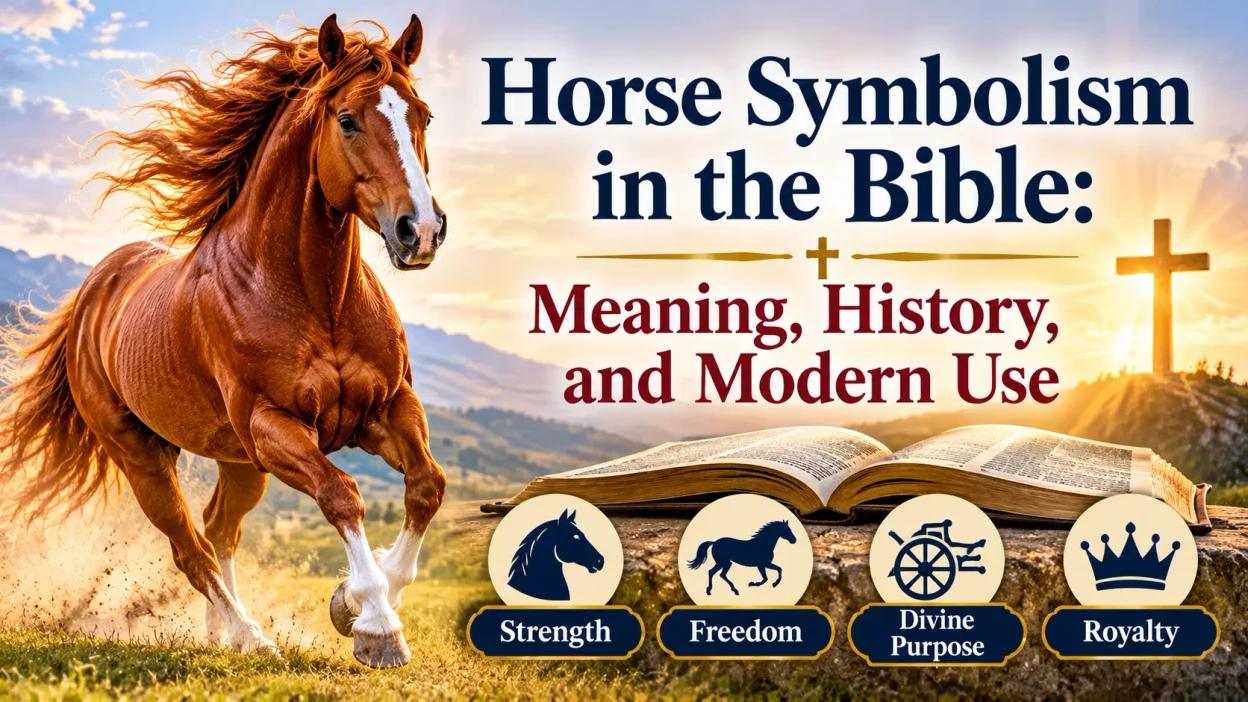
Horses appear throughout the Bible as animals associated with warfare, royal power, speed, military strength, and divine intervention. In biblical stories, a horse is rarely just a means of transportation. Its presence often reveals something about human authority, the dangers of trusting military power, or the relationship between earthly strength and God’s authority.
Understanding horse symbolism in the Bible requires looking at the circumstances in which horses appear. A horse pulling a king’s chariot carries a different meaning from the horses in the Book of Revelation or the heavenly horses described by the prophet Zechariah.
For modern American Christians and readers interested in biblical imagery, horses can represent courage, freedom, victory, and strength. However, the Bible also uses them to warn against pride and misplaced confidence. These contrasting meanings make the horse an especially interesting biblical symbol.
Quick Answer
Horse symbolism in the Bible commonly represents strength, military power, victory, and human authority, while also warning against relying on worldly power instead of trusting God. In prophetic passages, horses can represent divine judgment, spiritual conflict, and the unfolding of God’s purposes.
TL;DR
- Horses frequently represent military strength and earthly power.
- Biblical kings used horses and chariots to demonstrate authority.
- Scripture warns against trusting military strength more than God.
- White horses can represent victory and conquest.
- Revelation’s four horses symbolize conquest, war, famine, and death.
- Modern Christians often associate horses with courage, freedom, and faith.
1. What Horses Represent in Biblical Imagery
In the biblical world, horses were valuable animals associated with transportation, warfare, wealth, and government. Unlike sheep, which frequently appear in connection with shepherding and God’s people, horses often appear in scenes involving kings, armies, military campaigns, and supernatural visions.
Their physical characteristics helped establish these associations. Horses were admired for their speed, muscular strength, endurance, and ability to carry warriors into battle. A large collection of horses could indicate that a kingdom possessed considerable military resources.
Several symbolic meanings emerge from these descriptions:
- Strength: The ability to overcome physical challenges and enemies.
- Authority: The influence and status associated with kings and rulers.
- Victory: Success in battle and the defeat of opposing forces.
- Pride: The temptation to depend on personal resources rather than God.
- Divine judgment: God’s authority over earthly kingdoms and human history.
These meanings are not interchangeable in every passage. The surrounding story determines whether a horse represents something admirable, dangerous, or part of a divine message.
2. Ancient Roots of Horses in Biblical History
Horses were established parts of ancient Near Eastern society long before many biblical texts reached their final written forms. Egyptians, Hittites, Assyrians, and other regional powers used horses primarily for chariot warfare, transportation, and royal display.
In ancient Israel, horses became particularly important as kingdoms developed more organized military forces. Chariots offered speed and mobility, while trained horses provided rulers with advantages during warfare.
The biblical account of Solomon describes an extensive royal horse and chariot system. First Kings 10:26–29 records his accumulation and trade of horses and chariots, including imports from Egypt and other regions.
Archaeological discoveries at Megiddo and other ancient sites have also contributed to discussions about Israelite horse management and military organization.
This historical background explains why biblical writers frequently associated horses with national security and political power. A horse could represent much more than an individual animal. It could stand for the military resources and ambitions of an entire kingdom.
3. Horses as Symbols of Strength and Military Power
One of the clearest biblical meanings of a horse is military strength.
In ancient warfare, horses provided mobility, speed, and the ability to move soldiers and equipment across difficult terrain. Chariots pulled by horses could create a significant advantage against armies that lacked similar resources.
The Bible frequently uses this imagery when describing powerful kingdoms and their military capabilities.
In Job 39:19–25, God describes the warhorse as an animal that displays remarkable courage and excitement during battle. Its strength, movement, and response to the sound of the trumpet illustrate the extraordinary abilities of the creature.
The passage is not simply praising military equipment. It draws attention to the natural world and the limits of human control over it.
For biblical readers, this description presents the horse as an image of physical courage, energy, and strength. It also reminds them that even impressive creatures exist within God’s creation.
4. The Biblical Warning Against Trusting in Horses
Although horses represented military strength, the Bible repeatedly warns against placing too much confidence in them.
Psalm 20:7 expresses this principle by contrasting people who trust in chariots and horses with those who trust in the name of the Lord.
The message is not that horses are inherently evil or that military preparation is always wrong. Rather, the passage challenges the belief that human resources can provide ultimate security.
Isaiah 31:1 makes a similar argument. The prophet criticizes those who seek help from Egypt and rely on its horses, chariots, and military strength instead of looking to God.
Deuteronomy 17:16 also instructs Israel’s future kings not to accumulate excessive numbers of horses or establish a relationship with Egypt for that purpose.
Together, these passages establish an important distinction:
- Physical strength can provide temporary advantages.
- Military resources cannot guarantee lasting security.
- Political power can encourage arrogance.
- Faith requires recognizing the limits of human ability.
This is one of the most important lessons connected with horses in biblical symbolism. Strength becomes spiritually dangerous when people begin treating it as a substitute for God.
5. Horses as Symbols of Kingship and Royal Authority
In biblical societies, horses were closely connected with kings, wealthy rulers, and military leaders.
Owning horses required resources for purchasing, feeding, housing, and maintaining them. A royal collection of horses and chariots therefore demonstrated the economic and political influence of a kingdom.
Solomon’s horses provide a notable example. His extensive collection reflected the scale of his government and international trading relationships.
However, the Bible also presents a tension between royal authority and spiritual responsibility.
A king could use horses to strengthen his military position, but the instructions in Deuteronomy emphasized that Israel’s rulers should not allow their resources to become a source of excessive pride.
This makes the horse an interesting symbol of leadership. It can represent authority, ambition, and responsibility, but it can also expose the dangers of becoming dependent on status and material possessions.
In modern Christian discussions, this distinction can be applied to leadership in general. Having influence or resources is not necessarily wrong; the important question is how those advantages are used.
6. White Horse Symbolism in the Bible
White horses have some of the most recognizable associations in biblical imagery. They are particularly important in the Book of Revelation, where they appear in two different visions.
In Revelation 6:1–2, the first of the four horsemen rides a white horse. The rider carries a bow, receives a crown, and goes out conquering.
Christians and biblical commentators disagree about this rider’s identity. Some interpret him as Christ or a representation of the gospel’s victorious spread. Others understand him as a symbol of military conquest, deceptive power, or an opposing force that imitates legitimate authority.
The white horse in Revelation 19:11 has a clearer identity. John sees heaven opened and describes a rider called Faithful and True. The surrounding passage identifies this figure with Christ returning as the victorious King.
The contrast between these two appearances is important. A white horse does not automatically mean that every rider represents goodness.
Common associations include:
- Victory over enemies.
- Royal authority.
- Conquest and triumph.
- Righteous judgment.
- Christ’s ultimate victory.
For modern Christians, the white horse often serves as an image of Christ’s triumph and the hope of divine justice.
7. Red Horse Symbolism: War and Bloodshed
The red horse appears in Revelation 6:3–4 as the second horse of the four horsemen.
Its rider receives authority to remove peace from the earth and is given a large sword. The passage directly connects this horse with violence, conflict, and bloodshed.
Red is an appropriate visual element for this scene because it evokes blood and the destruction associated with warfare.
Unlike some other biblical uses of red, this particular passage does not present the color as an expression of celebration or prosperity. Its meaning comes from the violent actions of the rider.
The red horse can therefore symbolize:
- War between nations.
- Human violence and aggression.
- The loss of peace.
- Bloodshed and destruction.
- The consequences of conflict.
For American readers, the image can bring to mind the devastating effects of war and the suffering experienced by civilians and soldiers.
However, it is important not to treat every red horse in biblical imagery as a direct prediction of a specific modern conflict. Revelation uses apocalyptic language to communicate larger spiritual and historical realities.
8. Black Horse Symbolism: Famine and Economic Hardship
The third horse in Revelation 6:5–6 is black. Its rider carries a pair of scales, an instrument traditionally used to measure and weigh goods.
A voice announces prices for basic food supplies, including wheat and barley. These details suggest scarcity, high food costs, and economic hardship.
The black horse therefore represents more than hunger alone. It illustrates a society in which ordinary necessities become difficult to obtain.
Its major associations include:
- Famine and food shortages.
- Economic instability.
- High prices and unequal access to resources.
- Poverty and hardship.
- The vulnerability of ordinary people during crises.
The scales are especially important because they connect the horse with the measurement and distribution of food.
In modern American Christian interpretation, this image may be discussed alongside concerns about food insecurity, economic inequality, and the consequences of widespread conflict.
Still, Revelation’s imagery should be understood within its prophetic context rather than used as a simplistic prediction about a particular economic event.
9. Pale Horse Symbolism: Death and Divine Judgment
Museum-Quality Oil Painting Reproductions
The fourth horse appears in Revelation 6:7–8. Unlike the other horses, its color is described using a Greek word commonly translated as pale. It can suggest a sickly greenish or ashen appearance rather than an ordinary white or gray coat.
Its rider is named Death, and Hades follows behind.
The passage associates this horse with death, disease, famine, and other forms of destruction.
Its symbolism includes:
- Mortality and the fragility of human life.
- Disease and widespread suffering.
- The consequences of violence and famine.
- Divine judgment.
- The limits of earthly security.
The pale horse is often the most unsettling of the four because its rider is explicitly identified with Death.
For Christian readers, it also reinforces the importance of understanding Revelation as a book that addresses suffering, judgment, perseverance, and ultimate hope.
The pale horse does not represent an ordinary death or an individual tragedy alone. Within the vision, it forms part of a larger picture of calamity affecting the world.
10. Horses in Zechariah: Divine Messengers and Heavenly Authority
The prophet Zechariah describes unusual visions involving horses of different colors.
In Zechariah 1:7–11, he sees a man riding a red horse among myrtle trees, accompanied by other horses. The riders have been sent to patrol the earth and report what they observe.
The vision communicates that God remains aware of conditions throughout the world, even when his people feel forgotten or abandoned.
Zechariah 6:1–8 presents another vision involving four chariots drawn by horses of different colors. The horses go out in different directions after presenting themselves before the Lord.
These images connect horses with:
- Divine authority over the nations.
- Heavenly messengers carrying out God’s purposes.
- Judgment against wrongdoing.
- God’s continued involvement in human affairs.
- Hope for people experiencing oppression.
The horses in these passages should not be confused with the four horsemen in Revelation. The imagery is related, but each vision has its own setting and purpose.
An important distinction is that Zechariah’s horses are part of a picture of divine oversight and action, rather than simply symbols of earthly military power.
11. The Horse in Job: Courage, Freedom, and God’s Creation
Job 39:19–25 offers one of the Bible’s most vivid descriptions of a horse.
God asks Job questions about the animal’s strength, neck, speed, and fearlessness in battle. The description emphasizes its physical abilities and its readiness to respond to the sounds of warfare.
The passage also highlights something important about the relationship between humans and animals.
People may train horses, ride them, and use them for practical purposes, but their natural strength and instincts are not entirely under human control.
This gives the horse several additional associations:
Courage: The warhorse does not easily retreat from the noise and activity of battle.
Freedom: Its strength and independent nature distinguish it from animals that are easier to manage.
Creation: Its abilities reflect the variety and complexity of the natural world.
Humility: Job is reminded that human understanding and control have limits.
For modern readers, this passage can provide a meaningful perspective on the relationship between strength and humility. An impressive creature does not need to demonstrate its superiority over others to have value.
12. What Horse Colors Mean in Biblical Interpretation
The colors of horses are particularly noticeable in prophetic passages, but they should not be interpreted through a universal color dictionary.
Their meanings depend on the actions of the riders, the surrounding narrative, and the purpose of each vision.
The following table summarizes the best-known associations.
| Horse color | Biblical context | Common symbolic meaning | Main passage |
|---|---|---|---|
| White | Revelation’s riders | Conquest, victory, royal authority | Revelation 6:2; 19:11 |
| Red | Prophetic horsemen | War, violence, bloodshed | Revelation 6:4 |
| Black | Prophetic horsemen | Famine, scarcity, economic hardship | Revelation 6:5–6 |
| Pale | Prophetic horsemen | Death, disease, destruction | Revelation 6:7–8 |
| Various colors | Zechariah’s visions | Divine oversight and judgment | Zechariah 1; 6 |
One important point is that the Bible does not assign the same meaning to every appearance of a particular color.
For example, white is associated with purity in several biblical passages, but the identity and actions of the rider in Revelation 6 make his interpretation more complicated.
Readers should therefore interpret horse colors through their biblical context rather than assuming that color alone reveals the message.
13. Emotional and Spiritual Meaning of Horses for Christians
Beyond their historical and prophetic roles, horses can communicate several emotional ideas to modern Christian readers.
Their strength and movement naturally suggest courage, determination, and the ability to face difficult circumstances.
A horse running freely may also remind people of independence and the desire to overcome limitations. These associations are understandable, although they are not all direct biblical teachings.
Some common spiritual reflections include:
- Courage during hardship: Job’s description of the warhorse can encourage reflection on bravery.
- Humility before God: The warnings in Psalms and Isaiah challenge people who depend entirely on their own strength.
- Faith during uncertainty: The prophetic visions remind readers that earthly events are not beyond God’s authority.
- Hope in Christ: Revelation 19 presents the returning Christ as a victorious King.
- Personal responsibility: The biblical treatment of royal power encourages thoughtful leadership.
These meanings can make horses meaningful images for Christians who appreciate biblical animals and their connections with everyday spiritual life.
However, it is important to distinguish personal reflection from a direct biblical promise. Seeing a horse does not automatically communicate a specific message from God.
14. Horse Symbolism in Modern American Christian Culture
In the United States, horses have a recognizable place in religious art, Christian literature, Western culture, and personal expression.
American associations with horses often include freedom, independence, courage, loyalty, and the open landscape. These meanings come from a mixture of biblical imagery and broader American history.
Christian artists sometimes use white horses to represent Christ’s victory or the hope of his return. Images inspired by Revelation 19 can appear in church artwork, religious illustrations, and Christian publications.
Horses also appear in personal expressions of faith.
For example, a Christian might choose a horse design because it reminds them of courage during difficult circumstances. Another person may prefer a biblical white horse because of its connection with Christ’s return.
Western Christian communities may also connect horses with stewardship, responsibility, and appreciation for God’s creation.
It is worth remembering that American interpretations are not identical to biblical meanings. The horse’s association with the American West, for example, is primarily cultural rather than a direct teaching from Scripture.
Nevertheless, these traditions help explain why horses remain recognizable symbols in modern Christian life.
15. Horses in Tattoos, Jewelry, Art, and Contemporary Design
Horse imagery continues to appear in modern personal style and decorative art.
People sometimes choose horse designs because they connect with qualities such as independence, strength, courage, or personal resilience.
In Christian tattoo culture, a white horse can represent faith, victory, and the imagery of Revelation 19. Some designs include a crown, a cross, or a biblical verse to make the religious association clearer.
Other common uses include:
Tattoos: A running horse can communicate freedom, determination, or a personal connection with biblical imagery.
Jewelry: Horse pendants and charms can represent courage, loyalty, and appreciation for God’s creation.
Home decor: Biblical horse artwork may reflect religious interests, while traditional horse paintings often emphasize rural life and American Western culture.
Christian artwork: Illustrations of the four horsemen are used to explore prophetic themes, judgment, and the Book of Revelation.
Social media: Horse images may accompany Christian messages about faith, perseverance, and overcoming difficult experiences.
A horse design does not automatically have a Christian meaning. The intended message depends on its accompanying imagery and the person’s beliefs.
16. Common Misunderstandings About Biblical Horse Symbolism
Because horses appear in several dramatic biblical visions, their symbolism is sometimes oversimplified.
Understanding the original context helps prevent common mistakes.
Misunderstanding 1: Every white horse represents Jesus.
Not necessarily. Revelation 19 identifies the rider as Christ, but the identity of the white-horse rider in Revelation 6 remains disputed.
Misunderstanding 2: Horses are always positive symbols.
The Bible uses horses to represent strength and royal power, but it also warns against trusting military resources instead of God.
Misunderstanding 3: Every colored horse predicts a specific modern event.
The four horsemen are part of Revelation’s apocalyptic vision. Assigning each horse to a particular contemporary war, leader, or disaster goes beyond what the passage explicitly establishes.
Misunderstanding 4: A horse appearing in a dream has one guaranteed biblical meaning.
The Bible contains symbolic dreams and visions, but it does not establish a universal interpretation for every modern dream involving a horse.
Misunderstanding 5: Horses represent evil in Christianity.
There is no general biblical teaching that horses are evil. Their meaning changes according to the passage in which they appear.
Recognizing these distinctions allows readers to appreciate the symbolism without turning every appearance of a horse into a prediction or spiritual warning.
Frequently Asked Questions
1. What does a horse symbolize spiritually in the Bible?
A horse can symbolize strength, courage, military power, royal authority, and victory. It can also represent the danger of relying on human resources instead of trusting God.
2. What does a white horse represent in the Bible?
A white horse can represent conquest and victory, but its meaning depends on the passage. In Revelation 19:11, the rider represents Jesus Christ returning as the victorious King, while the rider in Revelation 6:2 has several competing interpretations.
3. What does a horse mean in a biblical dream?
The Bible does not provide one universal meaning for dreaming about a horse. Its symbolism may remind a Christian of strength, courage, or spiritual responsibility, but a dream should not automatically be treated as a message from God.
4. Is a horse a positive or negative symbol in the Bible?
A horse can have either positive or negative associations. It can represent courage and strength, but biblical writers also use it to illustrate pride, military dependence, war, and judgment.
5. What do the four horses in Revelation symbolize?
The four horses represent different forms of conquest and suffering. The white horse is associated with conquest, the red horse with war, the black horse with famine, and the pale horse with death.
6. Why does the Bible say not to trust in horses?
Horses represented military strength and national security in ancient societies. Psalm 20:7 and Isaiah 31:1 teach that people should not place their ultimate confidence in military resources instead of relying on God.
7. Does a horse symbolize freedom in Christianity?
Freedom is a common modern association with horses, especially in American culture. Although the Bible describes their strength and independence, freedom is not their primary or universal biblical meaning.
Conclusion
Horses carry several meanings throughout Scripture, including strength, military power, royal authority, courage, conquest, and divine judgment. Their symbolism changes according to the biblical passage, making it important to consider the surrounding story rather than assigning one meaning to every appearance.
For modern Christians, horse symbolism in the Bible offers an especially interesting lesson about the difference between physical strength and spiritual trust. A horse can represent impressive human abilities, but Scripture repeatedly reminds readers that lasting security does not come from military power, wealth, or personal influence.
Ultimately, the biblical horse is a reminder that strength has its place, but faith, humility, and trust in God matter more than the power people possess.