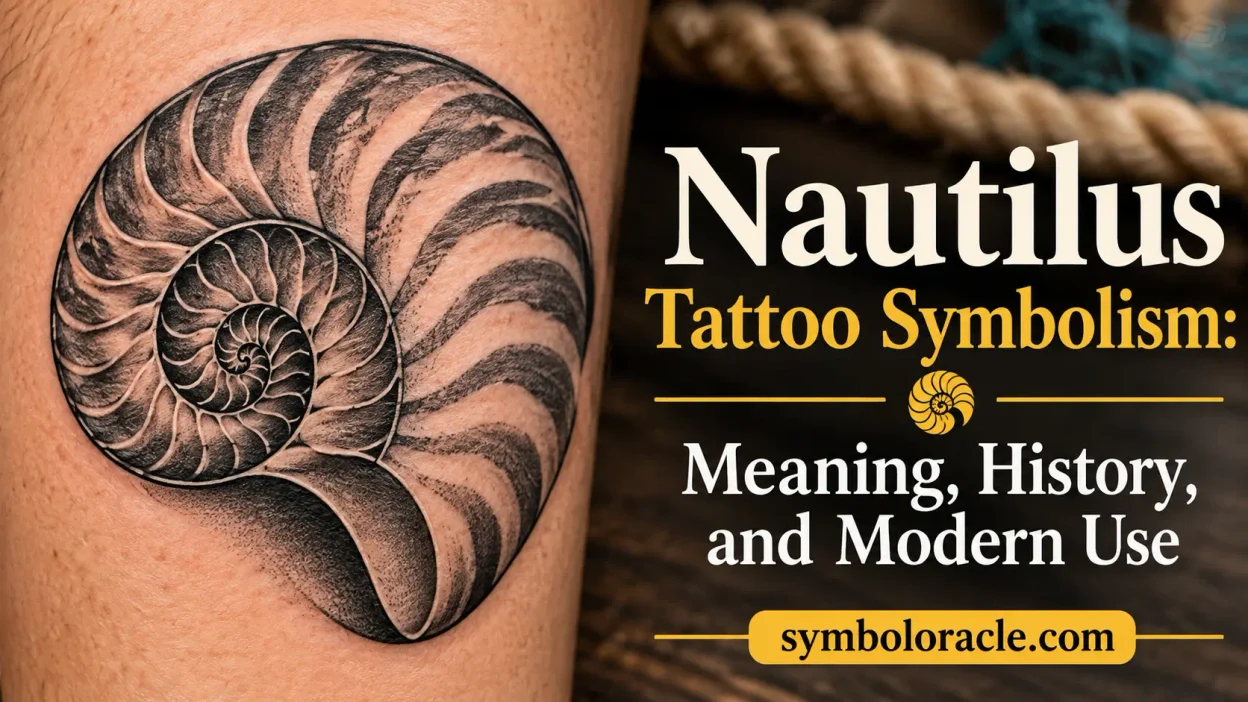
Nautilus tattoo symbolism is closely connected with personal growth, natural balance, resilience, and the continuous movement of life. The nautilus is a marine animal recognized for its beautiful spiral shell, which develops through a series of chambers as the creature grows. Its unusual structure has made it an appealing subject for people who want a tattoo representing change, self-discovery, and the relationship between nature and personal development.
In the United States, nautilus tattoos appeal to people interested in ocean life, mathematics, natural patterns, philosophy, and minimalist artwork. Some choose the design because it represents their own journey through different stages of life, while others appreciate its connection to geometry and the natural world.
Unlike many tattoo symbols associated with one particular mythology or religious tradition, the nautilus has meanings drawn from several sources. Its biological structure provides the foundation for ideas about growth and adaptation, while its spiral appearance encourages interpretations involving continuity, proportion, and the passage of time.
Understanding this tattoo requires separating what the animal actually represents in nature from the additional meanings people have assigned to its shell. Both contribute to its appeal, but they are not always the same.
Quick Answer
Nautilus tattoo symbolism commonly represents personal growth, balance, resilience, and life’s ongoing journey in modern American tattoo culture. Its chambered spiral shell has also inspired associations with natural geometry, continuity, adaptation, and the relationship between individual experiences and the larger world.
TL;DR
- Growth: The expanding shell represents development through different life stages.
- Resilience: Its protective shell suggests endurance and adaptation.
- Balance: Its natural structure inspires ideas about proportion and harmony.
- Continuity: The spiral represents life’s ongoing movement and change.
- Ocean connection: It can express appreciation for marine life and nature.
- Self-discovery: The design represents learning from experiences and personal transformation.
1. What Is a Nautilus and Why Is Its Shell Recognizable?
The nautilus is a marine cephalopod, a group of animals that also includes octopuses, squid, and cuttlefish. Unlike most living cephalopods, the nautilus has an external shell that protects its body.
The shell is usually pale with brown or reddish bands on the outside. When viewed in cross-section, it reveals a spiral divided into separate chambers. As the animal grows, it develops a new, larger chamber and moves forward, leaving older chambers behind.
These chambers are connected by a living tissue structure called the siphuncle, which helps regulate gas and liquid within them. This system contributes to the animal’s ability to control its buoyancy in the water.
The shell’s shape is one reason the nautilus has become a recognizable image in art and design. It combines a visible spiral with an organized internal structure, creating an appearance that feels both organic and carefully arranged.
People encounter nautilus imagery in:
- Marine biology illustrations and natural history museums.
- Ocean-inspired jewelry and decorative objects.
- Mathematical and geometric artwork.
- Tattoos representing growth and personal change.
- Coastal interior design and nautical illustrations.
For tattoo enthusiasts, the nautilus offers something unusual: a design that is visually attractive while also having a real biological story behind it.
2. The Main Symbolic Meaning of a Nautilus Tattoo
The nautilus does not have one universally established symbolic meaning. Its modern tattoo interpretations generally develop from the shell’s spiral structure, the animal’s growth, and its ability to survive in a changing marine environment.
Personal growth is one of its most common interpretations. The animal adds chambers as it develops, making the shell a natural image of progression. Each chamber can represent a different stage of someone’s life.
Balance and harmony come from the shell’s organized structure. Its arrangement can suggest that growth does not have to mean disorder and that different experiences can become part of a larger whole.
Resilience is connected to the protective function of the shell. A person may choose the design to represent surviving difficult experiences while continuing to move forward.
Continuity comes from the spiral itself. Rather than ending abruptly, the shape curves around a central point, suggesting an ongoing process.
Self-discovery is another modern interpretation. The shell can represent the idea that understanding oneself requires time, experience, and reflection.
These meanings make the nautilus particularly suitable for people who prefer a thoughtful nature-inspired tattoo rather than a symbol with a single predetermined cultural or religious meaning.
3. Ancient Origins and the Nautilus in Natural History
The nautilus belongs to an ancient lineage of marine animals. Nautiloid cephalopods appeared in the fossil record hundreds of millions of years ago, long before dinosaurs existed.
Ancient relatives of modern nautiluses included numerous species with different shell shapes and sizes. Some extinct forms developed long, straight shells, while others had curved or coiled structures.
The modern chambered nautilus is often described as a living representative of an ancient animal lineage. However, today’s nautiluses are not unchanged survivors of prehistoric times. They have continued to evolve, and modern species differ from their extinct relatives.
Their unusual shells attracted scientific and artistic attention during the development of European natural history collections. Nautilus shells became objects of curiosity, particularly because their internal chambers revealed an orderly structure hidden beneath the exterior.
Over time, the animal became associated with the study of marine evolution, natural design, and the relationship between living organisms and their environments.
For tattoo symbolism, this history adds another layer: the nautilus can represent endurance across changing conditions, although a modern tattoo interpretation should not be confused with an ancient religious meaning.
4. The Spiral Shell and the Symbolism of Growth
The nautilus shell is especially meaningful because its spiral develops as the animal grows. Each new chamber is larger than the preceding ones, creating a visible record of physical development.
This process has inspired a human interpretation of growth as something cumulative. People do not simply become different overnight. Their experiences build upon one another, shaping the person they eventually become.
A nautilus tattoo can therefore represent:
- Learning from earlier experiences.
- Accepting different stages of life.
- Moving beyond childhood or an earlier identity.
- Developing confidence through challenges.
- Recognizing progress without rejecting the past.
The older chambers remain part of the shell even as the animal moves into a larger one. This offers a useful metaphor for personal history: moving forward does not require pretending that earlier experiences never happened.
For someone recovering from a difficult period, the design may represent a willingness to continue growing. For another person, it may commemorate education, parenthood, career development, or a major personal transition.
The meaning is not that every stage of life is easy. It is that development happens through successive experiences, each contributing to the larger structure.
5. The Golden Ratio, Sacred Geometry, and Natural Balance
One reason the nautilus became popular in modern tattoo art is its connection to mathematical patterns. The shell forms a logarithmic spiral, a curve that expands while maintaining a consistent general shape.
This visual arrangement has encouraged comparisons with the golden ratio, a mathematical proportion often associated with design, architecture, and aesthetics. Artists sometimes use the nautilus as an example of how mathematical patterns can appear in nature.
However, an important distinction is necessary: the chambered nautilus shell is not an exact golden spiral. Measurements of actual shells show variation, and the popular claim that every nautilus follows the golden ratio is scientifically inaccurate. California Academy of Sciences+1
For tattoo enthusiasts, the distinction does not make the design less interesting. Its natural spiral still offers an appealing visual expression of proportion, repetition, and organic growth.
A nautilus tattoo inspired by sacred geometry may represent:
- Appreciation for mathematical patterns in nature.
- The relationship between order and organic development.
- Harmony between different parts of life.
- Curiosity about science, geometry, and the natural world.
- A desire to live with greater balance.
Some people combine the shell with geometric circles, fine lines, or mathematical diagrams. These additions can make the design look more technical, while a simple shell outline can preserve its natural character.
6. Nautilus Symbolism in American Culture
In the United States, the nautilus is recognized primarily through marine science, natural history, decorative art, and tattoo culture. It does not have the same established national or religious status as symbols such as the bald eagle, cross, or American flag.
Its popularity in American visual culture partly reflects an interest in ocean-inspired imagery and nature-based design. The shell appeals to people who appreciate the ocean but want something less familiar than a wave, anchor, shark, or sea turtle.
American tattoo enthusiasts may use it to communicate personal development, intellectual curiosity, environmental awareness, or a connection to coastal life.
The nautilus also has a place in American literature and art. Oliver Wendell Holmes Sr.’s 1858 poem The Chambered Nautilus helped establish an influential interpretation of the shell as an image of spiritual and personal development. The poem compares the animal’s expanding home with the idea of human beings continuing to develop beyond their previous limitations. California Academy of Sciences+1
This literary association gives the tattoo an additional meaning for people familiar with the poem. Someone who has never read it may still appreciate the shell as a representation of growth, but the historical connection adds another interpretive layer.
Unlike holiday-specific symbols, the nautilus does not belong to one particular American celebration. Its meaning is more likely to be personal, artistic, or connected to an individual’s interest in marine life.
7. The Nautilus in Literature and the Meaning of Personal Transformation
The nineteenth-century poem The Chambered Nautilus is particularly important to the modern symbolic interpretation of the shell.
Written by American poet Oliver Wendell Holmes Sr. and published in 1858, the poem uses the nautilus’s expanding chambers as an analogy for human development. Its central idea is that people should continue moving beyond earlier limitations rather than remaining confined by familiar ways of thinking.
The poem transformed an observation from natural history into a moral and spiritual reflection. The shell became an image of personal improvement, suggesting that each stage of development should make room for a more expansive understanding of life.
This interpretation influenced how later readers viewed the nautilus in decorative art, literature, and personal symbolism.
A tattoo inspired by the poem may represent:
- Outgrowing an earlier version of oneself.
- Continuing education and intellectual development.
- Leaving restrictive circumstances behind.
- Becoming more confident with age and experience.
- Finding meaning in life’s different stages.
The literary connection is especially appropriate for someone who has experienced a major transition, such as completing an education, changing careers, recovering from a difficult experience, or beginning a new chapter.
However, the poem’s interpretation is not the only legitimate meaning. A person can choose the nautilus simply because they appreciate its anatomy, spiral, or connection to marine ecosystems.
8. Cross-Cultural Interpretations of the Nautilus Shell
Unlike the dragon or lotus flower, the nautilus does not have one widely shared symbolic system across major world religions and cultures. Its historical importance varies according to geography, trade, craftsmanship, and scientific interest.
In parts of the Indo-Pacific, where living nautiluses naturally occur, their shells have been collected and used in decorative objects. The animal’s presence in these marine environments connects it to local natural history and material culture.
In European decorative traditions, nautilus shells became prized objects during the Renaissance and early modern periods. Craftspeople mounted them in precious-metal settings, sometimes transforming them into elaborate drinking vessels and ornamental objects. These objects combined the perceived beauty of nature with human craftsmanship. LACMA Collections+1
The shell also attracted attention from naturalists, mathematicians, and artists because of its spiral and internal chambers.
These traditions contribute to several possible tattoo interpretations:
| Cultural or artistic context | Common interpretation | Associated ideas |
|---|---|---|
| Modern American tattoo culture | Personal growth | Change, development, identity |
| Natural history | Ancient lineage | Evolution, survival, adaptation |
| Mathematical art | Natural proportion | Geometry, balance, structure |
| European decorative arts | Beauty and craftsmanship | Artistry, rarity, refinement |
| Contemporary ocean-inspired design | Connection to marine life | Nature, conservation, curiosity |
It is important not to assign the nautilus a traditional religious meaning without evidence. Its appearance in an artwork or historical object does not automatically make it a sacred symbol.
9. What a Nautilus Tattoo Says About Personality and Identity
A tattoo can communicate something about the wearer even when its meaning is not immediately obvious to other people.
The nautilus often appeals to people who prefer symbols that combine scientific interest with personal interpretation. It is less direct than a heart representing love or a lion representing courage. Instead, it invites people to consider how different experiences contribute to an individual’s identity.
Someone who chooses this tattoo might identify with the idea of gradual development. They may value learning, reflection, independence, or the ability to adapt when circumstances change.
For others, the design expresses a connection to the ocean. People who grew up near the coast, enjoy diving, study marine biology, or feel emotionally connected to the sea may choose the nautilus as a reminder of that relationship.
The tattoo can also suggest an appreciation for complexity. Its exterior appears relatively simple, but its interior contains a carefully organized system of chambers. This contrast may appeal to people who feel that their own lives contain experiences and qualities that are not immediately visible.
Still, tattoo choices cannot reliably reveal someone’s personality. The wearer may simply enjoy the design. The most accurate interpretation comes from the person who chose it.
10. Nautilus Tattoo Designs and Their Symbolic Meanings
The nautilus works in several tattoo styles because its shell can be represented as a simple outline or an intricate illustration.
A simple outline emphasizes the recognizable spiral. It often represents personal growth, simplicity, and an appreciation for natural forms.
Detailed shading and shell patterns highlight the animal’s biological structure. This style can express scientific curiosity, marine appreciation, or respect for nature.
Circles, measured lines, and geometric elements emphasize proportion and structure. It is suitable for people interested in mathematics, order, and natural design.
Blue, turquoise, and green washes create an ocean-inspired appearance. The design can suggest creativity, freedom, and emotional connection to the sea.
Waves, coral, or aquatic plants connect the shell to its natural environment. This combination often expresses environmental appreciation and a personal connection to the ocean.
The design can also include meaningful dates, initials, or short quotations. These additions make the tattoo more personal, especially when it commemorates a significant period of development.
11. Best Placement for a Nautilus Tattoo
The shell’s spiral makes it adaptable to different parts of the body. Placement can influence how much detail an artist can include and how the design interacts with the body’s natural shape.
Forearm: A popular option for a visible design. The relatively flat area provides room for a recognizable spiral and detailed shell lines.
Upper arm: Suitable for medium or larger illustrations, particularly designs that include ocean waves or geometric backgrounds.
Shoulder: The curved surface can complement the rounded structure of the shell.
Back: Offers space for a larger composition, especially when the tattoo includes multiple marine elements.
Chest: Can accommodate a detailed design that the wearer wants to keep relatively private.
Ankle or wrist: Works best with simpler illustrations because very small shell chambers and fine lines may become difficult to distinguish over time.
When choosing placement, consider the amount of detail, expected aging of the tattoo, visibility, and personal comfort. A highly detailed cross-section usually requires more space than a basic spiral outline.
12. Nautilus Symbolism in Jewelry, Fashion, and Home Decor
Although tattooing is one way to express the nautilus’s meaning, the shell also appears in jewelry and decorative design.
In jewelry, nautilus pendants and earrings can represent personal development, appreciation for the ocean, or an interest in natural geometry. Some pieces use actual shell material, while others reproduce the spiral through metalwork or carved designs.
In home decor, the nautilus is often used in coastal interiors, decorative sculptures, framed illustrations, and architectural patterns. Its curved structure provides an organic alternative to straight geometric shapes.
Fashion designers may incorporate the spiral into textile patterns, accessories, and ornamental details. These uses generally emphasize visual appeal rather than a specific symbolic message.
The shell also appears in educational and scientific illustrations, where it represents marine evolution and the relationship between an organism’s structure and its environment.
For people who do not want a permanent tattoo, these objects provide alternative ways to incorporate the design into everyday life.
13. The Nautilus, Ocean Conservation, and Environmental Awareness
The nautilus has another meaning that has become increasingly relevant: the importance of protecting marine biodiversity.
Although its ancient lineage makes it appear exceptionally resilient, living nautilus populations face serious pressures from human activity. Their attractive shells are collected and sold internationally for jewelry, decorative objects, and souvenirs.
The chambered nautilus was listed as threatened under the U.S. Endangered Species Act in 2018. Commercial harvesting and international shell trade are among the concerns affecting its survival. NOAA Fisheries+1
This creates an interesting contrast between the animal’s symbolic association with endurance and its actual vulnerability.
For some tattoo enthusiasts, the nautilus represents respect for marine ecosystems and a desire to protect ocean wildlife. A design featuring the animal alongside coral, sea plants, or ocean waves can communicate this environmental connection.
A conservation-inspired tattoo may represent:
- Respect for marine biodiversity.
- Concern about unsustainable wildlife trade.
- Appreciation for ancient animal lineages.
- Responsibility toward natural environments.
- A personal commitment to environmental awareness.
There is also a practical consideration when choosing a nautilus design: reproducing the animal through artwork does not require purchasing a real shell. A tattoo can celebrate the species without contributing to demand for its physical remains.
14. Common Misunderstandings About Nautilus Tattoo Symbolism
The nautilus is frequently surrounded by claims that sound convincing but require clarification.
The nautilus does not follow an exact golden ratio. Its spiral resembles certain mathematical patterns, but actual shell proportions vary. Calling every nautilus shell a perfect golden spiral exaggerates the scientific relationship.
It is not simply a symbol of infinity. The continuous spiral can suggest continuity, but the shell has a definite biological structure. Infinity is a modern artistic interpretation rather than an established universal meaning.
The nautilus is not an octopus. Both belong to the cephalopod group, but the nautilus has an external chambered shell and differs considerably from octopuses and squids.
It does not have one ancient religious meaning. Its symbolic associations developed through literature, natural history, craftsmanship, and modern personal interpretation. Claims that it has always represented spiritual awakening or divine perfection should be treated cautiously.
The nautilus is not biologically unchanged. Although its lineage is ancient, modern nautiluses have continued to evolve. Calling it a living fossil is a convenient description, not proof that the animal has remained identical for hundreds of millions of years.
Understanding these differences helps tattoo enthusiasts choose a design based on genuine natural history rather than popular exaggerations.
15. How the Meaning of the Nautilus Has Evolved
The nautilus has moved through several stages of human interpretation.
Initially, its significance was closely connected to its physical presence in the ocean and the distinctive shell that made it recognizable. Its structure attracted collectors and craftspeople, who transformed shells into decorative objects.
During the nineteenth century, natural history and literature added new interpretations. Oliver Wendell Holmes Sr.’s poem connected the shell’s expanding chambers with personal development, helping establish growth as one of its most recognizable symbolic associations.
In the twentieth century, the nautilus became increasingly familiar through scientific illustrations, decorative arts, architectural design, and nature-inspired imagery. Its spiral offered artists an attractive way to explore geometry and organic form.
Modern tattoo culture has expanded these interpretations further. Today, the design can represent personal milestones, emotional resilience, intellectual curiosity, environmental responsibility, or an individual’s connection to the ocean.
Social media has also made geometric and minimalist shell designs more visible. However, not every person who chooses the image follows the same symbolic tradition.
The nautilus remains appealing because its natural structure offers several interpretations without requiring the wearer to accept one fixed definition.
Frequently Asked Questions
1. What does a nautilus tattoo symbolize spiritually?
A nautilus tattoo can represent spiritual development, self-discovery, continuity, and the desire to move beyond previous limitations. These interpretations are largely personal and literary rather than belonging to one universally recognized religious tradition.
2. Is a nautilus tattoo a symbol of personal growth?
Yes. The shell grows by adding larger chambers, making it a natural metaphor for development through different stages of life. It can represent learning from past experiences while continuing toward new opportunities.
3. What does a nautilus shell symbolize in Christianity?
The nautilus is not a standard or universally recognized Christian symbol. Some Christians may personally interpret its expanding chambers as an image of spiritual maturity, renewal, or growth in faith, but these meanings are individual interpretations.
4. Does a nautilus tattoo represent the golden ratio?
It can represent an interest in mathematical proportions and natural geometry, but the actual shell does not follow a perfect golden ratio. Its logarithmic spiral is visually related to broader mathematical patterns, which explains its popularity in geometric tattoo designs.
5. Is a nautilus tattoo a good symbol for overcoming difficult experiences?
It can be a meaningful choice for someone who wants to represent recovery and continued development. The expanding shell offers a visual reminder that earlier experiences remain part of a person’s history without determining everything that comes next.
6. What does a nautilus tattoo with ocean waves mean?
Combining the shell with ocean waves usually emphasizes a connection to marine life, adaptability, and the natural world. It can also represent someone’s relationship with the sea, particularly if coastal experiences have played an important role in their life.
7. Is the nautilus considered a symbol of good luck?
There is no widely established universal tradition that identifies the nautilus as a good-luck symbol. However, individuals may associate it with positive change, protection, and opportunities for growth.
Conclusion
Nautilus tattoo symbolism brings together personal growth, resilience, natural balance, continuity, and appreciation for the ocean. Its chambered shell provides a genuine biological example of development, while its spiral has inspired artistic, mathematical, and literary interpretations.
In modern American tattoo culture, the nautilus is particularly suitable for people who want to represent personal transformation, intellectual curiosity, or a connection to marine life. Its meaning can also become more specific through geometric patterns, ocean imagery, or references to Oliver Wendell Holmes Sr.’s poem.
Ultimately, the nautilus offers a way to represent the relationship between past experiences and future possibilities. Each stage contributes to the whole, making the shell an appropriate reminder that personal development is an ongoing process.