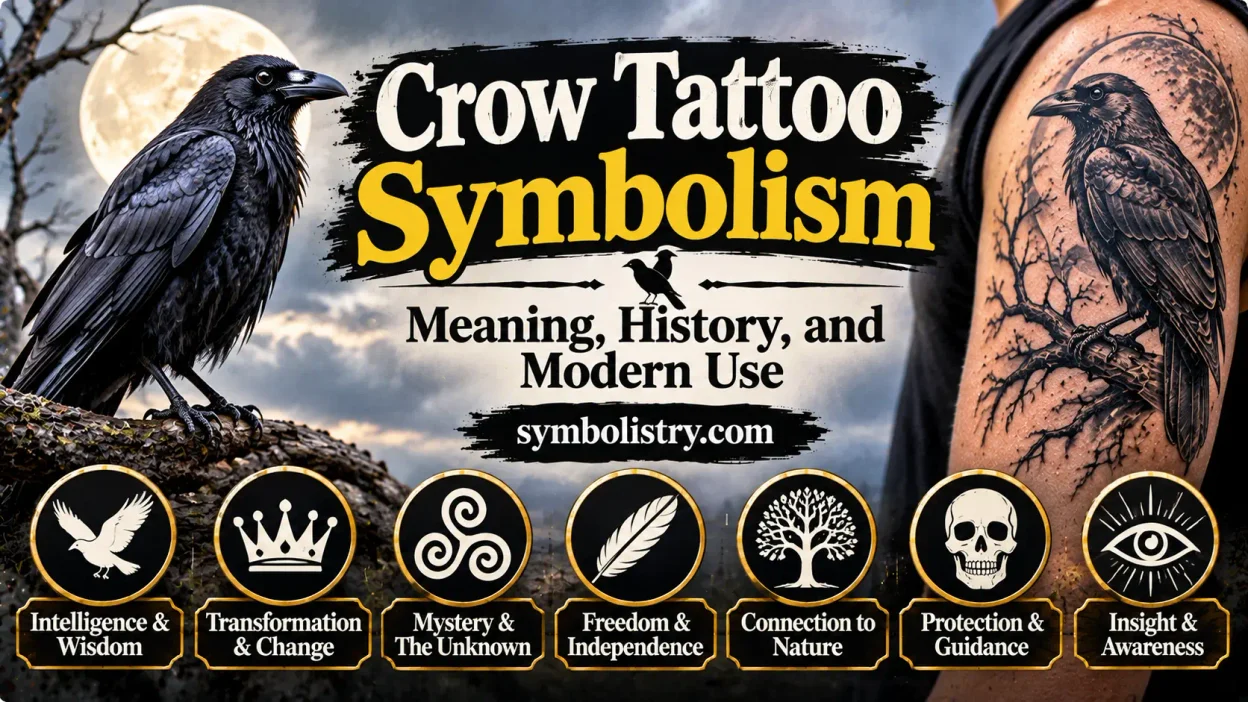
Crow tattoo symbolism is commonly associated with intelligence, independence, transformation, mystery, and the ability to adapt to difficult circumstances. Recognized by their glossy black feathers, sharp eyes, and remarkable problem-solving abilities, crows have inspired stories, spiritual beliefs, folklore, and artwork across many societies. When someone chooses a crow tattoo, the design often represents more than an appreciation for birds; it can communicate a personal philosophy, an important life experience, or a connection to cultural traditions.
In the United States, crow tattoos appeal to people who appreciate dark natural imagery, wildlife, folklore, and symbols with multiple interpretations. Some choose a single crow to represent independence, while others prefer a group of crows to express family, community, or the idea of shared intelligence. Designs featuring flying crows, skulls, moons, trees, or ravens can introduce additional layers of meaning.
Crows have not always been viewed positively. In some traditions, they are connected with death, omens, and supernatural forces. In others, they are respected as messengers, clever survivors, and figures associated with creation or spiritual knowledge. Understanding these different interpretations helps explain why crow tattoos can communicate both darkness and hope.
Quick Answer
Crow tattoo symbolism commonly represents intelligence, independence, transformation, and resilience in modern American tattoo culture. Historically, crows have also been associated with death, spiritual messages, prophecy, creation, and trickster figures in different cultural traditions.
TL;DR
- Intelligence: Crows represent cleverness, observation, and problem-solving.
- Independence: A solitary crow can symbolize self-reliance and individuality.
- Transformation: Crows connect with personal change and new beginnings.
- Mystery: Their dark appearance links them with folklore and the unknown.
- Death and renewal: Some traditions associate crows with mortality and spiritual transition.
- Modern tattoos: Crow designs express identity, resilience, heritage, and personal experiences.
1. What a Crow Tattoo Looks Like
A crow tattoo usually depicts a medium-sized black bird with a sturdy body, strong beak, dark feathers, and an alert expression. Its silhouette is recognizable even in simple tattoo designs, making it suitable for both small minimalist artwork and large, detailed compositions.
Crows are members of the genus Corvus, a group of birds that also includes ravens, rooks, and jackdaws. Although people sometimes use the words crow and raven interchangeably, they refer to different birds. Ravens are generally larger, have heavier beaks, and often possess more prominent throat feathers.
Tattoo artists can portray crows in several ways:
- A perched crow with an attentive expression.
- A crow flying with its wings fully extended.
- A crow sitting on a branch or gravestone.
- A crow holding a small object in its beak.
- Multiple crows flying across the shoulder or back.
- A realistic crow surrounded by flowers, moons, or skulls.
Black and gray ink is especially popular because it reflects the bird’s natural coloring. Some designs incorporate blue highlights, white detailing, or red accents to create contrast.
The bird’s posture also influences the message. A perched crow can suggest patience and observation, while a flying crow may communicate freedom, movement, and the willingness to embrace change.
2. Intelligence and Wisdom: The Most Recognized Meaning
One of the strongest reasons people choose crow tattoos is the bird’s reputation for intelligence.
Crows are among the most capable birds studied by animal behavior researchers. They can recognize human faces, remember experiences, use tools, solve problems, and adapt their behavior when circumstances change. Some species can even understand relationships between objects and use several steps to obtain food.
These abilities have made crows symbols of cleverness, awareness, and practical wisdom.
A person with a crow tattoo may use the bird to represent learning from mistakes, thinking independently, or recognizing situations that others overlook. The design can also express a preference for observation rather than impulsive action.
For someone who has experienced difficult circumstances, the crow’s intelligence may represent the ability to find solutions instead of giving up.
A crow perched quietly on a branch is particularly suitable for this interpretation. Its stillness can suggest careful observation, patience, and the importance of understanding a situation before responding.
3. Independence and Individuality
Crows are social birds, but they also demonstrate considerable independence. They can forage alone, explore unfamiliar environments, and make decisions based on changing conditions.
This combination of social intelligence and individual capability makes the crow a useful symbol of personal independence.
In American tattoo culture, a solitary crow may represent someone who values personal freedom, self-direction, and the ability to follow an unconventional path.
People sometimes choose this design after leaving a difficult relationship, changing careers, moving to a new place, or overcoming pressure to conform to other people’s expectations.
A single crow standing against an empty background can communicate this idea without additional imagery.
However, independence does not necessarily mean loneliness. Crows also form strong social relationships, recognize familiar individuals, and cooperate in certain situations. A crow tattoo can therefore represent the balance between maintaining personal identity and remaining connected to others.
4. Transformation, Rebirth, and New Beginnings
Crow tattoos frequently appear in discussions of transformation because the bird is associated with changing circumstances, survival, and movement between different environments.
Crows are highly adaptable. They can live in forests, agricultural areas, suburban neighborhoods, and large American cities. Their ability to adjust to changing conditions provides a natural connection to personal reinvention.
For some tattoo owners, a crow represents a major transition: recovering after hardship, leaving an unhealthy situation, rebuilding confidence, or beginning a different chapter of life.
A flying crow can emphasize movement away from the past. A crow emerging from darkness may represent the decision to continue despite uncertainty.
This symbolism also connects with the broader idea of renewal. Although crows are sometimes associated with death, death imagery does not always represent a literal ending. In personal artwork, it may symbolize the closing of an old identity and the beginning of a different one.
A crow combined with a rising sun, new leaves, or a broken chain can make this interpretation more visible.
5. Death, Mortality, and the Unknown
The crow’s black feathers and presence around animal remains have contributed to its association with death and mortality. Historically, crows have sometimes been observed feeding on carrion, placing them in environments where death and the natural process of decay are visible.
In European folklore, this association helped connect crows and ravens with battlefields, graveyards, supernatural warnings, and the world of the dead.
In American tattoo culture, a crow beside a skull, gravestone, or wilted flower can represent awareness of mortality. For some people, it serves as a reminder that life is temporary and that personal choices matter.
However, a death-related crow tattoo does not automatically represent sadness or an obsession with darkness. It may commemorate someone who has passed away, acknowledge a difficult period, or express acceptance of life’s natural cycles.
The distinction between literal death and symbolic endings is important. A crow can represent grief, but it can also represent the courage to move forward after loss.
6. Mystery, Intuition, and Spiritual Awareness
Crows often appear in folklore as creatures that seem to understand things beyond ordinary human experience. Their intelligence, alert behavior, dark coloring, and loud calls have helped create an image of birds connected with hidden knowledge and unusual events.
In contemporary tattoo designs, this association makes crows suitable symbols of curiosity, intuition, and interest in spiritual subjects.
A crow positioned near a crescent moon, stars, or an eye may represent awareness of things that are not immediately obvious. Some people choose these designs to express an interest in mythology, dreams, astrology, or supernatural storytelling.
The symbolism is personal rather than universal. A crow tattoo does not prove that someone follows a particular spiritual practice or believes in supernatural messages.
For many Americans, the bird simply provides an artistic way to express fascination with the unknown. Its dark silhouette creates an atmosphere of uncertainty without requiring a specific religious interpretation.
7. Crow Symbolism in Native American Traditions
Crow symbolism in Indigenous North American cultures is diverse. Different nations have their own oral histories, teachings, and relationships with the natural world, so it would be inaccurate to assign one meaning to every Indigenous tradition.
In some Indigenous stories, crows appear as tricksters, creators, transformers, or figures involved in bringing important elements of the world into existence. Their cleverness and ability to navigate difficult situations can make them significant characters in traditional narratives.
For example, some Pacific Northwest Indigenous traditions include stories involving Raven, a related but distinct bird figure, who plays an important role in creation and the release of light. Raven should not automatically be treated as interchangeable with Crow, even though popular discussions sometimes combine their stories.
In other Native American traditions, Crow figures can carry different responsibilities and meanings. Some narratives emphasize intelligence and resourcefulness, while others explore relationships between humans, animals, and the spiritual world.
For someone considering a tattoo inspired by Indigenous traditions, cultural accuracy matters. A design based on a specific nation’s story should be approached with respect for that community rather than presented as a generic Native American symbol.
A crow tattoo can express admiration for Indigenous storytelling, but it should not imply cultural membership or reproduce sacred imagery without understanding its significance.
8. Crows in Celtic and European Folklore
European folklore contains numerous stories connecting crows and ravens with war, fate, prophecy, and the supernatural.
In Celtic mythology, the goddess Morrígan is associated with warfare, sovereignty, prophecy, and death. She is frequently connected with battlefield imagery and can appear in crow- or raven-like forms in later artistic interpretations.
This association has influenced modern tattoo designs featuring dark birds, ancient symbols, weapons, and mythological figures.
In broader European traditions, crows and ravens have also appeared in stories about omens and supernatural encounters. Their presence near battlefields and their scavenging behavior helped establish their connection with death and conflict.
In medieval European Christian imagery, black birds could sometimes be used to communicate negative associations, although the meanings were not consistent across every story or artistic tradition.
Today, people interested in Celtic-inspired tattoos may choose a crow to represent fate, survival, prophecy, or a connection with ancient mythology.
It is worth remembering that modern tattoo interpretations often combine elements from several different traditions. A crow tattoo inspired by Celtic mythology may be an artistic interpretation rather than a historically exact representation.
9. Crows in Norse Mythology and the Stories of Odin
Norse mythology is especially relevant to crow and raven tattoo symbolism, although the distinction between the two birds matters.
Odin, a central god in Norse mythology, is associated with two ravens named Huginn and Muninn. Their names are commonly translated as Thought and Memory.
According to the mythology, the birds travel throughout the world and return with information about what they have observed. They represent the gathering of knowledge and the importance of remembering what happens beyond one’s immediate surroundings.
Although these are ravens rather than crows, the visual similarities often lead people to use crow-like designs when creating Norse-inspired tattoos.
A tattoo featuring two dark birds can therefore represent thought, memory, observation, and the pursuit of knowledge.
Other designs incorporate runes, Nordic patterns, or images of Odin to establish a more recognizable mythological connection.
For accuracy, someone who specifically wants to represent Huginn and Muninn should consider using raven imagery rather than labeling the birds as ordinary crows.
10. What Different Crow Tattoo Designs Represent
The number of birds, their position, and the objects surrounding them can change the interpretation of a crow tattoo.
Often represents independence, intelligence, personal identity, and self-reliance. Its meaning can be especially personal when chosen after an important life transition.
May represent family, stages of life, shared experiences, or transformation. The number three does not have one universally accepted crow-related meaning.
Commonly suggests freedom, ambition, movement, and leaving the past behind. It can also communicate the courage to explore unfamiliar possibilities.
Connects the bird with mortality, grief, acceptance, and the temporary nature of life. It is often selected for darker, gothic-inspired artwork.
Can express intuition, mystery, nighttime imagery, and interest in spiritual or supernatural themes.
Often communicates endurance, solitude, survival, and the ability to remain strong during difficult periods.
These interpretations are common artistic associations, not fixed rules. A person may choose a skull because it represents a loved one, or a flying crow simply because they appreciate the bird’s shape.
11. Crow Tattoo Placement and Its Symbolic Meaning
Tattoo placement can contribute to the personal message of a crow design. Although there are no universal rules, certain placements have become popular because of the way they affect visibility and composition.
| Placement | Common Interpretation | Design Considerations |
|---|---|---|
| Forearm | Independence and personal identity | Works well for flying or perched crows |
| Upper arm | Strength and resilience | Allows detailed black-and-gray artwork |
| Chest | Personal memories and emotional connection | Suitable for larger compositions |
| Back | Transformation and freedom | Provides space for wings and multiple birds |
| Neck | Individuality and bold self-expression | Usually works best with simplified designs |
| Hand | Visibility and personal commitment | Small details may require future touch-ups |
A forearm crow can be a visible reminder of personal independence, while a chest design may represent something more private and emotionally important.
A large crow with extended wings can work well across the back because the available space allows the artist to include feather details and surrounding scenery.
Placement should also account for practical considerations, including professional preferences, skin movement, tattoo aging, and the level of visibility the owner wants.
12. Crow Tattoos in Modern American Culture
In the United States, crow tattoos fit naturally into several established artistic styles, including blackwork, realism, traditional tattooing, gothic illustration, and nature-inspired designs.
The bird’s strong silhouette makes it especially suitable for black ink. Its feathers can be represented through carefully layered shading, while the eyes and beak provide opportunities for realistic detail.
Crow tattoos also appeal to people who enjoy darker visual themes without necessarily identifying with a gothic lifestyle. A crow can communicate intelligence, wildlife appreciation, independence, or cultural interests without requiring an association with death.
American tattoo culture places considerable emphasis on personal storytelling. Someone may choose a crow after recovering from a difficult experience, remembering a family member, or developing a new appreciation for nature.
The bird also appears in Halloween-related artwork, horror-inspired illustrations, clothing designs, and seasonal decorations. These uses reinforce its association with mystery and the supernatural, although they represent only part of its broader cultural history.
Social media has expanded the popularity of detailed crow tattoos by making blackwork and nature-inspired designs easier to discover. People can compare different artistic styles and combine traditional bird imagery with personal symbols.
13. The Emotional and Psychological Meaning of a Crow Tattoo
For many people, a tattoo is a permanent reminder of something they want to carry into the future. Crow imagery offers several emotional interpretations because the bird can represent both difficult experiences and the ability to move beyond them.
Resilience: The crow’s adaptability makes it a suitable emblem for someone who has survived challenging circumstances.
Awareness: Its reputation for intelligence can represent careful thinking, curiosity, and the desire to understand the world.
Acceptance: A crow associated with mortality may help someone acknowledge grief or recognize that change is part of life.
Individuality: A solitary bird can communicate the importance of maintaining personal values and independence.
Connection: For someone who associates crows with family memories or cultural traditions, the tattoo can become a permanent expression of belonging.
There is also an important emotional difference between choosing a tattoo because of its appearance and choosing it because of a personal event. Both are valid, but the second often creates a more individual interpretation.
A crow tattoo cannot reveal someone’s personality or life history on its own. Its emotional meaning belongs primarily to the person wearing it.
14. Common Misunderstandings and Negative Associations
Crows have acquired several negative associations, particularly in Western folklore and popular entertainment. Understanding where these ideas come from helps separate cultural history from superstition.
A crow does not automatically mean bad luck. Some traditions interpret the bird as an omen, but others regard it as intelligent, protective, or spiritually significant.
A crow tattoo does not necessarily symbolize death. Although the bird has connections with mortality, it can just as easily represent independence, survival, or wisdom.
Crows and ravens are not identical. They belong to the same genus but are different birds. Norse mythology’s famous pair of birds, Huginn and Muninn, are ravens.
A black bird is not automatically a symbol of evil. Dark coloring has contributed to associations with nighttime and mystery, but assigning moral meaning to the bird’s appearance is a cultural interpretation rather than a biological fact.
Not every crow-related symbol has the same cultural origin. Celtic mythology, Indigenous storytelling, Norse mythology, and modern American gothic art should not be blended into one supposedly universal tradition.
These distinctions are particularly useful when choosing a tattoo inspired by a specific culture or mythological story.
15. Crow Tattoo Meaning Compared Across Different Traditions
The following table illustrates how the crow’s broader symbolism changes across cultural and artistic settings.
| Context | Common Symbolic Meaning | Important Association |
|---|---|---|
| Modern American tattoo culture | Independence, intelligence, resilience | Personal identity and life experiences |
| European folklore | Death, omens, mystery | Supernatural beliefs and battlefield imagery |
| Celtic mythology | Prophecy, warfare, fate | Connections with the Morrígan |
| Norse mythology | Thought, memory, knowledge | Odin’s ravens, Huginn and Muninn |
| Some Indigenous traditions | Creation, transformation, cleverness | Nation-specific oral histories and teachings |
These comparisons are not universal definitions. They identify recurring associations while recognizing that cultural meanings differ between communities and historical periods.
Frequently Asked Questions
1. Is a crow tattoo a good or bad symbol?
A crow tattoo is generally a personal symbol rather than a sign of good or bad fortune. It can represent intelligence, independence, resilience, and transformation, although some people choose it for its associations with death and mystery.
2. What does a black crow tattoo mean?
A black crow tattoo commonly represents mystery, wisdom, independence, and awareness of mortality. Its dark appearance can also communicate an interest in gothic art, folklore, or supernatural themes.
3. What does a crow tattoo mean spiritually?
Spiritually, a crow tattoo may represent intuition, transformation, spiritual awareness, or communication between different worlds. These interpretations vary considerably across religious and cultural traditions.
4. What does three crows tattoo symbolize?
Three crows may represent family, personal growth, transformation, or important stages of life. Some designs also draw on folklore and supernatural storytelling, but there is no single established meaning for three birds.
5. What does a crow tattoo mean for someone who has lost a loved one?
For someone experiencing grief, a crow tattoo can serve as a memorial and a reminder of someone who has passed away. It may also represent acceptance, remembrance, and the decision to continue living while carrying meaningful memories.
6. What is the difference between a crow and raven tattoo?
Crow tattoos commonly emphasize intelligence, adaptability, independence, and mystery. Raven tattoos are often associated with Norse mythology, prophecy, memory, and figures such as Odin, although the two birds share several cultural associations.
7. Where is the best place to get a crow tattoo?
The forearm, upper arm, chest, and back are popular locations for crow tattoos. The best placement depends on the design’s size, desired visibility, and whether the bird is shown perched, flying, or surrounded by additional imagery.
Conclusion
Crow tattoo symbolism brings together intelligence, independence, mystery, transformation, and resilience. Its connections with death and supernatural folklore add darker interpretations, while its appearances in mythology and Indigenous storytelling reveal associations with knowledge, creation, and cleverness.
In modern American tattoo culture, a crow can represent personal survival, cultural heritage, individuality, or remembrance. Whether someone chooses a single bird, a flying silhouette, or an elaborate mythological composition, the design can communicate a message that is both visually distinctive and personally meaningful.
Ultimately, a crow tattoo does not have to represent darkness or misfortune. It can stand for the ability to adapt, learn from experience, and move forward without losing one’s identity.