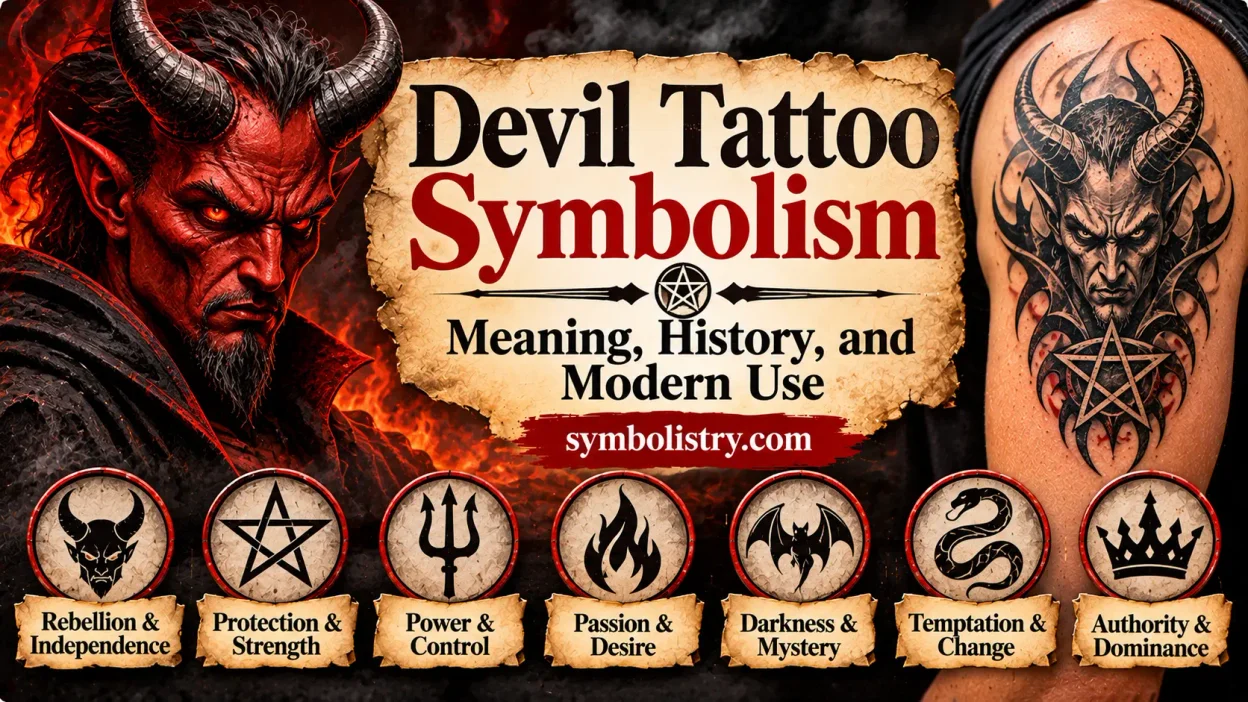
Devil tattoo symbolism explores the meanings behind one of the most recognizable and controversial figures in religious imagery, folklore, and popular culture. Often depicted with horns, a pointed tail, sharp features, and a pitchfork, the devil can represent temptation, evil, rebellion, personal freedom, or resistance to authority. The interpretation depends heavily on the tattoo’s design and the person wearing it.
In the United States, devil tattoos have a complicated cultural identity. Some people view them as expressions of independence, dark humor, or alternative fashion, while others associate them with Christianity, spiritual danger, and the struggle between good and evil. The same image can communicate completely different messages depending on someone’s beliefs and experiences.
Devil imagery also has a long artistic history. Its appearance in medieval religious art, European folklore, literature, music, and modern entertainment has shaped how people understand the figure today. Exploring these influences helps explain why devil tattoos can represent much more than a simple fascination with darkness.
Quick Answer
Devil tattoo symbolism commonly represents rebellion, independence, temptation, defiance, and personal freedom in modern American tattoo culture. Historically, the devil has also represented evil, spiritual opposition, human weakness, and the conflict between good and evil in religious traditions.
TL;DR
- Rebellion: Represents resistance to authority and conventional expectations.
- Temptation: Reflects desire, risk, and the struggle with personal choices.
- Independence: Can communicate self-expression and rejection of social judgment.
- Religious meaning: Represents evil, spiritual opposition, and moral conflict.
- Dark humor: Sometimes expresses sarcasm, mischief, or an unconventional personality.
- Modern tattoo culture: Combines traditional folklore, alternative fashion, and personal identity.
1. What a Devil Tattoo Looks Like
A devil tattoo usually features a human-like figure with supernatural or monstrous characteristics. Common visual elements include pointed horns, a long tail ending in an arrow-shaped tip, red skin, sharp teeth, clawed hands, and a pitchfork.
However, there is no single design that defines the devil. Some tattoos portray a frightening demonic creature, while others use a cartoon-like character with an exaggerated grin and playful expression.
Popular design elements include:
- Horns: Often associated with danger, aggression, and supernatural identity.
- Pitchfork: A familiar attribute of the traditional Western devil.
- Pointed tail: Reinforces the creature’s association with folklore and popular depictions of hell.
- Red skin: Commonly communicates heat, anger, danger, or infernal imagery.
- Flames: Suggest hell, destruction, punishment, or intense desire.
- Wings: May create a connection to fallen angels and religious interpretations.
- Dark eyes: Can emphasize menace, secrecy, or supernatural power.
The design can be realistic, traditional, minimalist, illustrative, or humorous. A small devil silhouette on the wrist communicates something different visually from a detailed demonic figure covering an entire back.
2. The Core Meanings Behind Devil Tattoos
Devil tattoos carry several overlapping meanings. Their interpretation depends on whether the wearer is interested in religious imagery, cultural rebellion, personal philosophy, or the aesthetics of dark art.
Rebellion and defiance are among the most recognizable modern associations. The devil has traditionally represented opposition to divine and social authority, making the figure a visual choice for people who identify with challenging established expectations.
Temptation and desire represent another important meaning. The devil is frequently portrayed as someone who encourages people to abandon restraint or pursue forbidden pleasures. A tattoo can therefore reflect an interest in human desires, moral decisions, and the consequences of personal choices.
Independence and self-expression appear in contemporary tattoo culture. Some wearers choose devil imagery to show that they are comfortable being different or do not want their identity defined by conventional standards.
Dark humor and mischief are especially relevant to cartoon-style devil tattoos. A smiling devil or mischievous character may communicate playfulness rather than hostility.
Moral conflict offers a more reflective interpretation. The image can represent the tension between good intentions and harmful impulses, or the recognition that people are capable of both admirable and destructive behavior.
These meanings are not mutually exclusive. Someone may choose a devil tattoo because it looks striking while also connecting with its associations with independence and personal complexity.
3. Historical Origins of the Devil’s Appearance
The familiar Western image of the devil developed gradually through religious interpretation, European folklore, artistic traditions, and popular storytelling.
In the Hebrew Bible, Satan’s role is not identical to the fully developed embodiment of evil found in later Christian traditions. The Hebrew term satan can refer to an adversary or accuser. Different biblical texts present the figure in different ways, and later Jewish and Christian interpretations developed additional ideas about spiritual opposition.
Christian theology increasingly associated Satan with rebellion against God, temptation, and the corruption of humanity. Medieval European artists helped make these abstract religious ideas visually recognizable.
The devil’s horns, claws, animal-like features, and frightening body were influenced by several artistic traditions. Some historians connect particular visual characteristics to older representations of horned pagan figures, including the Greek god Pan. However, the familiar devil image did not simply originate from one ancient deity.
Medieval artists combined religious ideas, folklore, and imaginative features to create a recognizable figure representing spiritual danger. Over time, paintings, sculptures, church illustrations, and theatrical performances helped establish the image that later appeared in tattoos.
This history explains why devil tattoos can communicate religious themes even when the wearer has no religious intention.
4. Religious Symbolism and the Devil’s Meaning in Christianity
Christianity provides one of the strongest historical foundations for the devil’s negative symbolism.
In many Christian interpretations, Satan represents opposition to God, temptation, pride, deception, and the rejection of divine authority. The figure is associated with humanity’s vulnerability to sin and the moral consequences of choosing wrongdoing.
The story of temptation in the Garden of Eden is frequently connected with the devil in Christian interpretation, although the serpent in Genesis is not explicitly identified as Satan within the original passage itself. Later Christian traditions connected these figures more directly.
The devil also appears in the New Testament as a tempter and adversary. The temptation of Jesus in the wilderness, for example, illustrates the conflict between spiritual commitment and the pursuit of worldly power or satisfaction.
For some Christian observers, a devil tattoo may appear disrespectful toward their religious beliefs. Others may interpret the image as a reminder of spiritual struggle or a warning against temptation.
The important distinction is between the religious figure and the tattoo wearer’s intention. A person wearing devil imagery is not necessarily expressing support for evil, rejecting Christianity, or identifying with Satan.
5. What Devil Tattoos Mean in American Culture
In the United States, devil imagery has developed beyond its original religious associations. It appears in traditional tattoo art, music, entertainment, fashion, sports-related imagery, and alternative subcultures.
American tattoo culture has often embraced symbols that challenge conventional expectations. Skulls, snakes, demons, flames, and devils have become familiar elements of traditional and contemporary tattoo designs.
For some Americans, a devil tattoo communicates a refusal to follow social expectations. It may represent confidence, individualism, or a willingness to accept criticism for personal choices.
For others, the image is primarily artistic. They may appreciate the dramatic appearance of horns, flames, and supernatural features without assigning the design a serious philosophical meaning.
The devil also appears in American popular culture through Halloween decorations, horror films, comic books, and music. These settings have helped make the figure familiar even to people who do not interpret it through religious beliefs.
However, the image can still provoke strong reactions. In communities where Christianity plays an important cultural role, devil imagery may be viewed negatively or interpreted as deliberately provocative.
Its meaning in American society therefore depends on context. A devil tattoo at a Halloween event may look playful, while the same design displayed in a religious setting may attract criticism.
6. Devil Tattoos as Symbols of Rebellion and Personal Freedom
One of the strongest modern interpretations of devil imagery is rebellion. Because the devil traditionally represents opposition to divine authority, the figure has become a recognizable symbol for challenging rules, questioning expectations, and rejecting conventional behavior.
In tattoo culture, this association can be especially appealing to people who value independence. A devil design may communicate that the wearer prefers to make personal decisions rather than live according to other people’s standards.
This does not necessarily mean rejecting every form of authority. For some people, rebellion is more personal than political or religious. It may represent overcoming family expectations, leaving a restrictive environment, or becoming comfortable with an identity that others do not understand.
The devil can also symbolize the willingness to accept criticism. Someone who chooses a visibly provocative tattoo may be communicating that social approval is not their highest priority.
However, rebellion is not automatically the message. A person might simply appreciate traditional tattoo artwork or enjoy the dramatic character of the design. The wearer’s explanation remains more meaningful than assumptions based on appearance.
7. The Meaning of Temptation, Desire, and Human Weakness
The devil has traditionally been portrayed as a tempter, encouraging people to pursue desires that may conflict with their values or responsibilities.
This association gives devil tattoos a psychological dimension. Rather than representing an external supernatural figure, the image can symbolize the internal struggle between impulse and self-control.
For example, someone might choose a devil tattoo to acknowledge past mistakes or remember a period when they made difficult decisions. Another person might use the image to represent their acceptance of human imperfections.
The symbolism can also be less serious. A smiling devil holding a pitchfork might represent enjoying life’s pleasures, taking risks, or having a mischievous personality.
There is an important difference between acknowledging temptation and celebrating harmful behavior. A tattoo can recognize that people experience conflicting desires without suggesting that every impulse should be followed.
For some wearers, this is precisely what makes the devil an interesting symbol: it represents the complicated side of human nature rather than an uncomplicated idea of goodness.
8. Fallen Angel Symbolism and the Devil Tattoo
Some devil tattoos are designed to resemble fallen angels. These images often feature large wings, a human-like face, dark clothing, and a dramatic expression.
The fallen angel concept comes from the development of Christian interpretations concerning Satan’s rebellion and expulsion from heaven. The relationship between Satan and fallen angels has been explored through theology, literature, and artistic imagination.
A fallen angel tattoo can represent several ideas:
- Pride: The danger of allowing ambition or ego to become excessive.
- Rebellion: Refusal to submit to a higher authority.
- Loss: Separation from something once valued.
- Transformation: A major change in identity or personal direction.
- Moral conflict: The struggle between good intentions and destructive decisions.
Some people interpret fallen angel imagery as a symbol of having experienced hardship and emerged with a different perspective. Others appreciate its connection to tragic characters in literature and art.
It is worth remembering that a fallen angel and a devil are not always interchangeable. The fallen angel represents a particular religious and literary concept, while devil imagery can draw from a much wider collection of folklore and popular traditions.
9. Devil Tattoo Designs and Their Different Interpretations
The specific design has a considerable influence on how a devil tattoo is understood. Facial expression, posture, surrounding imagery, and artistic style can change its message.
Often associated with classic tattoo culture, rebellion, mischief, and bold self-expression. Its exaggerated appearance can make it more playful than frightening.
May communicate fear, inner conflict, danger, or fascination with darker aspects of mythology and horror art.
Commonly suggests humor, mischief, playfulness, and a lighthearted relationship with unconventional imagery.
Often represents rebellion, pride, separation, transformation, or the tension between spiritual ideals and personal desires.
Can express independence, a mischievous personality, or interest in dark symbolism without relying on a complicated image.
These interpretations are general associations rather than fixed definitions. A traditional red devil may represent personal memories for one person and simply reflect an appreciation for vintage tattoo art for another.
10. What Devil Tattoos Mean in Different Colors
Color can change the emotional impression of a devil tattoo. Traditional devil imagery often uses red, but modern designs also incorporate black, gray, green, and other shades.
| Color | Common Symbolic Association | Typical Visual Effect |
|---|---|---|
| Red | Passion, anger, danger, temptation | Bold and traditionally infernal |
| Black | Mystery, darkness, defiance | Dramatic and serious |
| Gray | Conflict, ambiguity, reflection | Subdued and realistic |
| Green | Folklore, mischief, unusual character | Playful or supernatural |
| Blue | Individuality, contrast, unconventional identity | Less traditional and distinctive |
Red is particularly recognizable because Western popular culture frequently depicts the devil with red skin. It can communicate danger, intense emotion, or a connection to traditional depictions of hell.
Black often gives the design a darker appearance. Black-and-gray devil tattoos may emphasize shadows, facial expression, and intricate details rather than bright supernatural imagery.
Green sometimes appears in cartoon illustrations and fantasy-inspired designs. It can make the devil look humorous, strange, or deliberately different from traditional religious representations.
Color symbolism is subjective, however. A person may choose a particular shade because it complements an existing tattoo collection rather than because it carries a specific meaning.
11. Devil Tattoos in Music, Movies, and Popular Culture
American entertainment has played a major role in making devil imagery familiar outside religious settings.
In horror movies, the devil is often portrayed as a frightening supernatural presence connected to possession, temptation, or evil. These portrayals reinforce the traditional religious associations while adapting them for modern storytelling.
Music has introduced another interpretation. Blues, rock, heavy metal, and other musical traditions have used devil imagery to explore freedom, danger, rebellion, and forbidden desires.
One famous example is the historical association between blues musician Robert Johnson and the legend that he made a supernatural bargain at a crossroads in exchange for musical ability. The story became part of American musical folklore, although it should not be treated as an established historical event.
In rock and metal culture, devil imagery has sometimes been used to challenge conservative expectations or create an atmosphere of theatrical darkness. It can also serve as an artistic motif without expressing literal religious beliefs.
Movies, comics, video games, and television have further expanded the devil’s identity. Some portray the figure as entirely evil, while others present complex characters with humor, intelligence, or unexpected emotional qualities.
These portrayals influence tattoo choices. Someone may select a devil design because it reminds them of a favorite musician, fictional character, album, or period in their life.
12. Psychological Meaning: Why People Choose Devil Tattoos
Choosing a devil tattoo can reflect an interest in identity, personal history, and the parts of human experience that people do not always discuss openly.
For some individuals, the image represents ownership of their imperfections. Rather than presenting themselves as flawless, they choose a figure traditionally associated with temptation and wrongdoing to acknowledge that human behavior can be complicated.
Others use devil imagery as a form of emotional expression. It may represent anger, frustration, survival, or a desire to stop hiding aspects of their personality.
There can also be an element of humor. A small cartoon devil can function as a visual joke, especially when paired with an otherwise gentle or unexpected design.
From a psychological perspective, tattoos can serve as markers of identity and autobiographical memory. A devil tattoo might commemorate a difficult period, a personal transformation, or a decision to live more independently.
It would be inaccurate to assume that someone with a devil tattoo has aggressive tendencies, rejects morality, or holds particular religious beliefs. Appearance alone cannot establish a person’s character or intentions.
The most useful interpretation begins with the individual story behind the design.
13. Devil Tattoos and Cultural Controversies
Devil tattoos can generate disagreement because the figure carries different meanings across religious, cultural, and social settings.
For many Christians, the devil represents spiritual opposition, deception, and sin. A visible tattoo featuring horns, flames, or demonic imagery may therefore be considered inappropriate or offensive, particularly in conservative religious communities.
Other people view the image as folklore, artistic expression, or a representation of personal independence. They may have no intention of communicating an anti-religious message.
Satanism also requires careful distinction. The presence of devil imagery does not automatically indicate membership in a Satanist organization or agreement with a particular religious or philosophical movement.
Different Satanist groups and individuals hold different beliefs. Some use Satan as a symbolic figure representing individualism, questioning authority, or personal autonomy, while others approach the figure through explicitly religious or spiritual frameworks.
There is also a difference between Satan, the devil, demons, and other supernatural figures. Popular culture sometimes treats these terms as interchangeable, but religious traditions and folklore do not always do so.
In American public life, the meaning of a devil tattoo may therefore depend on the setting. It might be accepted as ordinary artistic expression in a tattoo studio but interpreted negatively in a religious gathering or conservative workplace.
Respectful interpretation requires avoiding assumptions about someone’s beliefs based on a single image.
14. Where Devil Tattoos Are Placed and What Placement Can Suggest
Tattoo placement can influence how a devil design is presented, although location does not establish a universal symbolic meaning.
Makes the design relatively visible and can communicate confidence, personal expression, or an appreciation for traditional tattoo artwork.
Provides space for detailed artwork while allowing the tattoo to remain covered by clothing when desired.
Creates a highly visible statement. Some wearers choose it to emphasize individuality, although hand tattoos can have practical and professional considerations.
Offers room for larger compositions, including fallen angels, flames, wings, and elaborate supernatural scenes.
Can suit smaller designs or more private personal symbols that are not constantly visible.
A tattoo’s placement is usually a personal design decision. Some people choose visible areas to make a statement, while others prefer locations that allow greater privacy.
15. How Devil Tattoo Symbolism Has Changed Over Time
The devil’s meaning has changed considerably as religious art, folklore, literature, and popular entertainment have influenced public imagination.
In medieval European Christianity, the devil was primarily a figure of spiritual opposition and moral danger. Artistic depictions emphasized frightening physical features to make religious teachings about sin and temptation understandable to viewers.
During later centuries, literature and theater introduced more complex portrayals. The devil could appear as a tempter, a clever deceiver, a rebellious character, or a figure used to explore human ambition and weakness.
American tattoo culture eventually adopted the image as part of a broader vocabulary of traditional designs. Its appearance in vintage tattoo flash, military-associated tattoo traditions, entertainment, and popular illustration helped establish it as a recognizable tattoo subject.
Modern tattoo artists have expanded its visual possibilities through realism, fine-line work, abstract compositions, and fantasy-inspired imagery.
Today, a devil tattoo can represent religious themes, rebellious identity, dark humor, personal memories, or an appreciation for dramatic artwork. Its history remains important, but the wearer has considerable freedom to shape its contemporary meaning.
Frequently Asked Questions
1. What does a devil tattoo symbolize spiritually?
A devil tattoo can represent temptation, spiritual conflict, rebellion, or the struggle between good and evil. Some people use it as a reminder of moral challenges, while others choose it for artistic or personal reasons without religious intentions.
2. Does a devil tattoo mean rebellion?
Rebellion is one of the most common modern interpretations of devil imagery. It can represent independence, resistance to social expectations, and a willingness to express an unconventional identity.
3. What does a red devil tattoo mean?
A red devil tattoo commonly represents temptation, passion, danger, mischief, and defiance. Its meaning can also be humorous, particularly when the character has an exaggerated expression or cartoon appearance.
4. Is getting a devil tattoo considered bad luck?
There is no established evidence that a devil tattoo causes bad luck. Some religious or cultural traditions attach negative associations to devil imagery, but personal beliefs and interpretations vary.
5. What does a devil and angel tattoo symbolize together?
An angel and devil tattoo commonly represents the contrast between good and evil, morality and temptation, or positive and negative impulses. It can also express the idea that people experience competing desires and must make their own choices.
6. Does a devil tattoo mean someone worships Satan?
No. A devil tattoo does not automatically indicate Satan worship, religious affiliation, or particular spiritual beliefs. Many people choose these designs because of traditional tattoo art, popular culture, personal symbolism, or an interest in supernatural imagery.
7. What does a small devil tattoo symbolize?
A small devil tattoo can represent mischief, independence, humor, temptation, or a rebellious personality. Its compact design may also make it a subtle personal symbol rather than an outward statement about religious beliefs.
Conclusion
Devil tattoo symbolism brings together rebellion, temptation, independence, moral conflict, and the complicated relationship between good and evil. Its historical roots in religious traditions and European folklore explain why the figure has traditionally represented spiritual danger, while modern tattoo culture has expanded its meaning to include individuality, humor, and personal freedom.
In the United States, devil tattoos can be expressions of alternative identity, artistic appreciation, personal experiences, or fascination with supernatural imagery. Their meaning changes according to the design, cultural background, and intentions of the wearer.
Ultimately, a devil tattoo does not tell the complete story of someone’s personality or beliefs. It is a symbol whose meaning depends on the person who chooses it and the message they want their artwork to communicate.