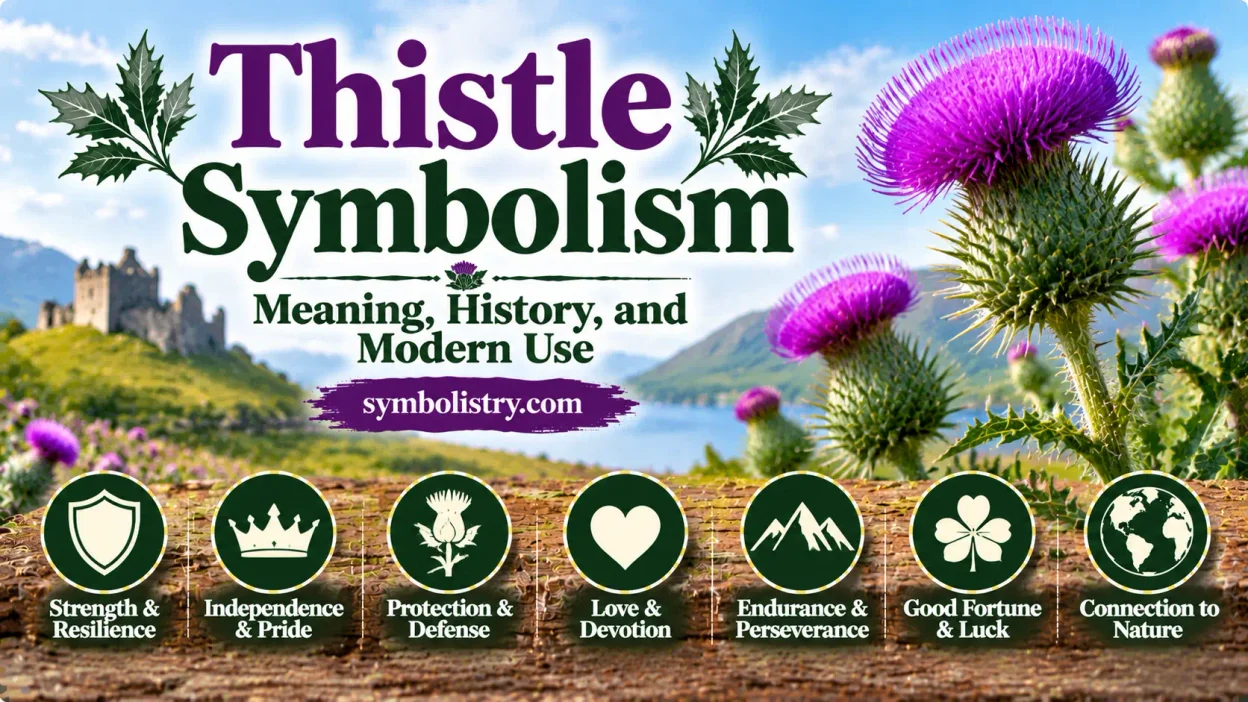
Thistle symbolism is closely associated with resilience, protection, independence, and the ability to thrive under difficult conditions. Recognized by its spiny leaves, prickly stems, and distinctive purple flower heads, the thistle is a wild plant that combines beauty with defense. Its appearance helps explain why it has become an emblem of strength, determination, and self-preservation.
In the United States, thistles appear in wildflower photography, botanical illustrations, gardens, tattoos, and nature-inspired artwork. Their meaning can be personal, representing the ability to survive hardship or maintain boundaries, or cultural, reflecting the history of Scotland and its national identity.
The thistle’s significance extends beyond its prickly exterior. Different species have played roles in traditional medicine, folklore, ecology, and national emblems. Understanding these connections reveals why a plant often dismissed as a weed can also represent dignity, endurance, and the courage to remain standing when circumstances are unfavorable.
Quick Answer
Thistle symbolism commonly represents strength, resilience, protection, and independence in modern American culture, particularly in tattoos, nature-inspired art, and personal expressions of perseverance. Historically, the thistle has also represented Scottish national identity, defense against threats, and survival in challenging environments.
TL;DR
- Resilience: The thistle thrives in conditions that challenge other plants.
- Protection: Its sharp spines symbolize boundaries and self-defense.
- Scottish heritage: The thistle serves as a national emblem of Scotland.
- Independence: Its untamed growth suggests self-reliance and individuality.
- Beauty and hardship: Its striking flowers contrast with its prickly exterior.
- Modern meaning: Tattoos and artwork use the thistle to express perseverance and pride.
1. What Is a Thistle, and What Makes It Distinctive?
A thistle is a common name for several groups of prickly flowering plants, many belonging to the sunflower family, Asteraceae. Their best-known features include spiny leaves, protective bracts, sturdy stems, and rounded flower heads that often appear purple, pink, or reddish-purple. Some species have white or yellow flowers.
Thistles grow in a wide range of environments, including meadows, roadsides, pastures, disturbed ground, and open fields. Depending on the species, they may be annuals, biennials, or perennials. Many produce seeds equipped with feathery structures that help them disperse in the wind.
Their physical characteristics contribute directly to their symbolism. The spines make the plant difficult to handle, suggesting protection and the defense of personal boundaries. Its flower heads, by contrast, can be strikingly beautiful, creating a visual contrast between toughness and delicacy.
This contrast is central to the thistle’s appeal as a symbol. It suggests that something can be attractive without being vulnerable, and that strength does not require the absence of beauty.
Not every plant called a thistle belongs to the same botanical group. Species such as the Scottish thistle and the common thistle encountered in American fields may have different ecological characteristics, so their cultural meanings should not automatically be treated as identical.
2. The Core Symbolic Meanings of the Thistle
The thistle carries several closely related meanings, shaped by its physical defenses, ability to grow in difficult conditions, and history as a cultural emblem.
Resilience and perseverance are among its most recognizable associations. Thistles can establish themselves in disturbed or challenging environments, making them useful symbols for people who have endured setbacks and continued moving forward.
Protection and self-defense arise from the plant’s sharp spines. Unlike a flower that can be handled easily, a thistle protects itself from many potential threats. Symbolically, this can represent healthy boundaries, self-respect, and the decision not to tolerate harmful treatment.
Independence and individuality reflect its untamed appearance. A thistle growing in an open field may seem unconcerned with cultivation or approval, making it an appealing emblem of self-reliance.
Courage and resistance are especially relevant to the thistle’s association with Scotland. The plant’s prickly character has become linked with a national identity that values endurance and the defense of home.
Beauty despite hardship comes from the contrast between the plant’s defensive exterior and its colorful blossoms. The thistle can represent the idea that difficult experiences do not eliminate a person’s capacity for warmth, creativity, or beauty.
These interpretations overlap, but each emphasizes something different. A thistle used in a personal tattoo might express emotional boundaries, while one displayed in a Scottish heritage design might communicate national pride.
3. The Historical Origins of Thistle Symbolism
People have interacted with prickly plants for thousands of years, using their appearance and growth habits to distinguish them from more easily handled vegetation. However, the symbolism of the thistle developed differently across regions and species.
In parts of Europe, thistles became familiar features of rural landscapes, where they could be admired as wildflowers or disliked when they spread through agricultural land. Their capacity to survive and reproduce made them noticeable plants, but their meaning depended on the setting.
Some thistles have also been used in traditional herbal practices. These practical associations helped establish the plant as something more complicated than a nuisance: it could be difficult to manage while still having useful qualities.
The thistle’s most recognizable historical symbolic role emerged through its connection with Scotland. Over time, it became an emblem of national identity, appearing in heraldry, decoration, military insignia, and official settings.
Its history illustrates an important principle of plant symbolism. A plant does not acquire cultural meaning simply because of its appearance; its meaning develops through stories, repeated use, political identity, and the experiences of the people who adopt it.
4. Why the Thistle Is the National Emblem of Scotland
The thistle is one of Scotland’s most recognizable national emblems. It appears in Scottish heraldry, public institutions, commemorative designs, and symbols associated with Scottish identity.
A popular legend connects the plant with an attempted Norse attack. According to the story, an enemy approaching a Scottish encampment stepped on a thistle and cried out, alerting the defenders. The warning supposedly helped the Scots repel the attack.
The story is widely repeated as an explanation for the thistle’s association with defense and national pride. However, it should be treated as a traditional legend rather than a securely documented account of a specific historical battle.
The plant’s formal association with Scotland developed over time, and thistle imagery became established in Scottish heraldic and institutional life. The Order of the Thistle, one of Scotland’s highest orders of chivalry, further reinforces the plant’s connection with honor and national tradition.
For Scottish people and those with Scottish ancestry, the emblem can communicate heritage, belonging, perseverance, and pride. In the United States, where Scottish ancestry is part of many families’ histories, the thistle may appear in clan-related artwork, family keepsakes, tartan designs, and cultural celebrations.
Its meaning is therefore both botanical and political: the plant’s defensive appearance has helped make it a memorable emblem of a community’s identity.
5. Thistle Symbolism in the United States
In the United States, the thistle does not have one dominant national meaning. Its interpretation depends on whether it appears as a wild plant, a garden flower, a Scottish emblem, or a personal design.
For Americans with Scottish ancestry, the thistle often serves as a visible connection to family history. It may appear on crests, jewelry, commemorative objects, embroidered clothing, or decorations used at Scottish festivals and Highland games. In these settings, the plant communicates cultural continuity and pride.
Outside heritage contexts, the thistle’s prickly structure makes it a natural emblem of perseverance. Someone who has overcome a difficult period may choose it as a reminder that adversity does not have to determine the future. Its defensive leaves can also represent independence and the right to establish personal boundaries.
The plant has a less celebratory side in American agriculture and gardening. Several introduced thistle species spread aggressively in pastures, roadsides, and disturbed land, where they can compete with other plants. As a result, some Americans associate thistles with weeds, difficult work, and unwanted growth.
Native thistles, however, can provide valuable resources for wildlife. Their flowers supply nectar and pollen, and their seeds feed birds such as goldfinches. This ecological role gives the plant another possible meaning: a species that seems inconvenient from one perspective may be valuable from another.
These contrasting interpretations make the thistle especially relevant to American culture, where ideas of self-reliance, environmental stewardship, heritage, and individual freedom often intersect.
6. The Thistle in Celtic Tradition and European Folklore
Thistles are often associated with Celtic identity, especially through Scotland, but their broader European folklore includes several different interpretations. It is important to distinguish documented cultural traditions from modern descriptions that group all Celtic peoples together.
In Scottish tradition, the thistle is an emblem of national endurance and defense. Its spines make it a fitting visual expression of the idea that a community can protect itself against outside threats.
European folk traditions have also attributed protective qualities to prickly plants. In some historical accounts of folklore, thistles were carried or placed in particular settings to ward off harmful influences. Such beliefs varied by place and period and should not be treated as a single, universally shared Celtic practice.
The plant’s physical form likely contributed to these associations. A thorny or spiny plant can function as a natural barrier, so it readily lends itself to stories about protection from danger. In folklore, this practical characteristic may be extended into a belief that the plant can defend people symbolically or supernaturally.
The thistle also appears in European heraldic art, where plants can identify a nation, family, or institution. In these contexts, it is not simply a representation of wild nature; it becomes a recognizable sign of collective identity.
For modern readers, the most responsible interpretation is that thistle folklore reflects particular communities and historical settings. Not every thistle tradition is Celtic, and not every protective belief about prickly plants originated in Scotland.
7. What the Thistle Represents Emotionally
The thistle’s emotional appeal comes from the tension between its outward defenses and its flowering head. It is neither entirely soft nor entirely threatening, which makes it a useful symbol for experiences that involve vulnerability and strength at the same time.
For someone recovering from a difficult relationship, the thistle may represent learning to protect personal boundaries. The spines suggest that kindness does not require unlimited access, while the flower indicates that self-protection does not have to eliminate warmth or openness.
For someone facing a major life change, the plant may stand for persistence. Its ability to grow in disturbed environments can serve as a reminder that difficult circumstances do not make future growth impossible.
The thistle may also express pride in being different. Its shape is unusual compared with familiar garden flowers, and it does not depend on a smooth, delicate appearance to attract attention. This makes it appealing to people who value independence or prefer symbols that feel less conventional.
There is no single psychological response to the plant. One person may see courage in its spines; another may see an unwanted weed. Emotional symbolism depends on personal memories, cultural familiarity, and the circumstances in which someone encounters it.
Its most useful message is not that people must always be tough. Rather, it suggests that resilience can include both protection and the ability to keep growing.
8. Thistle Symbolism in Tattoos and Personal Style
Thistle tattoos are often chosen for their associations with endurance, heritage, courage, and self-respect. Their distinctive outlines also work well in different tattoo styles, from fine-line botanical illustrations to bold traditional designs.
A person with Scottish ancestry might choose a thistle to honor family roots or celebrate a connection to Scotland. A person without that heritage might select the same plant because it represents surviving a difficult period or learning to defend personal boundaries.
The design can change the emphasis. A single flowering thistle may suggest independence or personal growth. A group of thistles can communicate family ties, solidarity, or shared heritage. A thistle paired with a name or date may commemorate a loved one or a turning point in life.
Color also affects the design’s mood. Purple blossoms create a vivid focal point, while black-and-gray artwork can emphasize the contrast between the sharp leaves and the softer flower head.
Thistle jewelry and clothing offer similar possibilities. A pendant can serve as a subtle reminder of resilience, while a Scottish thistle brooch may be chosen primarily for cultural identity.
These meanings are personal interpretations, not a standardized code. A thistle tattoo does not automatically indicate a particular personality, hardship, or ancestry. Its significance is best understood through the reason the wearer chose it.
9. The Thistle in Gardens, Art, and Home Decor
Thistle imagery can bring a combination of ruggedness and elegance to interior design. Botanical prints, embroidered textiles, ceramic patterns, and metalwork sometimes feature the plant’s spiny leaves and rounded flower heads.
In a rustic or nature-inspired interior, a thistle motif may suggest wild landscapes, independence, or an appreciation for plants that grow beyond carefully managed gardens. In Scottish-inspired decor, it can serve as a recognizable heritage symbol.
Artists also use the plant’s structure to explore contrasts. Its spines provide strong lines and angular shapes, while the flower head creates a softer focal point. This makes the thistle useful in both realistic botanical illustrations and stylized decorative designs.
Living thistles require more consideration than a printed motif. Some species can spread aggressively, and several are invasive or regulated weeds in parts of the United States. Gardeners who appreciate their appearance can consider suitable native alternatives or ornamental species that are appropriate for their region.
A thistle-inspired design can communicate admiration for wild nature without encouraging the spread of an invasive plant. In this way, the symbol’s meaning can align with ecological awareness as well as visual taste.
10. Purple Thistles and the Meaning of Color
Many familiar thistles produce purple or violet flower heads, and this color contributes to their visual identity. Purple has long-standing associations in various Western settings with dignity, distinction, ceremony, and royalty.
In Scottish heraldic imagery, purple thistle blossoms can create a striking contrast with green foliage and metallic decorative elements. The color helps make the emblem recognizable, although the national significance comes from the thistle’s cultural history rather than from purple alone.
In contemporary floral art, purple may suggest individuality, creativity, or an unconventional approach to beauty. These associations can reinforce the thistle’s image as a plant that does not fit neatly into the category of a soft, ornamental flower.
The meaning changes with the design. A purple thistle in a Scottish crest points toward heritage; a purple thistle in a personal illustration may express independence or admiration for wildflowers.
Color symbolism is not universal, however. Purple can carry different religious, political, or ceremonial meanings in other contexts. It is best understood as an additional layer of interpretation rather than a fixed explanation of what every thistle represents.
11. Thistle Symbolism in Nature and Environmental Awareness
The thistle’s ecological role adds a practical dimension to its symbolism. Although some species are invasive weeds, native thistles can support wildlife and contribute to local ecosystems.
Their flowers attract bees, butterflies, and other insects seeking nectar and pollen. Later, their seeds provide food for birds, including goldfinches, while the plant’s structure can offer shelter or nesting material for some wildlife.
These relationships complicate the familiar image of the thistle as a nuisance. A plant that causes problems in a pasture may still provide resources for animals in an appropriate habitat. The key is identifying the species and understanding where it grows.
For environmentally minded readers, the thistle can symbolize the importance of looking beyond appearances. A prickly plant is not automatically harmful, just as a beautiful plant is not automatically beneficial. Ecological value depends on the species, location, and effects on the surrounding community.
This interpretation also offers a grounded form of resilience symbolism. The thistle’s ability to establish itself in disturbed areas can illustrate adaptation, but its success should not be confused with an unlimited capacity to thrive without ecological consequences.
In American gardening and conservation, recognizing the difference between native and invasive thistles is therefore essential. Appreciation for the symbol should go hand in hand with responsible plant identification.
12. Positive and Negative Interpretations of the Thistle
The thistle is an example of a symbol whose meaning changes according to the observer’s relationship with it.
For someone interested in Scottish history, it may represent honor, identity, and courage. For a person who has experienced hardship, it may stand for persistence and self-protection. For a gardener dealing with an invasive species, it may instead represent frustration and unwanted competition.
These interpretations are not necessarily contradictory. They reflect different experiences of the same physical qualities.
The spines can be understood as a form of protection, but they can also suggest defensiveness or emotional distance. The plant’s ability to spread may indicate determination in one setting and a lack of restraint in another.
Its visual beauty offers another contrast. The flower head can be admired while the plant’s practical disadvantages remain real. Symbolism does not require ignoring those disadvantages.
This balance makes the thistle a more nuanced symbol than a simple emblem of strength. It can encourage people to consider when protection is helpful, when persistence becomes stubbornness, and how an individual’s perspective shapes the meaning assigned to nature.
13. Comparing Thistle Meanings Across Different Contexts
The same plant can communicate different ideas depending on where and how it appears.
| Context | Common symbolic meaning | Why it fits |
|---|---|---|
| Scottish heritage | National pride and identity | The thistle is Scotland’s floral emblem. |
| Personal tattoos | Resilience and self-respect | Its spines suggest protection and endurance. |
| Wildflower artwork | Natural beauty and individuality | Its unusual form stands apart from familiar garden flowers. |
| Folklore | Defense and protection | Prickly plants readily suggest barriers against danger. |
| Ecological settings | Adaptation and complexity | Different species have different effects on their habitats. |
These meanings provide useful starting points, but none should be treated as mandatory. Personal intention, cultural knowledge, and the specific species all influence how the thistle is understood.
14. Common Misunderstandings About Thistle Symbolism
Several misconceptions can make the thistle’s cultural meaning seem simpler than it really is.
The thistle is not a symbol of every Celtic culture. Its strongest national association is with Scotland. Other Celtic communities have their own histories, emblems, and plant traditions, so the Scottish thistle should not automatically represent all Celtic peoples.
The legend of the Scottish thistle is not proven history. The familiar story about a barefoot Norse warrior stepping on a thistle is widely repeated, but there is no firm historical evidence establishing that incident as the reason Scotland adopted the plant. The emblem’s documented use is more reliable evidence of its historical importance than the legend itself.
Every thistle is not an invasive weed. Some species are troublesome agricultural weeds, but native thistles can be valuable for pollinators and birds. Identifying the species matters more than judging the entire group by its reputation.
Thistle symbolism does not always mean emotional toughness. Although the plant can represent resilience and self-defense, it can also communicate heritage, beauty, individuality, or an interest in nature.
There is no universal spiritual meaning for the thistle. Some folklore assigns protective qualities to prickly plants, but these beliefs vary by region and tradition. It would be inaccurate to present the thistle as a standard religious symbol across all cultures.
Understanding these distinctions allows the plant’s symbolic associations to remain meaningful without turning cultural stories or personal interpretations into universal facts.
15. How Thistle Symbolism Has Evolved Over Time
The thistle’s meaning has changed as people have encountered it in different environments and used it for different purposes.
In rural life, the plant could be an obstacle in a field or a familiar feature of the countryside. Its spines made it difficult to handle, while its flowers offered visual appeal. These ordinary experiences provided the basis for contrasting interpretations of the plant as both troublesome and beautiful.
In Scotland, the thistle acquired a more specific public identity through heraldry, royal imagery, and national tradition. Its prickly form made it suitable for an emblem associated with defense and honor, and its continued appearance in institutions helped preserve that association across generations.
In modern America, the plant carries these historical meanings alongside more personal interpretations. Someone may choose a thistle to celebrate Scottish ancestry, commemorate a difficult period, or express an appreciation for unconventional beauty. Another person may encounter it mainly as a wildflower or an agricultural weed.
Environmental awareness has added another dimension. Greater recognition of native plants and invasive species encourages people to distinguish between a symbol’s appearance and its ecological role.
The thistle’s enduring appeal comes from this flexibility. It can express cultural identity, personal boundaries, or natural persistence without losing its recognizable character. Its history demonstrates how a familiar plant can acquire new meanings while retaining the qualities that made it memorable in the first place.
Frequently Asked Questions
1. What does a thistle symbolize spiritually?
A thistle can symbolize protection, perseverance, and the ability to withstand adversity. Some historical folk traditions also attributed protective qualities to prickly plants, although the thistle does not have one universal spiritual meaning.
2. What does a thistle tattoo mean?
A thistle tattoo commonly represents resilience, independence, personal boundaries, or Scottish heritage. The design may also commemorate overcoming hardship or honoring a family connection, depending on the wearer’s intention.
3. Why is the thistle the national flower of Scotland?
The thistle became established as Scotland’s national emblem through centuries of royal and heraldic use. A popular legend credits the plant with alerting Scottish defenders to a nighttime attack, but this story has not been verified as historical fact.
4. Does a thistle symbolize strength or protection?
It can represent both, but the meanings emphasize different qualities. Strength relates to endurance and perseverance, while protection reflects the plant’s sharp spines and their association with defending personal boundaries.
5. Is the thistle a positive or negative symbol?
The thistle can have either interpretation. It may represent courage, heritage, and resilience in cultural or personal designs, while its reputation as an agricultural weed can associate it with unwanted growth and frustration.
6. What does a purple thistle symbolize?
A purple thistle may suggest individuality, dignity, natural beauty, or Scottish pride, depending on its setting. The plant’s historical associations are more firmly established than any universal meaning assigned to the color purple.
7. What does a thistle symbolize in a dream?
Some people interpret a thistle in a dream as a representation of protection, obstacles, or perseverance. There is no scientifically established universal interpretation, so personal experiences and the emotions associated with the dream provide a more useful starting point.
Conclusion
Thistle symbolism brings together resilience, protection, independence, and cultural identity. Its spiny leaves and distinctive flowers help explain its associations with self-defense and beauty, while its history as Scotland’s national emblem gives it a lasting connection to heritage and pride.
In the United States, the thistle can represent Scottish ancestry, personal perseverance, or an appreciation for wild nature. Its meaning also depends on context: a tattoo may commemorate survival, a family keepsake may celebrate heritage, and a native thistle in a garden may represent the value of supporting local wildlife.
Ultimately, the thistle reminds us that strength and beauty are not mutually exclusive. A plant can protect itself, flourish under challenging conditions, and still produce a striking flower—a fitting image for people who continue to grow without surrendering their individuality.