
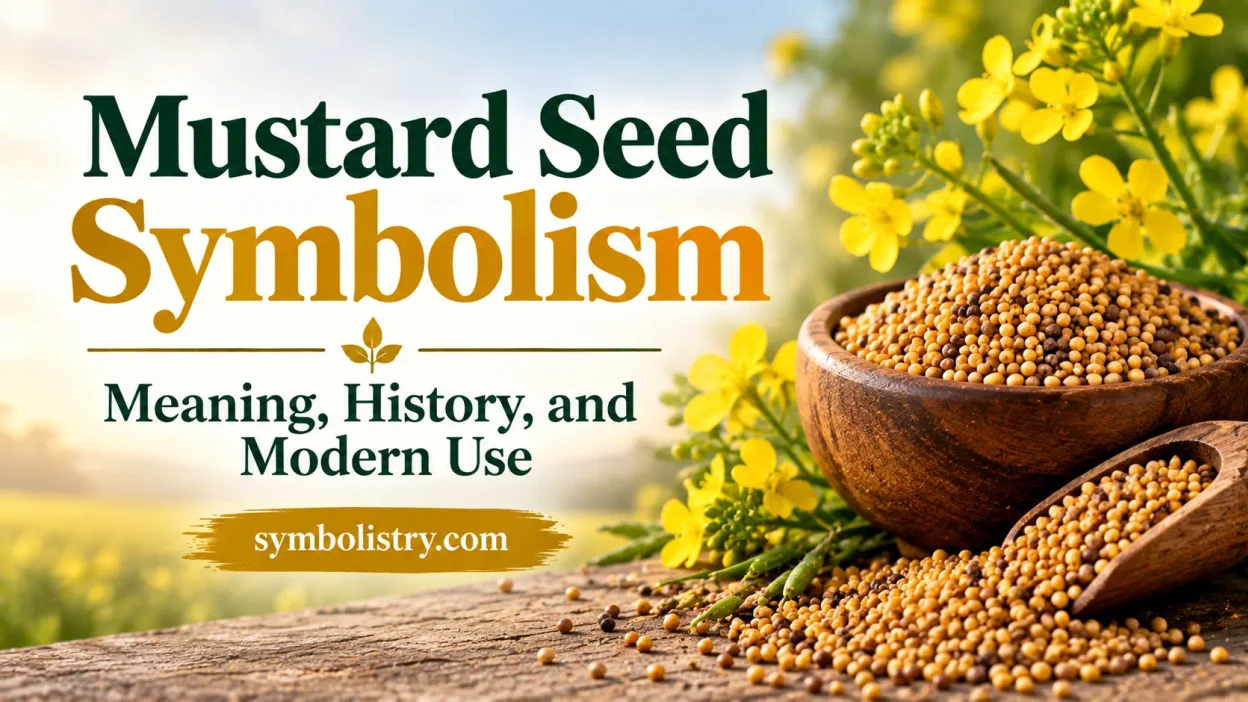
The mustard seed is a tiny, ordinary seed that became one of the most recognizable symbols of faith in Christian tradition. Mustard seed symbolism is especially associated with faith, growth, possibility, and the idea that something seemingly insignificant can develop into something much larger.
For many Americans, the mustard seed is familiar from church lessons, Bible studies, devotional jewelry, tattoos, artwork, and gifts carrying a small seed or the phrase “faith like a mustard seed.” Its meaning comes primarily from several teachings attributed to Jesus in the New Testament, where the mustard seed becomes a comparison for faith and for the growth of the kingdom of God.
The symbol remains relevant because it connects an everyday object with a larger human experience: beginning with something small and trusting that it can develop through time, care, and commitment.
Quick Answer
Mustard seed symbolism commonly represents faith, growth, hope, and the potential for small beginnings to produce significant results in modern American culture. Its strongest historical association comes from the New Testament, where the mustard seed illustrates faith and the surprising growth of God’s kingdom.
TL;DR
- The mustard seed commonly represents faith, growth, and small beginnings.
- Its strongest symbolic roots come from Jesus’ parables.
- American Christianity often uses it as a reminder of faith.
- The seed also represents patience and gradual personal development.
- Jewelry and tattoos have made the symbol highly personal.
- Modern interpretations often extend beyond explicitly religious settings.
What the Mustard Seed Looks Like
Mustard seeds are remarkably small, usually appearing as tiny round or nearly round grains in shades ranging from yellowish-brown to dark brown or black, depending on the species. The mustard plant itself can be much more substantial than the seed suggests, producing stems, branches, and flowers.
The biblical references are generally understood by Bible scholars to fit black mustard, Brassica nigra, although identifying the exact plant with complete certainty is difficult. Historical discussions have also proposed other plants, which means modern illustrations should not automatically be treated as scientifically exact depictions of the biblical mustard plant.
That contrast between the seed and the mature plant is essential to its symbolism. A person looking at the seed sees almost nothing: a tiny object that can easily be overlooked. The mature plant provides the visual counterpart—a reminder that size at the beginning does not necessarily determine what something can become.
The Core Meaning: Faith That Begins Small
The most recognizable meaning of the mustard seed is faith.
In Matthew 17:20, Jesus compares faith to the size of a mustard seed while speaking about moving a mountain. The passage has traditionally been understood as emphasizing that genuine faith does not need to appear large or impressive to matter.
This is slightly different from the popular modern idea that “small faith” is automatically enough for anything a person wants. The biblical image is more specifically concerned with trust in God and the relationship between faith and divine action.
That distinction matters. The mustard seed does not traditionally symbolize confidence in one’s own ability to control events. Instead, within its Christian context, it points toward trust that can remain meaningful even when a person feels that what they possess is small.
This is why a tiny seed can carry such a large religious meaning.
The Parable of the Mustard Seed
The mustard seed appears prominently in three Gospel passages: Matthew 13:31–32, Mark 4:30–32, and Luke 13:18–19. In these passages, the seed is used to describe the kingdom of heaven or kingdom of God.
The image follows a simple progression:
small seed → planting → growth → large plant → shelter for birds
The point is not merely that mustard grows quickly or becomes physically large. The comparison draws attention to the surprising relationship between an apparently insignificant beginning and a much larger result.
Matthew and Mark emphasize the contrast between the seed’s smallness and the plant’s eventual size, while Luke presents the kingdom of God through the image of a planted seed that grows into a large plant where birds can nest.
This gives the mustard seed another important meaning: growth that begins quietly.
Ancient Roots and the Everyday World of Jesus
The symbolism works partly because mustard was not an exotic object to the people hearing Jesus’ teachings. Mustard plants were part of the agricultural environment of the ancient Mediterranean and Near East.
The exact species referred to in the Gospels remains debated, but black mustard has traditionally been considered the strongest candidate. It could grow considerably larger than its tiny seeds would suggest, making it suitable for the kind of comparison used in the parables.
The importance of this background is easy to miss today. A modern reader may encounter a mustard seed mainly as a religious symbol printed on a necklace card or decorative plaque. For an ancient audience, however, the image was connected to farming, planting, food, gardens, and ordinary work.
That everyday quality helped make the teaching memorable.
Why Small Beginnings Became So Important
The mustard seed does not symbolize growth simply because plants grow. Its symbolic force comes from contrast.
The beginning looks insignificant.
The eventual result is much larger.
That pattern appears repeatedly in human experience. A habit can begin with one decision. A relationship can begin with one conversation. A community project can begin with a handful of people. A religious commitment can begin with a single act of trust.
For this reason, the mustard seed has gradually become useful outside strictly biblical interpretation. People often use it as a visual reminder that progress does not have to look impressive at the beginning.
The symbol therefore combines two ideas that can seem contradictory: humility at the beginning and confidence in future growth.
Mustard Seed Symbolism in the United States
In the United States, the mustard seed is particularly recognizable within Christian communities. Churches, Sunday schools, Bible-study groups, Christian bookstores, devotional products, and religious artwork have helped keep the image familiar across generations.
The symbol commonly appears in:
- necklaces and bracelets
- framed Christian artwork
- bookmarks
- greeting cards
- journals and devotionals
- church lessons for children
- wedding and baptism gifts
- memorial objects
- tattoos
- social media graphics
American interpretations often combine the biblical meaning of faith with broader ideas such as perseverance, hope, encouragement, and personal growth.
However, these meanings should not all be treated as equally ancient. Faith is directly rooted in the New Testament passages, while ideas such as personal development and motivational perseverance are largely modern extensions of the image.
| Context | Meaning in the USA | Common Associations | Notes |
|---|---|---|---|
| Christian teaching | Faith and trust in God | Bible study, sermons, prayer | Closest to the biblical tradition |
| Personal jewelry | Faith carried personally | Hope, remembrance, devotion | Often chosen for emotional reasons |
| Tattoos | Commitment or spiritual identity | Faith, growth, resilience | Meaning varies by wearer |
| Weddings | Faith and a growing relationship | Commitment, family, future | Usually a modern adaptation |
| Memorials | Continuing faith and remembrance | Hope, comfort, memory | Meaning depends on the person and setting |
The Emotional Meaning of a Mustard Seed
The mustard seed often carries a reassuring emotional message: you do not have to begin with everything figured out.
Its small size can represent vulnerability. Someone may feel that their faith is uncertain, their circumstances are difficult, or their efforts are too modest to matter. The seed provides a visual counterpoint to that feeling.
It says, in effect, that beginnings can be small without being meaningless.
This is one reason the symbol can work especially well during transitions. A person starting a new chapter, recovering from disappointment, beginning a spiritual practice, or pursuing a long-term goal may see the seed as a reminder to value the beginning rather than judge it against the final destination.
The symbolism is therefore less about instant transformation and more about allowing something to develop.
Mustard Seed Symbolism and Personal Growth
Modern American culture frequently separates personal growth from explicitly religious language. In that setting, the mustard seed can become a general metaphor for development.
Someone might use a mustard seed image to represent:
- starting a new career
- developing a new habit
- rebuilding after hardship
- beginning a creative project
- strengthening a relationship
- pursuing education
- developing confidence
- making gradual progress toward a long-term goal
This interpretation is not the original biblical meaning, but it grows naturally from the same visual structure: something small is planted, given time, and allowed to develop.
The difference is important. A secular interpretation may focus on persistence and personal development, whereas a Christian interpretation normally places faith and trust in God at the center.
Religious Meaning Beyond a Simple “Small Faith” Message
The mustard seed is sometimes reduced to the phrase “even a little faith is enough.” That captures part of its popular meaning, but the biblical imagery is broader.
The parables in Matthew, Mark, and Luke use the seed to talk about the kingdom of God or kingdom of heaven, not simply about private confidence.
This means the image can also symbolize the growth of a community, a religious movement, or God’s work in the world.
The birds resting in the branches add another layer to the image. The growing plant becomes a place where other creatures can find space and shelter. Readers therefore have sometimes understood the mature plant as an image of something that expands beyond itself.
That makes the symbol less individualistic than many modern motivational uses suggest.
Cross-Cultural and Biblical Connections
The strongest documented symbolic tradition surrounding the mustard seed comes from Christianity and the New Testament. It should not be assumed that every culture independently developed the same symbolic meaning.
The New Testament itself contains two closely related mustard-seed images. Matthew 17:20 associates the seed with faith, while Matthew 13, Mark 4, and Luke 13 use it in parables about the kingdom of God or heaven.
These passages are sometimes blended together in popular culture, producing the familiar combination of “faith + growth.”
That combination is understandable, but historically it is useful to recognize that the Gospel passages are making related yet distinct comparisons.
Why the Symbol Appears in Christian Jewelry
Mustard seed jewelry is popular partly because the object is physically small enough to carry.
A pendant containing an actual mustard seed, a seed-shaped charm, or a necklace engraved with a mustard-seed reference can turn a biblical teaching into a private reminder.
For one person, the necklace may represent faith during a difficult period. For another, it may commemorate a baptism, marriage, family relationship, or spiritual commitment.
The object can therefore operate on two levels:
publicly: it can communicate Christian identity.
privately: it can preserve a personal reminder that outsiders may not fully understand.
This dual function helps explain why the mustard seed works particularly well as jewelry.
Mustard Seed Tattoos and Modern Identity
Tattoos have expanded the mustard seed’s symbolic vocabulary.
A tiny seed tattoo may represent Christian faith, but the wearer may also connect it with recovery, personal growth, family, hope, or a particular period of life. Some designs include a sprouting plant, roots, leaves, Scripture references, crosses, dates, or initials.
The design can change the emphasis. A seed alone may stress beginnings. A seed with roots may emphasize stability. A sprouting seed can suggest development. A mature plant can emphasize the result of sustained growth.
There is no universal tattoo meaning, so the personal explanation of the wearer remains more important than any generic symbolism list.
Mustard Seed Symbolism in Weddings and Family Life
The mustard seed has also found a place in American Christian weddings and family celebrations.
Couples may use seed imagery to express the idea that a marriage begins with something small and requires care over time. Parents may give mustard-seed jewelry or artwork to children as a reminder of faith.
In these contexts, the symbol often combines commitment, growth, patience, and family continuity.
This is primarily a modern cultural application rather than a specific biblical teaching about marriage. It illustrates how symbolic objects can move from their original religious setting into new ceremonies while retaining part of their earlier meaning.
Common Misunderstandings About the Symbol
One common misunderstanding is that the Bible teaches that mustard is literally the smallest seed in existence. Modern botany makes that statement inaccurate if understood as a scientific claim about every seed species.
The Gospel passages are better understood in their historical setting, where mustard could be described as extraordinarily small relative to the plants familiar to the audience. Some Bible translations and study resources explicitly note this contextual point.
Another misunderstanding is that the mustard seed guarantees that every desired outcome will happen. Matthew 17:20 is a religious teaching about faith, not a general promise that belief gives a person unlimited control over circumstances.
A third misunderstanding is treating every seed-related design as specifically Christian. Seeds are universal natural objects, and modern artists can use them to represent beginnings or growth without intending a religious message.
How the Meaning Has Evolved
The mustard seed’s symbolic history can be understood as a series of overlapping meanings rather than a single definition.
Its earliest Christian associations are tied to Jesus’ teachings about the kingdom of God and faith. Over time, Christian communities turned those teachings into sermons, devotional practices, artwork, educational materials, and personal objects.
In contemporary America, the symbol has expanded again. It can now communicate spiritual faith, resilience, personal development, hope, family commitment, or simply the idea of starting small.
The original religious context still matters, but it is no longer the only context in which Americans encounter the image.
What the Mustard Seed Means Today
Today, the mustard seed occupies an unusual place between religious symbol and everyday metaphor.
For practicing Christians, it can remain a direct reference to Jesus’ teachings. For others, it can function more generally as a reminder that meaningful change often begins with a small action.
Its continuing appeal comes from the simplicity of the visual idea. A seed does not look like the plant it may become. That makes it an effective image for situations where the beginning provides little evidence of the eventual result.
The symbol does not promise that growth will be immediate. Instead, its imagery depends on planting, development, and time.
Frequently Asked Questions
What does a mustard seed symbolize in Christianity?
In Christianity, the mustard seed is especially associated with faith and with the growth of God’s kingdom. Matthew 17:20 uses the seed as an image for faith, while Matthew 13, Mark 4, and Luke 13 use it in parables about the kingdom of God or heaven.
What does a mustard seed tattoo mean?
A mustard seed tattoo often represents faith, spiritual identity, growth, or perseverance. Its precise meaning depends on the wearer, especially when the design includes a Bible reference, plant imagery, dates, or other personal symbols.
Why did Jesus use a mustard seed as an example?
Mustard seeds were familiar and very small, while the resulting plant could become substantially larger. That contrast provided an accessible everyday image for teachings about faith and the surprising growth of God’s kingdom.
Does the mustard seed symbolize hope?
It can symbolize hope in modern American usage, particularly when people focus on the seed’s potential for growth. Hope is a later interpretive extension rather than the only or original meaning of the biblical image.
Is the mustard seed a Christian symbol?
It is strongly associated with Christianity because of its repeated use in the New Testament teachings of Jesus. However, a mustard seed can also be used in secular art, jewelry, and personal symbolism to represent beginnings or development.
What does “faith like a mustard seed” mean?
The phrase comes from Jesus’ comparison between faith and the small mustard seed. In popular American Christianity, it commonly conveys the idea that faith does not have to appear large to be meaningful, while the surrounding biblical context connects the image with trust in God.
Is the mustard seed actually the smallest seed?
No, not in a literal modern botanical sense. The biblical comparison reflects the exceptionally small mustard seed known in its historical setting, rather than making a scientific claim that no smaller seed exists.
Conclusion
The mustard seed became a lasting symbol because its physical appearance creates a simple contrast: something extremely small can become something much larger. In Christian tradition, that contrast is connected especially with faith and the growth of God’s kingdom, while modern American culture has extended the image to hope, personal development, perseverance, and new beginnings.
Mustard seed symbolism therefore works on more than one level. Its biblical meaning remains the foundation, but its modern uses show how people continue to adapt old religious images to personal experiences, relationships, milestones, and everyday life.
The seed’s message is ultimately practical rather than mysterious: beginnings can be modest, growth takes time, and the significance of something cannot always be judged by its size at the start.
[…] emblem. Its symbolism therefore depends heavily on context, with older traditions supplying meanings that modern Americans may interpret more […]
[…] See also Mustard Seed Symbolism: Meaning, History, and Modern Use […]