
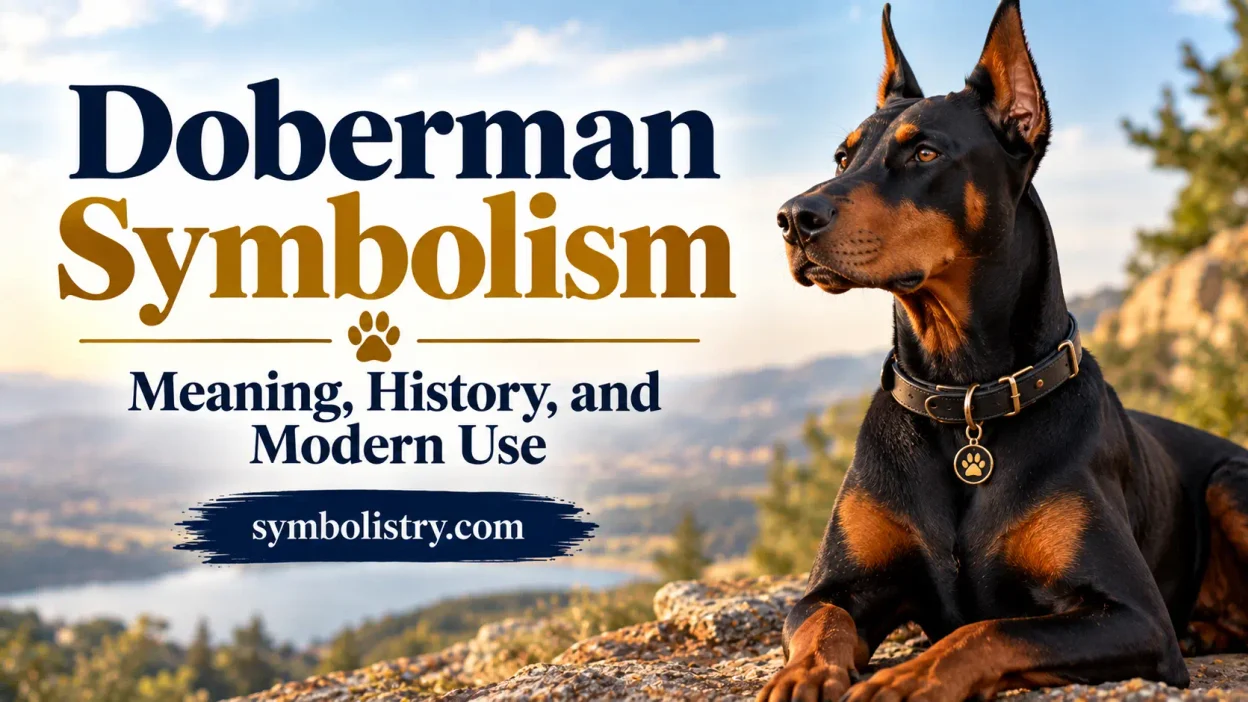
Dobermans are often recognized before people even notice the details of their appearance. Their narrow head, athletic build, alert posture, and distinctive markings create an image that many people associate with confidence and protection. In the United States, doberman symbolism is therefore closely connected with loyalty, vigilance, discipline, courage, and personal strength.
But the meaning of a Doberman goes beyond its intimidating appearance. The breed was deliberately developed in Germany in the late nineteenth century as a working dog capable of protecting and accompanying its owner. That original purpose helps explain why the breed became associated with watchfulness and dependable companionship rather than aggression alone.
Today, a Doberman can represent very different things depending on context. A tattoo may express personal protection or resilience, while a family may see the same breed as affectionate, intelligent, and devoted. Its cultural image has developed through working history, American popular culture, military service, dog sports, and everyday relationships between people and their dogs.
Quick Answer
Doberman symbolism commonly represents loyalty, protection, vigilance, confidence, and disciplined strength in modern American culture. Historically, those associations grew from the breed’s development as a personal protection and working dog in Germany, while its later police, military, and companion roles broadened its symbolism.
TL;DR
- Dobermans commonly symbolize loyalty, protection, alertness, and confidence.
- The breed originated in nineteenth-century Germany as a protector-companion.
- American culture often connects Dobermans with disciplined strength and guardianship.
- Their military and police history reinforced their image as working dogs.
- Modern owners also associate them with affection, intelligence, and family loyalty.
- Tattoos and artwork often use Dobermans to represent resilience and personal boundaries.
What a Doberman Represents at a Glance
The Doberman carries several related meanings rather than one fixed symbolic message. Its symbolism usually comes from the breed’s physical appearance, original working purpose, historical reputation, and the relationship people develop with individual dogs.
| Context | Meaning in the USA | Common Associations | Notes |
|---|---|---|---|
| Family life | Loyalty and companionship | Trust, devotion, protection | The intimidating appearance can contrast with close family bonds |
| Protection | Vigilance and security | Guarding, awareness, boundaries | Closely connected to the breed’s original purpose |
| Tattoos | Strength and resilience | Courage, independence, survival | Often represents a personal relationship with the breed |
| Military history | Service and duty | Discipline, bravery, sacrifice | Dobermans served as war dogs during World War II |
| Fashion and design | Confidence and authority | Control, elegance, boldness | Often emphasizes the breed’s distinctive silhouette |
The important point is that these meanings are connected. Protection suggests vigilance; vigilance suggests responsibility; and responsibility can develop into loyalty and trust.
Why Dobermans Symbolize Protection
Protection is probably the most straightforward meaning attached to the Doberman.
The breed was developed by Friedrich Louis Dobermann in Apolda, Germany, during the late nineteenth century. Dobermann worked as a tax collector and also had other occupations involving dogs. He wanted a dog capable of accompanying him and providing protection during potentially difficult encounters.
The exact breeds used to develop the Doberman are not completely documented. Historical accounts and later breed research associate its ancestry with several German and English working breeds, including dogs related to the German Pinscher, Rottweiler, Manchester Terrier, Greyhound, and Weimaraner.
That uncertain ancestry actually makes the central purpose more important than a precise recipe. The dog was shaped for practical work: alertness, responsiveness, physical ability, and a willingness to protect.
This history explains why the Doberman became a natural symbol of a guardian.
When people use a Doberman image to represent protection, they are often expressing the idea of someone or something standing between what is valuable and what might threaten it.
The Meaning of Loyalty and Devotion
Protection alone does not explain the Doberman’s symbolism. The breed is also strongly associated with attachment to its human companions.
A guard dog that simply reacts to danger would not fulfill the broader role for which the Doberman was developed. The ideal working dog also needed to remain attentive to its handler and responsive to direction.
That combination creates an important symbolic contrast: strength under control.
In American culture, this can translate into loyalty rather than simple toughness. A Doberman depicted beside a person, family, or home may communicate devotion and guardianship at the same time.
This is one reason Dobermans can carry a softer meaning for their owners than their public image suggests. Someone who lives with a Doberman may associate the breed less with danger and more with a companion who follows them through everyday life.
The symbolism therefore depends heavily on relationship. To a stranger, the dog may represent caution. To its owner, it may represent trust.
How the Breed’s Appearance Shapes Its Symbolism
Visual symbolism matters considerably with Dobermans.
The breed has a short coat, athletic body, long limbs, and a clean, streamlined outline. Its posture often appears alert even when the individual dog is relaxed. Traditional black-and-rust coloring is particularly recognizable in the United States, although Dobermans also occur in other accepted colors.
These physical characteristics contribute to several common associations:
- Athleticism suggests physical capability.
- Alert posture suggests awareness.
- Angular features suggest seriousness and precision.
- Muscular structure suggests strength.
- Clean silhouette suggests discipline and control.
- Direct expression can suggest confidence or vigilance.
This is why the Doberman works so effectively as a visual symbol in logos, tattoos, artwork, and graphic design. Its outline is distinctive enough to communicate an idea without requiring much additional imagery.
A Doberman silhouette can imply protection even when the dog is not shown barking, attacking, or behaving aggressively.
From German Working Dog to American Symbol
The Doberman’s meaning changed as the breed moved beyond its original German setting.
The breed became established internationally during the late nineteenth and early twentieth centuries. In the United States, the American Kennel Club recognized the Doberman Pinscher in 1908. American breeders subsequently played a significant role in shaping and promoting the breed.
Its working reputation was particularly important. Dobermans became associated with police work, military service, obedience, tracking, and other demanding activities.
The breed’s World War II history also became part of American cultural memory. Twenty-five U.S. Marine Corps war dogs, including Dobermans, died during the campaign to liberate Guam in 1944. The Doberman therefore acquired an association with military service, duty, and sacrifice in addition to its earlier image as a personal guardian.
This history helped expand the symbolism from protecting one person to serving a larger group or mission.
Doberman Symbolism in American Culture
In the United States, the Doberman has developed an unusually broad cultural image.
Part of this comes from the contrast between appearance and personality. Popular portrayals frequently emphasize the breed’s intimidating appearance, while people who know individual Dobermans often describe them in terms of affection, intelligence, playfulness, and attachment.
That contrast has become part of the breed’s cultural identity.
A Doberman can represent:
- a strong exterior with a devoted interior
- personal boundaries
- confidence without unnecessary aggression
- responsibility for protecting others
- discipline and self-control
- loyalty to family
- physical and emotional resilience
The American interpretation is therefore not limited to the idea of a guard dog.
For many owners, the symbolic message is closer to “I protect what matters to me.”
Courage Without Recklessness
Courage is another common association, but it is useful to distinguish courage from aggression.
A dog bred for protection must be able to respond to unfamiliar situations without simply reacting uncontrollably. In symbolic terms, that makes the Doberman an interesting representation of controlled courage.
A Doberman tattoo, illustration, or emblem may therefore represent someone who wants to communicate that they can face difficult circumstances while remaining composed.
This interpretation is especially common when the dog is shown standing calmly rather than attacking.
The visual difference matters. An aggressive pose can emphasize confrontation, while a calm, upright Doberman can communicate readiness, confidence, and self-possession.
That distinction helps explain why the breed appears in symbolism associated with personal resilience.
Intelligence, Discipline, and Self-Control
Dobermans are also commonly associated with intelligence and trainability.
Historically, their working roles demanded more than physical strength. A useful protection or service dog needed to recognize situations, respond to human direction, learn commands, and work consistently.
Consequently, the breed can symbolize disciplined intelligence rather than brute force.
This makes the Doberman especially suitable as a symbolic image for people who value:
- strategic thinking
- self-discipline
- responsibility
- awareness
- controlled reactions
- competence under pressure
In artwork, these ideas may be communicated by depicting the dog in a composed posture with its head raised and attention focused forward.
The message becomes less “I am dangerous” and more “I am prepared.”
Doberman Symbolism and Personal Boundaries
One of the more modern interpretations of the breed involves boundaries.
A guardian dog naturally evokes the idea of deciding what can enter a protected space and what cannot. In contemporary American culture, that can translate into psychological and interpersonal boundaries.
Someone may choose a Doberman tattoo because the breed reminds them to protect their time, family, independence, or personal identity.
This interpretation does not necessarily mean hostility toward other people. Instead, the Doberman can symbolize the right to establish limits.
The symbolism is particularly relevant in artwork that combines the dog with a home, fence, shield, initials, or another personal emblem.
In that setting, the dog becomes a visual guardian of something specific.
Emotional and Psychological Meaning
The emotional symbolism of a Doberman often depends on what the viewer has experienced with the breed.
For someone who grew up with Dobermans, the animal may represent childhood, family, safety, or a particular companion. For someone who has only encountered the breed through movies or photographs, it may initially represent authority or intimidation.
This difference illustrates an important principle in animal symbolism: personal experience can outweigh general cultural associations.
A Doberman can simultaneously communicate two seemingly opposite ideas:
Strength and tenderness.
The breed’s physical appearance suggests capability, while a close relationship with an individual dog can create associations with affection, routine, comfort, and companionship.
That combination is one reason Dobermans can carry strong emotional meaning in memorial artwork.
Dobermans in Military and Service Symbolism
The Doberman’s history as a working and military dog adds another layer to its symbolism.
During World War II, Dobermans served with the U.S. Marine Corps as sentries, messengers, scouts, and other working roles. Their service became associated with military duty and the risks faced by working animals alongside human personnel.
This history gives the breed a meaning that extends beyond individual protection.
In a military or memorial context, a Doberman can represent:
- duty
- service
- vigilance
- companionship under difficult conditions
- sacrifice
- responsibility
The symbolism is particularly significant when the dog is depicted alongside military insignia, memorial dates, or references to a particular service member.
In such cases, the meaning comes from documented history and personal remembrance rather than from the breed’s appearance alone.
Doberman Tattoos and Personal Identity
Doberman tattoos are often less about the breed as a generic symbol and more about the owner’s personal story.
A person may choose a Doberman tattoo after losing a beloved dog, growing up with the breed, or identifying with qualities such as loyalty and independence.
Different tattoo designs can change the emphasis.
A realistic portrait often focuses on companionship and remembrance. A side-profile silhouette can emphasize elegance and strength. A Doberman with a collar or nameplate may represent a specific pet. A protective pose can emphasize guardianship.
Color can also alter the message. Traditional black-and-rust coloring may emphasize the recognizable breed identity, while monochrome designs often create a more memorial or artistic effect.
The most accurate interpretation is therefore often found in the owner’s story rather than in a universal tattoo dictionary.
Doberman Symbolism in Fashion, Decor, and Design
The Doberman’s distinctive shape makes it useful in visual design.
Its silhouette can be recognized quickly, which allows designers to use the breed as a shorthand for qualities such as confidence, security, speed, and authority.
In home decor, a Doberman image may appear in paintings, sculptures, pillows, posters, or personalized artwork. In these settings, the image can reflect affection for the breed as much as symbolic meaning.
Fashion and graphic design sometimes emphasize the breed’s sleek appearance. A simplified Doberman profile can communicate a sharper, more modern aesthetic than a photograph of a softer-looking companion breed.
The symbolism is therefore partly aesthetic: the Doberman’s body itself has become a recognizable visual language.
Cross-Cultural Perspectives on the Doberman
Unlike animals that have ancient religious symbolism in multiple civilizations, the Doberman is a comparatively modern breed.
Its symbolic history is primarily connected with modern working-dog culture rather than ancient mythology or religious tradition.
The breed originated in Germany, and its international development later gave it different associations in Europe, North America, and elsewhere. The name itself also varies. In Germany and much of the world, the breed is generally called the Dobermann, while “Doberman Pinscher” remains the standard American name.
Because the breed is relatively recent, it would be misleading to assign it ancient symbolic meanings that belong to unrelated dogs or older canine traditions.
Its symbolism is better understood through its documented working history, appearance, and modern human relationships with the breed.
Common Misunderstandings About Doberman Symbolism
The most common misunderstanding is treating the Doberman as a universal symbol of aggression.
The breed’s history certainly includes protection work, but protection does not automatically mean uncontrolled hostility. The original purpose involved creating a capable working companion that could respond to threats and remain connected to its handler.
Another misconception is that every Doberman symbolizes danger.
In contemporary American households, many Dobermans are companion animals. Their owners may primarily associate them with affection, exercise, family routines, and companionship.
It is also important not to confuse popular-media imagery with historical fact. Films, television, advertising, and other entertainment have sometimes used Dobermans as visual shorthand for intimidating security or threatening characters. Such portrayals can reinforce stereotypes that do not describe every individual dog.
Symbolism reflects cultural storytelling, not a guarantee of animal behavior.
How Doberman Meaning Has Evolved
The breed’s symbolic development can be understood as a series of expanding associations.
It began with a practical purpose: a personal protector and working companion in nineteenth-century Germany. Police and military use then reinforced the ideas of vigilance, service, and courage.
As the breed became established in the United States, its role expanded further. It became a show dog, family companion, working animal, athletic competitor, and recognizable cultural image.
That evolution changed the symbolic emphasis.
The early image centered on protection.
The working era added service and discipline.
American popular culture added authority and intimidation.
Modern pet ownership increasingly adds companionship, affection, and family loyalty.
The result is a symbol with several layers rather than a single definition.
What a Doberman Can Symbolize in Different Situations
Context is the best way to interpret a Doberman image.
A Doberman standing beside a child or family may communicate protection and devotion. A military-themed Doberman may represent service or remembrance. A tattoo showing only the dog’s face may be primarily about a beloved pet.
A snarling Doberman in a commercial or fictional setting may be intended to communicate threat or authority, while a sleeping Doberman in home decor can suggest comfort and companionship.
The animal itself has not changed meaning completely from one situation to another. Instead, the surrounding context tells the viewer which part of the breed’s symbolic history matters.
This is why a single universal definition cannot explain every Doberman image.
Frequently Asked Questions
What does a Doberman symbolize spiritually?
There is no single established religious symbolism for the Doberman comparable to animals with long-standing roles in religious traditions. In modern personal symbolism, people may use the breed to represent protection, loyalty, vigilance, courage, or devotion.
What does a Doberman tattoo mean?
A Doberman tattoo can represent loyalty, protection, resilience, independence, or a personal connection with the breed. When it commemorates a deceased pet, the tattoo may primarily symbolize remembrance and companionship rather than toughness.
Is a Doberman a symbol of strength?
Yes, strength is one of its common modern associations, especially in American visual culture. The breed’s muscular build, athletic ability, and history as a working protector all contribute to that interpretation.
Why are Dobermans associated with protection?
The association comes largely from the breed’s original purpose. Louis Dobermann developed the dog in nineteenth-century Germany as a protective working companion, and later police and military roles reinforced the guardian image.
Do Dobermans symbolize aggression?
They can be used in popular culture to symbolize aggression or threat, but that is only one interpretation. The breed’s historical and modern associations also include loyalty, intelligence, companionship, discipline, and controlled protection.
What does a black Doberman symbolize?
A black Doberman often emphasizes the breed’s traditional visual identity while adding associations such as authority, seriousness, confidence, or protection. The meaning depends heavily on the surrounding artwork and the reason the image was chosen.
What does a Doberman symbolize in a dream?
Dream symbolism is personal rather than universal. A Doberman might represent protection, boundaries, vigilance, loyalty, or fear depending on the dreamer’s experiences with dogs and what the animal was doing in the dream.
Conclusion
The meaning of a Doberman comes from a combination of history, appearance, working purpose, and human relationships. In the United States, the breed most commonly represents protection, loyalty, vigilance, confidence, discipline, and controlled strength, while personal experiences can add meanings such as family, remembrance, and companionship.
Understanding doberman symbolism also means looking beyond the stereotype of an intimidating guard dog. The breed was created to work closely with people, and its later roles in police work, military service, competition, and family life expanded its cultural identity.
That combination explains why the Doberman remains such a flexible symbol: it can represent the instinct to protect while also expressing the bond between a person and a trusted companion.