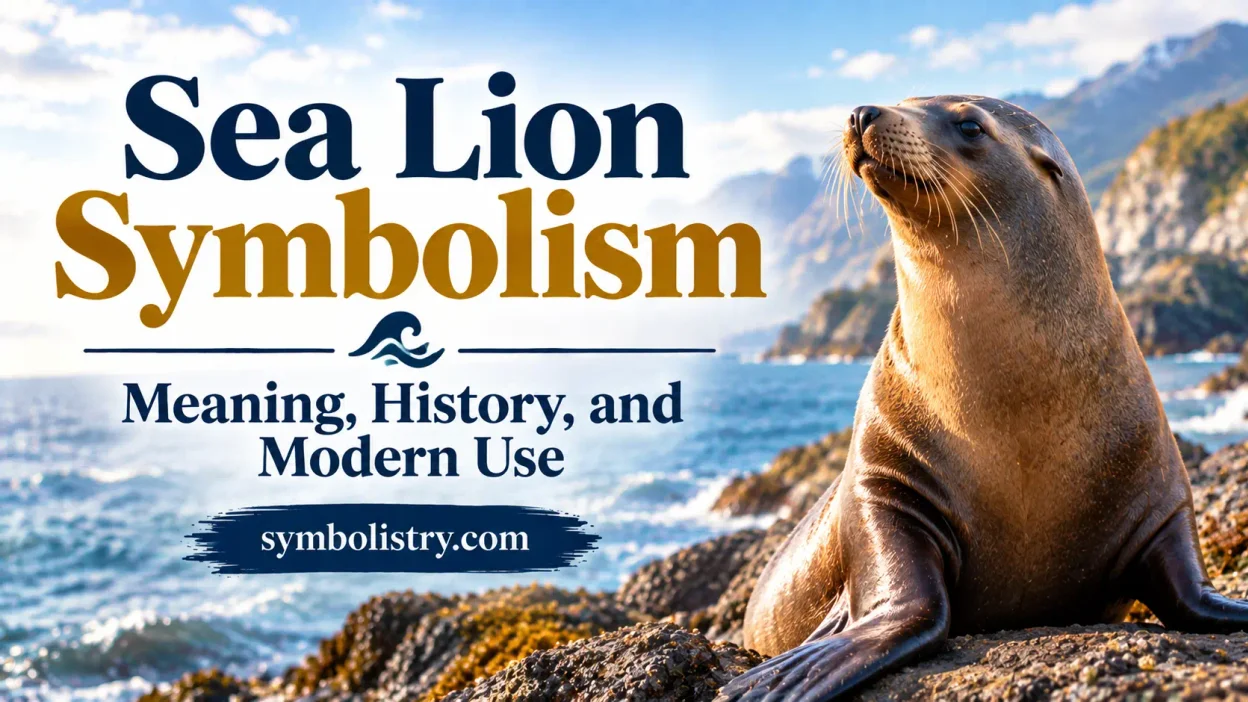
Sea lions are among the most recognizable marine mammals on the Pacific coast of the United States. Their barking calls, social behavior, large flippers, and ability to move between water and land give them an unusual presence: they belong to the ocean, yet they are equally visible resting on rocks, beaches, docks, and jetties.
That combination helps explain why sea lion symbolism has developed around ideas such as adaptability, community, communication, survival, and a close relationship with the sea. In Indigenous coastal traditions, however, the animal can carry much more specific cultural meanings tied to subsistence, stories, family relationships, place, and ceremonial life.
Modern Americans often encounter sea lions through wildlife photography, aquariums, coastal tourism, conservation work, tattoos, artwork, and social media. Understanding the symbol therefore requires separating contemporary personal interpretations from the distinct cultural traditions that gave sea lions meaning long before they became familiar icons of the American West Coast.
Quick Answer
Sea lion symbolism commonly represents adaptability, playfulness, communication, social connection, and resilience in modern American culture. In Indigenous coastal traditions, sea lions have also been connected with subsistence, material survival, ancestry, storytelling, and relationships between people and the marine environment.
TL;DR
- Sea lions commonly symbolize adaptability and social connection.
- Their land-and-water lifestyle supports ideas of flexibility.
- Indigenous traditions connect sea lions with food, tools, clothing, and livelihood.
- Playful behavior contributes to modern associations with joy and curiosity.
- Coastal Americans often associate them with Pacific identity.
- Modern artwork frequently emphasizes conservation and ocean connection.
What a Sea Lion Represents as a Symbol
The most common modern interpretation begins with the animal’s behavior rather than an ancient symbolic dictionary.
Sea lions are highly social, vocal, mobile, and comfortable in two very different environments. California sea lions, for example, can be seen swimming offshore and then hauling out on beaches, rocks, docks, buoys, and jetties. They are also notably vocal and form large groups.
Those characteristics naturally encourage several symbolic associations:
- Adaptability — moving effectively between sea and land.
- Communication — loud calls and close social interaction.
- Community — living and resting in large groups.
- Playfulness — active behavior and curiosity.
- Resilience — surviving environmental and human pressures.
- Connection to nature — an unmistakable relationship with coastal ecosystems.
These meanings are modern interpretations, not universal rules. A person choosing a sea lion image may associate it with a particular beach, childhood memory, family experience, profession, or personal relationship with the ocean.
Why the Land-and-Water Lifestyle Matters
One of the clearest reasons sea lions lend themselves to symbolism is their unusual position between two environments.
Sea lions are pinnipeds, a group of marine mammals whose lives remain tied to land even though they spend substantial amounts of time in the water. Their evolutionary history reflects this amphibious existence rather than a complete transition to permanent life at sea.
Symbolically, that makes the sea lion a useful image for living between worlds.
This does not necessarily have to mean something supernatural. In everyday language, it can describe someone adapting to different communities, careers, environments, or stages of life.
A sea lion image may therefore appeal to someone who has moved between places or identities without abandoning either one. The animal becomes a visual shorthand for flexibility without complete separation from one’s roots.
Ancient and Indigenous Coastal Connections
The history of sea lion symbolism in North America cannot be reduced to one “Native American meaning.” Indigenous peoples have distinct languages, histories, ceremonies, and traditions, and interpretations differ between communities.
In Alaska and along the Pacific Northwest, sea lions were not merely decorative animals. They were important sources of food and raw materials. Archaeological evidence documents their use for meat, oil, bone, sinew, intestines, skins, and other materials.
For Alutiiq communities, for example, sea lion skin could be used for boats, while other parts supplied clothing, containers, tools, and other necessities. Sea lion whiskers were also incorporated into hunting equipment.
This practical relationship matters symbolically. An animal that contributes directly to transportation, food, clothing, tools, and burial practices occupies a different cultural position from an animal encountered only as wildlife.
In these contexts, meanings connected with survival, provision, skill, responsibility, and reciprocity can be more historically grounded than generic modern claims about “spiritual energy.”
Sea Lions in Alaska Native Traditions
Alaska provides some of the clearest examples of the cultural importance of sea lions.
Alutiiq and Aleut peoples traditionally hunted sea lions, and the animals supplied materials for many parts of daily life. The National Park Service notes that Alutiiq and Aleut hunters have harvested Steller sea lions for hundreds of years.
Traditional oral traditions also contain sea lion narratives. Historical collections of Aleut stories include accounts involving hunting, transformation, and relationships between humans and sea lions. An Alaska Department of Fish and Game review also documents the animal’s prominent place in Aleut oral traditions and Northwest Coast storytelling.
The important point is that these traditions do not reduce the sea lion to one personality trait.
The animal can be food, resource, character, relative, clan-related figure, or participant in a story. Its meaning depends on the community and the particular tradition.
That is why broad statements such as “all Native Americans believe sea lions symbolize X” should be treated cautiously.
Sea Lion Symbolism Along the Pacific Coast
The Pacific coast provides another important layer of meaning because sea lions are physically embedded in coastal landscapes.
California’s Channel Islands have longstanding Indigenous connections, including those of the Chumash. Sea lions and seals remain visible parts of the islands’ ecology, and Indigenous place names preserve knowledge of locations where these animals congregated. One Chumash place name recorded by the National Park Service literally refers to a “house of seals and cormorant.”
The broader archaeological and cultural record shows that California Indigenous communities developed sophisticated maritime cultures based on the resources of the coast and surrounding islands. The Chumash, for example, relied extensively on marine resources and maintained complex relationships with the Channel Islands.
For modern readers, this creates an important distinction: sea lion imagery may represent California coastal identity, but its deeper cultural history belongs to particular Indigenous communities rather than to a generalized “California symbolism.”
What Sea Lions Mean in the United States Today
In contemporary American culture, sea lions are usually understood through a mixture of wildlife observation and coastal identity.
For people living along the West Coast, a sea lion may immediately evoke a pier, harbor, rocky shoreline, marine sanctuary, or Pacific beach. California sea lions are particularly familiar because they gather around human infrastructure as well as natural haul-out sites.
This has produced several modern associations:
| Context | Meaning in the USA | Common Association | Notes |
|---|---|---|---|
| Coastal wildlife | Connection to nature | Pacific coast | Often linked to West Coast identity |
| Family imagery | Community and attachment | Social groups | Reflects the animal’s gregarious behavior |
| Tattoos | Adaptability and ocean identity | Personal experience | Meaning varies by design |
| Conservation art | Environmental responsibility | Healthy oceans | Emphasizes habitat and wildlife |
| Children’s media | Playfulness and curiosity | Friendly wildlife | Usually simplified for accessibility |
The sea lion can therefore function as both a regional symbol and a personal one.
Someone from California may see it primarily as a familiar coastal animal. Someone from Alaska may associate it with subsistence traditions or local ecosystems. Someone who has never lived near the Pacific may simply read it as a playful marine mammal.
Playfulness, Curiosity, and Social Connection
The sea lion’s personality in popular culture is strongly shaped by its observable behavior.
California sea lions are described by NOAA Fisheries as playful, intelligent, and highly vocal. They live socially and communicate through barking and other vocalizations.
That behavior has encouraged modern associations with:
- friendship
- humor
- curiosity
- sociability
- enthusiasm
- affection
- enjoyment of life
This is one reason sea lion imagery can feel lighter than symbols traditionally associated with predators.
A shark may immediately suggest danger. An eagle may suggest freedom or authority. A bear can suggest strength. A sea lion often allows several qualities to coexist: physical ability without aggression, confidence without isolation, and sociability without losing independence.
Strength Without Aggression
The name “sea lion” itself contributes another layer.
Male sea lions can be large and physically imposing, and some species have a mane-like appearance around the head and neck. Their loud calls also help explain the “lion” comparison.
Yet modern images of sea lions rarely emphasize dominance in the same way lion symbolism often does.
Instead, the animal can represent a softer form of strength: being capable without constantly displaying aggression.
That makes sea lion imagery suitable for people who want a symbol of confidence, endurance, or physical strength without a militaristic or confrontational message.
The distinction is particularly useful in personal symbolism. A tattoo or illustration can communicate strength while still retaining associations with family, play, water, and companionship.
Emotional and Psychological Associations
From a psychological perspective, sea lion symbolism works largely through recognizable behavioral qualities.
The animal’s ability to move through water and then return to land can evoke emotional flexibility. Its social behavior can suggest the importance of belonging. Its vocal communication can represent the need to be heard.
A person might therefore choose a sea lion image during a period of transition because it reflects the idea of adjusting to a new environment.
Another person might associate it with emotional openness: remaining connected to others while retaining the ability to move independently.
These interpretations are personal rather than scientific claims about personality. There is no universal psychological rule that says seeing or wearing a sea lion produces a particular emotional state.
The meaning comes from the relationship between the image and the person using it.
Sea Lion Symbolism in Tattoos
Sea lion tattoos are relatively specialized compared with more common animal designs, which can make them especially personal.
A person might choose one because of:
- a connection to the Pacific Ocean
- a coastal hometown
- marine biology or conservation work
- an important memory involving sea lions
- admiration for marine wildlife
- an interest in adaptability
- family experiences near the coast
Design details can change the interpretation considerably.
A sea lion surrounded by waves may emphasize ocean identity. A mother and pup can highlight family attachment. A realistic California sea lion may function primarily as a tribute to a particular place or species. An abstract design may focus more on movement and freedom.
The animal does not come with one fixed tattoo definition.
Sea Lions in Art, Decor, and Fashion
Sea lion imagery works especially well in coastal design because the animal immediately identifies a marine setting.
In American homes, artwork featuring sea lions can suggest a connection to beaches, boating, wildlife, or a particular coastal region. Tourist art may emphasize the recognizable California or Pacific Northwest character of the animal.
In children’s design, the sea lion is often presented as friendly and humorous. In wildlife photography, it becomes an emblem of the marine ecosystem rather than a fantasy creature.
This flexibility allows the same animal to function in very different settings.
A realistic photograph can communicate conservation. A cartoon can communicate playfulness. A carved or painted Indigenous work may carry cultural meanings that cannot be separated from its community and artistic tradition.
Conservation and the Modern Meaning of the Sea Lion
Environmental awareness has added another contemporary layer.
California sea lions were historically hunted for products such as fur and blubber. Their populations later recovered substantially after legal protections and changing human practices, although the animals still face threats including disease, harmful algal blooms, entanglement, and human-caused injuries.
As a result, sea lion imagery today can represent ocean stewardship and wildlife conservation.
That meaning is particularly visible in aquariums, national parks, marine education, rescue organizations, photography, and environmental campaigns.
The symbol has consequently shifted from being associated primarily with resource use in many historical coastal communities to also representing the protection of marine ecosystems in contemporary public culture.
Both meanings can exist without contradiction. Conservation is partly possible to understand because people recognize the animal’s ecological and cultural importance.
Common Misunderstandings About Sea Lion Symbolism
One common mistake is treating “sea lion symbolism” as if it were an ancient universal code.
It is not.
Different cultures have used sea lions in different ways, and many traditions are connected to specific places and communities. Alaska Native traditions, Northwest Coast traditions, and California Indigenous traditions should not be collapsed into one generalized mythology.
Another misunderstanding is confusing sea lions with seals.
The two are related marine mammals, but they are not identical. Sea lions have external ear flaps and can rotate their hind flippers underneath themselves to move more effectively on land. California sea lions are also notably vocal.
Finally, modern internet lists sometimes assign highly specific meanings to animal symbols without explaining where those meanings came from. Such lists may be useful for inspiration, but they should not be mistaken for evidence of a universal historical tradition.
How the Symbol Has Changed Over Time
The meaning of the sea lion has evolved because human relationships with the animal have changed.
For many Indigenous coastal communities, the animal was deeply integrated into everyday life through food, clothing, transportation, tools, trade, and ceremony. In other contexts, it appeared in stories, clan identities, artistic traditions, or local histories.
European and later American societies increasingly encountered sea lions through commercial hunting, coastal development, scientific study, tourism, zoos, aquariums, and wildlife photography.
Today, a person is more likely to encounter a sea lion on a dock or in a wildlife photograph than through hunting.
That change in relationship has influenced symbolism. Contemporary associations often emphasize playfulness, environmental awareness, coastal identity, and personal freedom, while historical meanings can be rooted in subsistence, place, ancestry, and cultural practice.
The modern symbol is therefore layered rather than fixed.
Why Sea Lions Remain Strong Coastal Symbols
Sea lions have an unusual advantage as symbols: people can actually see them behaving in ways that support the meanings attached to them.
They gather together. They vocalize. They move through water and across land. They rest in large groups. They occupy recognizable coastal spaces.
The symbolism does not need to be invented from nothing.
For Americans living near the Pacific, seeing a sea lion can be an ordinary part of coastal life. That familiarity makes the animal especially effective in regional identity, tourism, conservation, and personal artwork.
At the same time, its long cultural history reminds us that the animal means more than a cheerful beach mascot.
Its relationship with people reaches into Indigenous economies, languages, stories, technologies, and landscapes.
FAQ
What does a sea lion symbolize spiritually?
There is no single spiritual meaning shared by all cultures. In modern personal symbolism, sea lions may represent adaptability, communication, community, and connection with the ocean, while particular Indigenous traditions have their own distinct meanings and stories.
What does a sea lion tattoo symbolize?
A sea lion tattoo can represent a connection to the ocean, coastal identity, adaptability, family, or appreciation for marine wildlife. The surrounding design often determines whether the emphasis is on adventure, family, conservation, or personal history.
Are sea lions symbols of strength?
They can be. Their size, physical ability, vocal presence, and ability to survive in demanding marine environments support associations with strength, but modern American imagery often combines that strength with playfulness and sociability.
What do sea lions symbolize in Native American cultures?
There is no single Native American interpretation. Among Alaska Native and Northwest Coast peoples, sea lions have appeared in traditions involving subsistence, materials, stories, social identity, and cultural practices, with meanings differing between communities.
Are sea lions a symbol of California?
They can function as a strong regional symbol because California sea lions are widespread along the state’s coast and have major breeding colonies in the Channel Islands. Their visibility around California harbors and beaches has made them familiar representatives of Pacific coastal wildlife.
What is the difference between sea lion and seal symbolism?
Their symbolic meanings often overlap because both are marine mammals, but the animals are biologically different. Sea lions have external ear flaps and greater mobility on land, which can encourage symbolic associations with communication, movement, and adaptability.
Does a sea lion always have a positive meaning?
No. Symbolic meaning depends on context. A sea lion can represent survival and provision in one tradition, playful wildlife in another, or environmental vulnerability when used in conservation imagery.
Conclusion
Sea lion symbolism is best understood as a collection of meanings built from the animal’s behavior, coastal environment, cultural history, and modern human relationships with marine life. Adaptability, communication, community, playfulness, and resilience are common contemporary associations, while Indigenous traditions provide much older and more specific connections to subsistence, place, storytelling, and cultural practice.
For Americans today, the sea lion can be both a familiar Pacific Coast animal and a personal symbol. Its ability to move between sea and land makes it a natural image for flexibility, while its social behavior supports associations with family and community. Its history with coastal peoples adds another dimension: the animal has not simply been observed by humans but has been part of human lives and cultures.
Ultimately, sea lion symbolism is most meaningful when its interpretation is connected to the setting in which the image appears—and to the particular relationship a person or community has with the animal.