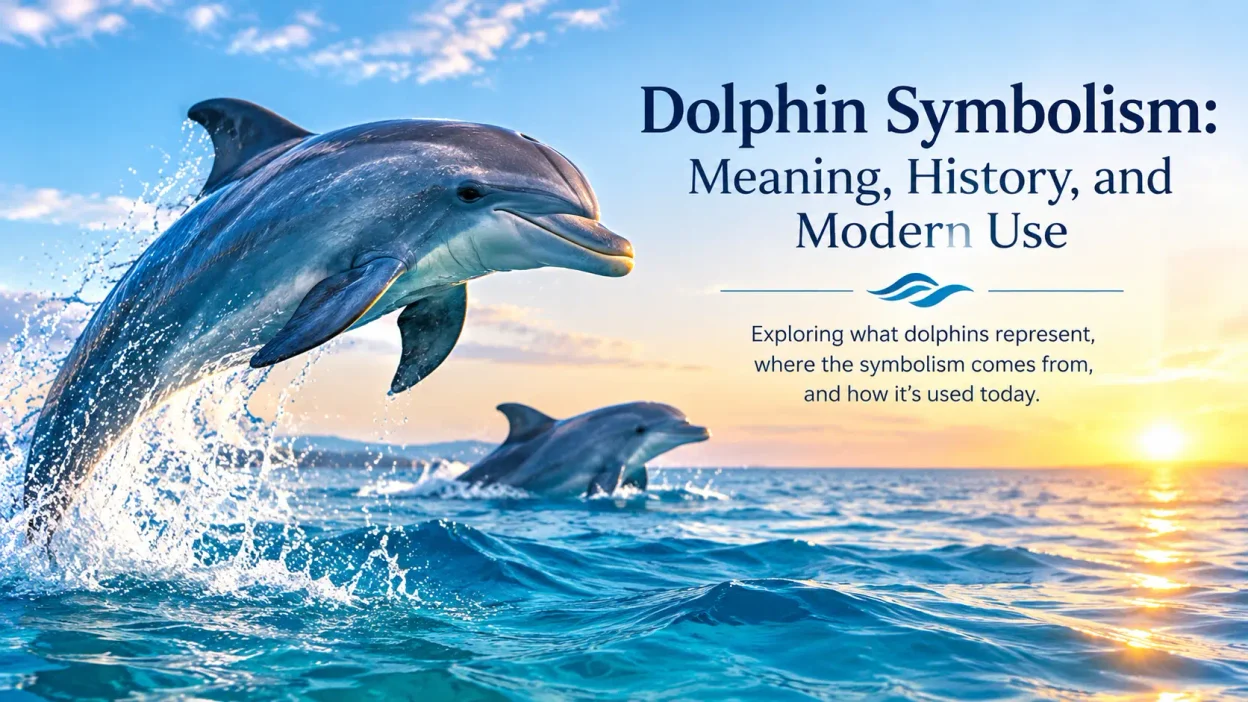
Dolphins are among the most recognizable animals in ocean imagery, appearing on jewelry, tattoos, children’s products, coastal décor, conservation campaigns, and popular media. Dolphin symbolism is especially associated in the United States with intelligence, playfulness, friendship, freedom, and connection with the sea.
Those associations are not based on one ancient tradition or a single religious meaning. They have developed from the animal’s observable behavior, centuries of mythology and art, maritime stories, and modern American culture. A dolphin can suggest joy and sociability in one setting, while in another it can represent protection, guidance, communication, or concern for the marine environment.
Understanding the symbol means looking at both the animal itself and the stories people have attached to it. Dolphins are highly social mammals that communicate through varied sounds and use echolocation to navigate and hunt. Their visible behavior—especially leaping, swimming in groups, and interacting with their surroundings—has helped shape the positive image they carry today.
Quick Answer
Dolphin symbolism commonly represents intelligence, joy, friendship, freedom, and social connection in modern American culture, especially in coastal imagery, tattoos, jewelry, and conservation themes. Historically, dolphins were also associated with protection at sea, divine favor, safe passage, and rescuing or guiding humans.
TL;DR
- Dolphins commonly represent intelligence, friendship, playfulness, and freedom.
- Ancient Mediterranean cultures connected dolphins with gods, sailors, and safe passage.
- American culture often treats dolphins as friendly symbols of ocean life.
- Tattoos can express independence, emotional connection, travel, or love of nature.
- Conservation has added environmental responsibility to the dolphin’s modern image.
- Cultural meanings vary, so context matters when interpreting the symbol.
What the Dolphin Represents as a Symbol
The dolphin carries several closely related meanings, but they tend to center on positive human qualities.
Intelligence is one of the strongest associations. Dolphins display complex communication, social behavior, cooperative hunting, and sophisticated navigation. Because people recognize these traits, the animal is frequently used as a symbol of cleverness and mental agility.
Friendship and cooperation come from the dolphin’s social nature. Dolphins commonly live in groups and interact through touch, vocalizations, coordinated movement, and other forms of communication. Symbolically, this makes the dolphin a natural image for companionship and community.
Playfulness comes from the animal’s energetic movements and its tendency to leap, surf, and interact with other dolphins. This has helped establish an association with curiosity, enjoyment, and a less rigid approach to life.
The dolphin can also represent freedom. Its environment is open water, and images of dolphins moving through waves often evoke travel, independence, and escape from ordinary boundaries.
A fifth meaning is protection and guidance, which comes more strongly from historical mythology and maritime stories than from modern science. Ancient stories frequently placed dolphins close to sailors, gods, and people crossing the sea.
Ancient Mediterranean Roots and the Sea
Some of the oldest influential dolphin imagery comes from ancient Greece and the wider Mediterranean world.
Greek art frequently placed dolphins in scenes involving the sea, ships, gods, and human travelers. Poseidon, the Greek god associated with the sea, was sometimes shown with dolphins among his attributes. Dolphins therefore became part of a larger visual language surrounding maritime power and the unpredictable ocean.
Dolphins were also connected with Apollo in some ancient traditions. Their relationship with Apollo contributed to associations involving music, prophecy, travel, and divine assistance.
One of the most famous Greek stories concerns Arion, a poet and musician who was said to have been thrown into the sea by sailors who wanted his wealth. According to the legend, his music attracted dolphins, which carried him safely toward shore. The story became an enduring example of the dolphin as a rescuer.
Whether viewed as mythology rather than literal history, stories like this mattered because they gave the animal a recognizable narrative role: the creature of the sea that helps a vulnerable human traveler.
That idea would survive long after the original religious context faded.
Dolphins in Greek and Roman Art
The dolphin appeared frequently in ancient Mediterranean decorative art. It could be found on pottery, coins, jewelry, mosaics, architectural decoration, and other objects.
Its meaning was not always identical. Sometimes it simply identified a marine environment or contributed to a decorative scene. In other cases, its presence carried associations with gods, sailors, fertility, travel, or the sea.
Roman artists inherited many Greek visual traditions and adapted them to their own culture. Dolphins appeared alongside Neptune, the Roman counterpart of Poseidon, and in imagery connected with Venus because of her association with the sea.
This history is important because it shows why modern interpretations should not reduce the dolphin to one fixed definition. Ancient artists used the animal in several overlapping symbolic contexts.
Protection, Rescue, and Safe Passage
The dolphin’s connection with rescue is one of its most enduring symbolic themes.
The Arion story is particularly important because the dolphin does not merely live in the sea—it crosses the boundary between the human world and the ocean to save someone. That makes it an image of unexpected assistance.
Maritime cultures have also preserved stories of dolphins accompanying ships or interacting with sailors. Such stories helped strengthen the impression that dolphins were friendly creatures that could guide people through dangerous waters.
In symbolic terms, this can translate into meanings such as:
- safe passage
- guidance during uncertainty
- protection while traveling
- help arriving unexpectedly
- trust between humans and nature
This interpretation is especially appropriate when a dolphin appears alongside a ship, compass, anchor, wave, or other travel-related imagery.
What Dolphins Mean in the United States
In contemporary American culture, the dolphin has largely moved away from its ancient religious associations and become a broadly accessible symbol of ocean life.
Americans often encounter dolphins through aquariums, marine documentaries, coastal tourism, children’s entertainment, wildlife photography, beach businesses, conservation campaigns, and recreational experiences.
The result is a relatively familiar emotional profile: dolphins are usually seen as intelligent, friendly, energetic, and approachable.
Their image is particularly strong in coastal states and communities. Florida, California, Hawaii, and other coastal areas frequently use dolphin imagery in tourism, hospitality, souvenirs, public art, and commercial design.
The dolphin is also closely associated with the idea of a healthy ocean. In modern environmental culture, seeing a dolphin can encourage people to think about marine ecosystems, pollution, fishing practices, habitat protection, and responsible wildlife viewing.
This represents an important shift. Earlier traditions often asked what dolphins could do for humans. Modern conservation culture increasingly asks what humans should do for dolphins.
Dolphin Symbolism in American Culture at a Glance
| Context | Meaning in the USA | Common Associations | Notes |
|---|---|---|---|
| Coastal décor | Relaxation and ocean life | Beaches, vacations, summer | Often decorative rather than religious |
| Tattoos | Freedom and personal connection | Travel, nature, independence | Meaning depends heavily on personal story |
| Jewelry | Friendship and affection | Gifts, family, relationships | Often chosen for positive emotional associations |
| Conservation | Marine protection | Healthy oceans, wildlife | Emphasizes responsibility rather than fantasy |
| Children’s culture | Curiosity and friendliness | Learning, play, adventure | Frequently presented as approachable and intelligent |
| Travel imagery | Freedom and safe passage | Boats, waves, coastal exploration | Connects with older maritime traditions |
Emotional and Psychological Associations
Symbolic meanings often develop because an animal’s visible behavior triggers a human emotional response.
The dolphin’s apparent friendliness makes it easy to associate with trust and connection. Its social behavior reinforces the idea that relationships are important.
Its movement creates a different emotional response. A dolphin emerging from the water appears energetic and unconstrained, which makes it a natural image for freedom and spontaneity.
The dolphin can also represent curiosity. It lives in an environment humans cannot naturally inhabit, yet it moves through that environment with remarkable efficiency. Symbolically, that can suggest a willingness to explore unfamiliar territory.
For some people, the dolphin represents a balance between intelligence and enjoyment. It is not usually portrayed as a solitary, stern, or purely intellectual creature. Instead, popular imagery combines mental ability with social interaction and visible play.
That combination helps explain why the animal is particularly common in symbols intended to feel optimistic rather than formal.
Dolphins and Communication
Communication is another important modern association.
Dolphins use whistles, clicks, and other sounds, while echolocation allows them to interpret their surroundings through reflected sound. Their communication abilities have contributed to the perception of dolphins as socially sophisticated animals.
Symbolically, a dolphin can therefore represent:
- listening
- communication
- cooperation
- understanding
- social intelligence
- expressing oneself clearly
This interpretation can be especially relevant when a dolphin appears in educational, therapeutic, interpersonal, or community-oriented imagery.
The association should still be understood as symbolic rather than scientific proof of human-like emotional or linguistic abilities. Animal behavior can inspire symbolism without requiring people to treat dolphins as miniature versions of humans.
Dolphins in Tattoos and Personal Identity
Dolphin tattoos are common because the image can communicate several positive ideas without requiring a long explanation.
A person may choose a dolphin to represent freedom, particularly if the tattoo is connected with travel, the ocean, or a desire for independence. Someone else may associate the animal with childhood memories of a beach, family vacation, marine life, or a meaningful coastal location.
Two dolphins swimming together can suggest companionship, partnership, or family. A dolphin jumping over waves may emphasize freedom and movement. A dolphin combined with flowers, a sunset, a moon, or ocean waves can create a more personal interpretation.
For others, the tattoo may have a conservation meaning. In that case, the dolphin represents not simply enjoyment of the ocean but a commitment to protecting marine animals and their habitat.
The most accurate interpretation of a dolphin tattoo therefore comes from the surrounding imagery and the person’s own reason for choosing it.
Dolphin Jewelry, Décor, and Fashion
Dolphin imagery works particularly well in jewelry because its recognizable silhouette can be simplified without losing its identity.
Pendants, earrings, bracelets, charms, and rings may use dolphins to express affection for the ocean, a coastal lifestyle, friendship, or a memory connected with travel.
In home décor, dolphins often appear in beach-themed rooms, bathrooms, vacation properties, artwork, sculptures, and decorative objects. In these settings, the animal usually communicates an atmosphere rather than a complex philosophical idea.
A dolphin in a home may simply say coastal, relaxed, playful, and connected with the sea.
That distinction matters. Not every dolphin image has a hidden symbolic message. Sometimes the image is chosen because the owner likes dolphins or wants a visual reminder of the ocean.
Dolphins in Popular Culture and Digital Life
American popular culture has made the dolphin especially recognizable to younger audiences.
Children’s books, animated films, educational programs, marine documentaries, toys, games, advertisements, and internet imagery frequently portray dolphins as intelligent and friendly.
Digital culture has made the dolphin even easier to use as an emotional shorthand. A dolphin emoji, illustration, or graphic can evoke beaches, swimming, vacations, summer, marine animals, or playful moods without requiring a detailed explanation.
At the same time, popular culture can simplify the animal. The friendly, smiling dolphin has become such a familiar image that people sometimes overlook the fact that real dolphins are wild predators with complex social lives.
The symbolic version and the biological animal are related, but they are not identical.
Dolphins in Conservation and Public Life
One of the most significant modern developments is the dolphin’s association with conservation.
In the United States, federal marine-mammal protections and public conservation programs have made dolphins part of a broader conversation about responsible interaction with wildlife. The familiar dolphin image has also appeared in programs addressing dolphin-safe fishing practices.
This gives the symbol a more serious dimension.
A dolphin can now represent not only freedom and enjoyment but also environmental responsibility. The image may ask viewers to think about bycatch, pollution, habitat disruption, underwater noise, and the consequences of feeding or approaching wild dolphins.
That shift reflects a broader change in animal symbolism. Instead of treating wildlife only as decorative or inspirational, modern environmental culture increasingly treats animals as living parts of ecosystems that deserve protection.
Cross-Cultural Meanings of Dolphins
Dolphin traditions extend far beyond Greece and the United States.
In Māori traditions of Aotearoa New Zealand, dolphins have sometimes been connected with taniwha, supernatural beings associated with waterways. Some traditions describe dolphin-like figures as guides or protectors of people traveling by canoe.
One notable example is Tuhirangi, a guardian taniwha associated with guiding and protecting canoes. Later stories connected Tuhirangi with Pelorus Jack, a famous dolphin known for accompanying ships.
These traditions show a different relationship between humans and dolphins from the modern American decorative image. The animal is not merely a symbol of happiness or beach life; it can be understood within a cultural framework involving guardianship, waterways, ancestors, and navigation.
Other societies have developed their own marine-animal traditions, so it is important not to treat Greek mythology or contemporary American culture as universal interpretations.
Religious and Spiritual Associations
Dolphins do not have one universal religious meaning.
Their strongest documented historical associations come from Mediterranean mythology and maritime traditions rather than from a single major modern religion. In some later artistic contexts, dolphin imagery could also coexist with Christian visual traditions, but it should not automatically be treated as a specifically Christian symbol.
People may nevertheless give a dolphin personal spiritual meanings such as guidance, protection, renewal, or connection with the natural world.
Those interpretations are individual rather than universally established religious definitions.
The safest approach is to distinguish between documented religious symbolism and modern personal spirituality. A dolphin necklace may be spiritually meaningful to its owner without having one fixed spiritual meaning shared by everyone.
Common Misunderstandings About Dolphin Symbolism
One common mistake is assuming that dolphins always symbolize happiness.
They often do, but their symbolic range is broader. Historical imagery connects them with the sea, divine figures, travel, rescue, and protection, while modern conservation imagery can emphasize vulnerability and environmental responsibility.
Another misunderstanding is treating dolphins as universally gentle or harmless. Their friendly image in popular culture is largely a symbolic construction. Real dolphins are wild animals with complex social behavior and ecological roles.
It is also misleading to claim that every ancient culture believed dolphins rescued humans. Stories of rescue and guidance occur in particular traditions, but they should not be generalized into a universal ancient belief.
Finally, a dolphin symbol does not automatically mean spiritual awakening, good luck, or emotional healing. Those meanings may appear in modern spiritual or commercial interpretations, but they are not universal historical definitions.
How Dolphin Meaning Has Changed Over Time
The dolphin’s symbolic history can be understood as a gradual movement from mythic sea creature to familiar cultural icon.
In ancient Mediterranean cultures, dolphins were integrated into mythology, religion, art, and maritime imagination. Their proximity to the sea made them natural companions of sea gods and stories involving sailors.
Later artistic traditions preserved some of these associations while adapting them to new cultural settings.
Modern American culture has largely secularized the image. The dolphin now commonly represents ocean life, intelligence, friendship, freedom, recreation, and environmental awareness rather than a particular deity.
This evolution does not erase older meanings. Instead, layers accumulate. A modern dolphin design can simultaneously evoke ancient stories of sailors, contemporary beach culture, and concern for marine conservation.
Why the Dolphin Remains Such a Positive Symbol
Part of the dolphin’s staying power comes from the unusual combination of qualities attached to it.
It is associated with the ocean but is not usually portrayed as threatening. It is intelligent without being represented as cold or solitary. It is social without losing its association with freedom. It moves quickly but is also often shown playing.
Those combinations give the dolphin unusual flexibility.
A business can use it to suggest friendliness. A coastal community can use it to represent its relationship with the ocean. A person can choose it for a tattoo about independence or travel. A conservation organization can use it to communicate concern for marine life.
Few symbols work in exactly the same way across all of these settings.
Frequently Asked Questions
What does a dolphin symbolize spiritually?
A dolphin may symbolize guidance, protection, emotional connection, freedom, or harmony with nature in personal spiritual interpretations. These meanings vary by tradition and should not be treated as one universal religious definition.
What does a dolphin tattoo usually mean?
A dolphin tattoo often represents freedom, friendship, travel, love of the ocean, or a personal connection with marine life. The surrounding design and the person’s reason for choosing it can change the meaning considerably.
Are dolphins a symbol of good luck?
Dolphins have been associated with favorable encounters at sea and helpful guidance in some traditions, which can support a good-fortune interpretation. However, good luck is not their universal or primary symbolic meaning.
What do two dolphins symbolize?
Two dolphins may suggest companionship, partnership, friendship, family, or mutual support. Their social nature makes paired dolphins especially suitable for representing relationships.
What do dolphins symbolize in ancient Greece?
Ancient Greek traditions associated dolphins with the sea, maritime travel, gods such as Poseidon and Apollo, and stories of human rescue. Their appearance in art could have different meanings depending on the particular object or story.
Why are dolphins associated with freedom?
Dolphins live in the open marine environment and are commonly depicted leaping and moving freely through waves. Modern American imagery has turned those visual qualities into an association with independence, travel, and an unrestricted lifestyle.
Do dolphins have a religious meaning?
Dolphins have important roles in some mythological and cultural traditions, particularly around the ancient Mediterranean, but they do not have one universal religious meaning. Modern spiritual interpretations are often personal rather than shared across all traditions.
Conclusion
The dolphin combines several ideas that remain recognizable in American culture: intelligence, friendship, playfulness, freedom, communication, and connection with the ocean. Older traditions add another layer, portraying dolphins as companions of gods, rescuers of sailors, and guides across dangerous waters.
Today, dolphin symbolism has become broader and more secular. It appears in tattoos, jewelry, coastal décor, tourism, popular culture, and conservation messaging, where the same animal can represent personal freedom or environmental responsibility depending on the context.
The most useful way to understand the dolphin is not to force it into one definition. Its meaning comes from the setting, the imagery around it, and the reason a person or community chooses the animal in the first place.