Elephants have long appeared in religious art, royal imagery, folklore, literature, advertising, and popular culture. Elephant symbolism matters because the animal carries several recognizable associations at once: strength, wisdom, memory, family, leadership, protection, and good fortune. In the United States, those associations have also been shaped by zoos, wildlife conservation, children’s stories, decorative art, and the elephant’s distinctive place in American political history.
The meaning is not identical everywhere. In South Asian traditions, the elephant can have a sacred religious role, particularly through Ganesha, while African traditions include associations with leadership, authority, transformation, community, and ceremonial life. In China, the elephant developed additional associations through language, art, and ideas about the visible order of the cosmos.
Today, an elephant image can therefore communicate something very simple—such as affection for animals—or something much more specific, depending on where and how it is used.
Quick Answer
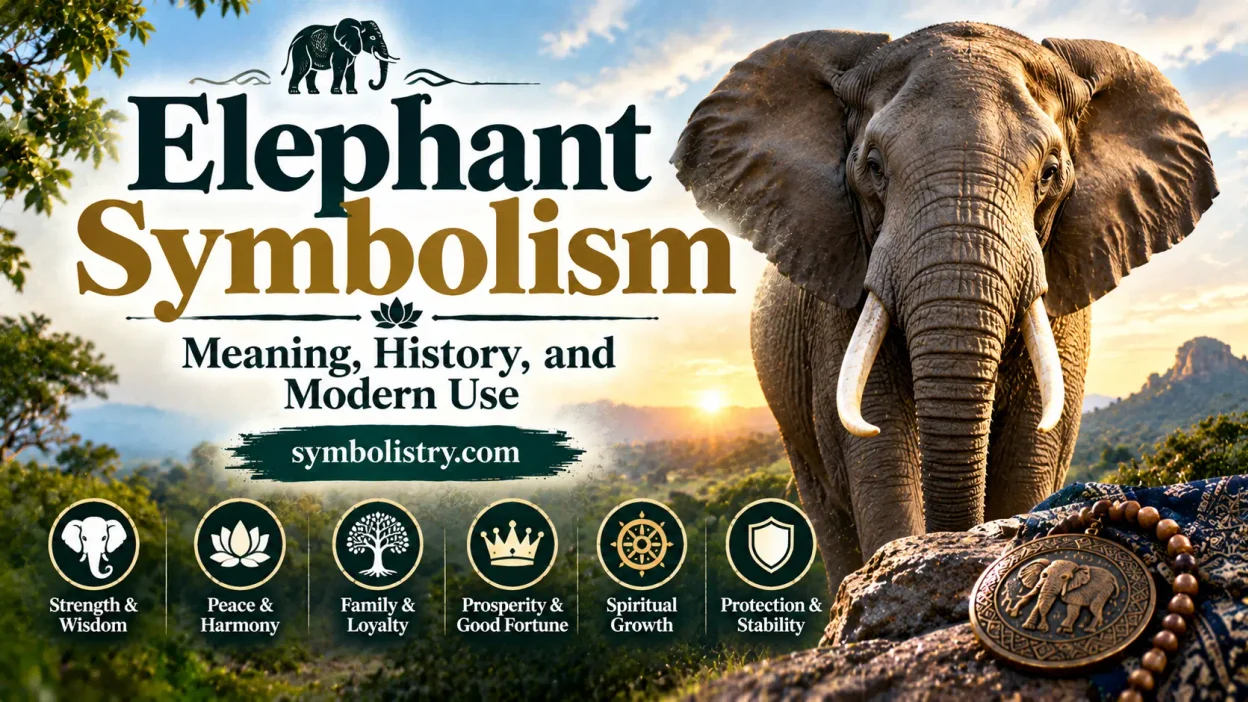
Elephant symbolism commonly represents strength, wisdom, loyalty, family, memory, and protection in modern American culture. Historically, elephants have also represented sacred power, kingship, prosperity, leadership, and spiritual authority across South Asian, African, and Asian traditions.
TL;DR
- Elephants commonly symbolize strength, wisdom, loyalty, and family.
- Ganesha connects the elephant with beginnings and removing obstacles.
- African traditions often connect elephants with leadership and social authority.
- American culture adds conservation, childhood, design, and political associations.
- Elephant tattoos often express family, resilience, memory, or personal strength.
- Modern elephant imagery can also represent wildlife protection and conservation.
What an Elephant Represents at a Glance
An elephant’s physical characteristics explain much of its symbolic appeal. It is enormous without being naturally associated with speed or aggression. Its size suggests strength, while its social behavior makes family and community especially relevant associations.
Its trunk is another important feature. The trunk combines strength and precision: an elephant can use it to move heavy objects while also performing delicate tasks. The animal’s ears, tusks, enormous body, and recognizable silhouette have made it one of the easiest animals to identify in visual art.
That combination gives elephant imagery unusual flexibility. A small elephant figurine can suggest good fortune and hospitality, while a monumental elephant sculpture can communicate authority or grandeur.
In modern American settings, the most common associations tend to be strength, wisdom, memory, family, loyalty, and steadiness. These are cultural associations rather than fixed meanings, so context still matters.
Why Elephants Became Symbols of Strength and Wisdom
Physical size is one of the simplest reasons elephants became associated with strength. An adult elephant is capable of moving objects that humans cannot handle and can travel considerable distances while carrying its enormous weight.
But strength alone does not explain the animal’s symbolic reputation. Elephants are also highly social animals, and their relationships within groups have encouraged people to associate them with cooperation and family bonds.
Their intelligence and behavior have contributed to the common idea of the “wise elephant.” In symbolic language, wisdom does not necessarily mean supernatural knowledge. It can refer to experience, patience, memory, and the ability to respond carefully rather than impulsively.
That distinction is useful when interpreting elephant imagery. A person who chooses an elephant for a tattoo may be communicating resilience or family loyalty rather than making a religious statement.
Ancient Roots and the Elephant in Human Culture
Human relationships with elephants are ancient and complicated. People have hunted elephants and used their bodies for food and materials, while other societies developed systems of elephant training, warfare, ceremonial use, and religious reverence.
In India, elephants became deeply embedded in courtly, military, artistic, and religious life. The Metropolitan Museum of Art notes that elephants appeared in painting, sculpture, textiles, temple settings, armies, hunts, rituals, and ceremonies.
This history helps explain why elephants can symbolize both earthly authority and sacred power. A royal elephant could represent the status of a ruler, while a religious image could communicate divine qualities.
The symbolic history therefore did not come from one single tradition. It developed through many relationships between humans and elephants over thousands of years.
Ganesha and the Meaning of New Beginnings
One of the most recognizable elephant-related religious traditions comes from Hinduism through Ganesha, the elephant-headed deity.
Ganesha is traditionally associated with new beginnings and the removal of obstacles. He is commonly invoked before important undertakings, and his imagery is especially familiar in South Asian religious art. The Smithsonian’s National Museum of Asian Art describes Ganesha as the remover of obstacles and a deity of new beginnings.
The elephant head also contributes to the symbolism. The Smithsonian explains that the elephant’s size and strength relate to Ganesha’s role in overcoming physical and metaphorical barriers.
This association has traveled beyond South Asia. Americans may encounter Ganesha imagery in museums, yoga studios, spiritual shops, restaurants, jewelry, tattoos, and decorative art. However, an elephant image is not automatically a symbol of Ganesha. Religious context matters, and using sacred imagery decoratively can carry different implications for different audiences.
Elephants in African Traditions
African elephant symbolism is especially diverse because Africa contains many distinct cultures and traditions. It is therefore misleading to assign one universal African meaning to the elephant.
In several documented traditions, elephants are associated with leadership, status, strength, transformation, and ceremonial importance. The Smithsonian’s National Museum of African Art describes elephant imagery in Bamileke traditions of Cameroon as connected with leadership and kingship. Elephant masks also appear in ceremonial, funeral, age-grade, and purification contexts among different African peoples.
Some African proverbs use the elephant to communicate social lessons about power, protection, importance, or following an influential person. In Côte d’Ivoire, for example, elephant imagery has been associated with transformation and the ability to respond to change.
These examples demonstrate why context is essential. An elephant used in African ceremonial art cannot automatically be reduced to the general Western ideas of “wisdom” or “good luck.”
Elephant Symbolism in China and East Asian Art
Elephants also developed distinctive meanings in Chinese art.
The Smithsonian notes that the Chinese word for elephant, xiang, sounds like a word associated with an image or emblem. This linguistic connection contributed to the elephant’s symbolic role as a visible manifestation of otherwise hidden cosmic principles.
Elephants became recurring subjects in Chinese decorative art, sculpture, jade carving, and other forms. Their physical qualities could support ideas about dignity, stability, and auspiciousness.
This tradition also shows how symbolism can emerge from language as well as from an animal’s physical characteristics. The meaning of an elephant does not always come simply from observing the creature; it can develop through wordplay, mythology, religious thought, artistic convention, and historical experience.
What Elephants Mean in the United States
The American interpretation is particularly layered.
For many Americans, elephants first appear through familiar childhood experiences: zoos, picture books, stuffed animals, cartoons, movies, and wildlife documentaries. This gives the animal a softer emotional identity than its enormous physical size might suggest.
Elephants can represent gentleness combined with strength. That combination is especially attractive in American decorative culture. A homeowner may choose an elephant sculpture because it suggests stability and good fortune without appearing aggressive.
Wildlife conservation has added another modern meaning. Americans increasingly encounter elephant imagery in discussions about habitat protection, ivory trafficking, endangered species, and responsible tourism. The Smithsonian notes that both African and Asian elephants face conservation pressures and that human-elephant conflict has become an important issue.
As a result, an elephant can now symbolize not only personal qualities but also environmental responsibility.
The Elephant as an American Political Symbol
The elephant has a separate, specifically American political meaning because it became associated with the Republican Party.
The connection developed during the nineteenth century. Political cartoonist Thomas Nast used an elephant labeled as the “Republican vote” in an 1874 Harper’s Weekly cartoon. The image was subsequently reused by other cartoonists and became established as a Republican symbol by the late nineteenth century.
This meaning is distinct from the broader cultural symbolism of strength or wisdom. In a U.S. political context, an elephant may function simply as an emblem identifying the Republican Party.
Because political symbols can carry strong partisan associations, the intended meaning should be interpreted from context. An elephant in a nursery, wildlife poster, or jewelry design does not necessarily have a political meaning.
| Context | Meaning in the USA | Common Associations | Notes |
|---|---|---|---|
| Home decor | Stability and good fortune | Prosperity, protection | Often decorative rather than religious |
| Tattoos | Personal strength or family | Loyalty, resilience, memory | Meaning depends heavily on the wearer |
| Wildlife imagery | Conservation | Nature, protection, endangered species | Often connected to environmental concerns |
| Religious imagery | Spiritual or sacred meaning | Ganesha, new beginnings | Requires cultural and religious context |
| Politics | Republican Party identity | U.S. political symbolism | Separate from general elephant meanings |
Family, Memory, and Emotional Meaning
The idea that elephants “never forget” is one of the most persistent modern associations with the animal. The phrase is culturally powerful, but it should not be treated as a scientific definition of elephant behavior.
Symbolically, however, memory has become closely connected with elephants. This makes the animal especially suitable for commemorating people, family relationships, childhood experiences, and important life events.
An elephant tattoo may therefore represent someone who wants to remember a parent, child, partner, friend, or important period of life.
The animal’s social nature adds another layer. Elephants live in social groups, making them useful symbols for family bonds and belonging. In this context, an elephant can communicate the idea that relationships endure even when circumstances change.
Elephant Symbolism in Tattoos
Elephant tattoos are popular because the animal can be adapted to many artistic styles.
A realistic elephant may emphasize respect for wildlife. A small minimalist outline can represent quiet strength or a personal connection to the animal. A mother and calf can suggest family protection, while a group of elephants may represent community or togetherness.
Some people choose elephant tattoos specifically because of Ganesha, in which case the tattoo has a religious dimension. Others use elephant imagery simply because they associate the animal with perseverance, memory, or family.
Color can also alter the impression. A gray or black elephant often feels natural and understated, while brightly colored or ornamental designs may lean toward decorative, spiritual, or celebratory symbolism.
The important point is that tattoo symbolism is personal. A conventional association may explain what the image commonly communicates, but it does not determine what it means to its wearer.
Elephants in Jewelry, Decor, and Fashion
Elephant imagery appears frequently in jewelry and home decor because the silhouette is recognizable even when reduced to a simple outline.
Small elephant charms may be marketed around ideas of luck, protection, or travel. Decorative statues can be associated with prosperity and hospitality. Wall art may emphasize nature, family, or global cultural traditions.
In American homes, elephant decor is often influenced by several traditions at once. A decorative elephant might borrow visual ideas from South Asian art, African sculpture, Asian decorative traditions, or contemporary wildlife illustration without carrying the full cultural meaning of any one source.
That makes context and respectful presentation important, especially when religious or ceremonial imagery is involved.
Positive and Negative Meanings
Elephants are overwhelmingly associated with positive qualities, but the symbolism is not universally positive.
Positive associations include:
- Strength
- Wisdom
- Patience
- Loyalty
- Family
- Protection
- Stability
- Good fortune
- Leadership
- Memory
Negative associations can emerge from the animal’s enormous size or from particular expressions and stories. An elephant can represent stubbornness, excessive force, heaviness, or something difficult to control.
The phrase “white elephant” is a good example of symbolic reversal. It came from the tradition of highly valued white elephants in Siamese royal culture and eventually became an English expression for something expensive or burdensome to maintain.
The familiar phrase “elephant in the room” creates another modern association, though it is not an ancient elephant tradition. It uses the animal’s enormous physical presence as a metaphor for an obvious issue people are avoiding.
Common Misunderstandings About Elephant Symbolism
One common mistake is treating every elephant image as a universal sign of good luck. That interpretation is popular in contemporary decor, but elephant meanings vary considerably by culture and setting.
Another misunderstanding is assuming that every elephant-headed figure is simply an “elephant god.” Ganesha has a specific religious identity and history within Hindu traditions. His symbolism should not be separated entirely from that context.
It is also important not to treat “African symbolism” or “Asian symbolism” as a single category. Both continents contain numerous cultures with different histories, languages, religious traditions, and artistic conventions.
Finally, an elephant’s symbolic reputation should not obscure the living animal. Modern conservation contexts remind us that elephants are not merely decorative symbols; they are species facing real pressures from habitat loss, human conflict, and illegal ivory trade.
How the Meaning Has Changed Over Time
The elephant’s symbolic history has moved through several overlapping stages.
In ancient and premodern societies, elephants could be associated with royal power, warfare, religious authority, ceremony, and material wealth. In South Asia, the animal became closely connected with sacred traditions and Ganesha. In parts of Africa, elephant imagery could communicate leadership and social authority. In China, artistic and linguistic traditions produced additional symbolic meanings.
Modern Western culture added new layers. Children’s literature and entertainment made elephants familiar and emotionally accessible. Zoos introduced generations of Americans to live elephants. Conservation movements shifted attention toward habitat protection and animal welfare.
In the United States, the nineteenth-century political association added yet another meaning. Today, the same animal can therefore represent family, wildlife, religion, decoration, political identity, or personal resilience depending on where it appears.
Why the Elephant Remains a Strong Modern Symbol
The elephant continues to work as a symbol because its visual qualities are immediately understandable. It is large, recognizable, socially complex, and visually distinctive.
More importantly, its meanings are broad without being completely vague. Strength comes from its physical size. Family associations connect with its social life. Memory comes from longstanding cultural perceptions of the animal. Leadership appears in royal and ceremonial traditions. Protection follows naturally from its combination of size and social behavior.
That makes elephant imagery useful across very different settings—from a conservation campaign to a children’s book, from a tattoo to a museum sculpture.
Its continued relevance does not require one universal interpretation. The symbol remains useful precisely because different communities have given the elephant different meanings.
Frequently Asked Questions
What does an elephant symbolize spiritually?
An elephant can symbolize strength, wisdom, protection, prosperity, and spiritual authority, but the exact meaning depends on the tradition. In Hinduism, Ganesha gives elephant imagery a specific connection with new beginnings and overcoming obstacles.
What does an elephant tattoo usually mean?
An elephant tattoo commonly represents strength, family, loyalty, resilience, memory, or a connection with nature. When the image specifically depicts Ganesha, the tattoo may instead carry a religious meaning connected with Hindu devotion and new beginnings.
Why is the elephant associated with wisdom?
The association comes partly from cultural perceptions of elephants as intelligent, experienced, deliberate, and socially complex animals. Over time, those qualities became simplified into the familiar symbolic idea of the “wise elephant.”
What does an elephant symbolize in the United States?
In American culture, elephants can represent strength, family, memory, good fortune, wildlife conservation, and affection for animals. The elephant also has a separate political meaning as a symbol of the Republican Party, a connection that developed through nineteenth-century political cartoons.
Is an elephant a symbol of good luck?
In some decorative and cultural traditions, elephant imagery is associated with good fortune and prosperity. However, this is not a universal meaning, and the symbolism can change depending on the culture, posture, objects shown with the elephant, and surrounding imagery.
What does a mother elephant symbolize?
A mother elephant commonly represents family protection, caregiving, loyalty, and the strength of close relationships. In personal artwork or tattoos, a mother and calf can therefore be used to express family attachment or parental love.
Are elephants religious symbols?
Elephants have religious significance in several traditions, most notably through Ganesha in Hinduism and through various Buddhist stories and artistic traditions. An ordinary elephant image, however, is not automatically religious and should be interpreted according to its context.
Conclusion
Elephant symbolism brings together several ideas that remain recognizable in modern American culture: strength without unnecessary aggression, loyalty to family, patience, memory, protection, and resilience. Those meanings developed through the animal’s physical characteristics as well as through centuries of religious, artistic, political, and social use.
At the same time, an elephant does not have one universal definition. Ganesha carries a specific Hindu meaning, African traditions contain their own distinct interpretations, Chinese art developed different associations, and American culture added conservation, entertainment, decorative, and political meanings. Understanding the context is what turns a familiar animal image into a meaningful symbol.