
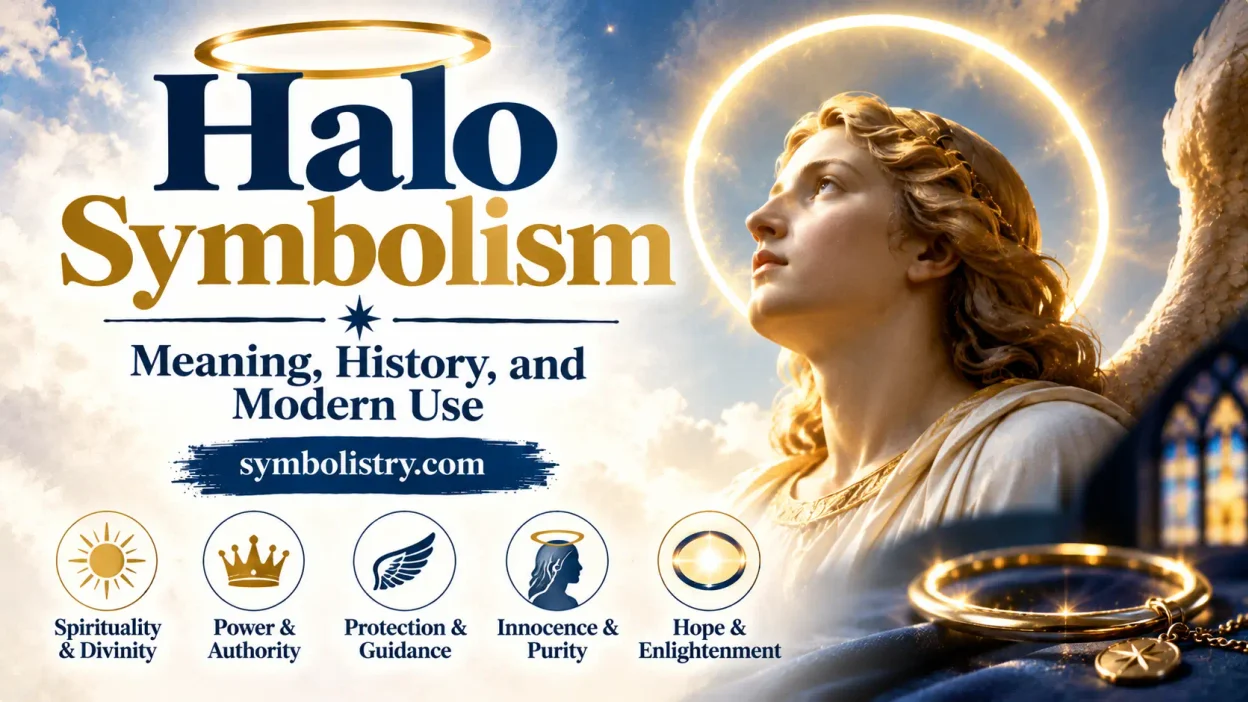
A halo is a circle, ring, or radiant shape placed around the head or body of a person in art. In halo symbolism, that visual feature usually marks someone as holy, spiritually significant, enlightened, or set apart from ordinary human life. The image is especially familiar in Christian paintings, icons, sculptures, stained glass, and popular depictions of saints and angels.
For Americans, the halo has also moved beyond formal religious art. It appears in tattoos, jewelry, illustrations, fashion, photography, cartoons, emojis, memorial designs, and expressions such as “an angel with a halo.” Its meaning can therefore range from religious holiness to innocence, goodness, protection, remembrance, or even playful irony.
Understanding the halo requires looking at both its religious history and its changing place in everyday visual culture. The same simple circle can communicate sanctity in an icon, innocence in a children’s illustration, or deliberate irony in contemporary art.
Quick Answer
Halo symbolism commonly represents holiness, goodness, innocence, or divine presence in modern American culture, especially in Christian imagery and representations of angels and saints. Historically, halos developed from older artistic traditions associated with radiance and elevated status before becoming an established feature of Christian and Buddhist religious art.
TL;DR
- Halos commonly identify holiness, innocence, or spiritual distinction.
- Christian artists developed the halo into a major visual convention.
- Older Mediterranean traditions also used radiant forms around important figures.
- Buddhist art uses halos to represent sacred or enlightened figures.
- Americans now use halos in religious, memorial, fashion, and popular imagery.
- A halo can also be used ironically to suggest false innocence.
What a Halo Looks Like and Where It Appears
The most recognizable halo is a circular disk surrounding the head. It may appear as a solid gold disk, a thin ring, rays of light, or an almost transparent glow.
Artists have never treated all halos exactly alike. Some are flat and geometric, while others look like illuminated metal, flames, clouds, or radiating light. In religious sculpture, a halo may be physically attached behind the head. In paintings, it can be painted directly onto the surface.
A halo can also extend beyond the head. A large almond-shaped radiance surrounding an entire figure is often called a mandorla or aureole. These forms are particularly important in religious scenes showing divine revelation or glorified figures.
The placement itself matters. A ring around the head generally identifies the individual, while a larger field of radiance can emphasize an entire supernatural appearance.
What a Halo Commonly Means in the United States
In the United States, the halo is most immediately associated with holiness and moral goodness. Many Americans recognize it even without having studied religious art.
A saint with a halo is understood to be holy. An angel with a halo is generally understood as heavenly or benevolent. A deceased loved one depicted with wings and a halo may be represented as having entered a peaceful spiritual existence.
The symbol also communicates innocence. This is where the expression “halo” becomes part of everyday language. Calling someone “an angel” or saying that a person has “a halo” can suggest kindness, patience, generosity, or unusually good behavior.
But the meaning is not always religious. A halo can function as shorthand for someone perceived as exceptionally good, admirable, pure, or harmless.
Ancient Roots and Early Radiant Imagery
The halo did not originate exclusively within Christianity. Radiant forms around important figures existed in several older artistic traditions.
Classical Mediterranean art sometimes represented gods and rulers with signs of radiance. The National Gallery notes that halos or radiant forms were associated with figures such as Apollo, while later Christian artists adopted and transformed established visual conventions.
The important point is that ancient artists already had a visual vocabulary for communicating extraordinary status. Light naturally offered an effective artistic metaphor: something illuminated appears different from its surroundings, so surrounding a figure with radiance could signal that the person possessed unusual authority, divinity, or elevated status.
Christian artists eventually incorporated this vocabulary into their own imagery rather than inventing the concept in isolation.
How Christianity Made the Halo a Familiar Religious Symbol
The halo became especially important in Christian art during late antiquity and the medieval period. By the fifth century, it was appearing as a recognizable feature of Christian religious imagery, initially associated with Christ, the Trinity, angels, and other sacred figures. It later became widely associated with Mary and the saints.
The symbol provided artists with a practical visual solution. Religious paintings often included several people in the same scene. A halo immediately distinguished sacred figures from ordinary participants.
The convention became increasingly elaborate. Christ could be shown with a cruciform halo, while saints and other holy figures might have circular halos. In medieval and Byzantine art, halos could be decorated with jewels, patterns, inscriptions, or gold.
The Metropolitan Museum of Art, for example, preserves Byzantine halo work dating from the 10th to early 11th century, showing that halos were not merely painted effects but could also become carefully crafted physical objects.
The Halo in Christian Iconography
Christian halos contain visual details that can carry additional meaning.
A plain circular halo generally identifies holiness or sacred status. A cruciform halo, in which a cross appears inside the halo, is strongly associated with Christ. A full-body aureole can emphasize divine glory or a supernatural manifestation.
Mary’s halo became particularly prominent in Western and Eastern Christian art. Images of the Virgin and Child frequently use halos to identify both Mary and Jesus as sacred figures. The Met’s medieval collection, for example, describes Mary’s halo as part of the visual language identifying her as the Queen of Heaven.
Gold became especially important because it does not simply imitate ordinary daylight. In medieval religious painting, gold backgrounds and gold halos could create a visual world distinct from ordinary physical space.
The halo therefore did more than decorate a person’s head. It helped establish the difference between the everyday world and sacred representation.
Halo Symbolism in Buddhist Art
The halo is not exclusively Christian.
Buddhist artists also use halos and larger fields of radiance around Buddhas and bodhisattvas. These forms can communicate spiritual attainment, sacred status, or enlightenment.
A particularly important example comes from Gandharan art. The Metropolitan Museum records a fifth- or sixth-century sculpture of a seated bodhisattva from the ancient Gandhara region, where combined halo-and-mandorla forms became established in Buddhist artistic traditions.
This history is important because it prevents an overly narrow interpretation of the halo. The visual idea of radiance around a sacred figure appears in different religious environments, although the precise theology and artistic conventions vary.
A Christian halo and a Buddhist halo should not automatically be treated as having identical meanings. They belong to different traditions and developed within different religious systems.
Why Light Became Associated With Holiness
The connection between light and sacredness is easy to understand without assuming that every culture meant exactly the same thing.
Light makes objects visible. It can also suggest purity, revelation, warmth, guidance, and life. Darkness, by contrast, can conceal objects and make ordinary visual distinctions difficult.
Religious traditions have frequently used this contrast in their language, rituals, and art. Artists could translate the idea into a simple visual device: put light around the figure.
The halo therefore works almost like visual punctuation. It tells viewers, before they read an inscription or understand the scene, that this person deserves special attention.
That helps explain why the symbol survived for so long. It is visually simple and immediately legible.
What Different Halo Styles Can Communicate
| Halo Form | Common Meaning in the USA | Common Associations | Notes |
|---|---|---|---|
| Circular halo | Holiness or goodness | Saints, angels, sacred art | Most recognizable form |
| Golden halo | Divine glory or sacred status | Christian paintings and icons | Often associated with traditional religious art |
| Cruciform halo | Christ’s sacred identity | Jesus in Christian art | Cross-shaped details distinguish it |
| Full-body aureole | Divine radiance or revelation | Christ, visions, sacred scenes | Extends beyond the head |
| Cartoon halo | Innocence or angelic goodness | Children’s media, humor | Often simplified for instant recognition |
| Broken or tilted halo | Imperfection or irony | Tattoos, modern art, fashion | Can challenge traditional ideas of purity |
Halo Symbolism in American Religious Culture
American religious culture has preserved the traditional Christian meaning of the halo while also simplifying it for everyday audiences.
Church art, Christmas decorations, children’s books, nativity scenes, religious jewelry, and devotional imagery frequently use halos to make sacred characters immediately recognizable.
The symbol is particularly familiar during Christmas. Angels in nativity scenes are often depicted with halos, even when the artistic style is highly simplified.
Halos also appear in images of saints, the Virgin Mary, and Jesus. In these contexts, the symbol usually retains its traditional association with holiness rather than merely representing general “goodness.”
Because Christian imagery is widespread in American visual culture, people who are not practicing Christians may still understand the basic meaning of the halo.
The Halo as a Symbol of Innocence
Outside formal religion, the halo has become one of the clearest visual signs of innocence.
A cartoon character wearing a halo is generally understood to be exceptionally well-behaved. The joke becomes especially obvious when the character has just done something mischievous.
This use depends on a shared cultural understanding. Viewers already know that a halo suggests goodness, so placing it above a morally questionable character creates contrast.
That contrast explains expressions such as “not exactly innocent” or “trying to look like an angel.” The halo has become a shorthand for a reputation for goodness, whether that reputation is deserved or not.
Halos in Mourning and Memorial Imagery
Halos also appear in American memorial culture.
A person who has died may be portrayed with angelic imagery, wings, clouds, light, or a halo. These designs can express remembrance and the hope that the deceased is now in a peaceful or heavenly state.
This use is particularly common in personalized memorial art, jewelry, tattoos, engraved objects, and digital tribute images.
The meaning is not necessarily a statement about formal theology. For many people, the halo provides a visual language for love, remembrance, innocence, and spiritual peace.
Its emotional effect often comes from the transformation of an ordinary portrait into something associated with the sacred.
Halo Symbolism in Tattoos and Jewelry
The halo has become a popular motif in personal style because it can be adapted to many different meanings.
A person may choose a halo tattoo to represent faith, a deceased loved one, personal innocence, spiritual identity, or a desire to remember someone as an angelic presence.
Halo imagery can also be combined with names, dates, wings, flowers, crosses, stars, portraits, or religious figures. The surrounding symbols often determine how the halo should be interpreted.
In jewelry, a halo may appear as a circular design around a central stone. Here, however, the meaning can change substantially. A jewelry “halo” around a gemstone often describes a design arrangement, not a religious symbol.
That distinction matters. Not every ring-shaped decoration around a central object is intended to communicate holiness.
Halos in Fashion, Design, and Popular Culture
Modern designers frequently borrow religious imagery without preserving its original theological meaning.
A halo may appear above a model’s head in a photograph, behind a singer in promotional artwork, or as a decorative graphic in fashion. In these situations, it can suggest innocence, celebrity status, beauty, transcendence, or deliberate contrast.
Pop culture also uses the halo as a visual shortcut. A character who appears innocent may receive a halo, while a morally complicated character may be given a broken or crooked one.
The symbol is particularly effective because viewers understand it almost instantly.
A modern artist does not need several sentences to establish the idea of “this person appears innocent.” A small ring above the head can accomplish it visually.
Emotional and Psychological Associations
The halo can evoke several related emotional ideas:
- Innocence — the impression of someone untouched by wrongdoing.
- Goodness — a visual association with kindness and moral behavior.
- Protection — especially when connected with angels or guardian figures.
- Peace — common in memorial and spiritual imagery.
- Admiration — placing someone above ordinary status.
- Spiritual aspiration — representing a quality a person hopes to embody.
These associations are not universal psychological rules. Personal experience, religious background, and cultural context influence how someone interprets the image.
A person familiar with Christian iconography may immediately recognize a saint. Someone encountering the same image in a fashion campaign may read it as a metaphor for innocence or beauty.
When the Halo Is Used Ironically
The halo can communicate the opposite of what it traditionally represents.
This happens when artists intentionally place a halo on a flawed, rebellious, arrogant, or morally questionable character.
The effect depends on contradiction. The audience recognizes the traditional meaning and notices that the person does not fit it.
A halo over a mischievous cartoon character is usually humorous. A halo over a controversial celebrity in an artwork can suggest criticism of celebrity worship or the tendency to idealize public figures.
In this sense, the halo has become flexible enough to symbolize not only innocence but the appearance of innocence.
That distinction is important. Someone can be shown with a halo because the artist believes the person is virtuous—or because the artist wants viewers to question whether that virtue is genuine.
Common Misunderstandings About the Halo
One common misconception is that halos were invented by Christianity. Historical evidence shows that radiant head imagery existed in earlier artistic traditions, and Christian artists adapted established visual conventions.
Another misconception is that every halo means exactly the same thing. Different shapes, positions, colors, and religious traditions can produce different meanings.
It is also easy to assume that a halo always represents moral perfection. Modern art frequently uses it ironically, and popular culture often uses it simply to communicate “angelic” or innocent behavior.
Finally, a halo should not automatically be interpreted as evidence that an artwork belongs to one particular religion. Contemporary artists frequently use religious symbols in secular contexts.
How the Meaning Has Changed Over Time
The halo has moved through several stages of interpretation.
In ancient visual traditions, radiant imagery could signal divine association or exceptional status. Christian artists adapted related conventions and made the halo a recognizable sign of holiness. Buddhist artists developed their own uses of radiance in sacred representations.
During the medieval period, the halo became deeply embedded in European religious art. Its visual language became increasingly specific, with different forms helping viewers identify Christ, Mary, angels, and saints.
Modern American culture has broadened the symbol again. The halo can now communicate goodness without explicitly referring to religion. It can also be used for memorialization, humor, fashion, advertising, photography, and satire.
The circle has remained recognizable even as its cultural setting has changed.
Why the Halo Still Works as a Modern Symbol
The halo remains effective because its visual message is remarkably economical.
A viewer sees an ordinary person with no special visual marker and may interpret the figure as ordinary. Add a ring of light around the head, and the figure becomes exceptional.
That difference can mean holiness, innocence, admiration, memory, or irony depending on context.
In the United States, this flexibility allows the halo to move comfortably between church art and secular culture. It can be solemn in a memorial, playful in a cartoon, fashionable in a photograph, or reverent in an icon.
The meaning is therefore carried not only by the halo itself but also by who wears it, where it appears, and what surrounds it.
Frequently Asked Questions
What does a halo symbolize?
A halo most commonly symbolizes holiness, sacred status, goodness, or spiritual radiance. In modern secular imagery, it can also represent innocence, admiration, or an intentionally angelic appearance.
What does a halo symbolize in Christianity?
In Christian art, a halo identifies a figure as holy or associated with divine presence. Different forms can provide additional information, such as the cruciform halo traditionally associated with Christ.
What does a halo tattoo mean?
A halo tattoo can represent faith, innocence, spirituality, remembrance, or a deceased loved one. Its meaning depends heavily on accompanying imagery and the reason the person chose it.
Why do angels have halos?
Halos became a conventional way for artists to indicate that angels belong to a heavenly or sacred realm. Their presence helps viewers distinguish supernatural figures from ordinary human characters.
Is a halo always a religious symbol?
No. Halos are now widely used in secular art, advertising, fashion, cartoons, photography, and memorial designs. In these settings, the halo may suggest innocence, goodness, beauty, celebrity, or irony rather than religious holiness.
What does a broken halo symbolize?
A broken halo often represents imperfect goodness, moral conflict, lost innocence, or the tension between appearance and reality. Contemporary artists and tattoo designers may use it to show that someone is neither completely innocent nor completely corrupt.
Why are halos usually shown as circles?
The circle provides a clear visual boundary around the head and has traditionally been associated with radiance and completeness. Artists can easily recognize and emphasize the sacred status of a figure by placing this simple geometric form behind the head.
Conclusion
The halo has become one of the most recognizable visual signs of holiness, but its history is broader than any single religious tradition. Older radiant imagery influenced later artistic conventions, while Christian and Buddhist artists developed distinct forms for representing sacred or spiritually elevated figures.
Today, halo symbolism continues to work because Americans recognize the basic visual message even when the religious context is absent. A halo can represent holiness in a church painting, innocence in a cartoon, remembrance in a memorial tattoo, or deliberate irony in contemporary art.
Its meaning ultimately depends on context. The circle may look simple, but the person wearing it—and the reason the artist placed it there—determines what the halo is actually saying.



[…] See also Halo Symbolism: Meaning, History, and Modern Use […]