
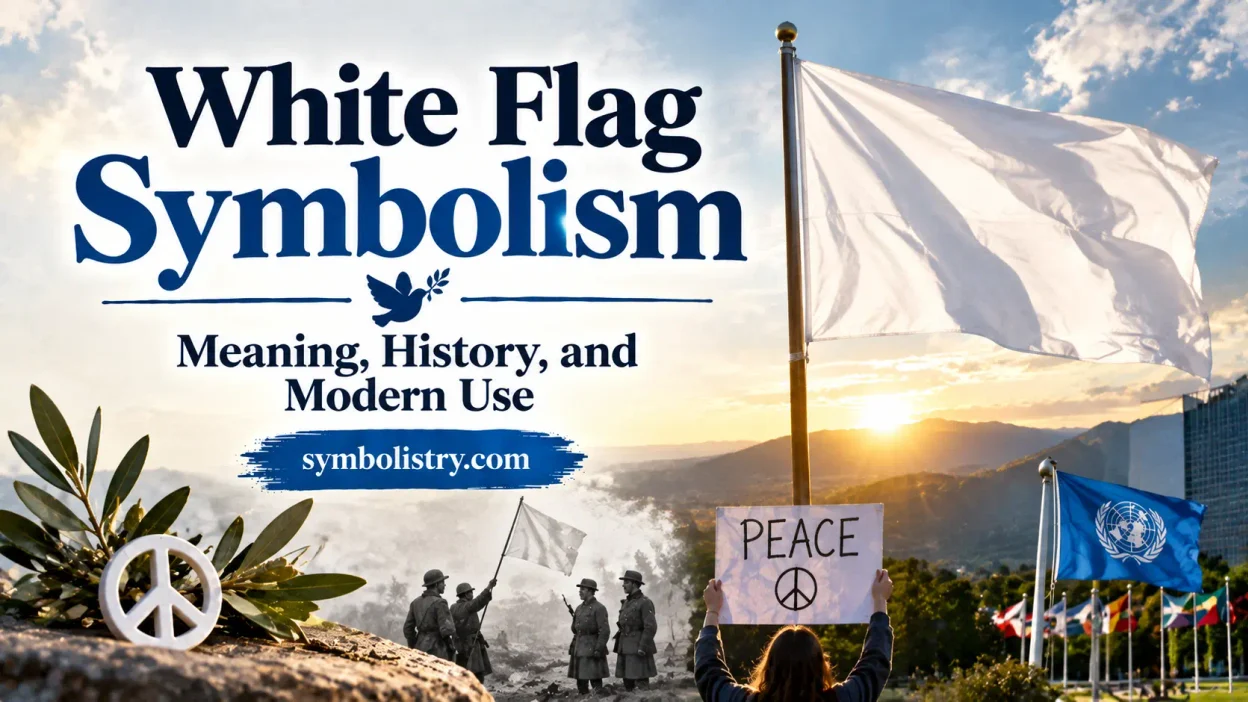
White flag symbolism is most commonly associated with surrender, a request to stop fighting, or an attempt to open peaceful communication. A plain white cloth can look almost empty, but in a conflict it can communicate an unmistakable message: the person displaying it does not want to continue attacking and is seeking some form of contact or resolution.
The meaning is not limited to military surrender. Historically, white flags have also been used to request a truce, negotiate, recover the dead and wounded, or communicate peaceful intentions. In the United States, the image became especially familiar through military history, including events such as Fort Sumter and the Confederate surrender at Appomattox.
Today, the white flag has also moved beyond literal warfare. People use it in conversation, sports, memes, advertising, art, and everyday language to suggest giving up, conceding a point, asking for peace, or admitting that an argument is no longer worth continuing.
Quick Answer
White flag symbolism commonly represents surrender, truce, or a willingness to stop fighting in modern American culture. Historically, it has also signaled a request for communication or negotiation, so displaying a white flag does not always mean unconditional surrender.
TL;DR
- White flags most commonly represent surrender or a desire for peace.
- Historically, they could request communication, negotiation, or temporary truce.
- American history helped make the symbol strongly associated with surrender.
- White cloth was practical because it was visible and readily available.
- Modern speech uses “raising the white flag” to mean giving up.
- Context determines whether the gesture means surrender, compromise, or negotiation.
What Does a White Flag Actually Look Like?
A traditional white flag is simply a piece of white fabric without a distinctive emblem, pattern, or national design. Its visual simplicity is part of its usefulness: unlike a military banner, national flag, or political emblem, it is intended to communicate a straightforward message rather than identify a particular side.
In a battlefield setting, the flag might be attached to a pole, carried by a person, or improvised from whatever white fabric was available. The material itself was not necessarily standardized.
That practical quality matters. A soldier did not need a specially manufactured flag to communicate with an opponent. A shirt, cloth, towel, or other visible white material could serve the purpose when circumstances demanded it.
This is one reason the symbol has remained recognizable across different periods and conflicts.
What the White Flag Commonly Means in America
For most Americans today, the first association is surrender.
The phrase “raise the white flag” is commonly understood as admitting defeat or deciding not to continue a struggle. Someone might use it literally in a historical discussion or figuratively after losing an argument, competition, or difficult challenge.
But surrender is only part of the traditional meaning.
In the laws and customs surrounding armed conflict, a white flag has also been associated with a request to communicate with an opposing force. That communication might concern surrender, but it could also involve negotiating a cease-fire, arranging an exchange, or dealing with the dead and wounded.
The distinction is important because popular culture often simplifies the symbol into “I give up.” Historically, the message has been closer to “I want to communicate without fighting.”
Ancient Roots and the Development of the Symbol
The precise origin of the white flag is difficult to establish. There is no single ancient event that can be identified as the moment when a plain white banner officially became a universal symbol of surrender.
Historical accounts do, however, describe earlier uses of white materials in wartime communication.
Accounts concerning the ancient Mediterranean describe white cloth being displayed alongside olive branches in situations involving peace or negotiation. These examples suggest that white fabric had peaceful associations long before the modern white flag became standardized.
One possible explanation is practical as well as cultural. Undyed fabric was widely available, and white cloth could be easier to recognize at a distance than a dark or complicated banner.
By the early modern period, clearer references to the white flag as a means of peaceful communication began to appear. By the seventeenth century, European discussions of the laws of war treated the white flag as a recognizable signal for requesting a parley.
The meaning therefore developed gradually rather than appearing fully formed.
Why White Became Associated With Peaceful Contact
Color symbolism provides part of the explanation, but practical visibility is just as important.
White has long been associated in many cultures with cleanliness, innocence, peace, and the absence of aggression. Those associations made it suitable for a signal intended to interrupt violence.
Yet battlefield practicality may have mattered even more. A plain white cloth was easy to make, easy to obtain, and visually different from the complicated standards carried by armies.
The symbol also communicated neutrality. A white flag did not represent the colors or political identity of either side. Instead, it temporarily shifted attention away from combat and toward communication.
This combination of visibility, simplicity, and peaceful association helped the symbol survive across centuries.
The White Flag in U.S. Military History
American history contains several well-known examples that strengthened the connection between white flags and surrender.
During the Civil War, the white flag appeared at major moments of military capitulation. At Fort Sumter in April 1861, Union commander Major Robert Anderson raised a white flag after sustained Confederate bombardment and agreed to surrender the fort.
Four years later, the surrender at Appomattox Court House became one of the most famous American examples. A Confederate officer carried an improvised white cloth, described as a dish towel, while approaching Union forces to communicate about surrender.
The episode is particularly revealing because it shows that the symbolism did not depend on an official, beautifully manufactured flag. What mattered was the recognizable message communicated by the white fabric.
These events helped cement surrender as one of the strongest American associations with the white flag.
White Flag Meaning in International Humanitarian Law
The white flag also has a more precise meaning in the law and customs of armed conflict.
Under the Hague rules concerning flags of truce, a person acting as a representative to communicate with an opposing force while carrying a white flag can receive special protection. This role is traditionally associated with a parlementaire, or representative sent to communicate with the enemy.
The important point is that the white flag does not automatically mean unconditional surrender.
A party may use it to seek negotiations or discuss practical arrangements. The International Committee of the Red Cross explains that the white flag can indicate an intention to communicate or negotiate, including discussions involving cease-fires or humanitarian matters.
There are also limits. The protection associated with a flag of truce can be lost if the privileged position is deliberately abused for hostile or treacherous purposes.
So the legal meaning is more precise than the popular phrase “I give up.”
White Flag Symbolism in the United States Today
Modern American culture has largely converted a military signal into a metaphor for everyday life.
A person may say, “I’m raising the white flag,” after deciding to stop arguing. A coach might jokingly use the expression when a team is overwhelmed. Someone struggling with an impossible task may post a white flag emoji to communicate, “I give up.”
The symbol therefore works particularly well in informal communication because its meaning is immediately recognizable.
There is also an important emotional distinction between defeat and acceptance. In one context, raising a white flag can mean losing. In another, it can mean deciding that continued conflict is pointless.
That makes the symbol useful for expressing resignation, compromise, exhaustion, or a desire for peace.
Emotional and Psychological Associations
The white flag can communicate several different emotional states depending on context.
Surrender suggests accepting that resistance is no longer possible or worthwhile.
Relief can appear when someone chooses to end a prolonged argument or struggle.
Humility may be present when a person admits that another side has prevailed.
Peace-seeking changes the emphasis from defeat to resolution.
Vulnerability can also be part of the image. Showing a white flag means temporarily giving up the protection that comes from confrontation and signaling a willingness to communicate.
These meanings explain why the symbol works so well outside military settings. Human conflicts often involve a decision about whether to keep fighting or begin negotiating.
White Flag Symbolism Across Different Contexts
The same white flag can communicate different ideas depending on where it appears.
| Context | Meaning in the USA | Common Associations | Notes |
|---|---|---|---|
| Battlefield | Surrender or communication | Defeat, truce, negotiation | Traditional military meaning |
| Everyday speech | Giving up or conceding | Frustration, acceptance | Usually metaphorical |
| Sports | Conceding defeat | Competition, exhaustion | Often humorous |
| Relationships | Ending an argument | Compromise, peace | Informal and context-dependent |
| Digital culture | “I give up” | Humor, stress, resignation | Often represented with an emoji |
| Historical art | Military capitulation | War, diplomacy, surrender | Meaning depends on the depicted event |
The important lesson is that the white flag does not carry exactly one emotional message. The surrounding circumstances determine whether it represents defeat, negotiation, or peace.
Religious and Cross-Cultural Associations
White itself has important symbolic roles in many religious and cultural traditions, although these meanings should not be confused with the specific military use of a white flag.
In Christianity and several other religious traditions, white can be associated with purity, peace, celebration, resurrection, or sacred occasions. In other cultural contexts, white can be strongly connected with mourning and death.
This variation demonstrates why color symbolism cannot be interpreted universally.
The white flag’s military meaning developed through a particular historical context: communication between opposing forces. Its broader color associations may reinforce ideas of peace or innocence, but they do not fully explain the flag’s meaning by themselves.
In cross-cultural settings, therefore, the flag convention is more important than simply seeing the color white.
Why White Flags Appear in Modern Media
Film, television, cartoons, video games, and advertising frequently use the white flag because audiences understand it almost instantly.
A character waving one can communicate surrender without dialogue. A cartoon character hiding behind a white cloth can turn a serious military symbol into a joke. A commercial may use the image to suggest that a customer has finally admitted defeat against a difficult problem.
Sports media also uses the phrase and image metaphorically. A losing team may be described as having “raised the white flag,” even though no literal flag is present.
This visual shorthand is particularly effective because it compresses a complicated historical idea into one recognizable image.
White Flags in Digital Culture and Everyday Language
Social media has expanded the symbol’s use even further.
The white flag emoji, 🏳️, can be used to communicate surrender, frustration, defeat, or a willingness to stop an argument. Its meaning is often intentionally exaggerated for humor.
For example, someone might post a white flag after dealing with a difficult household project, a complicated recipe, or a long workday. In such cases, there is no literal conflict. The symbol simply means, “I have had enough.”
The expression can also be playful rather than genuinely negative. Someone might jokingly surrender during a friendly debate without suggesting that the relationship itself is in trouble.
White Flag Tattoos and Personal Symbolism
A white flag tattoo can carry several personal meanings.
For some people, it represents accepting a difficult reality rather than continuing an exhausting struggle. Others may connect it with overcoming conflict, choosing peace, or recognizing a turning point in their lives.
Because the symbol traditionally implies surrender, however, it can also communicate a more complicated idea: knowing when to stop fighting.
That interpretation differs from simple defeat. A person may choose the white flag because they believe ending a conflict requires more strength than continuing it.
Tattoo meanings are ultimately personal, so the same design can represent very different experiences.
White Flag Symbolism in Art, Design, and Decor
A plain white flag is visually minimal, which makes it useful in contemporary art.
Artists can use it to explore war, peace, political conflict, vulnerability, diplomacy, or the human consequences of confrontation. Removing national colors can also create a deliberately neutral visual field.
In interior design, the white flag is less common as a literal decorative motif than in art or historical displays. When it does appear, the meaning usually comes from the setting rather than from traditional home decor symbolism.
The symbol can suggest peace in one environment and defeat in another.
That ambiguity is often what makes it interesting to artists.
Common Misunderstandings About the White Flag
One of the biggest misunderstandings is that a white flag always means surrender.
Historically and legally, that is too narrow. The white flag can signal a desire to communicate, and communication can concern surrender, negotiation, a temporary cease-fire, or other arrangements.
Another misunderstanding is that displaying a white flag gives unlimited protection under every circumstance. The rules surrounding flags of truce contain specific conditions, and misuse can affect the protections associated with the signal.
A third misunderstanding is that white has one universal meaning across all cultures. White can represent peace or purity in some traditions and mourning in others, so color symbolism should always be interpreted within its cultural setting.
How the Meaning Has Changed Over Time
The white flag’s history shows a gradual movement from practical wartime communication toward a broader cultural metaphor.
Earlier examples emphasized communication and temporary peace. As military conventions became more formal, the white flag gained a recognized role in communication between opposing forces.
In American historical memory, famous surrender events strengthened its association with defeat. Popular language then transformed the military gesture into expressions such as “raising the white flag.”
Today, the symbol can mean anything from literal surrender to jokingly admitting that a task has become too difficult.
Its central idea has remained remarkably consistent, though: the decision to stop active conflict and change the relationship between opposing sides.
FAQ About White Flag Symbolism
What does a white flag symbolize spiritually?
A white flag can suggest peace, surrender, humility, or a willingness to stop conflict. Spiritual interpretations are personal, however, and should be distinguished from the flag’s established historical and military meaning.
Does a white flag always mean surrender?
No. In traditional military usage, it can indicate a request to communicate or negotiate rather than an immediate unconditional surrender. The exact meaning depends on the circumstances.
What does a white flag tattoo mean?
A white flag tattoo can represent surrender, acceptance, peace, ending a struggle, or knowing when to stop fighting. Its meaning depends heavily on the personal story behind the tattoo.
Why does a white flag mean giving up?
The association developed from its use as a signal that a fighting force wanted to stop active hostilities or communicate with an opponent. Over time, that military gesture became a metaphor for conceding defeat in everyday speech.
What does a white flag mean in American culture?
In the United States, it is most commonly understood as a sign of surrender or giving up. It can also represent negotiation, compromise, or a desire to end an argument.
Is a white flag a symbol of peace?
It can symbolize peace, but more specifically it traditionally signals a desire to communicate or suspend hostilities. It should not be treated as a universal peace emblem in every context.
What does the white flag emoji mean?
The 🏳️ emoji is commonly used online to express surrender, frustration, concession, or humorous defeat. Its meaning usually depends on the surrounding message rather than on a formal convention.
Conclusion
The white flag began as a practical means of communicating across a conflict and gradually became one of the world’s clearest symbols of surrender, negotiation, and a desire to stop fighting. Its history shows why the popular idea of “giving up” is only part of its meaning: historically, the signal could also open a conversation.
In modern America, white flag symbolism works both literally and metaphorically. It can describe military surrender, a decision to end an argument, a humorous admission of defeat, or the recognition that continuing a struggle is no longer productive.
The enduring meaning is less about weakness than about changing the terms of a conflict—from confrontation toward communication.