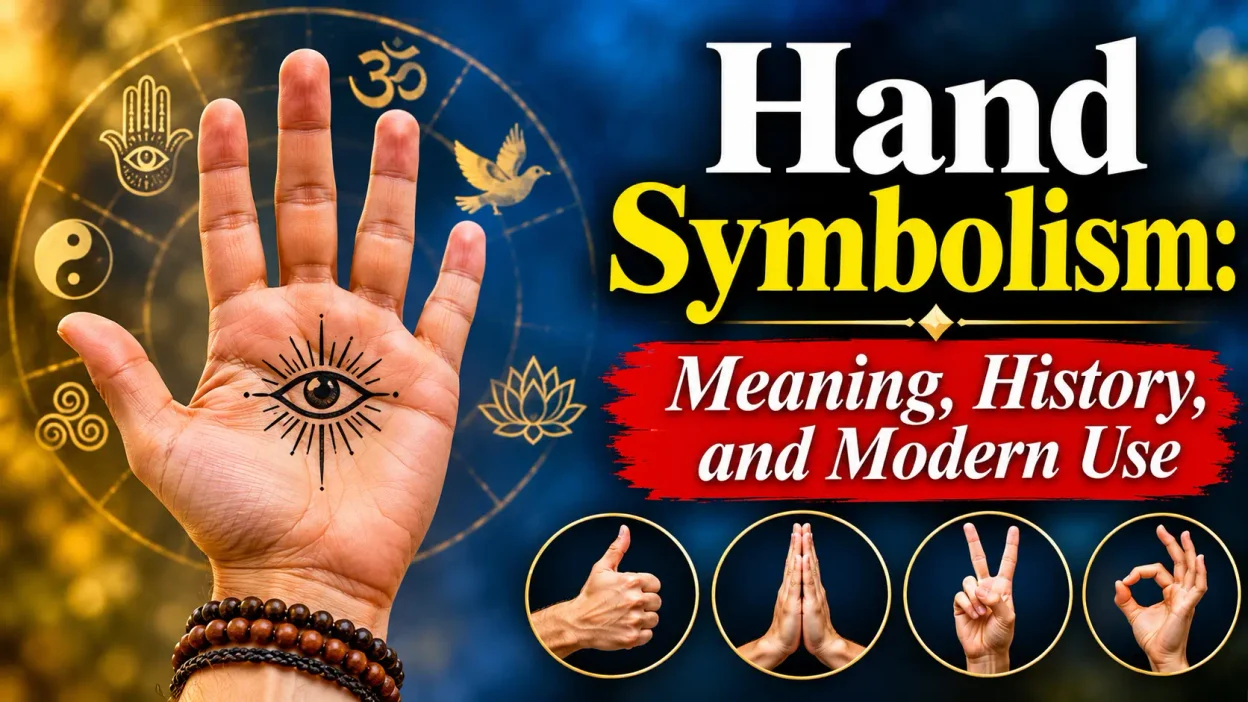
Hands are among the most recognizable and expressive symbols in human life. They represent much more than physical ability. A raised palm can communicate peace, a clenched fist can express resistance, and two joined hands can represent friendship, trust, or commitment. These familiar gestures help explain why hand symbolism appears in art, religion, literature, politics, and everyday American culture.
People use their hands to build, create, protect, comfort, communicate, and work. Because hands are involved in so many important human activities, they have become natural symbols of personal identity, independence, generosity, authority, and human connection. Even a simple illustration of an open hand can communicate an idea without requiring written words.
In the United States, hand imagery appears in everything from wedding ceremonies and political movements to tattoos, jewelry, religious artwork, and social media. Understanding its meaning requires looking beyond individual gestures and considering how different societies have interpreted the human hand over time.
Quick Answer: What Does Hand Symbolism Mean?
Hand symbolism commonly represents communication, creativity, protection, strength, generosity, and human connection in modern American culture. Historically, hands have also symbolized divine blessing, authority, spiritual protection, healing, and the relationship between people and higher powers.
TL;DR
- Open hands commonly represent honesty, peace, acceptance, and generosity.
- Clenched fists symbolize determination, resistance, unity, and strength.
- Religious traditions use hands to communicate blessing, prayer, and protection.
- Handshakes represent trust, agreement, friendship, and professional respect.
- Hand tattoos often express identity, personal beliefs, and meaningful experiences.
- Ancient hand amulets were associated with protection against misfortune.
What the Human Hand Represents as a Symbol
The human hand is a distinctive symbol because it combines physical ability with communication. Unlike many other parts of the body, hands can perform practical tasks while expressing emotions and intentions.
An open hand may suggest that someone has nothing to hide. A hand reaching toward another person can communicate compassion or a desire to help. Two hands working together often represent cooperation, while a hand raised above the head may indicate celebration, protest, or a request to speak.
The fingers also contribute to the symbolism. Their arrangement can change the meaning of an image entirely. A single pointing finger directs attention, joined fingers can indicate a particular religious gesture, and a closed fist communicates a different message from an open palm.
Hands are also associated with human individuality. Fingerprints are unique to each person, making the hand an especially recognizable representation of personal identity.
In visual art, a hand can therefore represent both the individual and the actions that shape a person’s life.
The Historical Origins of Hand Symbolism
Hand imagery has ancient roots. Long before written language became widespread, people used handprints and hand-shaped images to leave recognizable marks in their surroundings.
Prehistoric cave art includes hand stencils created by placing a hand against a surface and applying pigment around it. These images appear at archaeological sites in different parts of the world. Their exact meanings remain uncertain, but researchers have considered possibilities involving identity, ritual activity, group participation, and artistic expression.
In ancient civilizations, the hand also appeared in protective objects, religious representations, and public monuments.
Ancient Egyptian imagery frequently used hands to communicate divine authority and human activity. In the ancient Mediterranean world, hand-shaped amulets and gestures could carry protective or religious associations.
As societies developed more elaborate religious and political systems, the hand became an important visual language. Rulers, deities, priests, and ordinary people were depicted using specific gestures to communicate status, blessing, authority, and devotion.
The symbolism was never completely universal. A gesture that communicated respect in one society could have a different meaning elsewhere.
What an Open Hand Symbolizes
<text> </text>
An open hand is one of the most widely recognized positive hand symbols. Its meaning depends on its position, direction, and surrounding imagery, but it commonly communicates openness, honesty, peace, and generosity.
In everyday American life, extending an open hand can indicate a willingness to greet someone. Showing an empty palm can also suggest that a person is not holding anything threatening.
The open hand has several important interpretations:
- Honesty: An exposed palm can suggest transparency and sincerity.
- Peace: A raised open hand may communicate a request to stop or avoid conflict.
- Generosity: An outstretched hand can represent giving, charity, and assistance.
- Acceptance: Open hands may express welcome and emotional availability.
- Protection: A palm facing outward can communicate defense or reassurance.
Open-hand imagery also appears in charitable organizations, public awareness campaigns, and community initiatives. It offers a straightforward visual representation of helping others.
In American design, an open hand can communicate accessibility and inclusion, particularly when paired with imagery representing different communities.
The Symbolism of a Closed Fist
A closed fist communicates a different set of ideas. Where an open palm suggests availability and peaceful interaction, a clenched hand often represents strength, determination, resistance, and unity.
The raised fist became especially important in modern political history. During the twentieth century, labor movements, anti-fascist campaigns, and civil rights organizations used the gesture to express collective resistance.
One of its most recognizable American appearances occurred during the 1968 Summer Olympics in Mexico City. African American athletes Tommie Smith and John Carlos raised black-gloved fists during the medal ceremony as a protest connected to racial inequality and civil rights.
The image became an enduring representation of Black Power and political resistance.
Today, the raised fist appears in protest artwork, social justice campaigns, posters, clothing, and digital graphics.
Its meaning can include:
- Resistance against injustice.
- Solidarity with a community.
- Determination during difficult circumstances.
- Collective strength and shared purpose.
- Personal courage and independence.
However, a clenched fist can also communicate anger or aggression. Its interpretation depends on whether it appears in a peaceful protest, a celebratory moment, or a threatening interaction.
Religious and Spiritual Meanings of Hands
Hands play important roles in religious traditions because they can represent the connection between physical actions and spiritual beliefs.
In Christianity, hands frequently appear in images of blessing, healing, prayer, and divine authority. Religious paintings often depict Jesus raising a hand in blessing or reaching toward someone in need. The laying on of hands is also practiced in different Christian communities during prayer, healing services, and certain religious ceremonies.
In Hinduism and Buddhism, symbolic hand positions are known as mudras. These gestures communicate particular spiritual ideas and are commonly found in sculptures and religious artwork.
For example, the abhaya mudra features a raised palm facing outward and represents fearlessness and protection. Other gestures communicate meditation, teaching, generosity, and the transmission of religious knowledge.
In Islamic and Jewish cultural traditions, the hamsa is a recognizable hand-shaped protective motif. It is frequently associated with protection against the evil eye and is used in jewelry, decorative objects, and household ornaments.
Hands in religious symbolism therefore communicate ideas that words alone may not fully express. They can represent divine presence, spiritual guidance, compassion, and the desire for protection.
The Hamsa Hand and Protection Against the Evil Eye
The hamsa, sometimes called the Hand of Fatima or Hand of Miriam in particular traditions, is one of the best-known hand-shaped symbols.
It typically appears as a symmetrical hand with five fingers and sometimes an eye positioned in the center of the palm. The design is associated with protection, good fortune, and the rejection of harmful influences.
The motif has a long history in the Middle East and North Africa and predates both Islam and Judaism. Its later associations developed across different religious and cultural communities.
In Islamic traditions, it is often called the Hand of Fatima, referring to Fatima, the daughter of the Prophet Muhammad. In Jewish traditions, it may be called the Hand of Miriam, referring to the sister of Moses.
Today, the hamsa appears in American homes, necklaces, bracelets, wall decorations, and decorative artwork. Some people wear it as a religious or cultural expression, while others appreciate its protective associations.
It is important to distinguish the hamsa from generic hand imagery. It has particular cultural and religious histories that should be respected rather than treating it as a meaningless decorative pattern.
Hand Gestures and Their Meanings Across Cultures
Hand gestures are a form of nonverbal communication. They allow people to communicate quickly, even when speaking is difficult or unnecessary.
However, gestures do not always have the same meaning across cultures. Their interpretation can change according to local customs, religion, social expectations, and historical experience.
Some familiar examples include:
| Hand Gesture | Common Meaning in the USA | Broader Associations | Cultural Notes |
|---|---|---|---|
| Thumbs up | Approval and encouragement | Success and agreement | Can be offensive in some cultures |
| Open palm | Greeting, peace, or stopping | Protection and honesty | Meaning depends on direction |
| Raised fist | Strength and solidarity | Resistance and protest | Strong political associations |
| Joined hands | Prayer or affection | Respect and unity | Common in religious settings |
| Peace sign | Peace and friendship | Antiwar movements | Palm direction can change its meaning |
In American culture, the thumbs-up gesture is generally understood as approval. The peace sign is associated with friendship, antiwar movements, and popular culture.
In India, hand gestures have an established place in classical dance and religious traditions. Specific movements communicate emotions, stories, and spiritual concepts.
In Japan, bowing is an important expression of respect, while hand gestures have their own social conventions.
These differences demonstrate why people should avoid assuming that every hand gesture has a universal interpretation.
Hand Symbolism in American Culture and Public Life
Hands have a particularly visible role in American public life because they are connected to communication, freedom of expression, work, and political participation.
The raised hand is familiar in classrooms, public meetings, and workplaces. It can communicate a desire to speak, ask a question, or participate in a discussion.
In American politics, hand gestures can become recognizable expressions of identity. The raised fist has been used in labor organizing, civil rights demonstrations, and contemporary protest movements.
The handshake is another important American social custom. It frequently appears during professional introductions, business negotiations, and formal agreements. Although its exact origins are debated, the gesture has become closely associated with trust and mutual recognition.
Hands also feature prominently in national and community symbolism. Volunteers helping after natural disasters, workers building infrastructure, and individuals participating in charitable projects are often represented through images of hands.
The symbolism is practical as well as emotional: hands demonstrate what people can accomplish together.
The Emotional and Psychological Meaning of Hands
Hands communicate emotions that people may struggle to express verbally.
A comforting hand on someone’s shoulder can suggest support. Holding another person’s hand may communicate love, reassurance, or companionship. A tightly closed fist can indicate tension, while relaxed hands may suggest calmness.
These associations are partly connected to everyday experience. Human touch plays an important role in social relationships, and the meaning of touch develops through family connections, friendships, caregiving, and cultural expectations.
Hand imagery can also represent personal confidence.
For example, someone who sees their hands as instruments of creativity may associate them with independence and achievement. An artist might interpret hands as symbols of imagination, while a craftsperson may associate them with patience and skill.
The hand can also represent vulnerability. Injuries or physical limitations affecting the hands may influence how people experience independence and daily life.
In literature and visual art, damaged, bound, or reaching hands are sometimes used to communicate helplessness, longing, or the desire for freedom.
The Meaning of the Five Fingers
The five fingers provide another layer of symbolic interpretation.
Each finger has practical functions, but artists and spiritual traditions have also assigned different meanings to individual fingers.
These associations are not universal. Nevertheless, certain interpretations appear regularly in modern symbolic artwork and spiritual systems.
Thumb: Often associated with willpower, independence, determination, and personal control. Its position is particularly important in gestures such as approval and opposition.
Index finger: Commonly represents direction, authority, leadership, and communication. Pointing can attract attention or indicate a particular destination.
Middle finger: In American culture, raising this finger independently is widely recognized as an offensive gesture. In other symbolic contexts, the middle finger may simply be part of a complete hand representation.
Ring finger: Strongly associated with marriage, commitment, and romantic relationships in Western traditions. Wedding rings are commonly worn on this finger in the United States.
Little finger: Sometimes associated with individuality, promises, and personal expression. The American pinky promise is a familiar example of a small gesture representing trust.
Together, the fingers can represent the different abilities and relationships that make up human experience.
Hand Symbolism in Tattoos and Personal Identity
Hand imagery is popular in tattoo culture because it can communicate personal values through a recognizable visual form.
Some people choose a hand tattoo to represent family, faith, protection, or determination. Others select a specific gesture because it reflects an important experience or personal belief.
Common designs include:
- Praying hands: Faith, devotion, remembrance, and spiritual commitment.
- Hamsa hand: Protection, cultural heritage, and good fortune.
- Raised fist: Resistance, solidarity, and personal strength.
- Holding hands: Love, friendship, and family connection.
- Open hand: Generosity, acceptance, and peace.
- Helping hand: Compassion, service, and community responsibility.
Hand tattoos can also commemorate relationships. A design showing two hands reaching toward each other might represent a lasting bond or someone who has passed away.
The meaning of a tattoo ultimately depends on the person wearing it. Two individuals can choose the same design while attaching completely different experiences to its imagery.
People considering culturally specific hand designs should understand their origins and avoid reducing meaningful religious imagery to a passing fashion trend.
Hands in Art, Literature, and Popular Culture
Artists have long used hands to communicate stories without relying entirely on facial expressions or written explanations.
A painting featuring two hands reaching toward each other can suggest separation, longing, or reconciliation. A hand holding a flower may represent affection, while a hand releasing a bird can suggest freedom.
One famous example is Michelangelo’s The Creation of Adam, located on the ceiling of the Sistine Chapel. The nearly touching hands of God and Adam have become an iconic representation of creation and the relationship between humanity and the divine.
In literature, hands frequently function as symbols of responsibility and action. A character who offers a hand may be extending friendship, while someone who washes their hands of a situation may be rejecting responsibility.
Popular culture also uses hand gestures to establish recognizable identities.
Musicians, athletes, performers, and fictional characters sometimes develop signature gestures that become associated with their public image. Fans may reproduce these gestures as expressions of admiration or community membership.
In movies and television, a simple gesture can communicate a character’s intentions before dialogue explains them.
Hand Symbolism in Jewelry, Fashion, and Home Decor
Hand-shaped designs have become common in American fashion and interior decoration.
Jewelry featuring hands can carry personal, cultural, or spiritual meaning. A hamsa pendant may be worn for its protective associations, while a ring shaped like intertwined hands can communicate commitment or connection.
Decorative hand sculptures and wall ornaments also appear in contemporary homes.
Some common examples include:
Hamsa wall hangings: Used as decorative objects and, for some owners, protective symbols.
Hand-shaped jewelry: Often associated with personal identity, spirituality, or meaningful relationships.
Helping-hand artwork: Frequently used to communicate generosity and community participation.
Handprint decorations: Sometimes created to preserve memories of childhood, family, or important milestones.
Hand sculptures: Used in artistic interiors to represent creativity, expression, and human connection.
The materials and colors can influence how an image is understood. Gold may suggest celebration or prestige, while natural wood can create associations with craftsmanship and human labor.
In modern American design, the hand has become a flexible visual element that can communicate either personal meaning or a simple appreciation of human form.
Controversies and Misunderstandings About Hand Symbols
Although many hand gestures seem straightforward, some have become controversial because their meanings changed or were deliberately distorted.
The OK gesture is a useful example. In everyday American communication, forming a circle with the thumb and index finger traditionally means approval, agreement, or that something is fine.
However, in 2017, an online trolling campaign deliberately promoted a false interpretation of the gesture as a white supremacist symbol. Some extremists later adopted the gesture in genuine expressions of their ideology, complicating its public interpretation.
The important distinction is that the gesture retains its ordinary meanings in most everyday situations. Its appearance alone is not sufficient evidence of someone’s political beliefs or intentions.
Other hand gestures can also cause misunderstandings when used internationally. A thumbs-up, an OK sign, or a pointing finger may communicate something different depending on the country.
Religious symbols require similar care. The hamsa, for example, has specific Jewish, Islamic, and broader regional histories. Using it without understanding those associations can overlook the communities that have preserved its traditions.
Context, intention, and cultural knowledge are essential when interpreting hand symbolism.
How Hand Symbolism Has Changed in Modern Society
The meaning of hands has evolved alongside communication, technology, and social relationships.
In ancient societies, hand images frequently appeared in religious art, protective objects, and representations of authority. In later periods, hands became increasingly important in formal greetings, political expression, and artistic representations of human relationships.
During the twentieth century, photography, television, and mass media helped make particular gestures recognizable across national boundaries.
The raised fist became a widely recognized political image. The peace sign became associated with antiwar activism and youth culture. The handshake remained an established symbol of professional agreement.
Digital communication introduced another transformation.
Hand emojis now allow people to express emotions and intentions through messages. A waving hand can replace a greeting, folded hands can communicate prayer or gratitude, and a thumbs-up can indicate agreement without requiring a written response.
Social media has also made gestures easier to reproduce and reinterpret. A hand sign can become part of an online community’s identity, a popular trend, or a political statement.
Despite these changes, the central importance of hands remains connected to what people do with them: communicate, create, support, and interact with others.
Frequently Asked Questions About Hand Symbolism
1. What is the most common symbolic meaning of a hand?
The hand most commonly represents communication, creativity, strength, and human connection. Its specific meaning changes depending on whether it is open, closed, raised, extended, or joined with another hand.
2. What does an open hand symbolize spiritually?
An open hand can represent protection, blessing, generosity, and acceptance. In some religious traditions, a raised palm is a formal gesture associated with fearlessness or divine protection.
3. What does a hand tattoo symbolize?
A hand tattoo can represent faith, personal strength, family, protection, or meaningful relationships. The design determines much of its interpretation, and the wearer’s personal experiences provide additional meaning.
4. What does a raised fist symbolize?
A raised fist commonly represents resistance, solidarity, determination, and collective strength. In American history, it became especially recognizable through labor activism, the Black Power movement, and civil rights demonstrations.
5. What does the hamsa hand represent?
The hamsa is commonly associated with protection, good fortune, and defense against the evil eye. It has important historical and cultural connections to Jewish, Islamic, and Middle Eastern and North African traditions.
6. Are hand symbols interpreted differently across cultures?
Yes. A gesture that communicates approval in the United States may be offensive or inappropriate elsewhere. Religious gestures, greetings, and finger positions also carry different meanings across cultural traditions.
7. What does holding hands symbolize?
Holding hands commonly represents affection, trust, companionship, and emotional support. Depending on the relationship, it can communicate romantic commitment, family connection, friendship, or reassurance.
Conclusion
Hands represent some of the most recognizable ideas in human experience. They communicate honesty, generosity, strength, creativity, protection, and connection through gestures that people encounter every day. Their meanings developed through ancient religious practices, cultural traditions, artistic representations, and ordinary social interactions.
In modern American life, hand symbolism remains visible in political movements, religious imagery, tattoos, jewelry, fashion, and digital communication. An open palm, a raised fist, and two joined hands may look simple, but each can communicate a distinct message shaped by history and personal experience.
Ultimately, the meaning of a hand depends on what it expresses and the cultural context in which it appears. It is a reminder that some of the most meaningful forms of human communication do not require words.