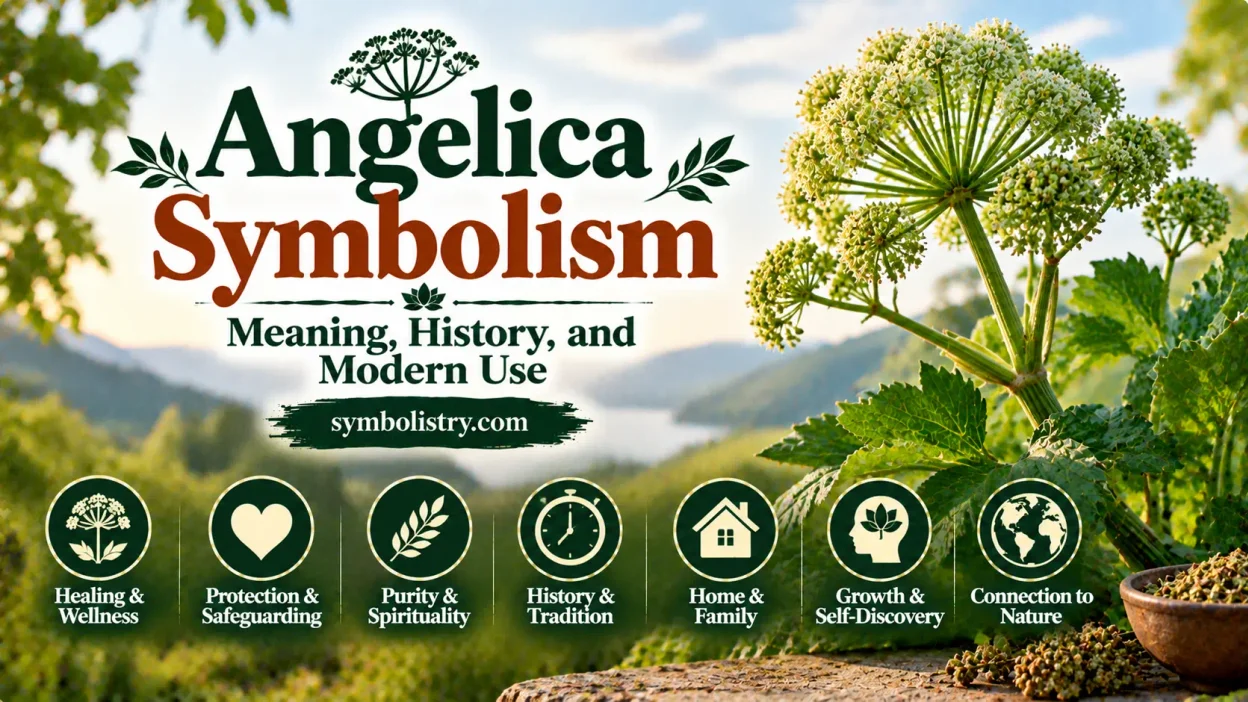
Angelica is a tall, aromatic flowering plant known for its rounded clusters of small flowers, hollow stems, and long history in traditional herbal practices. In angelica symbolism, the plant is commonly associated with protection, healing, purity, and spiritual guidance, reflecting the beliefs that developed around its name, appearance, and traditional uses.
For centuries, angelica has occupied a distinctive place in European folklore, monastery gardens, and herbal traditions. Its reputation grew from the belief that it could help protect people against illness and harmful influences. The plant’s name, which is connected to the word angelic, also encouraged associations with heavenly care and divine intervention.
Today, angelica can appeal to gardeners, herbal enthusiasts, artists, and people interested in botanical symbolism. Its meaning is especially relevant when exploring how ordinary plants acquire cultural importance through traditional medicine, religious belief, folklore, and personal experience.
Quick Answer
Angelica commonly symbolizes protection, healing, purity, and hope in modern American culture, particularly in botanical art, gardens, and nature-inspired designs. Historically, European folklore and Christian traditions associated the plant with angelic protection and protection against illness, although these beliefs should be understood as cultural traditions rather than proven supernatural effects.
TL;DR
- Protection: Angelica was traditionally believed to guard against illness and harmful influences.
- Healing: Its symbolism reflects its long history in European herbal medicine.
- Purity: White flower clusters and its angelic name encourage associations with innocence.
- Spiritual guidance: Christian folklore connected the plant with heavenly protection.
- Hope: Its spring growth suggests renewal, resilience, and recovery.
- Modern use: Angelica appears in gardens, botanical illustration, herbal traditions, and nature-inspired art.
What Is Angelica, and Why Does It Matter Symbolically?
Angelica usually refers to plants in the genus Angelica, part of the carrot family, Apiaceae. One well-known species, Angelica archangelica, is native to northern Europe and parts of Asia and has a history of cultivation for culinary and traditional herbal purposes.
The plant can grow quite tall, producing sturdy, often hollow stems, divided leaves, and broad, rounded flower clusters made up of many small blossoms. Depending on the species and growing conditions, its flowers may appear greenish-white or creamy white, giving the plant a delicate appearance despite its substantial size.
Angelica’s symbolism comes from several overlapping sources. Its name suggests a connection with angels, its traditional medicinal reputation encouraged associations with healing, and its vigorous growth made it a useful subject for thinking about endurance and renewal.
Unlike a universally recognized emblem such as a national flag, angelica has no single fixed meaning. Its interpretation depends on whether someone encounters it in a historical herbal text, a religious legend, a garden, or a contemporary artwork.
The Core Symbolic Meanings of Angelica
Four meanings appear particularly often in interpretations of angelica: protection, healing, purity, and spiritual care. Hope and renewal are also reasonable modern associations, especially when the plant is used in botanical imagery.
Protection is closely tied to angelica’s place in European folklore. People once believed that certain plants could help ward off disease or harmful forces, and angelica acquired a reputation as a protective herb.
Healing reflects the plant’s historical use in traditional herbal practices. Its association with healing developed from the idea that a useful medicinal plant could help restore health and support the body.
Purity comes partly from the plant’s pale flowers and partly from its angelic name. White flowers have been used in many settings to express innocence, sincerity, reverence, or spiritual cleanliness, although these meanings vary across cultures.
Spiritual guidance reflects the Christian imagery attached to the plant in European tradition. The idea of angelic care made angelica a natural symbol for people who wanted to express faith, comfort, or a sense of being watched over.
Hope and renewal are more interpretive than historically fixed meanings. They emerge from the plant’s return during the growing season and its association with recovery and care.
Ancient and Medieval Roots of Angelica Symbolism
The best-documented symbolic associations of angelica belong to European herbal and Christian traditions rather than to one universally shared ancient belief system.
During the medieval period, plants served practical and cultural purposes in communities where access to medical care was limited. Monasteries and other religious institutions cultivated herbs, preserved botanical knowledge, and participated in traditions that connected the natural world with divine creation.
Within this setting, a plant believed to offer protection could acquire religious associations. Angelica’s name reinforced that process, encouraging people to view it as a gift connected with heavenly assistance.
The historical record does not support the claim that every medieval European community regarded angelica in the same way. Nor should the plant be assigned a single, precisely dated origin story without reliable evidence. Its symbolism developed through overlapping traditions rather than one universally accepted founding event.
This distinction matters because modern retellings sometimes present plant folklore as though it were an established religious doctrine. Angelica’s history is better understood as a combination of practical herbal knowledge, Christian interpretation, and popular belief.
The Legend of the Archangel and the Plant’s Name
One familiar European tradition connects angelica with the archangel Michael. In versions of the story, the plant is revealed or recommended as a remedy during a time of disease, making it a sign of divine assistance.
The botanical name Angelica archangelica helped reinforce this association. The word angelica evokes angels, while archangelica connects the species’ name even more directly with the language of archangels.
The legend is important because it explains why the plant came to represent more than medicinal usefulness. If a plant was believed to have been revealed through heavenly intervention, using or growing it could become an expression of gratitude, hope, or religious trust.
However, the story should be treated as folklore, not as a verified historical event. It is one explanation for the plant’s reputation, not evidence that an angel delivered it or that it possesses supernatural powers.
For modern readers, the legend offers a useful example of how names influence symbolism. A plant’s appearance and practical uses matter, but the stories people tell about it can shape its cultural identity just as strongly.
Angelica and Traditional Herbal Healing
Angelica’s association with healing is grounded in its documented history as a traditional herb. Different species have been used in herbal preparations, and Angelica archangelica has also served culinary purposes, including flavoring certain foods and beverages.
In earlier communities, useful plants were valuable resources. Their cultivation and preparation required knowledge passed between generations, and their perceived benefits could give them a place in household customs and local folklore.
That practical role helped create a symbolic connection between angelica and recovery. The plant came to represent the hope that illness might be relieved, strength restored, and ordinary life resumed.
It is important to distinguish traditional use from modern medical evidence. Historical reputation does not establish that angelica treats a particular condition or protects people from infection. Plants in this genus can also be confused with other members of the carrot family, some of which are dangerously toxic.
The symbolic association with healing remains meaningful even when separated from medicinal claims. In art or personal reflection, angelica can represent care, restoration, and the desire to feel well again without implying that the plant itself guarantees a health benefit.
What Angelica Symbolizes in the United States
In the United States, angelica is less widely recognized as a cultural symbol than familiar plants such as the rose, oak, or lily. Its meanings are therefore usually encountered through gardening, herbal interests, botanical illustration, and broader nature-inspired spirituality rather than through major national customs.
American interpretations often draw on inherited European folklore. Someone familiar with traditional herbal history may see angelica as a protective plant, while a gardener may associate it with natural beauty, resilience, and the seasonal rhythms of growth.
Its white flower clusters can also fit into decorative themes involving simplicity, serenity, and botanical elegance. In a painting or garden design, these visual qualities may communicate calm or understated beauty without making a specific religious statement.
Angelica’s relative obscurity gives it another modern use: it can serve as a personal symbol rather than a standardized cultural emblem. Someone might choose it to represent recovery, a new beginning, or a connection to family herbal traditions.
These interpretations are possibilities, not universal American beliefs. The plant’s meaning depends on the person, the setting, and the story attached to it.
Angelica in Christianity and Spiritual Interpretation
Angelica’s association with angels makes it relevant to some Christian interpretations of the natural world. The plant can evoke divine care, providence, and the belief that creation may offer reminders of spiritual truths.
The traditional connection with Saint Michael, an archangel associated in Christian tradition with protection against evil, strengthens the plant’s protective associations in some accounts. However, angelica is not a universally established Christian symbol, and it does not have the same official religious status as the cross or the dove.
Outside explicitly Christian settings, the plant may be interpreted more broadly as a reminder of guidance, comfort, or the possibility of finding help during difficult periods. In this context, the angelic association functions as personal imagery rather than a claim about a specific religious teaching.
Respectful interpretation means distinguishing individual spirituality from formal doctrine. A person may find angelica meaningful as a symbol of faith without assuming that every Christian shares the association.
Cross-Cultural Perspectives on Angelica
Angelica’s symbolic history is especially associated with Europe, but plants in the same genus have been used in different cultural and medicinal traditions.
In East Asian herbal traditions, certain Angelica species have their own established histories. For example, Angelica sinensis, often called dong quai, has a place in traditional Chinese medicine. Its historical uses and cultural associations should not automatically be transferred to Angelica archangelica.
This distinction is important because botanical names can cover plants that differ in appearance, preparation, and cultural context. A meaning associated with one species does not necessarily apply to another.
European folklore emphasizing angelic protection also differs from the ways other traditions understand medicinal plants. Some traditions focus on particular bodily functions, seasonal customs, or inherited systems of herbal knowledge rather than angelic associations.
There is no sound basis for claiming that angelica symbolizes the same thing in every culture. Its symbolism is a reminder that plants gain meaning through specific histories, languages, religious beliefs, and practical uses.
The Emotional and Psychological Meaning of Angelica
Angelica can evoke comfort because its traditional associations bring together care, protection, and the hope of recovery. For someone dealing with a difficult transition, these ideas may offer a way to express the desire for stability and reassurance.
Its upright stems and broad flower clusters can suggest strength paired with delicacy. The plant is visually substantial without relying on the dramatic appearance of a large tree or a brightly colored ornamental flower.
The name itself also shapes perception. Words associated with angels may encourage people to see the plant as gentle, benevolent, or spiritually reassuring before they know much about its botanical history.
These responses are personal and culturally influenced, not universal psychological effects. A person who has never encountered angelica folklore may simply appreciate its appearance, while someone familiar with the tradition may connect it with protection or healing.
This flexibility is part of its appeal as a symbol. Angelica can express a private hope or memory without requiring everyone who sees it to interpret it in the same way.
Angelica Symbolism in Gardens, Art, and Home Decor
Angelica’s tall stems and rounded flower heads make it visually distinctive in cottage gardens, naturalistic planting schemes, and botanical illustrations. Its form can contribute to a sense of abundance, structure, and connection with the natural world.
In a garden, angelica may symbolize patience and seasonal renewal. Its growth reminds viewers that plants develop over time, and its flowering stage can become a marker of change in the landscape.
In artwork, the plant can carry more specific associations. An illustration paired with other medicinal herbs might suggest traditional knowledge, while a composition emphasizing its pale flowers and open form could convey simplicity or quiet contemplation.
Home decor offers another possibility. Botanical prints, pressed-plant-inspired designs, and garden-themed textiles can incorporate angelica as an understated alternative to more familiar floral motifs.
These uses should not be mistaken for established conventions. Angelica has no widely standardized decorative meaning in the United States, so the artist or homeowner usually determines the interpretation through context.
Why People May Choose Angelica for Tattoos and Jewelry
Angelica is a relatively uncommon tattoo or jewelry motif, especially compared with roses, lilies, olive branches, and other widely recognized botanical symbols. Its appeal may lie in its personal associations rather than in a meaning that others immediately recognize.
Someone might choose an angelica design to represent recovery after a difficult experience, a family connection to gardening or herbal practices, or a sense of spiritual reassurance. A person interested in botanical history may also appreciate the plant because it connects natural science with folklore.
The visual treatment influences the message. A fine-line illustration can emphasize botanical detail, while a design incorporating an angel wing or a subtle halo may make the protective association more explicit.
Jewelry inspired by angelica could use its flower clusters or leaves as a distinctive natural motif. In these cases, the symbolism is most effectively communicated when the wearer understands what the plant represents to them.
Angelica tattoos do not have a universally recognized meaning, and there is no established rule that they signify a particular religious commitment. Their significance comes primarily from personal intention and the design’s surrounding details.
Angelica in Food, Fragrance, and Everyday Culture
Angelica has practical uses that extend beyond the symbolic world. Certain species are cultivated for their aromatic qualities, and Angelica archangelica has been used in confectionery, preserves, and flavoring.
Its stems have historically been candied, while other parts of the plant have appeared in traditional preparations. Angelica is also used as a flavoring ingredient in some beverages and botanical blends.
These uses can shape its cultural associations. A person who knows angelica through food may connect it with hospitality, craft, and inherited recipes rather than protection or spiritual guidance.
Fragrance and botanical products can also draw attention to the plant’s distinctive aromatic character. In such settings, it may represent natural ingredients or traditional plant knowledge, although the exact association depends on the product and its presentation.
The plant’s everyday uses show why symbolism rarely develops in isolation. The same species can function as a practical ingredient, a garden plant, a subject of folklore, and a personal emblem.
A Quick Comparison of Angelica’s Symbolic Meanings
| Context | Common Interpretation | Historical or Cultural Basis | Important Note |
|---|---|---|---|
| European folklore | Protection | Traditional beliefs about protective herbs | Folklore, not proof of supernatural effects |
| Herbal history | Healing and recovery | Longstanding medicinal traditions | Traditional use does not establish medical effectiveness |
| Christian-associated stories | Angelic care and guidance | Legends connecting angelica with archangels | Not an official universal Christian emblem |
| Gardens and botanical art | Renewal and natural beauty | Seasonal growth and distinctive flower clusters | Often a modern personal interpretation |
| Tattoos and jewelry | Hope, recovery, or private faith | Individual associations with the plant | No standardized tattoo meaning |
| Food and fragrance | Craft and botanical heritage | Culinary and aromatic uses | Associations depend on the specific context |
Common Misunderstandings About Angelica Symbolism
One frequent misunderstanding is that angelica has a single, universal spiritual meaning. In reality, its associations developed through particular European traditions, and modern interpretations can differ considerably.
Another mistake is treating the legend of Saint Michael as documented fact. The story belongs to folklore, and its cultural influence can be discussed without presenting it as a verified supernatural event.
It is also misleading to assume that every plant called angelica has the same symbolic or medicinal properties. The genus includes multiple species, and the history of one should not be treated as interchangeable with the history of another.
Finally, protection and healing are symbolic associations, not guarantees of physical safety. Angelica should not be treated as a substitute for medical care or as a plant that can automatically prevent illness.
Accurate interpretation does not diminish the plant’s appeal. Instead, it makes the symbolism more meaningful by showing how practical experience, religious imagination, and cultural storytelling contributed to its reputation.
How Angelica’s Meaning Has Evolved Over Time
Angelica’s symbolic development reflects a shift in how people encounter plants and interpret their usefulness.
In historical herbal settings, its practical value and reputation for protection were closely connected. When a plant was believed to help during illness, that reputation could become part of a larger story about providence, faith, and survival.
Religious folklore gave the plant an additional layer of meaning, particularly through its association with angels and Saint Michael. Its name helped preserve that connection even as many people became less familiar with the original herbal traditions.
In contemporary settings, angelica’s meaning is often less tied to traditional medicine. Gardeners may value its appearance, artists may use it as a botanical subject, and individuals may interpret it as a sign of hope or personal recovery.
The change is not a complete break with the past. Protection and healing remain recognizable themes, but they are now frequently expressed as personal values or artistic ideas rather than shared community beliefs.
Angelica illustrates how a symbol can retain its historical associations while acquiring new meanings that reflect the interests of the people who use it.
Frequently Asked Questions About Angelica Symbolism
What does angelica symbolize spiritually?
Angelica is commonly associated with protection, divine care, spiritual guidance, and hope because of its name and European Christian folklore. These associations are traditional and personal rather than universal religious teachings.
Is angelica considered a symbol of protection?
Yes, protection is one of angelica’s best-known historical associations in European folklore. The belief developed partly from its traditional reputation as an herb used during times of illness and from stories connecting it with angelic intervention.
What does an angelica tattoo mean?
An angelica tattoo may represent recovery, reassurance, faith, or a connection to botanical traditions. Because the design is uncommon, its meaning is usually personal and may need explanation to people unfamiliar with the plant.
Is angelica associated with angels or archangels?
Yes, European folklore includes stories linking angelica with Saint Michael and heavenly assistance. The plant’s name reinforces this connection, but the legend should not be confused with an official belief shared by all Christian denominations.
Does angelica symbolize healing?
Angelica is associated with healing because of its historical role in traditional herbal practices. This is a cultural and symbolic connection, not proof that the plant can cure illness or replace evidence-based treatment.
Is angelica symbolism positive or negative?
Angelica is generally interpreted positively, with associations such as protection, care, recovery, and spiritual comfort. Its meaning can still depend on the context, although it has no widely established negative symbolic interpretation in mainstream American culture.
Can angelica symbolize new beginnings?
Yes, angelica can symbolize renewal and new beginnings in contemporary botanical art and personal interpretation. This meaning comes from the plant’s seasonal growth and its association with recovery, rather than from one fixed historical tradition.
Conclusion
Angelica brings together botanical beauty, traditional herbal knowledge, and European folklore. Its most recognizable associations are protection, healing, purity, and spiritual care, while modern interpretations often extend to hope, recovery, and renewal.
Understanding angelica symbolism means recognizing both its history and its limits. The plant’s association with angels and healing reflects the stories and practices of particular communities, not a universal doctrine or a guarantee of supernatural or medical benefits.
Today, angelica can serve as a thoughtful botanical symbol for people drawn to its appearance, history, or personal associations. Its meaning is most compelling when the plant is understood not as a mysterious emblem, but as a living part of the cultural relationship between people, nature, and the stories they preserve.