Chrysanthemums are among the most recognizable flowers of autumn, appearing in American gardens, front porches, floral arrangements, and Thanksgiving decorations. Their full, layered petals and wide range of colors make them visually striking, but chrysanthemum symbolism extends beyond their appearance. Depending on the culture, the flower can represent happiness, longevity, loyalty, nobility, or mourning.
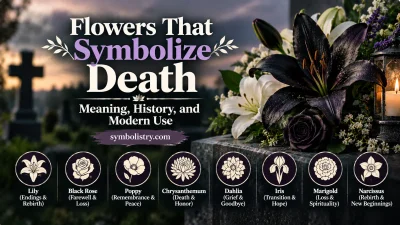
In the United States, chrysanthemums, commonly called mums, are strongly associated with fall, friendship, and seasonal celebrations. They are also the traditional birth flower for November, making them a popular choice for birthday bouquets and autumn gifts. Yet their meanings are not universal. In Japan, the flower has close connections to the imperial family, while in parts of Europe it is closely associated with funerals and remembrance.
Understanding these different interpretations reveals why one flower can communicate celebration in one setting and grief in another. Its meaning depends on cultural traditions, color, personal experience, and the occasion on which it appears.
Quick Answer: What Does Chrysanthemum Symbolism Mean?
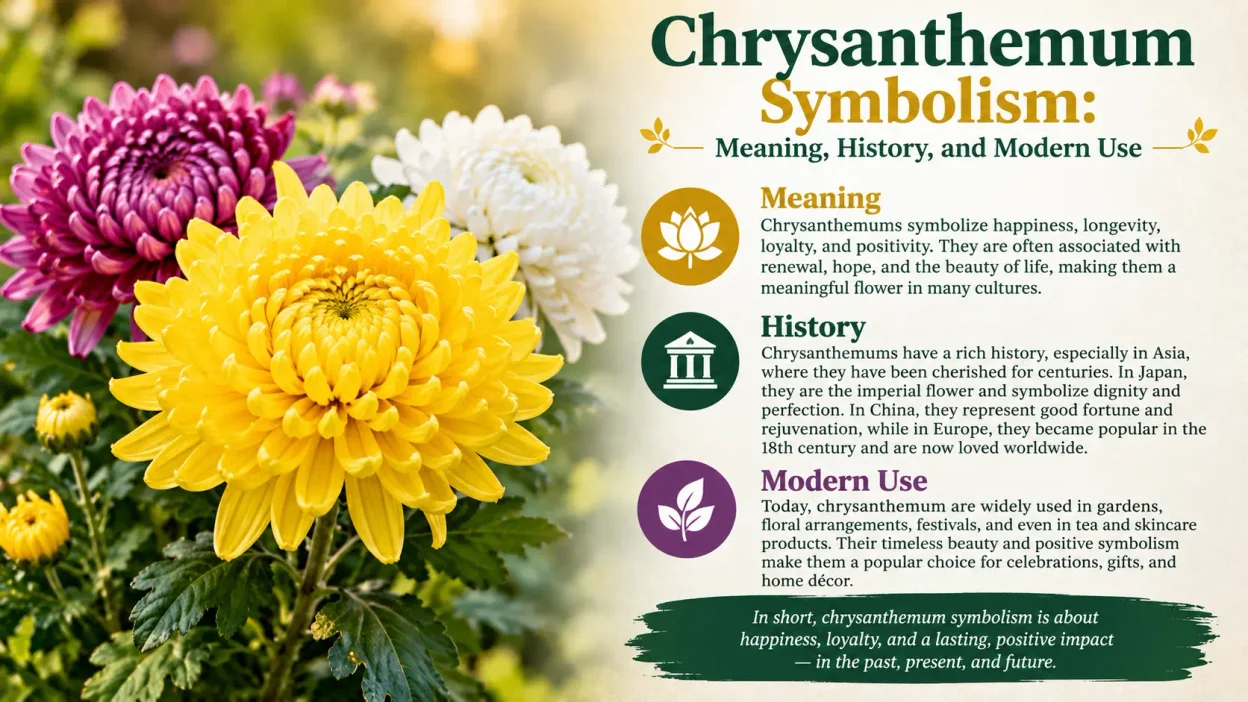
Chrysanthemum symbolism in modern American culture most commonly represents happiness, friendship, longevity, and the warmth of autumn. Historically, chrysanthemums have also symbolized nobility, endurance, and long life in East Asian traditions, while some European cultures associate them with death and remembrance.
TL;DR
- Happiness: Bright chrysanthemums are associated with cheerfulness and positive feelings.
- Longevity: Chinese traditions connect the flower with long life and vitality.
- Royalty: The chrysanthemum holds an important place in Japanese imperial symbolism.
- Autumn: American mums represent fall gardens, harvest celebrations, and seasonal abundance.
- Remembrance: In several countries, chrysanthemums are traditional flowers for honoring the dead.
- Personal expression: Color, setting, and cultural background influence the flower’s meaning.
1. What Chrysanthemums Look Like and Why Their Form Matters
Chrysanthemums belong to the daisy family, Asteraceae. Although a single bloom may look like one large flower, it is actually a collection of many small individual florets arranged into a flower head.
Their appearance varies considerably. Some have broad, overlapping petals that form rounded cushions; others feature narrow, curled, spoon-shaped, or spiderlike petals. They grow in shades of white, yellow, gold, bronze, orange, pink, red, purple, and green.
This variety contributes to their symbolism. Rounded, abundant blooms can suggest fullness and prosperity, while their numerous petals create an impression of order and completeness. Golden chrysanthemums naturally evoke sunlight and harvest, and deep red varieties can suit romantic or celebratory arrangements.
The flower’s late-season blooming habit adds another layer. When many summer flowers begin to fade, chrysanthemums continue to provide color. Their presence near the end of the growing season makes them a natural emblem of persistence, seasonal change, and beauty that lasts beyond summer.
2. The Core Symbolic Meanings of Chrysanthemums
Several meanings recur across chrysanthemum traditions, although their importance varies by region.
Happiness and cheerfulness are prominent associations in contemporary American gardening and floral design. Bright yellow, orange, and pink mums often communicate warmth, celebration, and optimism.
Longevity and vitality come largely from East Asian traditions, particularly historical Chinese associations between chrysanthemums, herbal use, and long life. The flower’s autumn flowering also connects it with endurance.
Honor and nobility are especially important in Japanese symbolism, where the chrysanthemum became closely connected with the imperial household.
Friendship and loyalty are common interpretations in modern flower gifting. A bouquet of mums can express appreciation without necessarily suggesting romance.
Mourning and remembrance appear in traditions where chrysanthemums are used at funerals and graves. This meaning is particularly prominent in parts of continental Europe and also occurs in East Asian memorial customs.
These meanings should not be treated as a universal dictionary. A chrysanthemum’s message is shaped by the culture in which it is given and the circumstances surrounding it.
3. Ancient Chinese Origins and the Symbol of Longevity
Chrysanthemums have been cultivated in China for many centuries, with historical records and artistic traditions connecting them to ornamental gardening, food, and herbal practices.
Early cultivation was not limited to decoration. Certain chrysanthemums were used in teas and other preparations, helping establish associations with health, vitality, and longevity. Traditional beliefs about the flower’s benefits contributed to its reputation as a plant connected with a long and flourishing life.
The chrysanthemum also became a subject of Chinese poetry and painting. Its ability to flower in autumn, when temperatures fall and other plants become less prominent, made it a fitting emblem of perseverance and self-possession.
In traditional Chinese art, the flower is associated with the Four Gentlemen, a group of plants used to express admired qualities of character. The chrysanthemum is particularly connected with autumn and the ability to maintain one’s integrity despite changing circumstances.
These artistic associations helped move the flower beyond its practical uses. It became a way to communicate refinement, restraint, and a steady character rather than simply a preference for a beautiful garden.
4. Japanese Chrysanthemum Symbolism, Royalty, and Honor
In Japan, the chrysanthemum, known as kiku, has a particularly distinguished cultural position. It is closely associated with the imperial family, and a stylized sixteen-petaled chrysanthemum appears in important imperial emblems.
This connection gives the flower meanings of dignity, authority, honor, and continuity. Unlike an ordinary decorative bloom, the imperial chrysanthemum carries associations with national history and the institution of the monarchy.
Chrysanthemums also feature in Japanese seasonal celebrations, traditional arts, and flower displays. The flower’s carefully arranged petals and varied cultivated forms have made it a subject of horticultural appreciation as well as cultural expression.
The Japanese observance known as the Chrysanthemum Festival, traditionally associated with the ninth day of the ninth lunar month, is linked to happiness and longevity. Chrysanthemums also appear in the wider tradition of autumn flower viewing.
However, the flower does not have one fixed meaning for every Japanese person or occasion. Imperial emblems, garden chrysanthemums, and white flowers used in memorial settings may communicate very different things.
Its Japanese symbolism demonstrates how a plant can acquire national significance through a combination of artistic tradition, seasonal customs, and historical institutions.
5. What Chrysanthemums Symbolize in the United States
In the United States, chrysanthemums are primarily associated with fall, cheerful color, and seasonal decoration. Their popularity rises as temperatures cool and gardens transition from summer flowers to autumn displays.
Garden centers sell potted mums for porches, steps, patios, and outdoor planters. Florists incorporate them into seasonal bouquets, while homeowners use them to decorate entryways and tables. In these settings, chrysanthemums suggest hospitality, abundance, and a welcoming home.
The flower is also associated with homecoming celebrations and school spirit in some communities. Decorative mums worn or carried at homecoming events can include ribbons, charms, and school colors. This practice gives the flower a social meaning that goes beyond its botanical identity.
Chrysanthemums are especially familiar in Thanksgiving displays, where their gold, bronze, orange, and burgundy shades complement pumpkins, gourds, and autumn foliage. The flowers help express appreciation for the season and the gathering of family and friends.
November birthdays provide another established connection. As the traditional birth flower for November, chrysanthemums offer a seasonal alternative to roses and other flowers available year-round.
Unlike in some European countries, chrysanthemums in most American settings are not reserved for funerals. They are widely sold as ordinary ornamental plants and are generally understood as positive, festive flowers.
6. Chrysanthemums as Symbols of Friendship and Emotional Support
Chrysanthemums can express affection without carrying the intensity of a traditional romantic bouquet. Their associations with cheerfulness and loyalty make them suitable for friends, relatives, coworkers, and people celebrating an everyday milestone.
A bright arrangement can communicate congratulations, appreciation, or a simple wish to improve someone’s day. Potted mums can be particularly appropriate as gifts because the recipient can continue enjoying the plant after the occasion has passed.
Their emotional effect is also connected to color and setting. Yellow and orange flowers may suggest warmth and energy, while pink varieties can feel gentle and affectionate. White blooms may communicate sincerity or respect, although their interpretation depends on cultural context.
Chrysanthemums can also serve as a quiet gesture of encouragement. Because they are associated with autumn and continued flowering, they can suggest maintaining hope during a period of transition. This is a personal interpretation rather than a universal traditional meaning, but it helps explain their appeal in thoughtful gifts.
A useful distinction is that flowers do not automatically communicate a precise message. The relationship between giver and recipient, the accompanying words, and the occasion often matter more than a formal list of flower meanings.
7. Chrysanthemum Color Meanings
Color can change how a chrysanthemum arrangement is understood. Some associations come from traditional flower-language guides, while others reflect contemporary design conventions.
| Chrysanthemum color | Common associations | How it may be used |
|---|---|---|
| Yellow or gold | Happiness, warmth, friendship, and autumn | Fall décor, congratulations, friendly gifts |
| Red | Love, affection, and romantic interest | Romantic bouquets or expressions of devotion |
| White | Sincerity, purity, respect, or mourning | Formal arrangements, ceremonies, and memorials |
| Pink | Tenderness, appreciation, and affection | Gifts for friends, relatives, and partners |
| Purple | Dignity, elegance, and admiration | Celebratory bouquets and refined floral designs |
| Orange or bronze | Energy, warmth, harvest, and seasonal abundance | Thanksgiving displays and autumn arrangements |
These interpretations are flexible rather than fixed rules. In Victorian flower-language traditions, red chrysanthemums could indicate love, while yellow ones were sometimes associated with slighted or neglected love. Modern American shoppers are more likely to read yellow mums as cheerful fall flowers than as a coded complaint.
White chrysanthemums require particular care when choosing flowers for international occasions. In some cultures, white is associated with mourning, while in others it can suggest honesty, purity, or respect. When the recipient’s cultural background is known, it is worth considering those conventions.
The overall arrangement matters too. A mixed bouquet of gold, red, and pink chrysanthemums may communicate celebration, whereas a restrained arrangement of white blooms may feel more formal or contemplative.
8. Autumn, Harvest, and the November Birth Flower
Few flowers are as closely connected with the American autumn season as chrysanthemums. Their flowering period overlaps with cooler weather, fall festivals, harvest displays, and Thanksgiving preparations.
Their seasonal symbolism comes partly from timing. Mums bring fresh color to gardens after many summer flowers have faded, so they can represent the beauty and abundance of the year’s later months.
Gold and bronze varieties resemble the colors of fallen leaves, ripened crops, and autumn sunlight. Grouped with pumpkins, dried grasses, and gourds, they reinforce the familiar visual language of the American harvest season.
As November’s birth flower, the chrysanthemum also carries personal significance. It offers a way to connect a birthday with the season and with traditional ideas of cheerfulness, friendship, and long life.
The flower is not itself a universal symbol of Thanksgiving, nor does every family associate it with the holiday. Its connection is primarily cultural and decorative: Americans encounter mums repeatedly during the same period when harvest imagery and family gatherings become prominent.
For that reason, chrysanthemums work well in both casual seasonal decoration and more formal autumn arrangements. Their meaning can be celebratory without requiring an elaborate explanation.
9. Chrysanthemums in Victorian Flower Language
During the nineteenth century, flower dictionaries and floral arrangements became popular ways of expressing feelings indirectly. This practice, often called floriography, assigned particular meanings to flowers and sometimes to their colors.
Chrysanthemums appeared in this tradition with associations that included cheerfulness, friendship, and rest. Some guides assigned more specific meanings to different colors, creating a system in which the same flower could communicate different emotions.
Red chrysanthemums were associated with love, while yellow chrysanthemums could suggest slighted affection. These interpretations reflected the conventions of particular flower dictionaries rather than an internationally agreed code.
The Victorian system is worth understanding because it continues to influence modern flower-meaning articles and gift advice. However, its historical meanings should not be treated as universal truths or assumed to be widely understood by contemporary recipients.
Today, someone who receives yellow chrysanthemums in the United States is more likely to see a friendly, seasonal gesture than a criticism of neglected affection. Victorian flower language provides historical context, but modern use is guided more strongly by color, occasion, and personal taste.
10. Chrysanthemums in European Mourning Traditions
In several European countries, chrysanthemums have a strong association with funerals, cemeteries, and remembrance of the dead. This differs markedly from the flower’s cheerful role in many American gardens.
In places such as France and Italy, chrysanthemums are commonly associated with memorial observances around early November, when families visit graves and place flowers in remembrance. The flower’s seasonal availability makes it particularly suited to these traditions.
In such settings, chrysanthemums communicate respect for the deceased, grief, and the continuation of family remembrance. Their meaning is not necessarily negative; rather, it reflects a culturally established way of honoring those who have died.
The contrast with American usage can cause confusion. A bouquet intended as a cheerful birthday gift in the United States might be interpreted differently by someone accustomed to seeing chrysanthemums primarily at cemeteries.
Even within Europe, practices vary by country, region, flower type, and occasion. It would be inaccurate to say that every European culture treats all chrysanthemums as funeral flowers.
The broader lesson is that floral symbolism is learned socially. Repeated use in a particular setting can shape a flower’s emotional associations more strongly than its appearance alone.
11. Religious, Spiritual, and Philosophical Interpretations
Chrysanthemums do not have one universal religious meaning. Their spiritual associations are shaped largely by regional customs, artistic traditions, and the beliefs attached to the natural world.
In Chinese cultural traditions, the flower’s connection with autumn and longevity has given it a place in poetry and art concerned with character, aging, and the passage of time. Its ability to flower in cooler weather can suggest steadiness in the face of change.
In Japan, the chrysanthemum’s imperial associations give it cultural and historical importance, although imperial symbolism should not be confused with a single religious doctrine.
In memorial settings, chrysanthemums can take on a spiritual role through their use in honoring the dead. The flower may represent remembrance, respect, or the enduring bond between family members across generations.
For contemporary Americans, a chrysanthemum may also serve as a personal reminder to appreciate seasonal change or remain resilient during difficult periods. Such interpretations can be meaningful, but they are personal reflections rather than established religious rules.
There is no sound basis for claiming that chrysanthemums universally attract luck, guarantee long life, or possess supernatural powers. Traditional beliefs deserve explanation without being presented as proven effects.
12. The Psychological Appeal of Chrysanthemums
The emotional associations of chrysanthemums arise partly from how people experience color, shape, season, and familiar cultural settings.
Their full flower heads can create an impression of abundance. Massed together in a garden or planter, they produce a dense field of color that feels welcoming and visually complete. This makes them effective in spaces intended for hospitality and celebration.
Warm shades such as yellow, orange, and bronze often appear in autumn design because they echo the surrounding landscape. People may associate these colors with harvest foods, falling leaves, warm interiors, and seasonal gatherings.
The flower’s timing can also shape its emotional meaning. Seeing blooms appear as days grow shorter may suggest continuity during a period of transition. For someone who enjoys gardening, chrysanthemums can represent the satisfaction of maintaining a colorful outdoor space late into the year.
These reactions are not identical for everyone. A person who associates chrysanthemums with a family funeral may experience them differently from someone who remembers them as a cheerful fixture on a childhood porch.
Personal memory, therefore, is an important part of floral symbolism. Cultural traditions provide a starting point, but individual experience often determines what the flower ultimately means.
13. Chrysanthemums in Tattoos, Fashion, and Modern Design
Chrysanthemums are popular subjects in floral artwork and tattoo design because their layered petals create intricate patterns and recognizable silhouettes. Their symbolism can be adapted to suit different styles without requiring the design to communicate a single fixed meaning.
In Japanese-inspired tattoo traditions, chrysanthemum designs may draw on established associations with honor, longevity, and Japanese artistic heritage. Such imagery should be approached with an understanding of its cultural context, especially when combined with other motifs that carry their own historical meanings.
A red chrysanthemum tattoo might be chosen to represent affection, while a golden bloom could serve as a reminder of autumn, family traditions, or personal resilience. White chrysanthemums may express remembrance for someone who has died, depending on the individual’s experience.
Outside tattoo culture, chrysanthemums appear in textile patterns, illustrations, greeting cards, table settings, and home accessories. Their symmetrical forms work well in both traditional decorative styles and contemporary graphic designs.
On social media, images of mums often accompany autumn activities, gardening projects, seasonal outfits, and Thanksgiving preparations. In these contexts, the flower functions as a visual marker of the season as much as a symbol with a specific emotional message.
For personal design, the most useful approach is to choose the flower for the meaning that matters to the wearer or creator rather than relying on a rigid universal definition.
14. Common Misunderstandings About Chrysanthemum Symbolism
One common misconception is that chrysanthemums always symbolize death. This interpretation comes from real mourning traditions in certain countries, but it does not accurately describe their everyday meaning in the United States.
The opposite assumption—that chrysanthemums are universally cheerful—is also incomplete. Their cultural associations vary, and white varieties in particular may have strong memorial meanings in some places.
Another misunderstanding involves color symbolism. Lists that assign one precise emotion to every color can make flower meanings appear more standardized than they are. Historical guides disagree, and modern recipients may not recognize older associations at all.
It is also easy to confuse botanical facts with symbolic claims. The chrysanthemum’s historical use in traditional remedies helps explain its association with vitality, but that history does not mean the flower itself guarantees health or longevity.
Finally, the flower’s imperial status in Japan should not be generalized to all East Asian cultures or interpreted as evidence of identical beliefs throughout the region. China, Japan, Korea, and other societies have distinct histories and customs, even where some floral associations overlap.
Understanding these distinctions allows the chrysanthemum to be appreciated without flattening its cultural variety into one simplified meaning.
15. How Chrysanthemum Symbolism Has Changed Over Time
The chrysanthemum’s symbolic history reflects the movement of plants, ideas, and traditions between societies. Its early roles in Chinese cultivation connected it with practical uses, seasonal change, and longevity. Artistic traditions added associations with character and refinement.
In Japan, the flower acquired an especially prominent imperial identity. In Europe, its introduction into horticulture eventually overlapped with local mourning customs, helping establish meanings different from those found in East Asia.
In the United States, chrysanthemums became widely familiar as ornamental plants and fall decorations. Their role in gardens, homecoming events, and November birthday gifts reinforced a predominantly cheerful interpretation.
Modern floral commerce and digital culture continue to circulate different meanings at the same time. A person may encounter chrysanthemums as a symbol of long life in an Asian art context, a memorial flower in a European tradition, or a festive seasonal plant in an American garden.
These interpretations are not necessarily contradictory. They show how symbolism develops through repeated cultural use rather than remaining permanently attached to a plant.
The chrysanthemum’s meaning continues to evolve as people use it to express family memory, personal identity, seasonal appreciation, and cultural belonging.
Frequently Asked Questions
1. What does a chrysanthemum symbolize spiritually?
Chrysanthemums can represent longevity, endurance, honor, and remembrance, depending on the cultural tradition. Their spiritual associations are most meaningful when understood within the specific beliefs and customs that give them context.
2. What does a chrysanthemum tattoo mean?
A chrysanthemum tattoo may represent resilience, longevity, love, remembrance, or personal growth. In Japanese-inspired designs, it may also reference traditional associations with honor and imperial imagery.
3. Are chrysanthemums considered funeral flowers in the United States?
No, chrysanthemums are not generally reserved for funerals in the United States. They are widely used in autumn decorations, birthday bouquets, gardens, and celebratory arrangements, although they can also appear in sympathy flowers.
4. What does a yellow chrysanthemum mean?
Yellow chrysanthemums commonly suggest happiness, warmth, friendship, and autumn in modern American settings. Some Victorian flower dictionaries associated yellow varieties with neglected or slighted love, but this interpretation is not a universal modern convention.
5. Why are chrysanthemums associated with Japan’s imperial family?
The chrysanthemum became an important emblem of the Japanese imperial household, and a stylized sixteen-petaled design is used in imperial symbolism. This historical connection gives the flower associations with dignity, authority, and continuity.
6. What does a white chrysanthemum symbolize?
White chrysanthemums can symbolize sincerity, purity, respect, or remembrance, depending on the setting. They are also associated with mourning in several cultural traditions, so their suitability as a gift depends partly on the recipient’s background and the occasion.
7. Are chrysanthemums positive or negative symbols?
Chrysanthemums have both celebratory and solemn associations rather than one universally positive or negative meaning. In the United States they are usually cheerful fall flowers, while in some other countries they are strongly connected with mourning and memorial observances.
Conclusion
Chrysanthemum symbolism brings together several ideas: happiness, friendship, longevity, honor, seasonal abundance, and remembrance. Its meaning is shaped by a long cultural history that includes Chinese artistic and herbal traditions, Japanese imperial symbolism, European mourning customs, and the familiar American practice of decorating homes with mums in autumn.
For Americans today, chrysanthemums most often evoke colorful gardens, Thanksgiving displays, November birthdays, and the warmth of seasonal gatherings. Yet the flower also reminds us that symbols do not mean exactly the same thing everywhere. A bloom associated with celebration in one culture may carry a more solemn message in another.
Whether planted beside a front door, given to a friend, included in a memorial arrangement, or chosen for a tattoo, the chrysanthemum offers a way to express a personal feeling through a familiar natural form. Its enduring appeal lies in that versatility: one flower can celebrate life, honor memory, and mark the changing seasons without losing its distinctive character.