Introduction
Red lily symbolism combines the traditional meanings of the lily with the strong emotional associations of the color red. In modern American culture, red lilies can represent passionate love, devotion, courage, beauty, vitality, remembrance, and personal transformation.
The meaning is not completely fixed. A red lily can communicate something different depending on its species, color shade, setting, cultural background, and the reason someone chooses it. A bouquet given to a romantic partner may suggest passion, while a red lily used in a memorial may represent love, remembrance, or emotional strength.
The lily has a long history in Western art, religion, gardens, and floral traditions. White lilies became especially connected with purity and the Virgin Mary, while red developed associations with love, blood, sacrifice, vitality, courage, and strong emotion. Combining these traditions gives the red lily a more dramatic symbolic character.
Understanding red lily symbolism also requires separating historical meanings from modern interpretations. People in the United States today rarely follow a strict flower dictionary. Instead, they usually interpret flowers through color, occasion, personal experience, cultural associations, and visual appeal.
That flexibility is one reason red lilies can appear in romantic bouquets, weddings, gardens, tattoos, artwork, home decor, celebrations, and memorial arrangements.
Quick Answer
Red lily symbolism commonly represents passionate love, devotion, courage, beauty, vitality, remembrance, and renewal. In modern American culture, the red lily is usually understood through its dramatic red color and the traditional history of the lily, rather than through one fixed symbolic definition.
TL;DR
- Red lilies commonly symbolize passion, devotion, courage, and affection.
- Red adds intensity to the traditional symbolism of lilies.
- Lilies have strong historical roots in European religious art.
- Red lilies can represent vitality, strength, and personal transformation.
- Their meaning changes with the occasion and cultural context.
- Modern Americans rarely follow a strict flower symbolism code.
- Red lilies can carry both romantic and memorial meanings.
What Does a Red Lily Look Like?
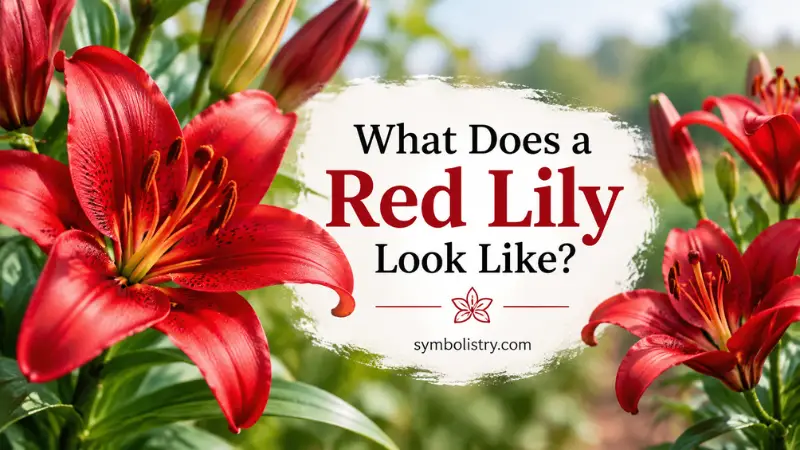
Before exploring red lily symbolism, it helps to understand why the flower makes such a strong visual impression.
True lilies belong to the genus Lilium and are known for large, noticeable flowers that grow from bulbs. Depending on the species and cultivar, lilies can appear in white, yellow, orange, pink, red, burgundy, and combinations of several colors.
Red lilies can range from bright scarlet and reddish-orange to deep crimson, wine, and burgundy. Some have solid petals, while others feature spots, stripes, darker centers, or contrasting edges.
The color immediately affects how the flower feels.
Red is one of the most visually powerful colors in floral design. It often brings associations with romance, excitement, courage, strength, blood, energy, and intense emotion. When that color appears across the large petals of a lily, the result can feel bold and expressive.
The shape of the lily adds another layer. Lily flowers can have open, star-like forms or trumpet-shaped blooms. Their large petals give them a noticeable presence, making them suitable for arrangements where the flower needs to stand out.
This combination of color and shape explains why red lily symbolism often feels more intense than the symbolism associated with softer-colored lilies.
What Does Red Lily Symbolize?
At its broadest level, red lily symbolism represents strong feeling combined with beauty and devotion. The seven most useful modern interpretations are passionate love, devotion, courage, beauty, vitality, sacrifice and remembrance, and renewal.
These meanings are not universal rules. They are interpretations built from the history of lilies, the associations of red, and the way people use flowers today.
1. Passionate Love
Passionate love is one of the clearest modern meanings associated with a red lily.
Red has a strong connection with romantic attraction in American culture. Red roses are much more established as a romantic symbol, but red lilies can communicate a similar intensity while feeling less predictable.
A red lily can represent a relationship that feels emotionally powerful, exciting, or deeply important. Its large bloom also creates a dramatic visual statement, which makes it suitable for romantic occasions.
This interpretation of red lily symbolism works especially well for anniversaries, romantic dinners, Valentine’s Day arrangements, engagements, or personal gifts between partners.
However, the flower does not automatically mean romance. If someone gives a red lily to a friend, parent, or family member, the meaning may instead be admiration, appreciation, courage, or personal affection.
The context matters more than the flower alone.
2. Devotion and Commitment
Another important part of red lily symbolism is devotion.
Lilies have appeared in religious, ceremonial, and artistic settings for centuries. Because of this history, lilies can suggest dedication, faith, commitment, and seriousness.
Red makes that message more emotionally intense.
A red lily can represent commitment to a romantic relationship, family, personal goal, belief, or important life journey. It may symbolize staying dedicated even when circumstances become difficult.
For couples, red lilies can express a relationship that is not merely exciting but also meaningful and lasting. For personal symbolism, they can represent dedication to a goal or decision.
This is especially useful when a person wants a flower that communicates both emotion and determination.
3. Courage and Strength
Courage is another strong interpretation of red lily symbolism.
Red is frequently connected with strength, determination, blood, bravery, and physical energy. These associations appear in many cultural settings, although the exact meaning of red varies between societies.
The visual strength of a red lily reinforces the idea.
Unlike a very pale flower that can feel delicate or quiet, a crimson lily demands attention. Its large petals and intense color can suggest confidence and the willingness to stand out.
A red lily can therefore become a meaningful image after overcoming a difficult experience. Someone might choose a red lily tattoo, painting, or piece of jewelry as a reminder of resilience.
In this context, the flower does not simply represent beauty. It represents the ability to remain visible and strong after hardship.
4. Beauty and Confidence
Lilies are naturally associated with beauty because of their large, symmetrical flowers and distinctive shapes.
When the flower is red, that beauty becomes more dramatic.
Red lily symbolism can therefore represent confident beauty, self-expression, and the desire to be noticed without apology. This interpretation is particularly common in artwork, fashion, tattoos, jewelry, and interior decoration.
A red lily arrangement can make a room feel elegant and dramatic. A red lily tattoo can communicate beauty while also suggesting strength.
The combination is important. The flower does not have to represent physical beauty alone. It can symbolize confidence in one’s identity, creativity, choices, or personal growth.
For someone who wants floral imagery that feels both attractive and assertive, the red lily is especially effective.
5. Vitality and Life
Red is often associated with energy and vitality.
Its connection with blood gives it a natural relationship with physical life, while its visual intensity can suggest excitement, movement, warmth, and enthusiasm.
The natural life cycle of lilies adds another layer. Lilies grow from bulbs, produce flowers during their growing season, and can return under suitable conditions.
That makes red lily symbolism useful for representing renewed energy, a fresh stage of life, or appreciation for being alive.
A person recovering from a difficult period might use a red lily as a personal reminder of strength and renewed purpose. In artwork, the flower can communicate energy without requiring a written explanation.
This meaning can also work well for birthdays, graduations, new jobs, new homes, or other milestones.
6. Sacrifice and Remembrance
Red can also create more serious meanings.
Because red has long been associated with blood, suffering, sacrifice, and intense emotional experience, red flowers can appear in artwork dealing with grief, conflict, martyrdom, or remembrance.
The lily has a separate religious history, especially in Christian art. When the two traditions overlap, a red lily can sometimes be interpreted through ideas of sacrifice, devotion, suffering, or profound love.
This does not mean that every red lily has a religious meaning.
In modern American culture, a red lily used at a memorial is more likely to communicate personal love, remembrance, respect, or emotional connection. The choice may reflect the personality of the person being remembered rather than a formal symbolic rule.
This is an important part of red lily symbolism because symbols can carry both joyful and serious meanings.
7. Renewal and Transformation
The seventh major interpretation is renewal.
Lilies grow from bulbs that remain hidden beneath the soil before producing visible flowers. Their seasonal growth makes them useful images of development, return, and renewal.
Red changes the emotional tone of that symbolism.
Instead of quiet renewal, a red lily can represent energetic transformation. It may symbolize starting again with confidence, moving through a major life transition, or becoming stronger after a difficult experience.
For tattoos, journals, personal artwork, and commemorative objects, red lily symbolism can represent a person’s decision to move forward.
The flower becomes a reminder that a difficult chapter does not necessarily define the rest of a person’s life.
Why Red Changes the Traditional Meaning of the Lily
The color of a flower cannot be separated from its symbolic interpretation.
Traditional lily symbolism is especially associated with white flowers. In European Christian art, the white lily became strongly connected with purity, chastity, and the Virgin Mary.
Red introduces a different emotional vocabulary.
Red commonly suggests romantic love, passion, vitality, courage, blood, sacrifice, and intensity. As a result, the same basic flower can communicate a very different idea when its color changes.
White lily symbolism may feel peaceful and restrained. Red lily symbolism tends to feel passionate, dramatic, courageous, and emotionally direct.
This contrast explains why it is misleading to describe every lily as having one single meaning.
The species, color, setting, and cultural tradition all contribute to interpretation.
Ancient and Medieval Roots of Lily Symbolism
The lily has a long history in Mediterranean, European, and Near Eastern cultures. However, historical references to a “lily” should be treated carefully because ancient plant names did not always correspond precisely to the modern botanical genus Lilium.
That distinction is important when discussing red lily symbolism.
Modern readers sometimes assume that every historical reference to a lily refers to the same flower recognized by botanists today. Historical plant identification was often less precise.
During the medieval period in Europe, lilies became particularly important in Christian visual culture. Artists used flowers as recognizable symbols within paintings, manuscripts, sculpture, and church decoration.
The white lily became strongly associated with the Virgin Mary because its whiteness supported ideas of purity and chastity.
This history created the foundation for many later interpretations of lilies.
The historical development also shows why modern red lily meanings should not be projected backward into every ancient tradition. The symbolism of the red flower today is partly created by combining older lily traditions with later associations of the color red.
Red Lilies and Christian Symbolism
Christian symbolism deserves careful explanation because the strongest traditional Christian association is with the white lily.
The Madonna lily, Lilium candidum, became an important symbol of Mary’s purity in Western Christian art. It appears frequently in representations of the Annunciation and other scenes involving the Virgin Mary.
Red has its own symbolism within Western Christian art.
It can represent blood, sacrifice, martyrdom, Christ’s Passion, and intense divine love. Because of these associations, a red flower appearing in religious artwork may be interpreted through themes of suffering or sacrifice.
That does not establish one universal religious definition for a red lily.
A more accurate explanation of red lily symbolism in Christian contexts is that two established visual traditions can overlap: the lily’s religious associations and the symbolic associations of red.
The meaning depends on the artwork, period, artist, and surrounding imagery.
Red Lily Symbolism in the United States
In the United States, red lily symbolism is generally flexible rather than standardized.
Americans encounter red lilies in gardens, flower shops, weddings, home decoration, botanical gardens, art, tattoos, celebrations, and memorial arrangements.
A florist may choose a red lily because it creates a dramatic centerpiece. A gardener may grow one because the color looks beautiful against green foliage. Someone buying flowers may choose lilies simply because the recipient likes them.
This practical side of American floral culture is important.
Not every flower is selected because of symbolism.
A red lily can look romantic without being intended as a romantic message. It can appear at a memorial because the person being remembered loved lilies. It can decorate a home simply because the homeowner enjoys strong colors.
Modern red lily symbolism is therefore often a combination of cultural association and personal meaning.
Red Lily Symbolism in Weddings and Romantic Relationships
Red lilies can create a bold wedding aesthetic.
They work especially well for couples who want flowers that feel passionate, elegant, dramatic, or visually distinctive. They can be paired with white flowers for contrast or combined with blush, greenery, burgundy, or darker decorative elements for a richer palette.
In romantic relationships, red lilies may communicate:
- Passion
- Attraction
- Devotion
- Commitment
- Admiration
- Celebration
- Strong affection
The red lily is particularly useful when someone wants a romantic flower that is less expected than the traditional red rose.
Red roses have a much more established romantic meaning in the United States. Red lilies offer romance while also bringing the broader symbolism of the lily.
For an anniversary or engagement, that difference can make the flower feel more personal.
Red Lily Symbolism in Holidays and Celebrations
Red flowers already have a strong place in American celebrations, so red lilies can fit many different occasions.
At Valentine’s Day, they can communicate romance and affection. During Christmas, they can complement traditional red and green decorations. At birthdays or graduations, they may suggest vitality, excitement, confidence, and celebration.
The same flower can therefore have different meanings depending on the occasion.
A red lily at a romantic dinner may represent passion. The same flower at a birthday may simply communicate joy and energy.
This flexibility is a major feature of red lily symbolism in modern America.
The occasion often tells the viewer how to interpret the flower.
Red Lilies and Grief, Memorials, and Remembrance
Flowers have an established role in American mourning and memorial traditions.
They can communicate sympathy, respect, affection, remembrance, and personal connection. Red lilies can be appropriate when a family wants a memorial arrangement that feels warm and emotionally expressive.
The color red can suggest strong love and emotional attachment.
It can also evoke sacrifice and remembrance in settings where those ideas are relevant.
Still, red is not the default funeral color in American culture. White and softer shades are generally more conventional for formal sympathy arrangements.
That means a red lily at a memorial can feel more personal and expressive.
The most meaningful choice is often the flower that reflects the person who died. If lilies were their favorite flowers, that personal connection may matter more than any traditional definition of red lily symbolism.
Red Lily Symbolism: Emotional and Psychological Meaning
The emotional effect of a red lily comes from several visual factors working together.
Red immediately attracts attention. The large size of a lily bloom also gives the flower a strong visual presence.
Together, these features can create impressions of:
- Passion
- Confidence
- Emotional intensity
- Beauty
- Courage
- Determination
- Vitality
- Personal growth
Color psychology should still be treated carefully.
People do not respond to red in exactly the same way. Personal experiences, culture, age, fashion, family traditions, and social surroundings can influence how a color feels.
One person may see a red lily and think about romance. Another may think of a garden. Someone else may associate the flower with a family memory.
This is why red lily symbolism should be treated as an interpretive tradition rather than a psychological law.
Red Lilies in Tattoos and Personal Style
Red lilies work especially well as tattoos because their distinctive shape remains recognizable even when the design is heavily stylized.
A red lily tattoo can represent passionate love, courage, resilience, remembrance, transformation, confidence, or personal beauty.
Additional symbols can make the intended message more specific.
For example:
| Added Element | Possible Meaning |
|---|---|
| Name | Honoring a specific person |
| Date | Marking an important event |
| Butterfly | Transformation and change |
| Thorns | Hardship, protection, or resilience |
| Cross | Christian or spiritual context |
| Skull | Mortality and remembrance |
| Green leaves | Nature, growth, and renewal |
Tattoo culture allows people to combine several symbols into one personal story.
Because of that, red lily symbolism in tattoos can be much more individualized than traditional flower dictionaries suggest.
Red Lily Symbolism: Red Lilies in Art, Jewelry, and Home Decor
Flowers have long been used in art because they combine visual beauty with possible symbolic meaning.
A red lily in a painting may represent love, vitality, sacrifice, beauty, or emotional intensity. It may also simply be included because the artist wanted a dramatic focal point.
Jewelry works in much the same way.
A red lily pendant can symbolize a relationship or personal memory, but it can also be nothing more than a botanical design that the wearer finds attractive.
Home decoration provides another example.
A red lily print may be selected because the homeowner wants a strong accent color. Artificial lilies may be displayed simply because they look elegant.
This is an important distinction when discussing red lily symbolism: not every decorative flower is a coded message.
Sometimes the aesthetic appeal is the entire reason for choosing it.
Red Lily Symbolism in the Language of Flowers
The Victorian language of flowers is often presented as though it were one official system, but historically it was much less consistent.
Flower language became fashionable in Britain and America during the nineteenth century after developing through European and especially French publications. Different writers assigned different meanings to flowers, so there was no single universal dictionary.
This matters when interpreting modern red lily symbolism.
A meaning found in one nineteenth-century flower guide should not automatically be described as an ancient truth or universal definition.
Victorian flower language allowed people to communicate emotional ideas through bouquets. The tradition influenced later floral customs, but modern Americans generally do not follow the elaborate coded system used during the Victorian period.
Today, meanings are broader and more personal.
Common Misunderstandings About Red Lily Symbolism
One common misunderstanding is that every red lily has exactly the same meaning.
It does not.
Different species, varieties, cultures, occasions, and personal experiences can change interpretation.
Another misunderstanding is that red lilies have exactly the same symbolism as red roses.
Both can suggest passion and love, but the red rose has a much stronger and more standardized romantic association in contemporary American culture.
A third misunderstanding is that all lily symbolism comes from Christianity.
Christian art played an important role in the development of Western lily symbolism, especially the association between white lilies and the Virgin Mary. However, lilies also have botanical, ornamental, cultural, and secular histories.
It is also inaccurate to say that red lilies always symbolize danger or death.
Red can be associated with blood and sacrifice, but it can just as easily suggest love, courage, energy, celebration, or vitality.
Context remains essential to red lily symbolism.
Red Lily Symbolism: Historical Meaning vs. Modern American Meaning
| Context | Historical Association | Modern U.S. Interpretation | Typical Use |
|---|---|---|---|
| Christian art | Purity, devotion, sacrifice | Faith, remembrance, devotion | Religious artwork |
| Victorian flower language | Coded emotional communication | Romance and nostalgia | Bouquets |
| Romantic gifts | Strong emotion | Passion and affection | Dates, anniversaries |
| Memorial settings | Sacrifice and emotional feeling | Love and remembrance | Memorial flowers |
| Home decor | Botanical beauty | Drama and elegance | Interiors and artwork |
The historical record shows that red lily symbolism developed from several overlapping traditions rather than one uninterrupted definition.
Modern American culture has simplified many of these older associations.
People are usually more likely to interpret a red lily according to its color, appearance, occasion, and personal significance than according to a formal flower dictionary.
Red Lily Symbolism: Positive and Negative Associations
Most modern interpretations of red lily symbolism are positive.
Common positive associations include:
- Love
- Passion
- Devotion
- Courage
- Beauty
- Confidence
- Vitality
- Strength
- Celebration
- Renewal
- Determination
- Affection
However, the flower can also carry more serious associations.
Because red can represent blood and sacrifice, red lilies may appear in artwork involving grief, war, martyrdom, mortality, or remembrance.
These meanings are not automatically negative.
In some cases, a symbol of sacrifice represents courage or love rather than suffering alone. A red lily tattoo might acknowledge a painful past while emphasizing survival.
The condition of the flower can also change its emotional effect.
A fresh red lily may suggest vitality and energy. A fading bloom may evoke memory, aging, loss, or the temporary nature of life.
This range makes red lily symbolism more nuanced than a simple list of positive meanings.
How Red Lily Meaning Has Changed Over Time
The meaning of lilies has changed as different cultures and periods have used them.
In medieval and Renaissance European art, the white lily became strongly associated with Christian purity and the Virgin Mary. Artists used botanical imagery to help communicate religious ideas and virtues.
Later, nineteenth-century flower language transformed flowers into a broader system of emotional communication.
The emphasis moved toward social relationships, romance, affection, and coded messages.
Today, the system is even more flexible.
Modern Americans usually interpret flowers through broad cultural associations rather than strict rules. A red lily can mean love because of its color, devotion because of its setting, courage because of a personal experience, or nothing symbolic at all because someone simply likes lilies.
This evolution is central to understanding red lily symbolism today.
Meaning is increasingly created through personal choice instead of inherited rules.
Red Lily Symbolism by Situation
The same flower can communicate different ideas depending on where and why it appears.
| Situation | Likely Meaning |
|---|---|
| Romantic bouquet | Passion, attraction, affection |
| Anniversary | Devotion, commitment, lasting love |
| Wedding | Passion, beauty, celebration |
| Birthday | Vitality, joy, admiration |
| Memorial | Love, remembrance, emotional connection |
| Tattoo | Resilience, transformation, personal meaning |
| Home decor | Beauty, drama, elegance |
| Garden | Natural beauty, vitality, personal enjoyment |
This is why the most accurate interpretation of red lily symbolism always considers the surrounding circumstances.
Red Lily vs. Red Rose Symbolism
Red lilies and red roses overlap in meaning, but they are not interchangeable.
| Symbol | Red Lily | Red Rose |
|---|---|---|
| Romantic love | Strong association | Very strong association |
| Passion | Strong | Very strong |
| Devotion | Strong | Strong |
| Beauty | Strong | Strong |
| Courage | Common interpretation | Less central |
| Renewal | Common interpretation | Less central |
| Traditional flower code | Less standardized | More familiar |
| Modern U.S. romance | Distinctive | Conventional |
The red rose is the more recognizable romantic symbol in the United States.
The red lily, however, can communicate passion while adding ideas of beauty, devotion, courage, renewal, and personal transformation.
How to Use Red Lily Symbolism Personally

If you are choosing a red lily for a gift, tattoo, garden, artwork, or memorial, start with your own reason for choosing it.
Ask:
- What emotion do I want the flower to communicate?
- Is the occasion romantic, celebratory, spiritual, or commemorative?
- Does the recipient have a personal connection to lilies?
- Does the color red have a special meaning in this situation?
- Are there other symbols that change the message?
These questions are often more useful than searching for one fixed definition.
For example, a red lily given to a spouse may represent passionate love and long-term devotion. A red lily planted in a garden after a difficult year might represent recovery and renewal.
The same flower can tell completely different stories.
FAQ About Red Lily Symbolism
Do red lilies have a Christian meaning?
The strongest traditional Christian lily association involves the white Madonna lily and Mary’s purity. Red can add associations with sacrifice, blood, Passion, and intense love, but there is no single universal Christian definition for a red lily.
What does a red lily tattoo mean?
A red lily tattoo can represent passion, courage, resilience, remembrance, transformation, beauty, or an important relationship. Names, dates, butterflies, crosses, thorns, and other elements can make the personal meaning more specific.
Are red lilies romantic?
Yes, red lilies can be romantic, especially when given to a partner or used for an anniversary. However, red roses have a much stronger and more standardized romantic meaning in contemporary American culture.
What does a red lily symbolize?
A red lily can symbolize passionate love, devotion, courage, beauty, vitality, remembrance, and renewal. The exact meaning depends on the species, setting, occasion, and personal reason for choosing the flower.
What is the difference between red lily and red rose symbolism?
Red roses have a much stronger modern association with romantic love and passion. Red lilies can communicate those ideas while also suggesting devotion, courage, beauty, vitality, remembrance, and renewal.
Are red lilies appropriate for funerals?
They can be appropriate when the flower has a personal connection to the deceased or when a family wants to express strong affection and remembrance. White and subdued flowers are more conventional for formal sympathy arrangements, so red lilies tend to create a more personal statement.
Are red lilies a positive symbol?
Generally, yes. They commonly represent love, beauty, courage, devotion, vitality, strength, and celebration. In memorial or religious artwork, however, they can also carry more serious meanings related to sacrifice, grief, or mortality.
Conclusion
Red lily symbolism brings together the visual intensity of red with the long cultural history of the lily. In modern American culture, red lilies can represent passionate love, devotion, courage, beauty, vitality, remembrance, and renewal.
The flower’s history also shows why symbolic meanings should not be treated as rigid formulas. White lilies became especially important in Christian art as symbols of purity, while red developed separate associations with passion, blood, sacrifice, courage, and vitality.
Later traditions such as Victorian flower language added another layer by turning flowers into tools for emotional communication.
Today, red lily symbolism is much more flexible. A red lily may represent romance in a bouquet, confidence in a tattoo, beauty in home decor, renewal in a garden, or remembrance at a memorial.
The most useful way to understand a red lily is to consider the flower, its color, the occasion, the surrounding imagery, and the person who chose it. Those details often reveal more than any fixed flower dictionary.
Ultimately, red lily symbolism is strongest when the flower’s traditional associations meet a personal story. That combination allows the same dramatic bloom to express love, strength, beauty, memory, or a new beginning.