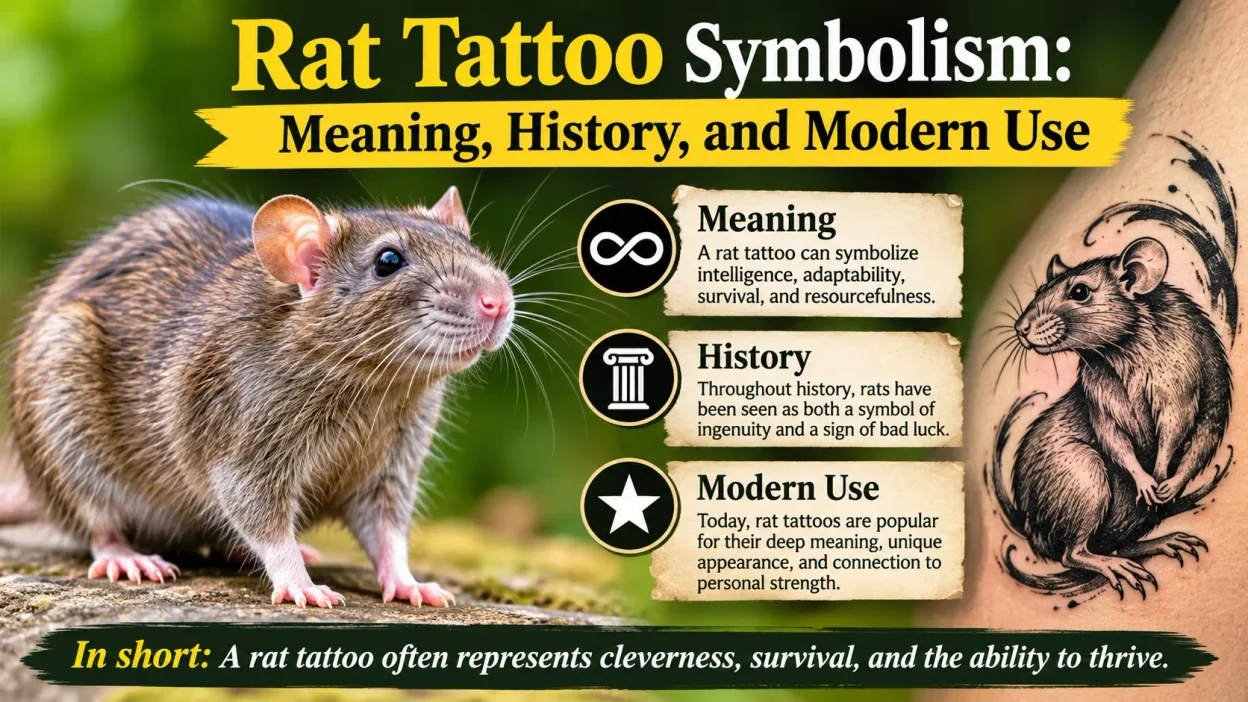
Rat tattoo symbolism often centers on survival, intelligence, adaptability, and the ability to overcome difficult circumstances. Although rats have traditionally been associated with disease, dirt, and urban decay in Western culture, they are also remarkably resourceful animals. They learn quickly, form social bonds, recognize familiar individuals, and survive in environments where many other creatures struggle.
In the United States, rat tattoos can communicate very different messages depending on the design. Someone might choose a rat to represent resilience after hardship, while another person may appreciate its connection to city life, underground culture, independence, or unconventional identity. For some, the animal’s negative reputation is precisely what makes it an interesting tattoo subject.
Rats also have a complicated cultural history. They appear in mythology, folklore, religious traditions, literature, and public-health history. Understanding these associations helps explain why a small rodent can become a meaningful personal emblem rather than simply an unusual tattoo choice.
Quick Answer
Rat tattoos commonly symbolize survival, intelligence, adaptability, and resilience in modern American tattoo culture, especially for people who identify with overcoming hardship or challenging expectations. Historically, rats have also represented prosperity, fertility, cleverness, disease, destruction, and transformation in different cultural traditions.
TL;DR
- Survival: Represents enduring difficult circumstances and finding ways forward.
- Intelligence: Reflects curiosity, problem-solving, and resourcefulness.
- Adaptability: Symbolizes adjusting to changing environments and unexpected challenges.
- Rebellion: Challenges conventional ideas of beauty, status, and respectability.
- Cultural history: Connects with mythology, folklore, urban life, and traditional beliefs.
- Personal identity: Can represent independence, loyalty, resilience, or an unconventional personality.
1. What a Rat Tattoo Looks Like
A rat tattoo typically features a small or medium-sized rodent with a pointed nose, rounded ears, prominent whiskers, a long tail, and a compact body. Artists can portray the animal realistically or simplify it into a traditional tattoo illustration, geometric design, cartoon character, or dark symbolic image.
The appearance changes the impression considerably. A realistic brown rat may emphasize intelligence and natural behavior, while a black rat surrounded by shadows might communicate secrecy, mystery, or an interest in darker imagery.
Common rat tattoo designs include:
- Realistic rats: Emphasize the animal’s physical characteristics and natural intelligence.
- Traditional tattoo rats: Use bold outlines, strong colors, and vintage tattoo aesthetics.
- Skull and rat combinations: Connect survival with mortality, decay, and the darker side of life.
- Rat with flowers: Contrast an animal associated with urban environments against ideas of beauty and renewal.
- Cartoon rats: Communicate humor, friendliness, nostalgia, or affection.
- Rat and dagger designs: Can suggest danger, rebellion, toughness, or survival.
The rat’s body language also matters. A rat standing alert can suggest awareness and confidence, while one carrying food may represent preparation, resourcefulness, and determination.
2. Survival and Resilience: The Central Meaning
One of the strongest modern interpretations of a rat tattoo is survival.
Rats are highly adaptable animals. They can establish populations in crowded cities, agricultural areas, buildings, and other environments where food and shelter are available. Their ability to learn about their surroundings and respond to changing conditions makes them familiar examples of animal resilience.
For someone who has experienced difficult circumstances, a rat tattoo can represent refusing to give up. It may commemorate a period of poverty, instability, personal struggle, or a major life transition.
The symbolism does not necessarily suggest that hardship was enjoyable or desirable. Instead, it recognizes the ability to continue despite circumstances that were difficult to control.
A rat tattoo can therefore become a personal reminder:
- I survived something difficult.
- I can adapt when circumstances change.
- My background does not determine my future.
- I can find opportunities where others see obstacles.
This interpretation is especially relevant to people who identify with working-class communities, challenging childhoods, or unconventional paths through life.
3. Intelligence, Curiosity, and Resourcefulness
Rats are known for their learning abilities and exploratory behavior. They can navigate complex environments, remember routes, recognize patterns, and solve certain problems.
These characteristics contribute to their symbolic connection with intelligence and resourcefulness.
A person who chooses a rat tattoo may appreciate the idea that intelligence is not always associated with academic achievement, wealth, or social status. Sometimes it means knowing how to solve practical problems, recognize opportunities, and make thoughtful decisions with limited resources.
Rats also investigate unfamiliar environments. Their curiosity can represent a willingness to explore, question assumptions, and learn through experience.
In tattoo designs, a rat holding an object, examining something, or standing upright can reinforce this interpretation.
For people who value independent thinking, a rat tattoo can communicate a preference for observation and practical knowledge over appearances.
4. Independence, Rebellion, and Rejecting Social Expectations
Rats have an unusual position in American popular culture. They are common animals, but they are rarely treated as attractive or respectable symbols.
That reputation creates an opportunity for unconventional self-expression.
Choosing a rat tattoo can represent a refusal to follow traditional ideas about which animals deserve admiration. Instead of selecting a lion, eagle, or butterfly, someone deliberately chooses a creature associated with alleys, basements, sewers, and neglected places.
This choice can communicate:
- Comfort with being different.
- Resistance to social expectations.
- Pride in an unconventional identity.
- Independence from popular standards of beauty.
- Appreciation for overlooked or misunderstood creatures.
In some tattoo communities, this attitude connects with punk aesthetics, underground music, street art, and alternative fashion.
However, a rat tattoo does not automatically indicate rebellion or membership in a particular subculture. For some people, it is simply a favorite animal or a humorous design.
5. Historical Origins of Rat Symbolism
Rats have lived alongside humans for thousands of years, particularly as agriculture, trade, and permanent settlements created new sources of food.
Grain storage, marketplaces, ships, and densely populated communities provided opportunities for rodents to thrive. As a result, human relationships with rats developed around both practical concerns and cultural interpretations.
In many societies, rats became associated with food loss, property damage, and disease. Their ability to reproduce and establish populations in human settlements sometimes made them symbols of uncontrolled growth or infestation.
Yet other cultures interpreted their behavior more positively. Their resourcefulness, fertility, and ability to locate food could connect them with abundance, intelligence, and prosperity.
The black rat (Rattus rattus) and brown rat (Rattus norvegicus) have particularly important places in human history. The brown rat became widespread in many urban environments, while the black rat was historically associated with major trade routes and shipboard populations.
These experiences produced a complicated symbolic history. Rats could be pests in one setting and signs of good fortune in another.
Modern rat tattoos draw from this mixture of historical meanings rather than one universally accepted tradition.
6. Rat Symbolism in Chinese Culture and the Zodiac
One of the most recognizable positive associations of rats comes from Chinese culture.
The Rat is the first animal in the traditional Chinese zodiac cycle. According to a popular version of the zodiac origin story, the rat used intelligence and quick thinking to reach the finish line ahead of the other animals.
This story helped establish the rat as a symbol of cleverness, ambition, and strategic thinking.
In traditional Chinese zodiac interpretations, people born in Rat years are often associated with qualities such as:
- Intelligence and quick thinking.
- Adaptability and practical judgment.
- Resourcefulness and financial awareness.
- Social ability and communication.
- Ambition and determination.
The Rat’s position at the beginning of the zodiac cycle also gives it an association with beginnings and initiative.
A rat tattoo inspired by Chinese zodiac traditions may therefore represent personal birth-year identity, cultural heritage, ambition, or cleverness.
It is important to distinguish the traditional zodiac animal from generic rat imagery. A tattoo based on the Chinese zodiac may include specific artistic elements or references that are not present in an ordinary realistic rat design.
7. Rats in Hindu Traditions and Religious Symbolism
Rats and mice have an important place in Hindu religious imagery through their association with Ganesha, one of the most widely recognized Hindu deities.
Ganesha is commonly depicted with a mouse or rat as his vehicle, known as a vahana. The animal is frequently called Mushika.
The relationship has several interpretations. The small creature can represent desires, impulses, or restless thoughts that require direction and control. Ganesha’s association with wisdom and the removal of obstacles creates a contrast between divine understanding and the animal’s small physical size.
The mouse also demonstrates that an apparently insignificant creature can have an important role in a larger spiritual picture.
For someone choosing a tattoo inspired by this tradition, the symbolism may involve wisdom, humility, overcoming obstacles, and the relationship between intelligence and desire.
However, Ganesha is a sacred figure in Hinduism. Designs using his image or religious attributes should be approached with cultural understanding rather than treated as generic decorative motifs.
Not every rat tattoo has a Hindu religious meaning, and ordinary rodent imagery should not automatically be connected to Ganesha.
8. Rats in European Folklore and the Black Death
European history gave rats some of their darkest symbolic associations. During the Middle Ages, outbreaks of plague devastated communities across Europe, with the Black Death of the fourteenth century becoming one of the most destructive epidemics in recorded history.
The disease was caused by the bacterium Yersinia pestis. Fleas associated with rodents played an important role in some historical transmission pathways, although the precise contributions of different transmission routes remain subjects of historical and scientific discussion.
Over time, rats became closely associated in popular imagination with plague, death, overcrowding, and unsanitary living conditions.
This association influenced European storytelling and visual culture. Rats appeared as creatures connected with abandoned places, disease, decay, and the dangers hidden within crowded settlements.
A modern tattoo drawing on this history may communicate darker ideas:
- Awareness of mortality.
- The fragility of human civilization.
- Fear of disease and destruction.
- Survival during dangerous circumstances.
- Attraction to gothic or macabre imagery.
It is important to distinguish historical association from biological reality. Rats were not the sole cause of the Black Death, and their reputation as carriers of disease became simplified in popular accounts.
For tattoo enthusiasts, however, this history explains why rats can create such a strong visual connection with death, darkness, and survival.
9. Loyalty, Friendship, and Social Bonds
Although rats are frequently portrayed as solitary pests, many species are highly social animals.
Domestic rats, in particular, can form recognizable relationships with other rats and familiar humans. They engage in social grooming, play, cooperative behavior, and other interactions that demonstrate their capacity for social connection.
These characteristics have contributed to a more affectionate modern image of rats, particularly among people who keep them as companion animals.
A rat tattoo can therefore represent:
Loyalty: A reminder of dependable relationships and staying connected through difficult circumstances.
Friendship: An appreciation for companionship that does not depend on appearance or social status.
Family: A symbol of belonging, care, and emotional attachment.
Acceptance: Recognition that meaningful relationships can develop with individuals or creatures that others misunderstand.
For someone who has owned a pet rat, the tattoo might commemorate a specific animal and the relationship they shared.
A pair of rats, two rats touching noses, or a rat surrounded by small hearts can reinforce these interpretations.
This meaning is particularly personal because it comes from actual experiences with animals rather than folklore alone.
10. What Rat Tattoos Mean in American Culture
In the United States, rats occupy an interesting position between disgust, affection, humor, and admiration.
They are associated with urban environments, particularly cities where rodents are part of everyday public conversation. At the same time, pet rats have developed a following among people who appreciate their intelligence, cleanliness when properly cared for, and social personalities.
American tattoo culture reflects these conflicting perceptions.
Some people use rat imagery to celebrate their connection to city life. Others choose the animal because it represents surviving difficult circumstances or refusing to be defined by society’s judgment.
Rats also appear in underground music, street art, graffiti, punk-inspired illustration, and dark humor. In these settings, the animal can become a symbol of people who exist outside conventional ideas of success or respectability.
There is no nationwide American holiday or official civic tradition centered on rat symbolism. Its significance is mainly personal, artistic, and subcultural.
| Tattoo context | Possible meaning | Common associations | Interpretation |
|---|---|---|---|
| Realistic rat | Survival and intelligence | Resourcefulness, awareness | Respect for the animal’s abilities |
| Rat with a crown | Independence and confidence | Pride, status, defiance | Refusing to feel inferior |
| Rat and skull | Mortality and hardship | Death, decay, gothic art | Accepting life’s darker realities |
| Pet rat portrait | Love and companionship | Loyalty, remembrance | Honoring an animal companion |
| Chinese zodiac rat | Ambition and cleverness | Heritage, prosperity | Personal or cultural identity |
The same design can communicate different things to different viewers. A rat tattoo may look provocative to one person and affectionate to another.
11. The Psychological Meaning of Choosing a Rat Tattoo
Choosing an animal that many people dislike can itself communicate something about identity.
For some tattoo wearers, a rat represents the experience of being underestimated, excluded, or judged by appearances. The animal’s reputation becomes a metaphor for how people can be misunderstood because of their background, circumstances, or social position.
This interpretation can be especially meaningful to people who have experienced rejection or struggled to fit conventional expectations.
A rat tattoo may express:
- Self-acceptance: Being comfortable with qualities others might criticize.
- Emotional resilience: Continuing after rejection or disappointment.
- Practical intelligence: Valuing resourcefulness over appearances.
- Individuality: Choosing a symbol that is not conventionally attractive.
- Humor: Enjoying the unexpected or deliberately unconventional.
There is also a psychological element of reclaiming an unpopular image. Instead of accepting the negative reputation attached to rats, a person may choose to give the animal a positive meaning.
This does not mean every rat tattoo communicates a history of hardship. Some people simply enjoy rodents, appreciate their behavior, or find their appearance visually interesting.
The strongest interpretation is usually the one that reflects the wearer’s actual reason for choosing the design.
12. Rat Tattoo Designs and Their Different Meanings
The details of a tattoo can significantly influence its interpretation. Combining a rat with another object, animal, or artistic style creates additional layers of meaning.
Represents an appreciation for the animal itself, including its intelligence, survival instincts, and adaptability. It can also serve as a memorial to a beloved pet.
Suggests confidence, self-respect, and reclaiming an animal traditionally treated as undesirable. It can communicate that status does not depend on popularity.
Combines survival with mortality, decay, and gothic aesthetics. It may reflect an interest in darker themes or the experience of confronting difficult realities.
Creates a contrast between an unpopular animal and a flower traditionally associated with beauty and love. It can represent unexpected affection or beauty in overlooked places.
Connects the design with the lunar zodiac, personal birth-year identity, intelligence, and ambition.
Often expresses affection, humor, simplicity, or a personal connection to the animal without relying on dramatic symbolism.
13. Rat Tattoos in Traditional, Neo-Traditional, and Modern Styles
Tattoo style can change how people interpret rat imagery even when the animal remains the same.
American traditional: Bold outlines, limited color palettes, and simplified shapes can give a rat an old-school appearance. The style may emphasize toughness, humor, rebellion, or vintage tattoo culture.
Neo-traditional: More detailed shading, decorative elements, and expressive colors can make the rat appear theatrical or character-driven. Flowers, crowns, and ornamental backgrounds often add additional meaning.
Blackwork: Solid black shapes and strong contrast can emphasize the rat’s connection with underground culture, darkness, and unconventional identity.
Fine-line tattoos: Delicate outlines create a softer representation of the animal. This approach often suits small pet portraits, minimalist designs, and personal remembrance.
Illustrative tattoos: These may portray rats in imaginative scenes, wearing clothing, carrying objects, or interacting with other animals. They can communicate humor, personality, and storytelling.
The style does not determine the tattoo’s meaning by itself. A blackwork rat can represent a beloved pet just as easily as a fine-line rat can symbolize resilience.
14. Common Misunderstandings and Negative Associations
Rat tattoos sometimes attract strong reactions because the animal has a complicated public reputation.
One common misunderstanding is that every rat tattoo represents dirtiness, dishonesty, or betrayal. In everyday American English, calling someone a rat can mean accusing them of informing on others or betraying a group. This slang association can influence how viewers interpret the tattoo.
However, the slang meaning is not the same as the animal’s broader symbolism.
Another misconception is that rats are naturally aggressive or inherently dangerous. Wild rats can bite when threatened, and rodents can carry pathogens, but their behavior and health risks depend on species, environment, and circumstances.
There is also a difference between choosing a rat because of its negative reputation and using it to express a positive personal meaning.
For example:
- A person may choose a rat to represent survival rather than disease.
- A pet owner may use it as a tribute rather than a symbol of urban decay.
- Someone interested in punk culture may appreciate its association with outsiders.
- A person born in a Rat zodiac year may choose it as a sign of heritage.
Understanding these distinctions prevents a single negative interpretation from overshadowing the many reasons someone might choose the animal.
15. How Rat Tattoo Symbolism Is Changing
The symbolic reputation of rats has gradually expanded as people’s relationships with animals, cities, and popular culture have changed.
Historically, rats were often viewed primarily through their impact on human settlements. They damaged stored food, spread certain diseases, and became associated with unsanitary environments.
Modern knowledge has added a more complicated picture. Research into rodent behavior has demonstrated learning abilities and social interactions, while the popularity of domestic rats has introduced many people to their individual personalities.
Tattoo culture has also helped transform the animal’s image. Artists increasingly use rats as subjects for creative illustrations, humorous designs, dark artwork, and unconventional forms of personal expression.
Social media has contributed to the visibility of pet rats and their owners, showing affectionate interactions that contrast with traditional negative stereotypes.
These developments have not erased the rat’s association with disease or urban problems. Instead, positive and negative meanings now exist alongside one another.
For contemporary tattoo wearers, this flexibility is part of the animal’s appeal. A rat can represent an underdog, a survivor, a clever problem-solver, a beloved companion, or someone who refuses to fit a conventional image.
Frequently Asked Questions
1. Is a rat tattoo a good or bad symbol?
A rat tattoo can have positive or negative associations depending on its design and personal meaning. It commonly represents survival, intelligence, adaptability, and independence, although some people use it to explore darker themes such as disease, betrayal, and mortality.
2. What does a rat tattoo mean for someone who has overcome hardship?
It can represent resilience, determination, and the ability to survive difficult circumstances. The rat becomes a reminder that even when life is challenging, resourcefulness and persistence can help someone move forward.
3. What does a black rat tattoo symbolize?
A black rat tattoo may represent mystery, independence, survival, or an interest in gothic aesthetics. Its meaning depends on the surrounding imagery, artistic style, and the wearer’s personal interpretation.
4. What does a rat tattoo mean in Chinese culture?
In Chinese zodiac traditions, the Rat represents intelligence, ambition, adaptability, and resourcefulness. A tattoo based on the zodiac animal may also celebrate someone’s birth year or connection to Chinese cultural heritage.
5. What does a rat tattoo symbolize spiritually?
A rat tattoo can represent overcoming obstacles, humility, intelligence, and awareness of personal desires. In Hindu religious imagery, the mouse associated with Ganesha carries additional spiritual interpretations connected with wisdom and the control of impulses.
6. What does a rat and skull tattoo mean?
A rat and skull combination often represents mortality, survival, decay, and the darker aspects of existence. It is also popular as a gothic or macabre artistic composition, particularly among people who appreciate unconventional tattoo imagery.
7. Does a rat tattoo symbolize loyalty?
It can. Rats are social animals capable of forming relationships, and people who keep domestic rats often choose tattoos to celebrate companionship, affection, and memories of a beloved pet.
Conclusion
Rat tattoo symbolism brings together survival, intelligence, adaptability, independence, and the ability to challenge social expectations. Although rats have historically carried negative associations with disease and urban decay, their resourcefulness and social behavior offer a very different perspective. Cultural traditions, particularly the Chinese zodiac and Hindu religious imagery, add further meanings involving ambition, wisdom, and overcoming obstacles.
In modern American tattoo culture, a rat can represent an underdog who refuses to give up, an unconventional personality, a beloved companion, or someone who finds value in what others overlook. Its meaning depends on the design, cultural background, and personal experiences behind the choice.
Ultimately, a rat tattoo can make an interesting statement: worth, intelligence, and resilience are not determined by appearance or popularity.