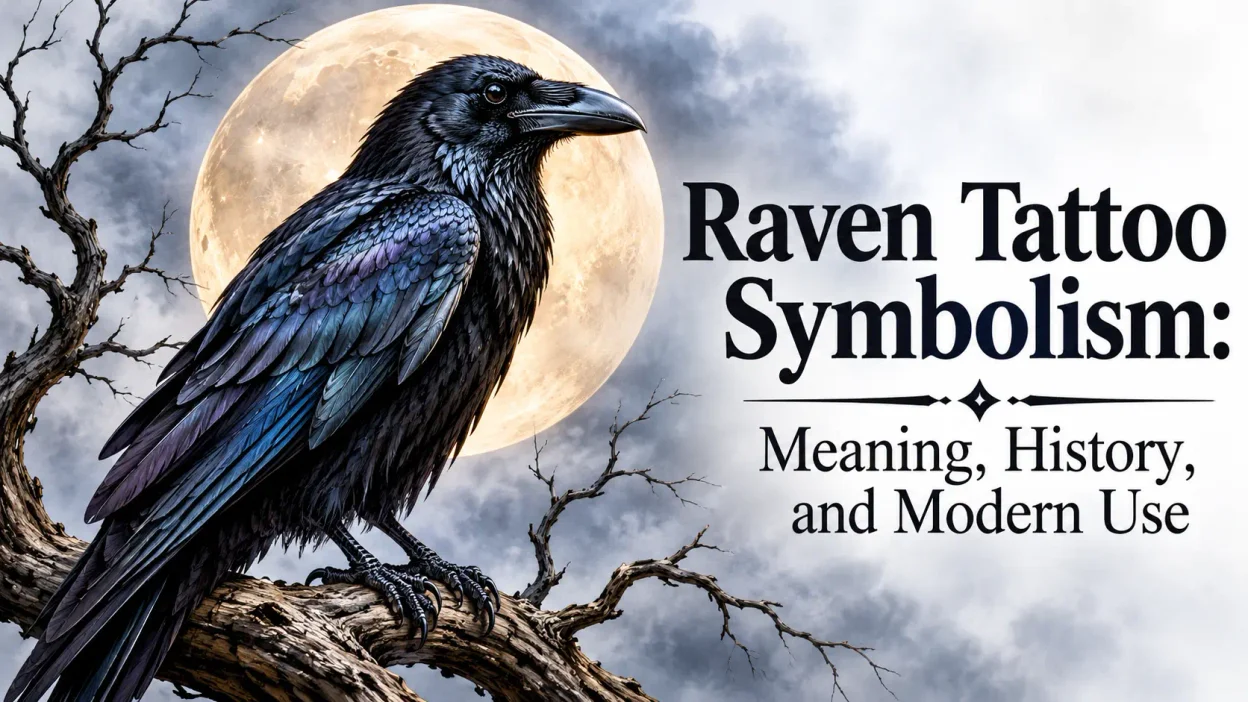
Raven tattoo symbolism is commonly associated with intelligence, mystery, transformation, independence, and the relationship between life and death. With their glossy black feathers, sharp eyes, and remarkable problem-solving abilities, ravens have attracted human attention for thousands of years. Their appearance in mythology, folklore, literature, and modern art has made them recognizable symbols of knowledge, prophecy, and the unknown.
In the United States, raven tattoos appeal to people who appreciate darker imagery, nature-inspired designs, mythology, and symbols of personal change. Some choose a raven to represent intelligence and self-reliance, while others connect it with grief, remembrance, spiritual beliefs, or an interest in the supernatural.
The raven is not simply a symbol of death or bad luck. Different cultures have viewed the bird as a creator, messenger, trickster, guardian, or bearer of wisdom. Understanding these traditions helps explain why the same black bird can communicate such different ideas when worn as a permanent piece of body art.
Quick Answer
Raven tattoo symbolism commonly represents intelligence, transformation, independence, mystery, and personal strength in modern American tattoo culture. Historically, ravens have also been associated with prophecy, death, spiritual messages, creation, and trickster figures in different cultural traditions.
TL;DR
- Intelligence: Ravens represent observation, problem-solving, and strategic thinking.
- Transformation: They can symbolize major life changes and personal renewal.
- Death and remembrance: Their association with mortality makes them meaningful memorial tattoos.
- Mythology: Ravens appear as messengers, creators, and tricksters in ancient traditions.
- Independence: A solitary raven can communicate self-reliance and individuality.
- Modern tattoos: Dark artwork combines folklore, Gothic aesthetics, and personal storytelling.
1. What a Raven Tattoo Represents
A raven tattoo typically depicts a large black bird with a strong beak, thick feathers, and an unmistakable silhouette. Its appearance can range from realistic wildlife artwork to elaborate illustrations inspired by mythology, fantasy, and Gothic design.
The common raven (Corvus corax) is particularly recognizable for its large size, wedge-shaped tail, and deep, rough vocalizations. It is also known for sophisticated social behavior, problem-solving, and adaptability.
These characteristics contribute to its symbolic appeal. Intelligence comes from the bird’s observable behavior, while mystery and death are connected to its appearance, scavenging habits, and presence in historical stories.
A raven tattoo can communicate several ideas:
- Wisdom and intellectual curiosity.
- Independence and personal freedom.
- Transformation after difficult experiences.
- Awareness of mortality.
- Protection and spiritual guidance.
- Interest in folklore, mythology, and the supernatural.
The design itself often changes the interpretation. A raven carrying an object may suggest knowledge or a message, while a bird with spread wings may communicate freedom, resistance, or strength.
Ultimately, the meaning depends on the wearer rather than a universal tattoo dictionary.
2. Intelligence, Wisdom, and Strategic Thinking
One of the most positive meanings of a raven tattoo is intelligence.
Ravens are among the most cognitively sophisticated birds. Research into their behavior has demonstrated their ability to solve problems, remember individuals, use tools in certain circumstances, and respond flexibly to changing situations.
These characteristics make the raven a natural symbol of observation and strategic thinking.
Someone who chooses this tattoo may want to express that they value knowledge over appearances, think independently, or prefer to understand a situation before acting.
A raven perched on a branch, looking directly outward, can communicate awareness and patience. A design showing the bird holding an object may emphasize curiosity, resourcefulness, or the pursuit of knowledge.
In American tattoo culture, this interpretation appeals to people who identify with intelligence, creativity, unconventional thinking, and independence.
Unlike a tattoo representing academic achievement, a raven can suggest practical wisdom: the ability to learn from experience and adapt when circumstances change.
3. Transformation, Rebirth, and Personal Growth
Ravens are frequently used to represent transformation, particularly after difficult periods in life.
Their dark appearance and association with death make them suitable symbols for experiences involving endings, loss, and significant personal changes. However, death in symbolic artwork does not necessarily mean physical death. It can represent the end of a relationship, an abandoned identity, a difficult chapter, or an old way of living.
A raven tattoo can therefore commemorate the person someone used to be while recognizing the person they have become.
For example, someone who has rebuilt their life after a major setback might choose a raven emerging from darkness. A bird flying toward an open sky could communicate the decision to move forward.
This interpretation is especially relevant in contemporary American tattoo culture, where tattoos often serve as permanent reminders of personal milestones.
Ravens do not literally symbolize rebirth in every historical tradition. This modern association comes from combining their connection to death and mystery with broader ideas about renewal and change.
4. Death, Mourning, and Remembrance
Ravens have a long-standing association with death, partly because they are scavenging birds that may feed on animal remains. Their presence around battlefields, burial grounds, and other places associated with mortality contributed to their appearance in folklore and literature.
This connection has made the raven a recognizable figure in Gothic artwork and mourning imagery.
For some people, a raven tattoo represents acceptance of mortality. For others, it serves as a memorial to someone who has died.
A raven resting beside a name, date, or meaningful object can become a personal tribute. The bird may represent the belief that memories survive physical loss, even when the person being remembered is no longer present.
There is also an important distinction between death symbolism and an attraction to death itself. Many people choose raven tattoos because they find meaning in remembering loved ones, acknowledging life’s limits, or recognizing that endings are part of human experience.
In American culture, these designs may overlap with memorial tattoos, Gothic aesthetics, and personal expressions of grief.
5. Raven Symbolism in Norse Mythology
One of the best-known historical connections between ravens and wisdom comes from Norse mythology.
The god Odin is traditionally accompanied by two ravens named Huginn and Muninn. Their names are commonly translated as Thought and Memory.
According to Norse mythological accounts, these birds travel throughout the world and return to report what they have observed. Their role connects ravens with information, awareness, memory, and knowledge beyond one’s immediate surroundings.
This tradition provides a particularly meaningful foundation for raven tattoo designs.
A tattoo featuring two ravens may represent:
- Thought and memory.
- Knowledge and awareness.
- The connection between past and present.
- Loyalty and companionship.
- The pursuit of wisdom.
A single raven inspired by Odin’s companions may represent intellectual curiosity or a desire to see beyond ordinary appearances.
For someone interested in Norse mythology, this design can also express an appreciation for Scandinavian cultural history. However, the mythology should be distinguished from modern fantasy interpretations that sometimes add meanings not found in traditional accounts.
6. Ravens in Native American Cultures
Ravens hold important places in several Indigenous traditions of the Pacific Northwest, including stories among Tlingit, Haida, and Tsimshian peoples.
In some traditions, Raven is a creator or culture hero associated with bringing important elements into the world. Stories describe Raven obtaining or releasing light, helping shape the world, and influencing the conditions of human life.
Raven is also frequently portrayed as a trickster. This character can be clever, selfish, humorous, unpredictable, or responsible for unexpected changes. Trickster stories often communicate lessons about human behavior, power, and the consequences of cleverness without wisdom.
These traditions differ between Indigenous nations and communities. There is no single Native American interpretation of the raven.
This distinction matters when choosing a tattoo inspired by Indigenous artwork. Traditional Northwest Coast formline art has its own visual conventions, cultural history, and community significance. It should not be treated as generic tribal decoration.
For people considering this style, learning about the specific nation and artistic tradition is more respectful than borrowing imagery without understanding its background.
7. Celtic Folklore and the Raven’s Association With War
Ravens also appear in Celtic mythology, particularly in stories involving conflict, sovereignty, prophecy, and supernatural power.
One important figure is The Morrígan. This complex figure is associated with warfare and fate and is sometimes connected with ravens and crows in traditional narratives.
Bird imagery associated with the Morrígan can evoke the aftermath of battle, the uncertainty of conflict, and the relationship between human decisions and destiny.
A raven tattoo inspired by these traditions may communicate:
- Courage in the face of danger.
- Awareness of mortality.
- Acceptance of life’s uncertainty.
- Protection during difficult circumstances.
- Respect for ancestral mythology.
However, the Morrígan is not simply a goddess of death, and reducing her to that description overlooks her broader mythological roles.
For modern tattoo wearers, Celtic-inspired raven designs often combine knotwork, ancient-looking patterns, and bird imagery. Understanding the underlying folklore gives these designs more context than decorative details alone.
8. Mystery, Prophecy, and Spiritual Messages
Ravens have frequently been treated as messengers between different realms in mythology and folklore.
Their black feathers, unusual calls, and ability to survive in challenging environments helped establish their association with the unknown. In some stories, a raven appears before an important event or carries information that ordinary people cannot access.
This has contributed to their modern association with prophecy, intuition, and spiritual communication.
A raven carrying a letter, appearing beside a moon, or flying through a dark sky may represent the search for answers or an awareness of things that are not immediately visible.
Some tattoo wearers interpret the bird as a spiritual messenger or a reminder to trust their judgment. Others simply appreciate its mysterious appearance.
It is important to distinguish personal spiritual interpretations from established religious teachings. Ravens do not have one universal meaning as supernatural messengers across all religions.
For many Americans, the appeal lies in the freedom to use the raven as a personal symbol of curiosity, intuition, and the unknown.
9. What Raven Tattoos Mean in Modern American Culture
In the United States, raven tattoos occupy an interesting space between wildlife imagery, mythology, Gothic art, and personal identity.
Some people choose them because they admire the actual bird. Others are drawn to the raven’s role in stories, its association with Edgar Allan Poe, or its appearance in fantasy and supernatural entertainment.
The design can communicate a personality that values independence, intellectual curiosity, or unconventional ideas. It can also express an appreciation for darker artistic themes without necessarily indicating sadness or pessimism.
Ravens are particularly popular subjects in black-and-gray tattoo artwork because their natural coloring works well with shading, contrast, and detailed feather patterns.
Their symbolism also makes them suitable for different stages of life. Someone may choose a raven after overcoming hardship, while another may use it to honor a deceased family member.
| Tattoo context | Common American interpretation | Symbolic association |
|---|---|---|
| Raven in flight | Freedom and independence | Personal growth |
| Two ravens | Thought and memory | Norse mythology |
| Raven with a skull | Mortality and acceptance | Death and remembrance |
| Raven on a branch | Patience and observation | Wisdom |
| Raven with a moon | Mystery and intuition | Spirituality |
| Raven with a rose | Love and loss | Emotional complexity |
These interpretations are common possibilities, not fixed rules. The same image can communicate something entirely different depending on the wearer’s story.
10. Raven Tattoos and Edgar Allan Poe’s Literary Influence
American interpretations of raven imagery have been strongly influenced by Edgar Allan Poe and his famous 1845 poem, The Raven.
The poem follows a grieving narrator visited by a raven that repeatedly speaks the word “Nevermore.” The bird becomes associated with loss, psychological distress, memory, and the narrator’s inability to escape his sorrow.
Poe’s work helped establish the raven as an important figure in American Gothic literature. Its cultural influence continues through illustrations, Halloween imagery, horror fiction, films, and tattoo designs.
A raven tattoo inspired by Poe may represent:
- Grief that remains part of someone’s life.
- The persistence of memories.
- The struggle to accept a painful ending.
- Literary appreciation and artistic identity.
- Fascination with Gothic storytelling.
Some designs include a raven sitting on a bust, an open book, or a solitary branch. Others incorporate the word “Nevermore” to connect the image directly to the poem.
Not every raven tattoo carries Poe’s meaning, but his literary influence is one reason American audiences frequently associate the bird with melancholy and mystery.
11. Different Raven Tattoo Designs and Their Meanings
The arrangement of a raven tattoo can change the message it communicates. Small details, including the bird’s posture, surroundings, and accompanying objects, help establish its intended symbolism.
Often represents freedom, independence, ambition, and moving beyond limitations. It can be especially meaningful after a major life transition.
Suggests patience, intelligence, observation, and careful decision-making. It can represent someone who prefers to watch and understand before taking action.
Often reference Huginn and Muninn. They can symbolize thought, memory, awareness, and the relationship between knowledge and experience.
Can represent discovery, hidden knowledge, new opportunities, or access to something previously unknown.
Connects the bird with mortality, acceptance, remembrance, and the temporary nature of physical life.
Often expresses mystery, intuition, nighttime imagery, and interest in spiritual or supernatural themes.
Choosing a design becomes easier when the wearer first decides what they want the tattoo to communicate. A realistic bird may emphasize admiration for nature, while a mythological composition can tell a more specific cultural or personal story.
12. Raven Tattoo Placement and Its Symbolic Interpretation
Tattoo placement is primarily an artistic and personal decision, but the location can influence how the design is perceived.
In American tattoo culture, some people also attach personal meanings to particular placements. These associations are flexible rather than established historical rules.
- Forearm: A visible raven tattoo can represent confidence, individuality, and an appreciation of the bird’s symbolism.
- Upper arm: This location works well for detailed designs and can communicate personal identity without always being visible.
- Chest: A raven placed near the heart may represent remembrance, emotional strength, or a deeply personal connection.
- Back: Larger compositions can depict flight, mythology, or transformation across an expansive area.
- Shoulder: A perched raven may create the impression of a companion or guardian.
- Hand or wrist: Smaller designs can serve as frequent personal reminders of independence, memory, or resilience.
- Leg: This placement allows larger vertical designs, especially ravens flying through branches or surrounding landscapes.
A tattoo’s placement does not determine its meaning. A raven on the chest is not automatically more spiritual than one on the forearm. The intended message comes from the artwork and the wearer’s personal connection.
13. Black Raven Tattoos, Color Choices, and Artistic Style
Ravens are naturally associated with black because of their feathers, making black-and-gray tattoos an especially recognizable choice.
However, their feathers are not simply flat black. Depending on the lighting, raven plumage can display blue, violet, and green iridescence. Tattoo artists sometimes reproduce these subtle effects to make a realistic design more visually interesting.
Different artistic approaches create different impressions.
Blackwork: Uses solid black areas and strong contrasts. It suits bold silhouettes and designs inspired by Gothic art.
Realism: Focuses on feather texture, accurate anatomy, and lifelike eyes. This style emphasizes admiration for the actual bird.
Traditional tattooing: Uses simplified shapes, strong outlines, and limited colors. It creates a more graphic interpretation.
Watercolor: Incorporates flowing colors and loose brush-like effects. This approach can soften the raven’s traditionally dark appearance.
Fine-line tattooing: Uses delicate outlines and restrained shading. It works well for smaller birds, feathers, and minimalist compositions.
Color can also change the intended atmosphere:
- Black emphasizes mystery, mortality, and Gothic aesthetics.
- Blue can suggest intelligence, depth, and the bird’s natural iridescence.
- Red can introduce associations with passion, sacrifice, or conflict.
- White can create contrast and suggest remembrance or spiritual reflection.
These are artistic interpretations rather than universal color codes. A skilled tattoo artist can help balance symbolic details with a design that will remain visually clear as it ages.
14. Emotional and Psychological Meaning of a Raven Tattoo
A raven tattoo can function as a personal statement about how someone understands their own experiences.
For one person, the bird may represent surviving a period of grief. For another, it may express the decision to think independently rather than follow expectations. Someone else may choose it simply because they have always admired ravens.
The bird’s association with intelligence can communicate confidence in one’s ability to solve problems. Its connection with mortality can acknowledge that life is temporary, while its mythological roles can express curiosity about history and the unknown.
Raven tattoos can also help people give visible form to emotions that are difficult to explain in ordinary conversation.
A person who has experienced a major loss might choose a raven because it allows them to acknowledge sadness without reducing their entire identity to grief. Someone rebuilding their life might use the bird to mark a transition from an earlier chapter.
There is no psychological rule that people who choose dark bird tattoos are unhappy, withdrawn, or fascinated by death. Tattoo preferences are shaped by aesthetics, culture, personal history, and individual taste.
The most meaningful interpretation is usually the one that accurately reflects the wearer’s own experience.
15. Common Misunderstandings and Controversies Surrounding Raven Tattoos
Ravens have accumulated many interpretations, and some popular claims oversimplify their history.
A raven tattoo does not automatically mean bad luck. Although some European folklore associates ravens with death and ominous events, other traditions portray them as intelligent, creative, or helpful figures.
Ravens and crows are different birds. Both belong to the genus Corvus, and they share several physical and behavioral characteristics. However, the common raven is generally larger and has a heavier bill, a shaggy throat, and a wedge-shaped tail. Their symbolic meanings sometimes overlap, but the two should not be treated as identical in every cultural tradition.
Ravens are not universally associated with evil. Their appearance in Gothic literature and horror entertainment has strengthened dark associations, but these represent only part of their cultural history.
Indigenous raven imagery requires cultural awareness. Traditional Northwest Coast artwork has specific artistic structures and cultural meanings. Copying ceremonial or culturally significant imagery without understanding its background can be disrespectful.
Norse-inspired designs should not be confused with extremist symbolism. Ravens and other Norse mythological images have legitimate historical and cultural contexts. Although some extremist groups have appropriated selected historical symbols, a raven image alone does not establish a political affiliation or extremist belief.
Understanding these distinctions allows people to appreciate raven imagery without confusing folklore, historical traditions, and modern cultural misuse.
16. How Raven Tattoo Symbolism Has Changed Over Time
The raven’s symbolic identity has developed through different cultural experiences.
In ancient mythology, it could represent a divine messenger, creator, trickster, or companion to a god. In European folklore, it became associated with battlefields, death, and supernatural events. Norse stories connected it with thought and memory, while Indigenous traditions of the Pacific Northwest gave Raven important roles in creation narratives and cultural teachings.
American literature introduced another influential interpretation. Poe’s The Raven connected the bird with grief, memory, and the persistence of sorrow, helping establish its Gothic identity in popular culture.
Modern tattoo culture brings these associations together. A contemporary design may combine Norse imagery, Gothic illustration, realistic bird anatomy, and personal memorial elements.
The raven has therefore moved beyond any single historical interpretation. It can represent wisdom without religion, darkness without negativity, and remembrance without being exclusively about death.
For many people, this flexibility is precisely what makes the bird an appealing subject for permanent body art.
Frequently Asked Questions
1. What does a raven tattoo symbolize spiritually?
A raven tattoo can represent spiritual awareness, intuition, transformation, and communication between different realms. In some mythological traditions, ravens serve as messengers or companions to supernatural figures.
2. Is a raven tattoo a symbol of death?
A raven tattoo can represent death, mortality, grief, and remembrance, but these are not its only meanings. Many people choose raven designs to express intelligence, independence, wisdom, or personal transformation.
3. What does a raven tattoo mean in Norse mythology?
In Norse mythology, Odin’s two ravens, Huginn and Muninn, represent Thought and Memory. A tattoo featuring these birds can symbolize knowledge, awareness, observation, and the importance of remembering the past.
4. What does a flying raven tattoo symbolize?
A flying raven commonly represents freedom, independence, ambition, and moving forward. It can also commemorate overcoming a difficult period or beginning a new chapter in life.
5. Is a raven tattoo considered good luck or bad luck?
There is no universal belief that raven tattoos bring good or bad luck. Some traditions associate ravens with death and omens, while others connect them with wisdom, protection, creation, and spiritual knowledge.
6. What is the difference between a raven and a crow tattoo?
Raven tattoos are often associated with mythology, mystery, wisdom, and death, while crow tattoos can carry similar meanings alongside trickery and adaptability. These associations overlap considerably, and the intended meaning depends more on the cultural reference and design than the bird’s name.
7. What does a raven tattoo with a skull mean?
A raven with a skull commonly represents mortality, acceptance, remembrance, and the relationship between life and death. Some people also use this combination to commemorate someone they have lost or acknowledge a major personal transformation.
Conclusion
Raven tattoo symbolism brings together intelligence, independence, mystery, transformation, and awareness of mortality. Its historical associations with Norse mythology, Indigenous traditions, Celtic folklore, and American Gothic literature give the bird a range of interpretations that extend far beyond its dark appearance.
In modern American tattoo culture, a raven can represent personal growth, remembrance, spiritual curiosity, or admiration for nature. Whether depicted flying across the sky, perched on a branch, or accompanied by mythological imagery, its meaning depends on the story behind the design.
A raven tattoo does not have to represent darkness or death. It can just as easily celebrate knowledge, resilience, memory, and the ability to move forward while carrying lessons from the past.