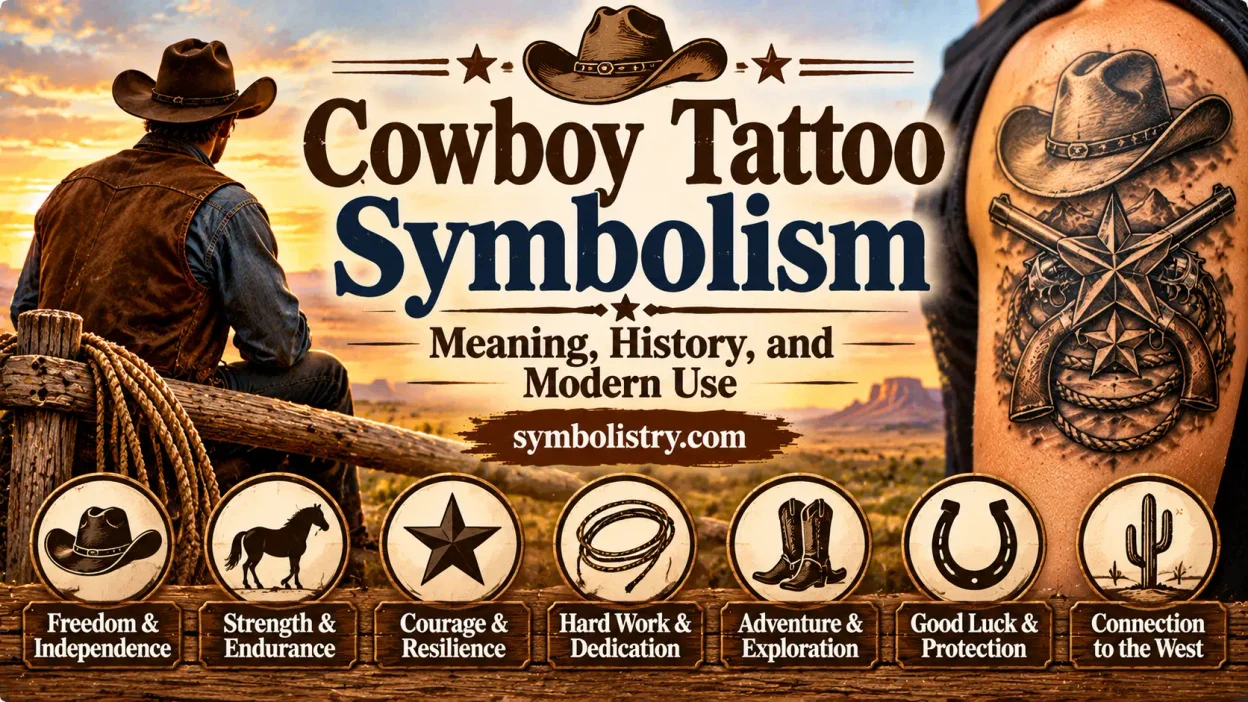
Cowboy tattoo symbolism is closely connected to freedom, independence, courage, hard work, and the American frontier. The cowboy has long represented a particular image of American identity: someone who values personal responsibility, faces difficult conditions, and finds a sense of purpose in an open landscape. When people choose cowboy imagery for tattoos, they often want to express these qualities or preserve a connection to Western culture.
A cowboy tattoo can take many forms. Some designs feature a horseback rider, a cowboy hat, or a pair of worn boots. Others show a rodeo rider, a lasso, a Western landscape, or a solitary figure watching the sunset. Each image carries slightly different associations, depending on the details and the person wearing it.
In the United States, cowboy imagery has a cultural history that extends beyond ranch work and cattle drives. It appears in Western movies, country music, rodeos, fashion, advertising, and regional identity. Understanding its symbolism means separating the historical lives of working cowboys from the romantic image created by popular culture.
Quick Answer
Cowboy tattoo symbolism commonly represents freedom, independence, resilience, courage, and self-reliance in modern American culture. Historically, cowboy imagery is connected to cattle ranching, the American West, frontier labor, and the changing mythology of the Western frontier.
TL;DR
- Freedom: Represents independence and the desire to live without unnecessary restrictions.
- Courage: Reflects the willingness to face difficult situations.
- Self-reliance: Honors responsibility, practical skills, and personal determination.
- Western heritage: Connects the wearer with American ranching and frontier history.
- Adventure: Represents exploration, travel, and an open-road lifestyle.
- Personal identity: Can honor family roots, rural communities, or cowboy culture.
1. What a Cowboy Tattoo Looks Like
A cowboy tattoo usually features recognizable elements of traditional Western life. The central figure may be a person wearing a broad-brimmed hat, boots, denim clothing, and a bandana. Depending on the design, the cowboy may be standing, riding a horse, working cattle, or sitting beside a campfire.
Common visual elements include:
- Cowboy hats: Associated with Western identity, independence, and practical working life.
- Horses: Represent movement, partnership, freedom, and the demands of ranch work.
- Cowboy boots: Suggest hard work, tradition, and a connection to Western fashion.
- Ropes and lassos: Reflect ranching skills, control, and practical experience.
- Desert landscapes: Evoke open spaces, solitude, and the American frontier.
- Saddles and spurs: Connect the design with horseback riding and traditional ranch work.
Some tattoos use realistic portraits, while others borrow from vintage Western posters, traditional tattoo flash, or minimalist line art.
The particular combination of objects matters. A cowboy riding toward the horizon may communicate adventure, while a portrait of an older cowboy may emphasize experience, endurance, and respect for tradition.
2. The Main Symbolic Meanings of Cowboy Tattoos
Cowboy tattoos bring together several ideas associated with Western life and the cultural image of the American cowboy.
Freedom and independence are among the strongest associations. The cowboy is often imagined traveling across open country, making decisions independently, and living according to personal values.
Courage and resilience reflect the difficult conditions historically associated with ranching and cattle work. Cowboys dealt with harsh weather, demanding physical labor, unpredictable animals, and long periods away from home.
Self-reliance represents practical competence and personal responsibility. The cowboy image often suggests someone who can solve problems rather than wait for someone else to handle them.
Adventure and exploration come from the open landscapes associated with Western stories. A cowboy tattoo may express a desire to travel, discover unfamiliar places, or avoid a predictable lifestyle.
Loyalty and honor appear frequently in Western storytelling. Cowboys are often portrayed as people who stand by their commitments, protect others, and take responsibility for their actions.
These meanings are not automatically present in every cowboy tattoo. A person may choose the image because of family history, a love of Western films, or simply an appreciation for traditional American tattoo art.
3. Historical Origins of Cowboy Symbolism in America
The historical cowboy developed from several ranching and livestock traditions rather than appearing as a single invention of the American frontier.
Spanish-speaking vaqueros played an important role in shaping cattle-handling practices across the Americas. Their horsemanship, equipment, riding techniques, and vocabulary influenced ranching traditions in what became the American Southwest.
During the nineteenth century, cattle ranching expanded across Texas and other parts of the western United States. After the Civil War, cattle drives transported large herds toward railheads and markets. Cowboys worked long hours moving livestock across difficult terrain.
Their responsibilities included riding horses, repairing fences, managing cattle, finding water, and protecting herds from weather and other dangers.
The historical cowboy was not necessarily a lone wanderer. He usually worked as part of a crew and depended on cooperation with other ranch hands. The familiar image of an independent individual emerged partly from later storytelling.
By the late nineteenth century, dime novels, traveling Wild West shows, newspaper accounts, and popular entertainment began turning Western workers into recognizable cultural figures.
These stories helped establish the cowboy as a symbol of American independence and adventure. That image eventually became an important foundation for Western-themed tattoos.
4. The Cowboy as a Symbol of Freedom and Independence
Freedom is perhaps the most recognizable meaning associated with cowboy imagery.
The cowboy is commonly depicted against large open landscapes, riding through mountains, deserts, and grasslands without obvious restrictions. This visual connection between the individual and the open land creates an association with independence.
For some tattoo wearers, the cowboy represents the desire to make personal decisions without allowing social expectations to determine every part of life.
A cowboy riding alone toward the horizon may communicate:
- Personal independence.
- Confidence in one’s decisions.
- A desire for adventure.
- Resistance to unnecessary restrictions.
- The ability to accept responsibility.
In modern American culture, this meaning also connects with road trips, country music, rural lifestyles, and the idea of living according to one’s own principles.
However, freedom in cowboy imagery is often an idealized concept. Historical ranching involved employers, economic pressures, demanding schedules, and dependence on other workers. The tattoo usually represents an emotional ideal rather than a literal description of nineteenth-century working conditions.
5. Courage, Strength, and Resilience
Cowboy tattoos frequently represent the ability to continue through difficult circumstances.
Historically, ranch work demanded physical stamina and practical courage. Workers faced unpredictable livestock, extreme temperatures, injuries, long journeys, and limited access to immediate assistance.
These realities helped establish the cowboy as a figure associated with endurance.
A tattoo showing a cowboy riding through a storm, standing beside a horse, or facing a challenging landscape may represent someone’s experience overcoming hardship.
The meaning can be particularly personal for people who have experienced difficult periods in their lives. They may use cowboy imagery to recognize survival, determination, or the decision to keep moving forward.
Strength in this context does not have to mean aggression or physical dominance. It can represent patience, emotional endurance, and the ability to remain dependable when circumstances become difficult.
A weathered cowboy portrait can communicate this idea particularly well because age, facial expression, and worn clothing suggest a life shaped by experience.
6. Cowboy Tattoos and American Western Heritage
Cowboy tattoos can express a connection to the American West, particularly for people whose families have lived in ranching or agricultural communities.
In states such as Texas, Wyoming, Montana, Oklahoma, and Colorado, Western traditions remain visible through rodeos, ranching, livestock shows, country music, and regional festivals.
For some people, cowboy imagery is part of everyday identity rather than an aesthetic choice. A tattoo may honor a family member who worked with horses or cattle, preserve memories of growing up in a rural community, or recognize a family’s connection to Western history.
The meaning can also extend to Mexican American and broader Latino heritage. The influence of vaquero traditions is an essential part of cowboy history, and modern Western culture reflects contributions from many communities.
Black cowboys also played an important role in the history of the American West. After the Civil War, formerly enslaved people and other African Americans worked as ranch hands, cattle drivers, horse trainers, and rodeo performers.
A historically informed cowboy tattoo can therefore represent a much broader heritage than the narrow image sometimes presented in older Western entertainment.
7. The Emotional Meaning Behind a Cowboy Tattoo
For many people, tattoos are connected to personal memories rather than general cultural definitions.
A cowboy tattoo may represent a father, grandfather, relative, or friend who loved ranching, horses, or Western traditions. The image can become a permanent reminder of someone whose values influenced the wearer.
It may also represent a particular stage of life.
Someone who grew up in a rural area might choose a cowboy tattoo after moving to a city as a way to preserve a connection with home. Another person may select the design after overcoming a difficult period, using the cowboy as a reminder of resilience.
The emotional associations can include:
- Nostalgia for childhood and family traditions.
- Pride in rural or Western identity.
- Respect for hard work.
- A desire for personal independence.
- Memories of travel and outdoor experiences.
- Appreciation for an uncomplicated, practical lifestyle.
The tattoo’s meaning does not have to match the traditional Western image perfectly. Its personal importance comes from the connection between the design and the wearer’s experience.
8. Different Cowboy Tattoo Designs and Their Meanings
The specific image chosen can change the message of a cowboy tattoo. Some designs focus on the person, while others use Western objects to communicate particular values.
Represents freedom, adventure, determination, and a close relationship with nature. It can also honor traditional ranching skills.
Symbolizes Western identity, independence, confidence, and respect for cowboy traditions. A hat belonging to a family member can also represent remembrance.
Often represent hard work, perseverance, practical living, and pride in Western culture. They can also commemorate someone’s connection to ranching or country life.
Combines Western identity with mortality, toughness, and acceptance of life’s uncertainties. It may also reflect traditional Western tattoo aesthetics.
Represent skill, resourcefulness, control, and the practical abilities associated with ranch work.
Suggests independence, reflection, nostalgia, and the desire to keep moving toward new experiences.
These designs can also be combined. A cowboy hat placed over a desert sunset, for example, can connect personal independence with memories of the American West.
9. Cowboy Tattoos in American Movies, Music, and Popular Culture
Movies and music have played a major role in shaping the modern image of the cowboy.
Classic Western films introduced audiences to familiar characters who faced difficult choices, defended communities, and traveled through challenging landscapes. The cowboy became a recognizable figure associated with individualism, justice, and personal responsibility.
Country and Western music expanded these associations. Songs about ranch life, horses, long journeys, heartbreak, and small-town communities helped establish cowboy imagery as part of American popular culture.
Television, rodeos, fashion, and contemporary entertainment continue to influence how people understand Western identity.
However, the popular cowboy is not always an accurate reflection of historical ranch workers. Hollywood frequently emphasized gunfighters and solitary heroes while giving less attention to the everyday labor of cattle workers and the diverse communities that shaped the West.
For tattoo enthusiasts, this distinction can be useful. A design inspired by a classic Western film may communicate admiration for a particular fictional character or cinematic style, rather than a direct connection to historical ranching.
10. Cowboy Tattoos, Masculinity, and Personal Identity
Cowboy imagery has traditionally been associated with masculinity in American popular culture. The familiar figure of a rugged man on horseback is often presented as physically strong, independent, confident, and emotionally controlled.
A tattoo featuring this image may express an appreciation for traditional masculine ideals, including responsibility, courage, loyalty, and the willingness to work through hardship.
But cowboy symbolism is not limited to men.
Women have participated in Western ranching, horseback riding, rodeo competition, and cowboy culture. Cowgirls have their own history and visual traditions, making cowboy-inspired tattoos equally relevant to women.
Some people choose a cowgirl portrait, a horse and rider, or traditional Western clothing to represent confidence and independence without relying on conventional masculine imagery.
Ultimately, the tattoo communicates the identity of the wearer rather than prescribing how someone should behave. Strength, self-reliance, and courage are human qualities, not characteristics belonging exclusively to one gender.
11. Cowboy Tattoos Across Different Tattoo Styles
The artistic style can influence how a cowboy tattoo feels and what it communicates.
| Tattoo StyleVisual CharacteristicsCommon Symbolic Impression | ||
|---|---|---|
| Traditional American | Bold outlines and limited colors | Heritage, confidence, classic Western culture |
| Realistic | Detailed portraits and landscapes | Personal memories and historical appreciation |
| Black and gray | Shading and strong contrasts | Experience, endurance, nostalgia |
| Minimalist | Simple silhouettes and clean lines | Independence and understated identity |
| Neo-traditional | Decorative details and expressive colors | Creativity and individual expression |
| Western illustrative | Vintage poster and storybook influences | Adventure and frontier nostalgia |
Traditional American tattooing works particularly well with cowboy hats, horseshoes, boots, and Western stars.
Realistic portraits are often chosen when the design represents a specific person or family memory. A detailed portrait of a grandfather wearing his ranch hat, for instance, can turn the tattoo into a personal memorial.
Minimalist designs appeal to people who want recognizable Western imagery without a large composition. A small cowboy silhouette or simple hat outline can communicate the intended idea without extensive detail.
There is no single correct style. The best artistic direction depends on the story the wearer wants the tattoo to tell.
12. Cultural Heritage and the Forgotten History of Cowboys
One important aspect of cowboy symbolism is the diversity of the people who helped create the American West.
The popular image of the cowboy has often centered on white male figures, particularly through older Western movies. Historical ranching communities were considerably more diverse.
Mexican vaqueros contributed essential cattle-handling techniques, clothing traditions, horsemanship, and equipment that influenced American cowboy culture. Many familiar Western terms and practices have Spanish-language roots. HISTORY+1
Black cowboys also formed a significant part of the nineteenth-century ranching workforce. The National Park Service notes that approximately one in four cowboys was African American, although estimates vary according to the period and population being discussed. National Park Service+1
Indigenous people also contributed to Western ranching and horse culture, while women participated as ranch owners, workers, riders, and performers.
This history gives cowboy tattoos additional possibilities for cultural expression. A wearer might choose a design that honors a particular regional tradition, family background, or overlooked historical figure.
It also encourages a more accurate understanding of Western heritage. The cowboy is not the product of one community alone but a figure shaped by multiple cultures and generations.
13. Common Misunderstandings About Cowboy Tattoo Symbolism
Cowboy tattoos are recognizable, but their meanings are sometimes oversimplified.
A cowboy tattoo does not automatically mean someone lives on a ranch. People choose Western imagery for many reasons, including family memories, music, movies, travel, and personal values.
Cowboy symbolism is not exclusively American in origin. American cowboy traditions developed partly from Mexican vaquero practices and earlier Indigenous and Spanish influences.
Not every cowboy tattoo represents masculinity. Women and people of different identities use cowboy imagery to express independence, confidence, heritage, and personal style.
A cowboy does not always symbolize violence. Although some Western entertainment emphasizes guns and confrontations, historical ranch work was primarily concerned with animals, transportation, and demanding physical labor.
The cowboy is not always a symbol of complete freedom. The romantic image of an individual traveling without restrictions overlooks the economic responsibilities, teamwork, and working conditions of actual ranch life.
Understanding these distinctions makes the symbolism more meaningful. A cowboy tattoo can celebrate Western culture without relying on every stereotype associated with the Old West.
14. Modern Uses and the Continuing Appeal of Cowboy Tattoos
Cowboy tattoos remain relevant because their visual language is immediately recognizable and adaptable to personal stories.
In contemporary America, Western aesthetics appear in clothing, music festivals, fashion photography, rodeo culture, and tattoo artwork. Cowboy hats, boots, horses, and desert imagery continue to provide familiar design elements.
Social media has also helped circulate different interpretations of Western style. Some people embrace traditional ranching imagery, while others use cowboy designs as part of a broader country-inspired or vintage aesthetic.
The appeal extends beyond the American West. Someone living in a large city may choose a cowboy tattoo because it represents a desire for adventure or a lifestyle different from their daily routine.
Others use the imagery to remember a particular person, celebrate a family tradition, or recognize a personal achievement.
Cowboy tattoos also work well as memorial designs. A hat, horse, or pair of boots can represent someone who loved ranch life without requiring a realistic portrait.
The modern meaning is therefore flexible. It can preserve an older tradition while expressing an entirely individual interpretation.
15. How Cowboy Symbolism Has Changed Over Time
The cowboy’s meaning has evolved from a practical working identity into a broader cultural symbol.
During the nineteenth century, cowboys were primarily associated with livestock management, cattle transportation, and ranching. Their skills were valuable because the expanding cattle industry depended on experienced workers.
By the late nineteenth and early twentieth centuries, Wild West shows, popular literature, and entertainment helped transform the cowboy into a romantic frontier hero.
Western movies and television strengthened the image of the solitary rider who represented justice, independence, and personal courage.
Later generations expanded the symbol through country music, fashion, rodeo competition, and regional celebrations. The cowboy became associated with a particular vision of American identity, even among people who had never worked with cattle.
Today, cowboy tattoos reflect all these layers. They may represent historical heritage, popular entertainment, rural identity, personal freedom, or admiration for traditional craftsmanship.
The image has not lost its connection to ranching, but its meaning now reaches far beyond the original occupation.
Frequently Asked Questions
1. What does a cowboy tattoo mean spiritually?
A cowboy tattoo does not have one established religious meaning. Some people interpret its imagery as a representation of life’s journey, perseverance, personal responsibility, or the courage to face uncertainty.
2. What does a cowboy hat tattoo symbolize?
A cowboy hat tattoo commonly represents independence, Western heritage, confidence, and personal identity. It may also honor a relative or friend who wore a cowboy hat as part of everyday life.
3. What does a cowboy riding a horse tattoo mean?
This design often symbolizes freedom, adventure, determination, and a connection with nature. It can also represent the relationship between a rider and a hardworking animal.
4. Is a cowboy tattoo a symbol of strength?
Yes, cowboy imagery is frequently associated with physical and emotional strength, endurance, and resilience. The meaning often comes from the historical demands of ranch work and the cultural portrayal of cowboys overcoming difficult conditions.
5. What does a cowboy skull tattoo mean?
A cowboy skull tattoo can represent mortality, toughness, courage, and acceptance of life’s uncertainties. Its interpretation may also depend on accompanying imagery, such as roses, horses, or Western landscapes.
6. Are cowboy tattoos only for men?
No. Cowboy and cowgirl tattoos are popular ways for people of different genders to express independence, cultural heritage, confidence, and an appreciation for Western traditions.
7. What does a cowboy tattoo mean in American culture?
In American culture, cowboy tattoos commonly represent the American West, individualism, freedom, hard work, and frontier heritage. They can also recognize the contributions of Mexican vaqueros, Black cowboys, Indigenous communities, and generations of ranch workers.
Conclusion
Cowboy tattoo symbolism represents freedom, courage, independence, resilience, and a connection to American Western heritage. Its meaning comes from both the historical work of ranchers and the cultural image developed through literature, music, rodeos, and Western entertainment.
For some people, a cowboy tattoo honors family traditions or a loved one. For others, it expresses a desire for adventure, personal responsibility, or a life guided by individual values. Its meaning can also recognize the diverse communities whose contributions shaped the history of the American West.
Ultimately, a cowboy tattoo is more than an image of a rider, hat, or horse. It can represent the values, memories, and experiences that someone chooses to carry with them.