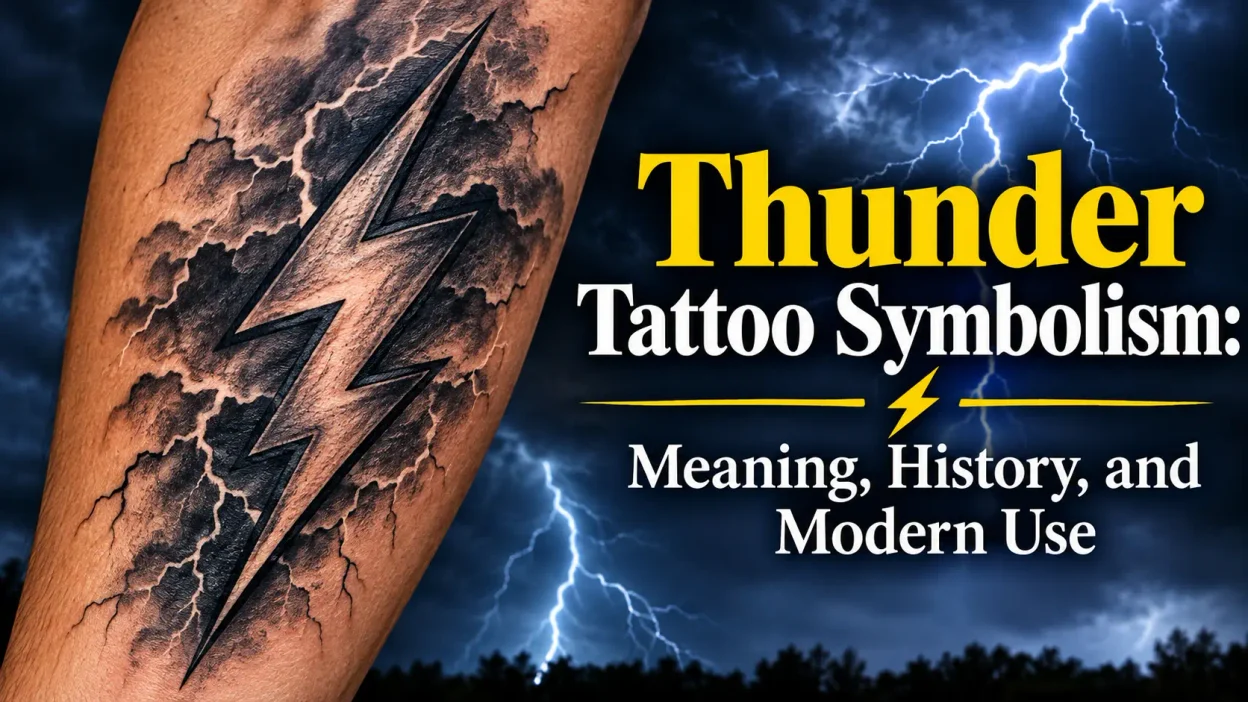
Thunder tattoo symbolism is commonly associated with strength, authority, raw natural power, and the ability to overcome adversity. A thunder tattoo can represent someone who refuses to remain silent, has survived difficult experiences, or identifies with the unpredictable force of nature. Depending on its design, it may also communicate spiritual protection, personal transformation, or respect for ancient storm deities.
Thunder has occupied an important place in human imagination because it is both physically powerful and impossible to control. Before modern meteorology explained thunderstorms, people interpreted the sound as an expression of divine anger, supernatural authority, or communication from the heavens. Different civilizations developed their own stories about the beings responsible for storms.
In the United States, thunder tattoos appeal to people who appreciate dramatic natural imagery, mythology, bold graphic designs, and symbols of resilience. Some choose a realistic storm cloud, while others prefer a stylized thunderbolt associated with ancient gods, comic-book heroes, or personal identity.
Understanding this tattoo requires distinguishing thunder from lightning. Thunder is the sound produced by rapidly expanding air heated by lightning, while lightning is the electrical discharge itself. Although the two naturally occur together, they can communicate slightly different symbolic ideas.
Quick Answer
Thunder tattoo symbolism commonly represents strength, personal power, resilience, and transformation in modern American tattoo culture. Historically, thunder has also been associated with divine authority, protection, supernatural forces, and the voices of storm gods across different civilizations.
TL;DR
- Strength: Thunder represents overwhelming natural force and inner determination.
- Authority: Ancient cultures connected thunder with powerful gods and rulers.
- Transformation: Storms can symbolize major changes and new beginnings.
- Protection: Thunder imagery sometimes represents divine guardianship and spiritual defense.
- Resilience: Surviving a storm reflects endurance through difficult experiences.
- Individuality: Modern tattoos use thunder to communicate confidence and independence.
1. What a Thunder Tattoo Looks Like
A thunder tattoo can take several visual forms, depending on whether the artist emphasizes the sound of a storm, its natural environment, or its mythological associations.
Some designs feature dark storm clouds with jagged lightning bolts cutting through the sky. Others use a simple thunderbolt, a dramatic lightning strike, or a combination of clouds, rain, and atmospheric effects.
Common design elements include:
- Storm clouds: Represent uncertainty, emotional intensity, and approaching change.
- Lightning bolts: Suggest speed, sudden realization, power, and decisive action.
- Heavy rain: Can represent cleansing, emotional release, or renewal.
- Dark skies: Often communicate mystery, conflict, or difficult experiences.
- Thunder gods: Connect the tattoo with mythology, authority, and supernatural strength.
- Sound waves: Offer an abstract interpretation of thunder as a voice that cannot be ignored.
Realistic storm tattoos often use black and gray shading to create depth. Traditional and illustrative designs may use bold outlines and simplified lightning shapes, while geometric versions reduce the storm to sharp angles and symmetrical forms.
The distinction between a thunderstorm and an isolated thunderbolt matters. A complete storm scene usually suggests a journey through difficulty, while a single bolt can emphasize sudden power or decisive action.
2. The Core Meaning of Thunder Tattoos
Thunder has several symbolic meanings, but most interpretations come from its volume, intensity, unpredictability, and connection to storms.
Strength and power are among its most recognizable associations. Thunder can be heard over considerable distances, making it a natural metaphor for a presence that commands attention.
Authority and dominance come from its historical association with divine figures who controlled storms and the heavens. In mythology, thunder was often an expression of a god’s ability to punish, protect, or establish order.
Resilience and survival emerge from the experience of storms passing. A person who chooses this design may see it as a reminder that difficult periods can be endured.
Transformation reflects the dramatic changes that storms bring to the atmosphere and landscape. Thunder can mark the arrival of something new, even when the transition is uncomfortable.
Emotional intensity is another possible interpretation. The sound of thunder can represent anger, grief, passion, frustration, or feelings that have been difficult to express.
These meanings are not mutually exclusive. Someone might choose a thunder tattoo because it represents both personal strength and the emotional struggles that helped develop that strength.
3. Ancient Origins of Thunder Symbolism
Long before scientific explanations of weather existed, thunder was one of the most striking natural phenomena people encountered. Its sudden sound, often accompanied by flashes of lightning, made it difficult to separate from ideas about supernatural power.
Many early civilizations interpreted thunderstorms through religious stories and mythology. Some believed that divine beings controlled storms, while others understood thunder as communication between the spiritual and human worlds.
These beliefs gave thunder a place in religious ceremonies, folklore, royal imagery, and traditional storytelling.
In ancient societies, control over weather could also represent control over agricultural survival. Rain was essential for crops, and storms could bring both water and destruction. A deity associated with thunder could therefore represent fertility, protection, authority, and danger at the same time.
Modern thunder tattoos often borrow from these historical associations, even when the wearer does not follow the religion or mythology from which the imagery originated.
4. Thunder in Greek and Roman Mythology
One of the most recognizable historical associations of thunder comes from ancient Greek mythology and its chief deity, Zeus.
Zeus controlled thunder, lightning, rain, and storms. His thunderbolt was a weapon of divine authority, allowing him to punish wrongdoing, defeat enemies, and demonstrate his position as ruler of the gods.
The Romans adopted a closely related figure in Jupiter. Jupiter also represented the sky and weather, and his thunderbolt became an important visual sign of authority.
These mythological associations explain why thunder and lightning imagery can communicate more than physical strength. They can suggest leadership, judgment, responsibility, and the ability to exercise power.
A tattoo featuring a classical thunderbolt, an eagle, or a storm surrounding a divine figure may draw from this tradition. Someone choosing such imagery might want to represent confidence, ambition, or a belief in standing firmly against opposition.
There is also a distinction between divine authority and uncontrolled aggression. Zeus and Jupiter were not simply symbols of physical force; their stories involved maintaining order, enforcing rules, and protecting their positions. A mythological thunder tattoo can therefore represent responsibility alongside power.
5. Thor and the Norse Meaning of Thunder
Thor is one of the most recognizable thunder-associated figures in world mythology. He was associated with thunder, lightning, strength, protection, and the defense of the gods and human world against destructive forces.
His famous hammer, Mjölnir, became an important symbol in Norse religious culture. Archaeological discoveries of Viking Age hammer pendants demonstrate that this imagery was worn as jewelry, not merely described in stories.
A Thor-inspired tattoo may communicate several ideas:
- Protection: The wearer identifies with the defender who confronts dangerous forces.
- Courage: The image represents facing challenges rather than avoiding them.
- Strength: Thor’s physical power makes him an enduring figure of masculine strength in popular interpretations.
- Heritage: Some people use Norse imagery to express an interest in Scandinavian history or family ancestry.
- Resistance: The struggle against giants can represent standing against overwhelming difficulties.
Thor’s hammer is not technically a thunder tattoo by itself. It is a mythological object associated with the god of thunder. However, combining Mjölnir with storm clouds or lightning can make the connection more explicit.
Modern American popular culture has also introduced Thor to audiences through comic books, movies, games, and merchandise. These fictional interpretations have expanded his recognition beyond people familiar with Norse mythology.
6. Thunder in Hindu Mythology and the Vajra
In Hindu mythology, thunder and lightning are strongly associated with Indra.
Indra is an important figure in the Vedic tradition, where he is associated with storms, rain, warfare, and the thunderbolt. His weapon, the Vajra, is particularly significant.
The vajra is commonly understood as a thunderbolt or diamond-like instrument, depending on the religious and artistic context. It represents indestructibility, spiritual strength, and the ability to overcome destructive forces.
In Buddhist traditions, the vajra also became an important ritual object, especially in Vajrayana Buddhism. Its symbolism includes spiritual firmness, awakened wisdom, and the inseparability of certain aspects of enlightenment.
A tattoo inspired by the vajra should be understood as more specific than a generic thunderbolt. It draws on established religious imagery and may carry sacred meaning for practitioners.
For someone considering this design, learning about its religious background is important. A vajra is not simply an attractive geometric lightning symbol; it has a place in living religious traditions.
7. Thunder and the Thunderbird in Indigenous North American Traditions
Thunderbird traditions are an important part of the cultural and spiritual histories of several Indigenous peoples in North America. However, there is no single Thunderbird story shared identically by every Native American nation.
In particular traditions, the Thunderbird is described as a powerful supernatural being associated with thunder, lightning, storms, and protection. Stories and artistic representations vary significantly between communities.
This imagery has sometimes been interpreted by outsiders as a general symbol of strength or freedom. Those interpretations do not capture the full cultural and spiritual significance that the figure may hold within a specific nation.
A Thunderbird tattoo is also different from a generic thunderstorm tattoo. It directly references a culturally specific figure and should not be treated as interchangeable with a lightning bolt or storm cloud.
Anyone considering this design should identify the particular tradition they are referencing and learn whether the imagery has ceremonial, spiritual, or community-specific significance. Respectful engagement is more meaningful than using Indigenous imagery simply because it looks dramatic.
8. What Thunder Tattoos Mean in Modern American Culture
In the United States, thunder tattoos are generally interpreted through ideas of personal identity, independence, strength, and resilience.
Unlike tattoos depicting a particular religious figure, a generic thunder design allows considerable freedom of interpretation. The wearer does not need to follow a particular mythology to connect with the symbolism of a storm.
Several modern American interpretations are especially common.
Personal independence: Thunder can represent someone who refuses to let other people determine their identity or direction.
Standing up for yourself: Because thunder is loud and difficult to ignore, it can serve as a metaphor for finding one’s voice and expressing personal convictions.
Overcoming adversity: A storm tattoo may commemorate a difficult period that changed someone’s outlook or priorities.
Confidence and authority: A dramatic thunderbolt can communicate a bold personality, ambition, or a desire to make a strong impression.
Connection with nature: Some people choose storm imagery because they appreciate thunderstorms, severe weather photography, or the dramatic beauty of the natural world.
American tattoo culture also gives considerable importance to personal storytelling. A design does not need an established historical interpretation to be meaningful. Someone may choose a thunder tattoo to commemorate a particular event, relationship, achievement, or personal turning point.
9. Thunder vs. Lightning: Understanding the Symbolic Difference
Thunder and lightning are connected, but they are not the same phenomenon. This distinction can influence the meaning of a tattoo.
Lightning is the visible electrical discharge, while thunder is the sound created when lightning rapidly heats the surrounding air, causing it to expand and produce a shock wave.
In tattoo design, lightning is easier to depict visually. Thunder, by contrast, is often represented indirectly through storm clouds, sound waves, or an overall storm scene.
| Tattoo designCommon symbolic meaningVisual emphasis | ||
|---|---|---|
| Single lightning bolt | Speed, power, sudden change | A sharp electrical strike |
| Thundercloud | Emotional intensity, uncertainty | Heavy clouds and darkness |
| Thunderstorm | Struggle, resilience, transformation | Clouds, rain, and lightning |
| Thunder god | Authority, protection, divine strength | Mythological figure and weapon |
| Sound-wave thunder | Voice, expression, being heard | Abstract lines and vibrations |
A single lightning bolt may communicate decisive action, while a full thunderstorm can suggest an extended period of struggle.
A sound-wave design offers a different interpretation altogether. It focuses on thunder as a voice or presence, making it suitable for someone who wants to express confidence, self-expression, or the decision to stop remaining silent.
10. The Emotional and Psychological Meaning of Thunder Tattoos
Thunder can represent emotions that are difficult to contain. Its sudden appearance and overwhelming sound make it a natural visual metaphor for feelings that have been building beneath the surface.
For some people, the image represents anger. However, anger does not necessarily mean hostility or violence. It can represent frustration with injustice, the refusal to accept mistreatment, or the determination to establish personal boundaries.
Others associate thunder with grief and emotional release. A storm can serve as an image of an intense period in life, especially when someone has experienced loss, disappointment, or a major personal transition.
There is also a connection between thunder and confidence. The sound fills the surrounding environment, creating a presence that cannot easily be ignored. For someone who previously struggled to express themselves, this imagery may represent a commitment to speaking openly.
The psychological meaning is ultimately personal. A thunder tattoo cannot reveal someone’s personality or emotional history by itself. Its significance comes from the experiences and intentions behind the decision to wear it.
11. Thunder Tattoo Designs and Their Specific Meanings
The visual arrangement of a tattoo can change its interpretation. Two people may choose thunder imagery but communicate very different ideas through their designs.
Realistic thunderstorm
Represents surviving difficult experiences, emotional intensity, and the ability to endure uncertainty. Dark shading can make the design feel dramatic and atmospheric.
Minimalist thunderbolt
Often communicates decisiveness, confidence, speed, and independence. Its simplicity makes it suitable for smaller tattoos.
Thor’s hammer with thunder
Connects the wearer with Norse mythology, protection, courage, and the struggle against destructive forces.
Zeus with a thunderbolt
Suggests divine authority, leadership, judgment, and command over natural forces.
Storm over mountains
Can represent endurance, obstacles, and the determination to continue despite difficult circumstances.
Other designs combine thunder with roses, skulls, animals, mountains, or clocks. These combinations create additional layers of meaning.
For example, a thunderstorm surrounding a mountain may suggest persistence, while a skull beneath a storm cloud may connect mortality with the unpredictability of life.
12. Thunder Tattoo Placement and What It Can Communicate
Tattoo placement does not have a universal symbolic meaning, but the location can influence how a design is presented and personally experienced.
Common placements include:
- Forearm: A visible location that can communicate confidence, self-expression, and personal strength.
- Upper arm: Often chosen for larger storm scenes or mythological designs associated with protection and authority.
- Chest: Can make the tattoo feel personal, representing emotional strength, conviction, or an important life experience.
- Back: Provides room for expansive storm imagery, dramatic clouds, and large lightning patterns.
- Shoulder: Works well for compact thunderbolts and designs associated with courage and determination.
- Leg: Offers flexibility for vertical lightning designs or storm scenes that follow the natural shape of the body.
- Neck: A highly visible placement that may communicate individuality and a preference for bold self-expression.
The most important consideration is whether the tattoo’s size, detail, and placement work together. A detailed thunderstorm needs more space than a simple lightning symbol.
13. Colors and Their Symbolic Meanings in Thunder Tattoos
Color can change the emotional impression of a storm tattoo. Black-and-gray designs are particularly popular because they recreate the contrast between dark clouds and bright lightning.
Here are some common interpretations:
| Color | Symbolic association | Design effect |
|---|---|---|
| Black | Strength, mystery, authority | Creates dramatic storm imagery |
| White | Clarity, hope, renewal | Highlights lightning and contrast |
| Blue | Calm, depth, stability | Suggests atmosphere and reflection |
| Red | Passion, anger, intensity | Adds emotional urgency |
| Purple | Imagination, spirituality, individuality | Creates a supernatural atmosphere |
| Yellow | Energy, optimism, illumination | Emphasizes lightning and sudden change |
These meanings are modern artistic associations rather than fixed historical rules. A red lightning bolt does not automatically represent anger, just as a blue thunderstorm does not necessarily indicate sadness.
Some tattoo enthusiasts prefer black-and-gray realism, while others use bright colors to create a graphic or illustrative appearance. The best choice depends on the story the wearer wants the design to communicate.
14. Misunderstandings and Cultural Sensitivity in Thunder Tattoos
Thunder imagery is generally flexible, but certain designs have cultural or historical associations that deserve careful consideration.
One common misunderstanding is treating thunder and lightning as interchangeable. They occur together during thunderstorms, but they represent different physical phenomena. A tattoo intended to symbolize voice, sound, or presence may be better represented by thunderclouds or sound-wave imagery than by a simple electrical bolt.
Another issue involves mythological symbols. Thor’s hammer, Zeus’s thunderbolt, and Indra’s vajra belong to different religious and cultural traditions. Although they share associations with storms, they are not identical symbols.
Indigenous Thunderbird imagery deserves particular care. Different Native American nations have their own histories, artistic conventions, and spiritual understandings. Using a culturally specific figure without understanding its background can turn a meaningful tradition into generic decoration.
There is also a modern political context to consider. Certain lightning-inspired symbols have been adopted by extremist groups or used in threatening visual language. However, an ordinary lightning bolt or thunderstorm tattoo is not inherently extremist. Meaning depends on the complete design, accompanying imagery, and recognizable historical associations.
A thoughtful tattoo choice involves understanding what the selected image represents rather than relying exclusively on its appearance.
15. How Thunder Symbolism Has Changed Over Time
Thunder’s symbolic meaning has evolved as human understanding of nature has changed.
In ancient societies, thunder was frequently connected with supernatural authority. Zeus, Thor, and Indra provided cultural explanations for the forces behind storms, and their associated weapons became recognizable symbols of divine power.
As scientific understanding developed, thunder and lightning gradually became understood through atmospheric electricity and weather processes. Benjamin Franklin’s eighteenth-century electrical experiments helped establish the connection between lightning and electricity, changing how people explained these events.
Yet scientific explanation did not eliminate the symbolic meaning of storms. Instead, thunder acquired additional interpretations through literature, visual art, music, entertainment, and personal expression.
In modern tattoo culture, people can draw from several layers of meaning simultaneously. One person may choose a thunderbolt because of an interest in Norse mythology, while another sees it as a representation of overcoming personal hardship.
Contemporary designs also borrow from superhero imagery, fantasy entertainment, traditional tattoo art, and storm photography.
The result is a symbol that has moved from religious explanations of natural phenomena into a flexible form of personal expression. Its historical associations remain recognizable, but individual interpretation now plays a much larger role.
Frequently Asked Questions
1. What does a thunder tattoo mean spiritually?
A thunder tattoo can represent divine authority, spiritual protection, transformation, and the presence of supernatural forces. Its interpretation depends on whether the design references a particular religious tradition or uses general storm imagery.
2. Is a thunder tattoo a symbol of strength?
Yes, thunder commonly represents strength because of its overwhelming sound and association with powerful storms. It can also represent courage, confidence, and the determination to face difficult situations.
3. What does a thunder and lightning tattoo symbolize?
A combined thunder and lightning tattoo often represents sudden change, personal power, emotional intensity, and resilience. The lightning suggests visible action, while thunder adds the idea of a strong presence or voice.
4. What does a Thor thunder tattoo represent?
A Thor-inspired tattoo commonly represents protection, courage, physical strength, and Norse cultural heritage. When it includes Mjölnir, the design also references an important symbol associated with the Norse god.
5. Are thunder tattoos considered positive symbols?
Generally, yes. Thunder tattoos are frequently chosen to communicate resilience, authority, confidence, and the ability to overcome adversity, although darker designs may also represent anger, conflict, or emotional struggles.
6. What does a thunderstorm tattoo mean after a difficult experience?
A thunderstorm tattoo can represent surviving a challenging period and emerging with a changed perspective. For some people, it commemorates a personal turning point, reminding them that difficult experiences do not have to define their future.
7. Is a lightning bolt tattoo the same as a thunder tattoo?
No. Lightning is an electrical discharge, while thunder is the sound produced by the rapid expansion of heated air around lightning. Their tattoo meanings overlap, but thunder can emphasize voice, presence, and emotional expression more strongly.
Conclusion
Thunder tattoo symbolism brings together strength, authority, resilience, transformation, and emotional expression. Its historical connections with Zeus, Thor, Indra, and other storm-associated figures give it a cultural background that extends beyond modern tattoo design. At the same time, its connection to natural storms makes it an accessible symbol for people who want to express personal experiences and identity.
In contemporary American tattoo culture, thunder can represent overcoming adversity, finding one’s voice, protecting personal values, or embracing an independent personality. Whether depicted as a realistic storm, a simple thunderbolt, or a mythological figure, the design takes on additional meaning through the wearer’s intentions.
Ultimately, a thunder tattoo can serve as a reminder that strength is not always quiet. Sometimes it is the courage to face uncertainty, make difficult changes, and allow your presence to be heard.